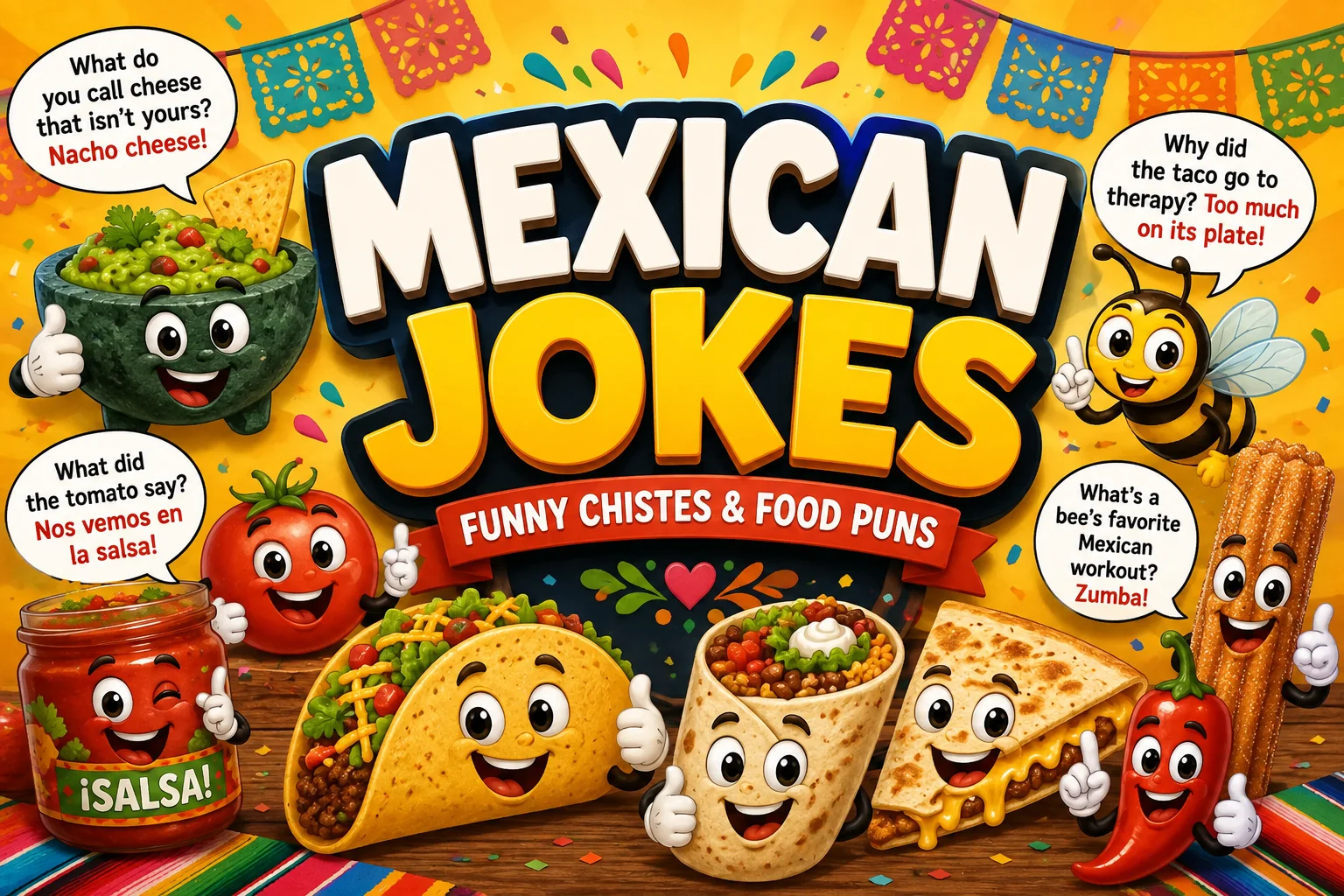
A Mexican joke, at its best, is a piece of wordplay not a stereotype. Mexican humour runs on double meanings, fast comebacks and a national love of puns so competitive it has its own name. This page collects the funniest Mexican jokes you can actually tell at work or at a family table: chistes in Spanish with English translations, taco and salsa puns, dad jokes, and knockknocks. Every joke here is clean, and every one is built on language or food rather than on making fun of a group of people.
What Makes a Mexican Joke Funny?
Mexican humour is built on speed and double meaning rather than on long setups. In everyday Mexican Spanish, a word can carry two or three meanings at once, and the joke lives in choosing the wrong one deliberately. That is why so many chistes are one or two lines long the listener is expected to keep up, and explaining the joke is considered a loss. Family gatherings, workplaces and street conversations all run on this back and forth, which is why Mexican comedy travels so well. The result is a style that rewards cleverness over cruelty, and that is exactly the kind of joke worth repeating.
- Short setup, fast punchline usually one or two lines
- Built on double meanings rather than on a group’s expense
- Food, family and language are the three biggest sources
- Delivered in a conversation, not as a performance
- Explaining the joke afterwards ruins it completely
- The best ones work in Spanish and English both
Albur: Mexico’s National Sport of Wordplay
An albur is a Mexican verbal duel where two people trade puns until one of them runs out of comebacks. It relies on words that sound innocent but carry a second meaning, and skilled players can keep it going for minutes without ever saying anything openly rude. Most al burs do not translate into English, because the joke lives inside the Spanish word itself. Understanding that this tradition exists explains why Mexican jokes are so punheavy compared with other joke styles. You do not need to speak fluent Spanish to enjoy the chistes below, but knowing about albures explains where the instinct comes from.
- Two people trade puns until someone runs out of comebacks
- The humour hides inside ordinary, innocent sounding words
- Speed matters as much as cleverness
- Most albures do not survive translation into English
- It explains why so many chistes are punbased
Funny Mexican Jokes in English
These are the Mexican jokes that work in English without losing anything in translation. They lean on food, family and everyday situations the same three sources that Mexican comedians have used for decades. Each one is short enough to drop into a conversation or a group chat without a runup. They are clean, so you can use them at work, in a classroom or at a family dinner. Pick two or three and you have a good Mexican joke ready for any moment.
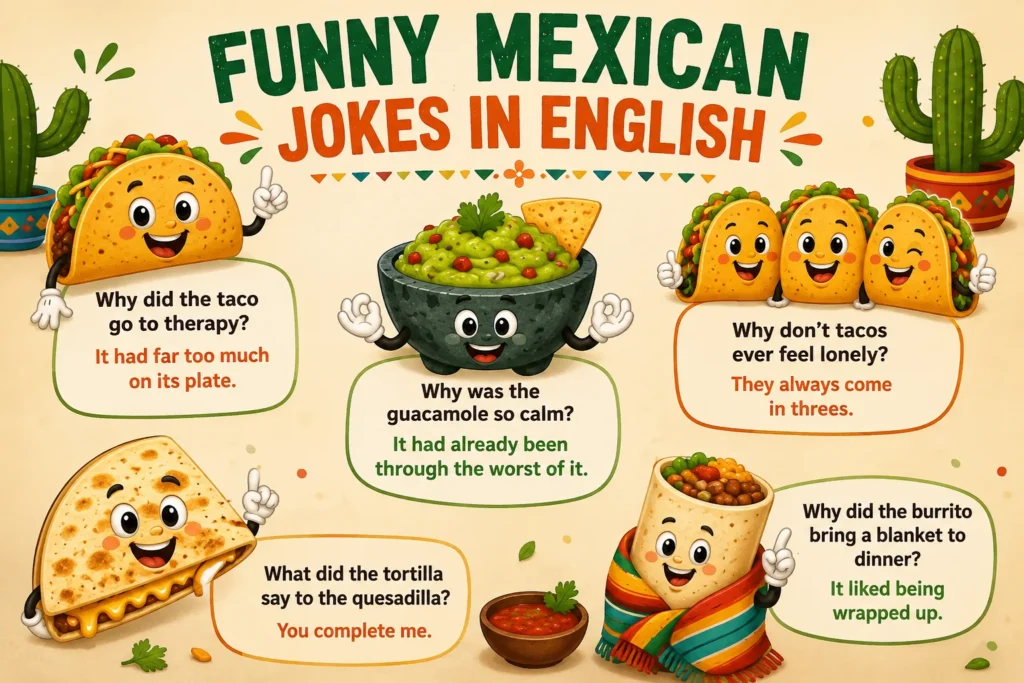
- What do you call cheese that isn’t yours? Nacho cheese.
- Why did the taco go to therapy? It had far too much on its plate.
- Why don’t tacos ever feel lonely? They always come in threes.
- What did the tortilla say to the quesadilla? You complete me.
- Why did the burrito bring a blanket to dinner? It liked being wrapped up.
- Why do salsas make terrible secret keepers? They always spill.
- What’s the most patient part of a Mexican meal? The slow cooked beans they’ve been waiting all day.
- Why was the guacamole so calm? It had already been through the worst of it.
- What do you call a Mexican meal that tells the truth? An honest to goodness enchilada.
- Why did the churro get invited to every party? It was sweet and always turned up warm.
Mexican Jokes in Spanish: Chistes with Translations
Chistes are the short jokes Mexicans actually tell each other, and most of them are pure wordplay. They are worth learning in Spanish because the pun usually disappears in translation, so the English version below is an explanation rather than a joke. Reading them out loud is half the fun, even if your accent is terrible. They also make excellent practice material if you are learning Spanish, because each one hangs on a single word doing two jobs. Try them on a Spanish speaking friend and watch how fast the comeback arrives.
- ¿Qué le dijo un tomate a otro? Nos vemos en la salsa. What did one tomato say to the other? See you in the salsa.
- ¿Qué hace una abeja en el gimnasio? Zumba. What does a bee do at the gym? Zumba. (zumbar means to buzz.)
- ¿Qué le dice un semáforo a otro? No me mires, me estoy cambiando. What does one traffic light say to the other? Don’t look, I’m changing.
- ¿Por qué el libro de matemáticas está triste? Porque tiene muchos problemas. Why is the maths book sad? Because it has too many problems.
- ¿Cómo se despiden los químicos? Ácido un placer. How do chemists say goodbye? It’s been a pleasure. (Ácido sounds like ha sido.)
Chistes Cortos: Short Mexican Jokes
Chistes cor tos are the shortest form of Mexican joke one line, one pun, no setup. They are the ones people memorise as children and keep using for the rest of their lives. Because they are so short, they work perfectly as a text message, a caption or a quick interruption in a conversation. The shorter the christe, the more forgivable a bad one becomes.
- ¿Cuál es el café más peligroso del mundo? El expreso. (expreso / expreso)
- ¿Qué hace un pez? Nada. What does a fish do? Nothing / it swims.
- ¿Cómo se llama el campeón de natación? Nada Nada Nada.
Mexican Food Jokes: Tacos, Salsa and Guacamole
Mexican food gives you more pun material than almost any other cuisine, which is why food jokes dominate this category. Tacos, salsa, guacamole, queso and churros all contain words that carry a second meaning in English, so the puns write themselves. These work brilliantly as restaurant captions, Taco Tuesday posts and menuboard jokes. They are also the safest Mexican jokes to tell in a mixed group, because the target is a tortilla rather than a person. Keep them short and let the food do the work.
- Why did the avocado go to the gym? It wanted to be a little less soft.
- What do you call a sad taco? A crying shell of its former self.
- Why did the salsa lose the argument? It got too heated too quickly.
- What’s a burrito’s favourite kind of story? Anything with a good wrapup.
- Why did the queso apply for a promotion? It wanted to be the big cheese.
- What do you call a nervous jalapeño? A little chilli.
- Why do tortillas make good friends? They’re always warm and flexible.
Taco Tuesday and Restaurant Caption Jokes
These are the short Mexican food jokes built specifically for social captions and menu boards. They need to land in under ten words, because nobody reads a long caption on a photo of a taco. Pair one with a picture and you are done with no explanation, no emoji chain.
- Taco Tuesday: the only reliable thing about this week.
- I followed my heart. It led me to the taco place.
- Guacamole is extra. So am I.
- In a queso emergency, order more nachos.
Mexican Dad Jokes
A Mexican dad joke follows the same rule as any dad joke: the pun is obvious, the delivery is confident, and the groan is the reward. What makes these ones Mexican is the material: food, family, Spanish words doing double duty. They are the jokes uncles tell at birthdays and fathers tell in the car, and they get worse and better with every retelling. Deliver them with a completely straight face and never repeat the punchline.
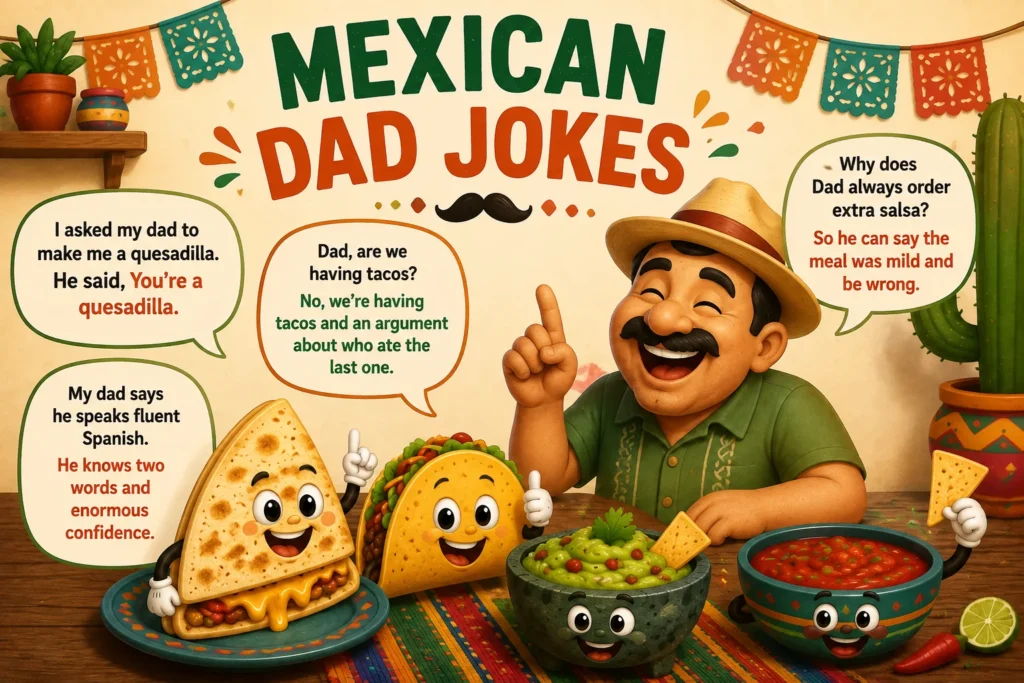
- I asked my dad to make me a quesadilla. He said, You’re a quesadilla.
- Dad, are we having tacos? No, we’re having tacos and an argument about who ate the last one.
- I tried to make a joke about tortillas, but I couldn’t flatten it out properly.
- My dad says he speaks fluent Spanish. He knows two words and enormous confidence.
- Why does Dad always order extra salsa? So he can say the meal was mild and be wrong.
Mexican KnockKnock Jokes (Toc Toc)
Knockknock jokes exist in Spanish too, and they start with Toc toc instead of knock knock. The structure is identical: a name, then a pun built out of that name. They are the easiest Mexican jokes for kids and for Spanish learners, because the vocabulary is simple and the payoff is instant. Read them aloud the pun only appears when you hear the words run together.
- Toc toc. ¿Quién es? Ana. ¿Ana qué? Anaranjada. (naranjada orange drink)
- Toc toc. ¿Quién es? Armando. ¿Armando qué? Armando escándalo. (armando escándalo causing a scene)
- Toc toc. ¿Quién es? Elena. ¿Elena qué? Elena de la casa. (ella llena she fills)
- Knock knock. Who’s there? Nacho. Nacho who? Nacho average knockknock joke.
Mexican Joke of the Day: Clean Ones Safe for Work
A Mexican joke of the day only works if you can tell it in an office without a follow up meeting. That rules out anything built on stereotypes and leaves you with the good stuff, food, language and everyday situations. Keep one in reserve for the morning standup or the group chat and rotate them so nobody hears the same pun twice in a week. Short is better than clever, and clean is better than either.
- Monday: Why did the taco skip the meeting? It was already fully booked.
- Tuesday: What do you call cheese that isn’t yours? Nacho cheese.
- Wednesday: Why was the burrito so confident? It had everything wrapped up.
- Thursday: What’s a bee’s favourite Mexican workout? Zumba.
- Friday: Why did the salsa get promoted? It brought the heat every single day.
What About Racist Mexican Jokes?
A large share of searches around this topic go looking for jokes that mock Mexican people rather than play with Mexican language and food. Those are not published here, and that is a deliberate choice rather than an oversight. Jokes built on ethnic stereotypes are not funnier than wordplay they are just lazier, because they borrow a readymade prejudice instead of building a pun. They also cause real harm to real people who did not agree to be the punchline. If you want the genuinely funny material, it is the chistes and albures above, which is where Mexican comedians have always found it.
- Stereotype jokes borrow prejudice instead of building humour
- Wordplay is harder to write and much more satisfying to hear
- Mexican comedy tradition is punbased, not stereotypebased
- Clean jokes work in more rooms, with more people
- The funniest material here is the Spanish wordplay, not the insults
Jump into Other Related Article
- Food Jokes: Deliciously Funny Jokes That Will Make You Hungry
- Monthly Jokes: A Month Full of Laughs
- Weekly Jokes: A Funny Joke for Every Day of the Week
- Funny Jokes That Will Make You Laugh
- Animal Jokes: Funny Animal Jokes That Will Make You Laugh
- Dad Joke of the Day | Today’s Pick + 60 More for Every Day
- Old Jokes | Classic Jokes by Kid’s Age, Plus Old Age Humor
- What Does Lame Joke Mean? Full Definition & Origin
Conclusion
The best Mexican jokes are the ones built out of language, not out of assumptions about people. Chistes, albures, taco puns and toc toc jokes give you more material than any stereotype ever could, and they work at a family table, in an office and in a Spanish class. Save a few of the short ones they are the ones you will actually use. Say them fast, keep a straight face, and never explain the pun afterwards.
- Keep two chistes in Spanish for showing off
- Keep two food puns for captions and Taco Tuesday
- Keep one dad joke for the group chat
- Deliver fast, straightfaced, and without explanation
What is a christe?
A christe is a short joke in Spanish, usually one or two lines long and built on a pun. Chistes cor tos are the shortest form and are the ones most people memorise as children.
What is the funniest Mexican joke?
The most repeated one in English is What do you call cheese that isn’t yours? Nacho cheese. In Spanish, the tomato and salsa christe is the classic everyone knows.
What is an al bur?
An al bur is a Mexican wordplay duel where two people trade puns with hidden double meanings until one of them runs out of comebacks. It is a genuine tradition in Mexican Spanish and the reason so many chistes are punbased.
Are there Mexican jokes suitable for work?
Yes the food puns, chistes and knockknock jokes on this page are all clean and worksafe. Anything based on stereotypes is not worksafe and is not included here.
What’s a good Mexican joke in Spanish for beginners?
Try ¿Qué hace un pez? Nada. It works as both nothing and it swims, so it teaches a double meaning in three words.
Can I use these jokes on social media?
Yes. The Taco Tuesday and caption lines in this article are written specifically to be short enough for posts, menu boards and photo captions.