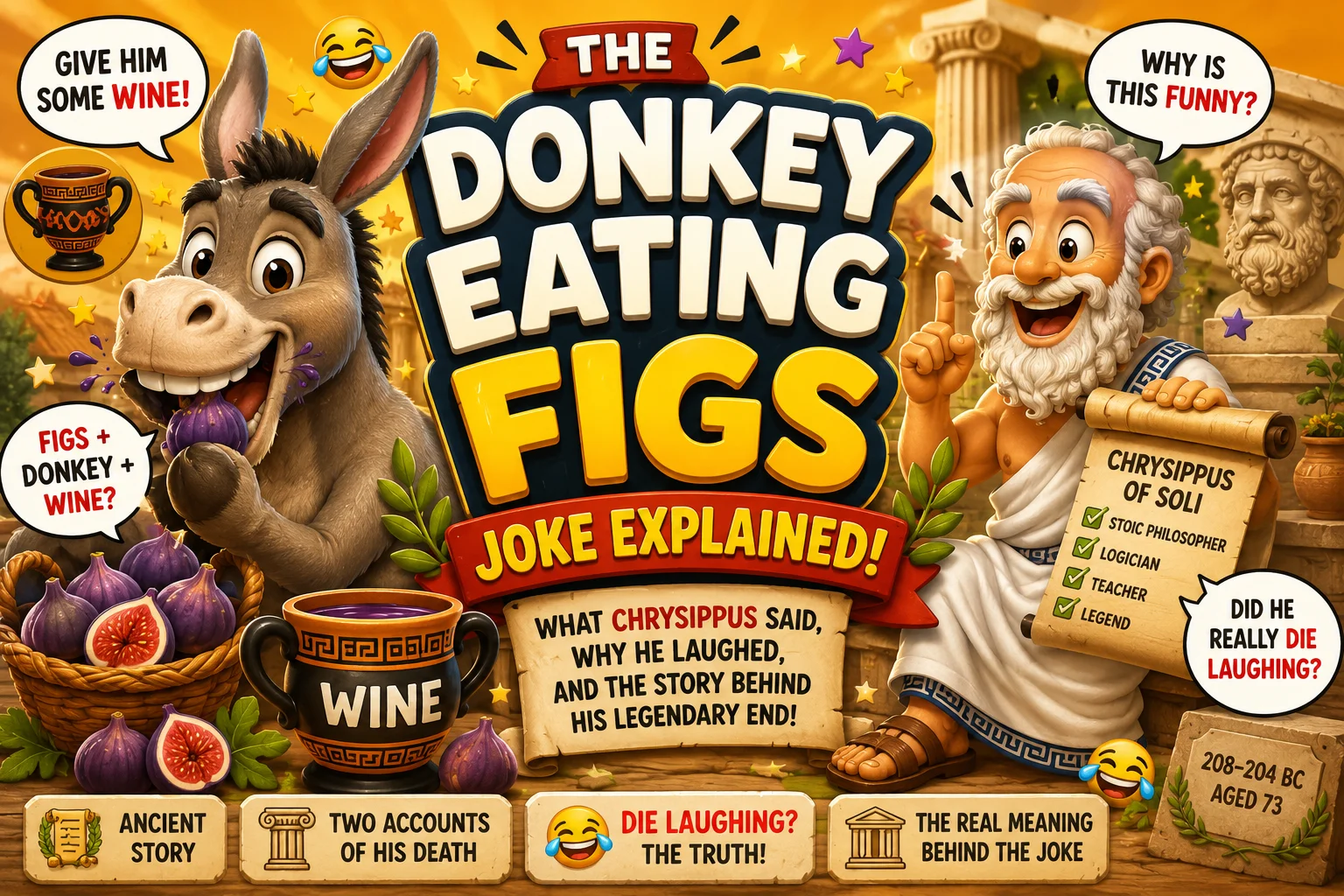
The donkey eating figs joke is a 2,200 year old one liner told by a Stoic philosopher who then, according to legend, laughed so hard he died. It circulates today as a meme with no context attached, which is why almost nobody who reposts it understands why it was ever funny. This page explains the joke properly: what Chrysippus actually said, what figs, donkeys and unmixed wine meant to a Greek audience, whether the story is true, and whether laughter can genuinely kill a person.
What Is the Donkey Eating Figs Joke?
The donkey eating figs joke is a line attributed to the Greek Stoic philosopher Chrysippus of Soli, recorded by the biographer Diogenes Laërtius. Chrysippus saw a donkey eating his figs, called out that someone should give the animal unmixed wine to wash them down, and then reportedly laughed himself to death. That is the entire joke one sentence, no setup, no punchline in the modern sense. It survives because the death is more memorable than the humour, and because a Stoic dying of uncontrolled laughter is almost too ironic to be real.
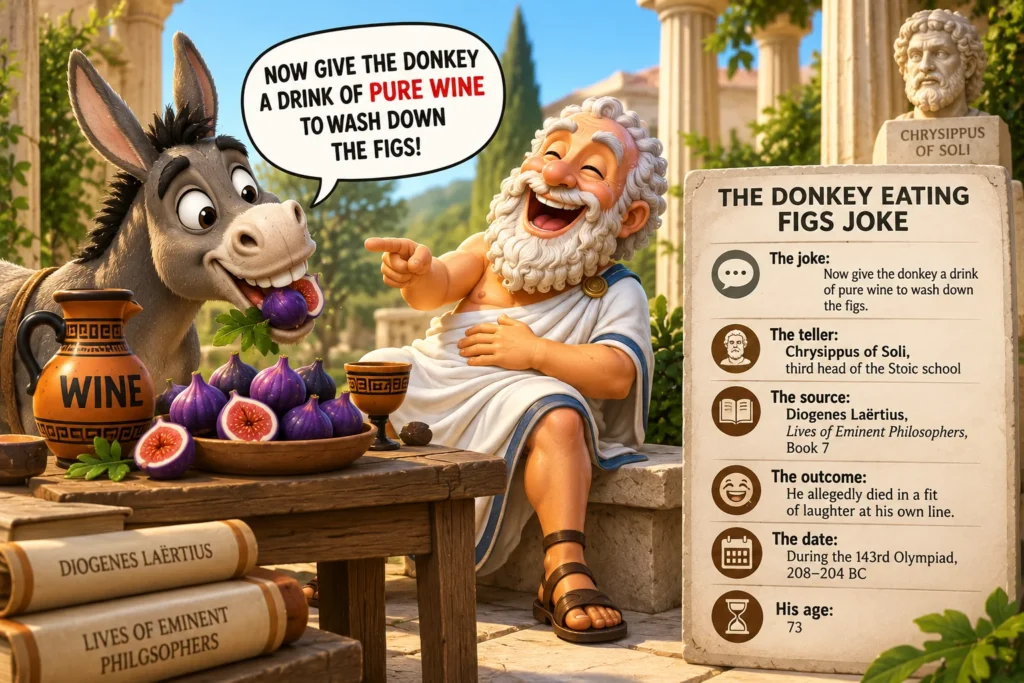
- The joke: Now give the donkey a drink of pure wine to wash down the figs
- The teller: Chrysippus of Soli, third head of the Stoic school
- The source: Diogenes Laërtius, Lives of Eminent Philosophers, Book 7
- The outcome: he allegedly died in a fit of laughter at his own line
- The date: during the 143rd Olympiad, 208–204 BC
- His age: 73
Who Was Chrysippus of Soli?
Chrysippus was not a comedian. He was one of the most important logicians of the ancient world, born around 279 BC in Soli, in what is now southern Turkey, and he moved to Athens to study under the Stoic philosopher Cleanthes. When Cleanthes died around 230 BC, Chrysippus took over as the third head of the Stoic school and systematised its doctrines so thoroughly that he became known as the second founder of Stoicism. Ancient sources credit him with more than 700 written works, almost none of which survive except as quotations in later writers. His nephew Aristocreon put up a statue in his honour in the Kerameikos, and his pupil Zeno of Tarsus took over the school after him.
- Born in Soli, Cilicia, around 279 BC
- Studied in Athens under Cleanthes
- Became the third head of the Stoic school around 230 BC
- Credited with over 700 works, surviving only in fragments
- Known as the second founder of Stoicism
- Died at 73, succeeded by Zeno of Tarsus
Why a Stoic Dying of Laughter Is So Ironic
Stoicism taught that the wise person governs their reactions and is not carried away by strong passions. A philosopher whose life’s work was emotional self command dying from an emotion he could not control is exactly the kind of ending that ancient biographers loved to record. That irony is the reason the anecdote survived for two millennia while most of his actual writing did not. It also gives us a good reason to be suspicious of the story.
- Stoicism valued measured judgement over unrestrained emotion
- Dying of laughter inverts everything the school stood for
- The irony made the anecdote highly repeatable
- Repeatable anecdotes are exactly the ones that get invented
The Two Accounts of Chrysippus’s Death
Diogenes Laërtius did not give one version of this death he gave two, side by side, and left the reader to choose. That is worth knowing before anyone presents the laughter story as established history. The two accounts share a date, an age and a setting, but they disagree completely on cause. Most modern retellings quietly drop the first version because it is far less entertaining. Some readers have suggested the two can be combined, with a drunk philosopher finding a donkey much funnier than a sober one would.
Version One | The Undiluted Wine
In the first account, Chrysippus drank unmixed wine at a sacrificial feast, was seized with dizziness, and died shortly afterwards. Ancient Greeks normally diluted wine with water, so drinking it neat was both socially disreputable and physically dangerous. This version is mundane, medically plausible and almost never repeated online. Several sources note that Laërtius himself appears to have leaned toward this explanation rather than the laughter one.
Version Two | The Donkey and the Figs
In the second account, Chrysippus watched a donkey eating his figs and called for someone described in the text as an old woman in his household to bring the animal unmixed wine to wash them down. He then laughed so violently that he collapsed and died. Some retellings add convulsions and foaming at the mouth, details that read more like a seizure than a laughing fit. This is the version that became the meme.
Why Was the Joke Funny? The Explanation
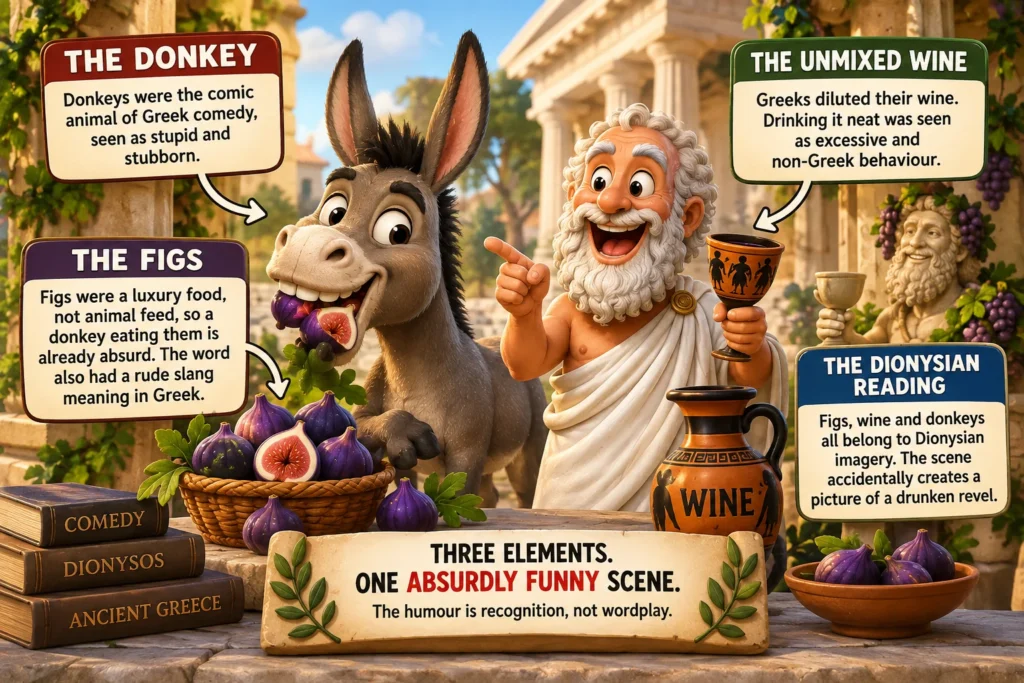
This is where most explainers stop, and it is the actual question people are searching for. The joke is not funny in English because every element that carried meaning in Greek has been stripped out by translation and time. Reassembled, it works as a compressed absurd image rather than a pun with a punchline. Three cultural pieces do the work: the donkey, the figs and the unmixed wine. Once you see all three, the line stops being baffling and becomes a recognisable type of joke.
The Donkey
Donkeys were the standard comic animal of Greek stage comedy, used as shorthand for stupidity and stubbornness. Putting a donkey into any scene already signalled to a Greek audience that something ridiculous was about to happen. It is roughly the role a chicken or a sloth plays in modern comedy.
- The default comic animal in Greek theatre
- Shorthand for stupidity and stubbornness
- Its presence alone flagged a scene as absurd
The Figs
Figs in the ancient Mediterranean were a cultivated delicacy, not livestock feed, so a donkey helping itself to them is already a small outrage. Fig also carries a bawdy double meaning in Greek slang, which adds a layer that translations understandably drop. Both readings work, and they may have worked at the same time.
- A cultivated luxury food, not animal fodder
- A donkey eating them is theft and absurdity at once
- The word also carried a crude slang meaning in Greek
The Unmixed Wine
Greeks diluted their wine; drinking it neat was associated with barbarians and with losing control. So Chrysippus is not just anthropomorphising a donkey he is proposing it drink in the most disreputable way possible. That is the pivot of the joke.
- Neat wine signalled excess and nonGreek behaviour
- The suggestion elevates the donkey into a badly behaved dinner guest
- It pairs a food course with a drink pairing, absurdly formally
The Dionysian Reading
Put the three together and you get figs, wine and a donkey, a cluster of imagery all associated with Dionysos and drunken revelry. On this reading, Chrysippus was not making a pun; he was recognising that an ordinary farmyard scene had accidentally assembled itself into a scene of divine debauchery. It is the ancient equivalent of noticing that a real life situation has arranged itself into the setup of a familiar joke.
- Figs, wine and donkeys all belong to Dionysian imagery
- The scene assembles itself into a drunken revel by accident
- Chrysippus supplies the missing element and completes the picture
- The humour is recognition, not wordplay
Is the Story Actually True?
Probably not, and it is worth saying so plainly. Ancient philosophical biography was not journalism; death scenes were routinely shaped to comment on what a philosopher taught, either confirming his wisdom or mocking it. A scholar of these texts, Sergi Grau, has argued that the death scene functioned as a final verdict on the subject’s ideas. Under that lens, a Stoic killed by his own uncontrolled laughter looks less like a report and more like a joke made at Stoicism’s expense by someone who disliked it. The competing wine story may be closer to what happened, or both may be inventions.
- Ancient biographies routinely dramatised philosophers’ deaths
- Death scenes were used to endorse or ridicule a thinker’s doctrine
- Two contradictory accounts in one source signals uncertainty
- Diogenes Laërtius wrote roughly four centuries after the events
- None of Chrysippus’s own writings survive to check against
Can You Really Die From Laughing?
Yes, but it is extremely rare, and it is not the laughter itself that kills. Recorded deaths attributed to laughter generally involve cardiac arrest or asphyxiation, and in most cases an underlying condition is doing the real damage. There is also a documented phenomenon called laughterinduced syncope, in which intense laughing causes blood pressure and heart rate to drop sharply enough to make a person faint. One frequently cited modern case is a British man who died of heart failure in 1975 after a prolonged laughing fit while watching a comedy programme. The realistic reading of Chrysippus is that if anything physical happened at all, the laughter was a trigger rather than a cause.
- Deaths linked to laughter usually involve cardiac arrest or asphyxiation
- Laughter induced syncope can drop blood pressure and heart rate sharply
- An underlying condition is almost always the real cause
- Documented modern cases exist but are exceptionally rare
- The convulsions in some retellings sound more like a seizure than laughter
Jump into Other Related Article
- Food Jokes: Deliciously Funny Jokes That Will Make You Hungry
- Monthly Jokes: A Month Full of Laughs
- Weekly Jokes: A Funny Joke for Every Day of the Week
- Funny Jokes That Will Make You Laugh
- Animal Jokes: Funny Animal Jokes That Will Make You Laugh
- Dad Joke of the Day | Today’s Pick + 60 More for Every Day
- Joke of the Day | 50+ Funny Jokes for Every Mood
- Dad Jokes | 60+ Funny, Corny OneLiners (Plus Their Surprising History)
- Deez Nuts Jokes | 50+ Names & Setups (Plus Where It Came From)
Other People Said to Have Died Laughing
Chrysippus is the most famous name on this list, but he is not alone, and the pattern of these stories is itself revealing. Zeuxis, a fifth century BC Greek painter, was said to have died laughing at his own portrait of Aphrodite. King Martin of Aragon reportedly died in 1410 after a combination of indigestion and a fit of laughter at his jester. The Italian writer Pietro Aretino is said to have suffocated from laughing in 1556. Notice how many of these are artists and rulers whose deaths conveniently comment on how they lived.
- Zeuxis died laughing at his own painting of Aphrodite
- King Martin of Aragon (1410) indigestion combined with a laughing fit
- Pietro Aretino (1556) said to have suffocated from laughter
- Chrysippus the Stoic undone by an uncontrolled emotion
Why the Donkey Joke Became a Meme
The line works online precisely because it does not work as a joke. Posted without context, now give the donkey a drink of pure wine to wash down the figs reads as surreal nonsense, and the reveal that a man died laughing at it is the actual punchline. It has become a running format on social platforms and discussion forums, usually accompanied by someone asking what it means. The gap between the joke’s flatness and its lethal reputation is the whole appeal.
- The line reads as absurd nonsense in isolation
- The real punchline is the death, not the joke
- Every repost generates a fresh round of people asking for an explanation
- Its obscurity is the reason it keeps spreading
Conclusion
The donkey eating figs joke is a genuine artefact of ancient humour that lost its context on the way to us. Reassembled, it is a compact absurdist image built from three loaded symbols: a comic animal, a luxury fruit and a disreputable drink arranged into an accidental scene of divine excess. Whether Chrysippus actually died laughing at it is doubtful; ancient biographers shaped deaths to fit the life. What is certain is that a joke nobody finds funny has outlived 700 volumes of serious philosophy by the same man, which is a punchline he might have appreciated.
- The joke needs Greek cultural context to land at all
- Diogenes Laërtius offered two competing causes of death
- Death from laughter is real but vanishingly rare
- The story is probably a biographer’s commentary, not a report
What is the donkey eating figs joke?
It is a line attributed to the Greek Stoic philosopher Chrysippus, who saw a donkey eating his figs and said someone should give it unmixed wine to wash them down. He then allegedly laughed himself to death.
Why is the donkey eating figs joke funny?
It relied on three things a Greek audience recognised instantly: donkeys as comic animals, figs as a luxury food with a crude slang meaning, and unmixed wine as a marker of barbaric excess. Together they form an absurd scene of drunken revelry.
Did Chrysippus really die of laughter?
Almost certainly not. Diogenes Laërtius recorded two versions, and the other one has him dying after drinking undiluted wine at a feast. Ancient biographies routinely invented deaths that commented on a philosopher’s teachings.
Who was Chrysippus?
A Stoic philosopher from Soli, born around 279 BC, who became the third head of the Stoic school in Athens and is often called the second founder of Stoicism. He wrote over 700 works, none of which survive intact.
Can you die from laughing too hard?
It is possible but extremely rare. Recorded cases involve cardiac arrest or asphyxiation, and laughterinduced syncope can cause fainting but there is almost always an underlying condition doing the real harm.
Where does the story come from?
From Diogenes Laërtius, Lives of Eminent Philosophers, Book 7, section 185 a third century AD compilation written roughly four hundred years after Chrysippus died.

Pingback: Airplane Dad Jokes | Classics, Aviation Humour & Plane Puns