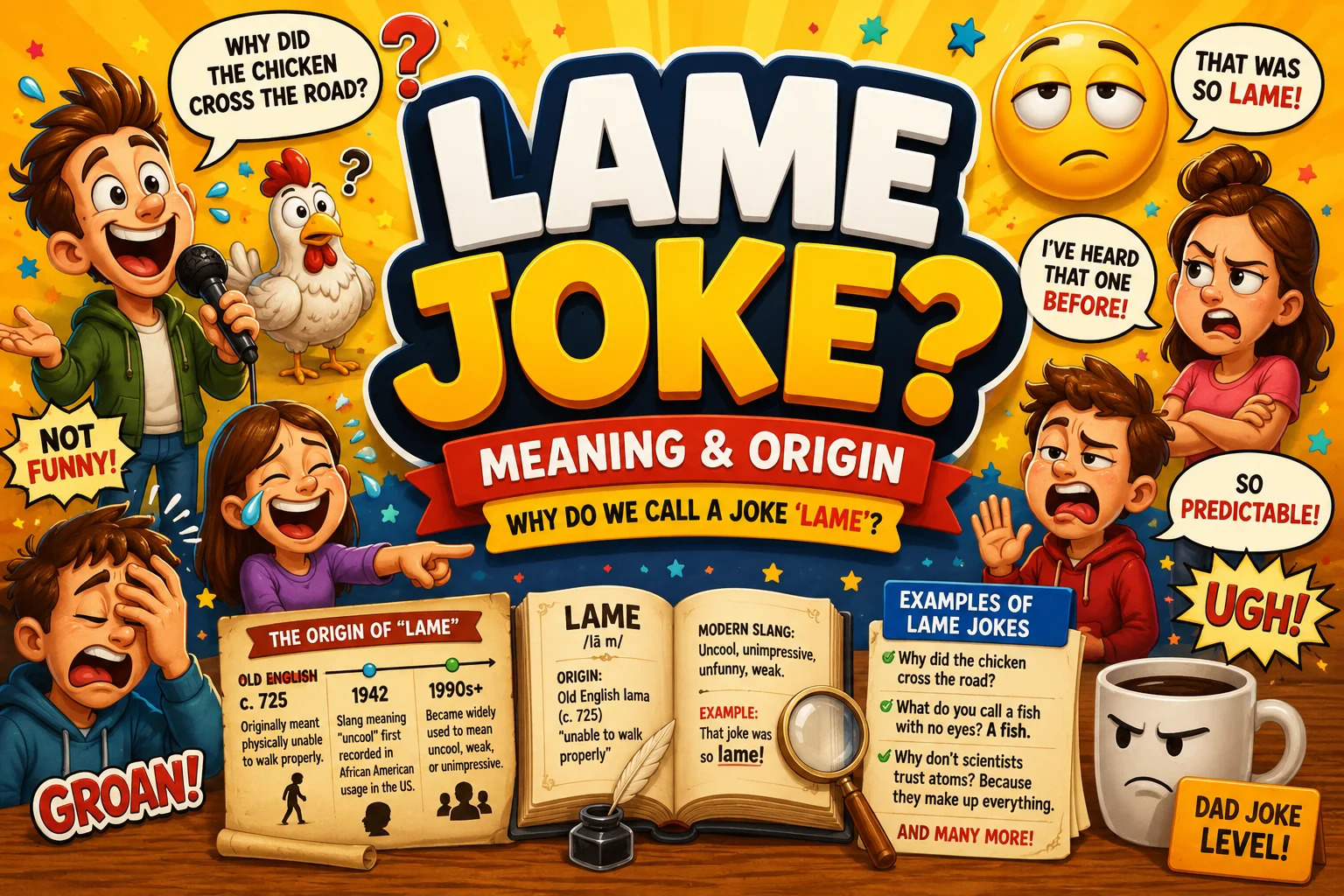
If you’ve come across the phrase lame joke and want a clear explanation of what it actually means, you’re not alone, this is one of the most commonly searched slang phrases in casual English, especially among people learning the language or encountering it for the first time online. The word lame itself has a genuinely surprising history, shifting meaning dramatically over the centuries before landing on the casual slang we use today. In this guide, we’ll explain exactly what lame joke means, where the word lame actually comes from, the completely different meaning behind lame duck, a few real examples of lame jokes, and how people typically respond when they hear one.
What Does Lame Joke Mean?
At its core, this is a simple, commonly used English phrase, but understanding the exact tone and usage helps clarify why it’s phrased this specific way. It’s the kind of expression that’s easy to understand in context but a little harder to define precisely, which is likely why so many people search for a clear explanation of it.
The Simple Definition
A lame joke is a joke that’s considered unfunny, weak, or unoriginal, typically because the punchline is too obvious, too overused, or simply falls flat when someone hears it. It’s used casually and isn’t meant to be a harsh insult, more of a lighthearted way of saying a joke didn’t land.
- Refers to a joke that fails to be genuinely funny
- Often describes a punchline that feels obvious or predictable
- Can also describe a joke that’s been overused or heard too many times
- Used casually in everyday conversation, not as a serious insult
- Similar in meaning to calling a joke corny or cheesy, though slightly more negative
- Commonly used to react to a joke right after hearing it
- Works as both a direct reaction and a general description
- Understood the same way across most English speaking regions
How the Phrase Is Typically Used
The phrase usually shows up as an immediate reaction, either said directly to the person who told the joke or used more generally to describe a type of humor that consistently misses the mark.
- Often said directly after hearing an unfunny joke
- Can be used to describe a specific joke or humor in general
- Frequently paired with an eyeroll or a groan for emphasis
- Common in both spoken conversation and text based chatting
- Sometimes used sarcastically, even when a joke is actually funny
- Understood as mild, casual criticism rather than genuine offense
- Appears frequently in online discussions ranking bad or corny jokes
- A widely recognized phrase across casual, everyday English
Where Does the Word Lame Come From?
Understanding lame joke fully means understanding where the word lame itself originated, since its meaning has shifted dramatically over hundreds of years, long before it ever had anything to do with humor.
The Original, Much Older Meaning
According to the Oxford English Dictionary, lame originally comes from Old English lama, first recorded as far back as the year 725, and it referred literally to someone unable to walk normally due to injury or physical impairment.
- Traced back to the Old English word lama
- First recorded usage dates to the year 725
- Originally referred to a physical inability to walk properly
- Descended further back from ProtoGermanic and ProtoIndoEuropean roots
- Remained the word’s primary meaning for many centuries
- The slang usage discussed below developed much later, and separately
- Confirmed through the Oxford English Dictionary’s documented history
- Represents one of the older words still actively used in English today
How Lame Came to Mean Uncool
According to the Oxford English Dictionary and language historians, the slang use of lame to mean uncool, unimpressive, or socially inept was first recorded in 1942, originating specifically within African American usage in the United States before spreading into broader mainstream slang over the following decades.
- First recorded in this slang sense in 1942, per the OED
- Originated specifically within African American usage in the US
- Gradually spread into wider, mainstream American slang afterward
- Linguist William Labov described being lame as being outside a group’s culture
- Became especially common and casual by the 1990s
- Used to describe people, jokes, ideas, and general behavior alike
- Some critics note the figurative use has drawn scrutiny given its origins
- Today used almost entirely in this casual, nonliteral sense
Lame Duck A Completely Different Meaning
Since lame duck often shows up in related searches, it’s worth clarifying that this specific phrase has an entirely separate meaning and history from lame joke, despite sharing the same first word.
Where Lame Duck Actually Comes From
According to language historians, lame duck was first used in 18th century England to describe someone who had defaulted on a debt, and it later evolved into its modern political meaning, referring to an official serving out the remainder of a term after already losing an election or being ineligible for reelection.
- Originated in 18th century England as a financial term
- Originally described someone who had defaulted on a debt
- Later evolved into a political term used mainly in the US and UK
- Refers to an official finishing a term after already losing power
- Completely unrelated to lame meaning uncool or unfunny
- The shared word lame is a coincidence of English vocabulary
- Frequently confused with lame joke due to the shared first word
- Worth understanding separately to avoid mixing up the two phrases
Examples of Genuinely Lame Jokes
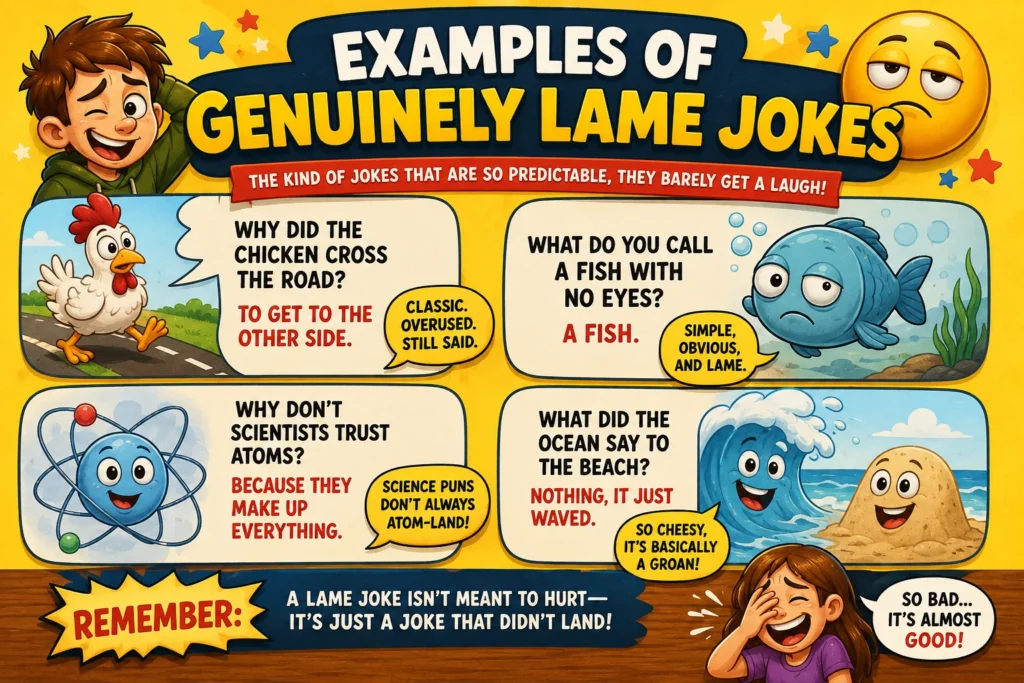
To make the definition concrete, here are a few jokes widely considered classic examples of the lame joke category, the kind so predictable they barely register as funny.
Jokes People Typically Call Lame
- Why did the chicken cross the road? To get to the other side.
- What do you call a fish with no eyes? A fish.
- Why don’t scientists trust atoms? Because they make up everything.
- What did the ocean say to the beach? Nothing, it just waved.
- Why did the tomato turn red? Because it saw the salad dressing.
- What do you call cheese that isn’t yours? Nacho cheese.
How to Respond to a Lame Joke
Since reacting to a lame joke is half the fun of hearing one, there are a few common, lighthearted ways people typically respond rather than taking it seriously.
Common Reactions and Comebacks
Most responses lean playful rather than genuinely harsh, treating the moment as a shared joke rather than a real criticism.
- That was so lame, I actually respect it.
- Wow, my grandpa told that same joke in 1995.
- A simple, exaggerated groan or eyeroll
- Please, never tell that joke again.
- That’s the worst joke I’ve ever heard.
- Laughing anyway, since the lameness itself is often the funny part
Jump into Other Related Article
- Food Jokes: Deliciously Funny Jokes That Will Make You Hungry
- Monthly Jokes: A Month Full of Laughs
- Weekly Jokes: A Funny Joke for Every Day of the Week
- Funny Jokes That Will Make You Laugh
- Animal Jokes: Funny Animal Jokes That Will Make You Laugh
- Dad Joke of the Day | Today’s Pick + 60 More for Every Day
- Joke of the Day | 50+ Funny Jokes for Every Mood
- Dad Jokes | 60+ Funny, Corny OneLiners (Plus Their Surprising History)
- Deez Nuts Jokes | 50+ Names & Setups (Plus Where It Came From)
- Banana Jokes | 60+ Funny Ones for Kids & Adults
- Cop Jokes | 50+ Funny Ones for Every Audience
- Penguin Jokes | 60+ Funny Ones for Kids & Adults
- Dinosaur Jokes for Kids | 60+ Funny Ones They’ll Love
- Cowboy Jokes | 60+ Funny Ones (Plus Dallas Cowboys Jokes)
- Shark Jokes | 60+ Funny Ones for Kids & Adults
- Funny Jokes | 60+ Jokes for Kids, Adults & Every Occasion
- Pasta Jokes | 60+ Funny Ones for Kids & Adults
Conclusion
Lame joke simply refers to a joke considered unfunny, predictable, or overused, a casual and lighthearted phrase rather than a serious criticism. The word lame itself has a genuinely surprising history, shifting from its original meaning of physical impairment in Old English to a slang term for uncool that emerged specifically in 1942, while lame duck developed as a completely separate phrase with roots in 18th century financial and political history. Now that you understand exactly where the phrase comes from and how it’s typically used, you’ll know exactly what someone means the next time they call a joke lame.
What does lame joke mean?
It means a joke that’s considered unfunny, weak, or overly predictable, usually said as a casual, lighthearted reaction rather than a harsh insult.
Where does the word lame come from?
It originally meant physically unable to walk properly, dating back to Old English, before the slang meaning of uncool developed separately in 1942.
Is lame joke the same as lame duck?
No, lame duck is a completely different phrase referring to an official finishing out a term after losing power, unrelated to humor or joketelling.`
Is calling something lame considered offensive?
Some people note the term’s figurative use traces back to a word describing physical disability, though in casual modern use it’s understood simply as slang for uncool or unfunny.
What’s an example of a lame joke?
Why did the chicken cross the road? To get to the other side is one of the most commonly cited examples of a classic lame joke.
How do you respond when someone tells a lame joke?
Common reactions include a playful groan, a joking comeback like that was so lame I respect it, or simply laughing at how predictable the joke was.