What is the oldest joke in the world? You might expect an ancient riddle about kings, a clever line from a philosopher, or a witty remark carved into a temple. The surprising answer is a joke about farting. Dating back to around 1900 BC, an ancient Sumerian proverb is widely recognized as the oldest recorded joke identified by researchers. Its humor revolves around a newly married woman and a bodily function that apparently deserved attention thousands of years ago.
But that ancient gag is only the beginning. History also preserves a mysterious dog-and-bar joke, an Egyptian joke about entertaining a bored pharaoh, and an old English riddle with a cheeky punchline. Below, you’ll discover what these jokes say about humor in the ancient world, why some historical punchlines are difficult to understand today, and a collection of funny jokes inspired by the oldest joke traditions.
What Is the Oldest Joke in the World?
The oldest recorded joke commonly identified by researchers is a Sumerian proverb from approximately 1900 BC. It has been translated as:
Something which has never occurred since time immemorial; a young woman did not fart in her husband’s lap.
The line is often described as the world’s oldest recorded fart joke. It was preserved on tablets associated with the Old Babylonian period, and the underlying material may be older still. Guinness World Records credits research led by Dr. Paul McDonald of the University of Wolverhampton with identifying it as the oldest recorded example of humor in the study.
The joke may not sound particularly sophisticated today, but its basic idea is easy to recognize: it takes an everyday bodily function and presents it as an extraordinary exception to what has supposedly happened throughout history.
There is an important distinction, however. This is the oldest recorded joke identified in a particular body of surviving evidence, not proof that it was the first joke any human ever told. People almost certainly laughed and joked long before anyone preserved humor in writing.
Why Is the Oldest Joke a Fart Joke?
To modern readers, the ancient Sumerian joke seems surprisingly familiar. Children still laugh at fart jokes, friends tease one another about embarrassing bodily noises, and comedians use toilet humor to break social rules.
The Sumerian proverb also appears to exaggerate an everyday situation. Instead of simply saying that a woman might fart, it frames the event as something that has supposedly never happened throughout all of time. The contrast between that grand introduction and the ordinary subject creates the joke.
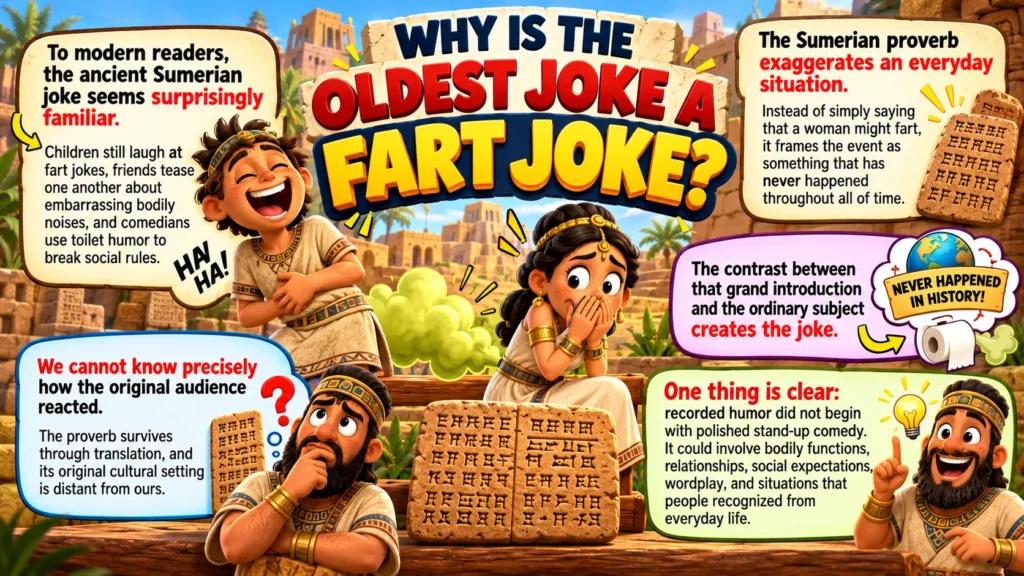
Still, we cannot know precisely how the original audience reacted. The proverb survives through translation, and its original cultural setting is distant from ours. Researchers can discuss its wording and structure, but claiming that every ancient listener laughed for exactly the same reason modern readers might would go beyond the evidence.
One thing is clear: recorded humor did not begin with polished stand-up comedy. It could involve bodily functions, relationships, social expectations, wordplay, and situations that people recognized from everyday life.
The Oldest Dog-and-Bar Joke in History
The Sumerians left behind another famous piece of ancient humor: a strange proverb often described as the world’s oldest recorded bar joke.
Its best-known English rendering tells of a dog entering a tavern and saying that it cannot see anything before asking whether it should open something. The wording varies across translations, and modern readers are still unsure what makes the original line funny.
Here is the familiar version:
A dog walks into a bar and says, I can’t see a thing. I’ll open this one.
It sounds like the beginning of a modern joke, but the punchline leaves many readers scratching their heads. Was it wordplay? Did the tavern setting have a different meaning in ancient Mesopotamia? Was the dog referring to a door, its eyes, or something else entirely?
Those are possible interpretations, not settled answers. The original language and cultural context make the joke difficult to decode with confidence. Even the word translated as tavern can carry associations that differ from those of a modern bar.
The joke is a reminder that humor depends on more than words. A punchline may once have been obvious to its audience but become mysterious after thousands of years of linguistic and cultural change.
The Ancient Egyptian Joke About a Bored Pharaoh
Another early example of recorded humor comes from ancient Egypt. A joke associated with Pharaoh Sneferu is dated to around 1600 BC in popular accounts of early jokes. It asks how someone could entertain a bored ruler. The proposed solution is to send a boatload of young women dressed in fishing nets down the Nile and encourage the pharaoh to catch a fish.
The joke is commonly retold as:
How do you entertain a bored pharaoh?
You send a boatload of young women dressed in fishing nets down the Nile and tell him to go fishing.
The humor relies on an unexpected image and the extravagant setting of a royal pastime. It also reflects a very different social world from ours, so the original audience’s response cannot be reconstructed with certainty.
Compared with the Sumerian proverb, the Egyptian gag feels more like a comic scenario than a short observation about married life. Both examples show that ancient humor could be built around surprise, social relationships, and the contrast between an ordinary problem and an unusual solution.
Jump into Other Related Article
- Moose Jokes | Funny Moose Jokes, Puns, Dad Jokes & One-Liners
- You’re So Skinny Jokes | Why They Hurt and How to Respond
- Difference Between Llama and Alpaca Joke | Funny Answers, Puns & Meaning
The Oldest English Joke in History
One of the oldest English jokes identified in the historical list published in 2008 dates to the 10th century. It survives in the Exeter Book, a collection of Old English poetry and riddles. Its wording is bawdy and uses a suggestive question before revealing an unexpectedly ordinary answer: a key.
The joke is usually rendered in modern English as a question about something hanging at a man’s thigh that wants to poke a hole that is often poked before. The answer is simply a key.
The trick is the misleading description. The question encourages the listener to imagine something sexual, but the punchline points to an everyday object. This type of misdirection remains common in riddles and adult humor.
The old wording and its cultural setting matter, so the modern version is best understood as a translation of a historical riddle rather than a verbatim joke preserved in contemporary English.
Is the Oldest Joke Really the First Joke Ever Told?
No one can establish the first joke ever told. Spoken humor leaves little direct evidence unless someone records it, and writing itself came long after humans began communicating verbally.
The Sumerian proverb is famous because it survives in ancient written material and has been identified as an early example of recorded humor. It does not mean that no one told a joke before 1900 BC. People may have teased friends, shared amusing stories, or made playful observations for generations before the surviving text was written.
It is more accurate to say the Sumerian fart proverb is widely recognized as the oldest recorded joke identified in this research, rather than calling it definitively the first joke in human history.
The distinction matters because historians work with evidence that has survived, not with every conversation that ever took place. A joke written on a tablet can be studied; an unrecorded joke told around a fire thousands of years ago is lost to history.
15 Funny Jokes Inspired by the Oldest Joke in the World
The following are newly written jokes inspired by ancient humor, old-fashioned sayings, and the kinds of everyday situations that have amused people for centuries. They are modern jokes, not quotations from ancient tablets.
1. Why did the ancient comedian carry a clay tablet? He wanted to make sure his jokes were set in stone.
2. What did the Sumerian comedian say after a bad performance? At least my jokes will survive longer than my career.
3. Why did the pharaoh hire a comedian? His royal advisers were great at giving advice but terrible at giving him a laugh.
4. What was the oldest comedian’s favorite writing material? Anything with a good punchline.
5. Why did the ancient scribe become a stand-up comedian? He was tired of writing jokes that nobody could hear.
6. What happened when a caveman told a joke? Everyone laughed, then someone had to explain it to the archaeologists.
7. Why did the ancient joke get so much attention? It had a very long history of making an impression.
8. What did the historian say after hearing an old joke? It’s funny, but I need three sources before I laugh.
9. Why did the ancient king dislike short jokes? He thought every royal story needed a long introduction.
10. Why did the dog enter the ancient tavern? He heard the place had a great bark menu.
11. What did the old joke say to the new joke? You may be trending, but I’ve been around for ages.
12. Why did the archaeologist laugh at the broken tablet? Even the punchline had been cracked.
13. How did ancient comedians promote their shows? They carved the date in stone and hoped nobody moved the wall.
14. Why did the pharaoh enjoy riddles? He liked questions that made people work for the answer.
15. What do the oldest jokes and modern jokes have in common? Someone still has to get the punchline.
15 Old-School Fart Jokes That Would Make History
Since the oldest recorded joke is famous for its toilet humor, here are some modern, family-friendly fart jokes. They are new jokes, not translations of Sumerian proverbs.
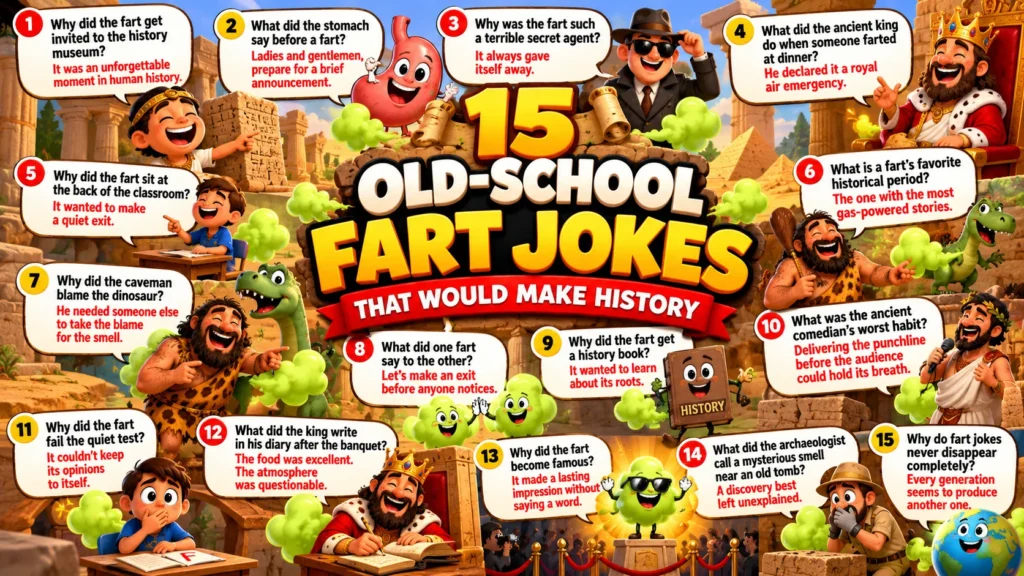
1. Why did the fart get invited to the history museum? It was an unforgettable moment in human history.
2. What did the stomach say before a fart? Ladies and gentlemen, prepare for a brief announcement.
3. Why was the fart such a terrible secret agent? It always gave itself away.
4. What did the ancient king do when someone farted at dinner? He declared it a royal air emergency.
5. Why did the fart sit at the back of the classroom? It wanted to make a quiet exit.
6. What is a fart’s favorite historical period? The one with the most gas-powered stories.
7. Why did the caveman blame the dinosaur? He needed someone else to take the blame for the smell.
8. What did one fart say to the other? Let’s make an exit before anyone notices.
9. Why did the fart get a history book? It wanted to learn about its roots.
10. What was the ancient comedian’s worst habit? Delivering the punchline before the audience could hold its breath.
11. Why did the fart fail the quiet test? It couldn’t keep its opinions to itself.
12. What did the king write in his diary after the banquet? The food was excellent. The atmosphere was questionable.
13. Why did the fart become famous? It made a lasting impression without saying a word.
14. What did the archaeologist call a mysterious smell near an old tomb? A discovery best left unexplained.
15. Why do fart jokes never disappear completely? Every generation seems to produce another one.
15 Oldest-Style Dog Jokes and Bar Jokes
The ancient Sumerian dog-and-tavern proverb is famous because its modern translation resembles the familiar walks into a bar joke format. Its original meaning remains uncertain, so the jokes below are modern wordplay rather than reconstructions of the ancient text.
1. A dog walks into a bar and asks for a drink. The bartender says, We don’t serve dogs. The dog replies, Good, I was hoping for a bowl of water.
2. Why did the dog enter the history museum? He wanted to learn about his ancestors’ bark side.
3. A dog walks into a library. The librarian says, Please be quiet. The dog whispers, Ruffly speaking, I always am.
4. Why did the dog become a historian? He loved digging up the past.
5. A dog walks into a bar and orders a bone-shaped biscuit. The bartender says, That’s not on the menu. The dog replies, Then I guess I’ll have to paws for thought.
6. Why did the ancient dog dislike the tavern? The conversation was ruff, and the chairs were uncomfortable.
7. A dog walks into a comedy club. The comedian asks, Do you like my jokes? The dog says, I’m still waiting for the treat at the end.
8. Why did the dog sit beside the old tablet? He thought it was a chewable history lesson.
9. A dog walks into a bar and says, I’ll have a round. The bartender asks, A round of what? The dog replies, A round of the park, obviously.
10. Why did the dog get kicked out of the museum? He kept marking the historical landmarks.
11. A dog walks into a tavern and asks for the bill. The bartender says, You haven’t ordered anything. The dog replies, I’m paying for all the barking.
12. Why was the dog the best storyteller in town? Every tale had a tail.
13. A dog walks into a bar and asks if they have a happy hour. The bartender says yes. The dog replies, Great! I’ve been wagging for one all day.
14. Why did the dog read the ancient joke twice? The first time, he missed the point. The second time, he chased it.
15. What did the dog say after hearing a 4,000-year-old joke? That punchline is older than my entire family tree!
15 Old-Fashioned Jokes That Still Work Today
Not every old joke needs an ancient tablet. Simple riddles, everyday misunderstandings, and playful wordplay can survive because people still recognize the situations.
1. Why did the scarecrow win an award? He was outstanding in his field.
2. Why don’t skeletons fight each other? They don’t have the guts.
3. What do you call cheese that isn’t yours? Nacho cheese.
4. Why did the bicycle fall over? It was two-tired.
5. What did one wall say to the other wall? I’ll meet you at the corner.
6. Why was the math book unhappy? It had too many problems.
7. What kind of room has no doors or windows? A mushroom.
8. Why did the clock get promoted? It always made time for work.
9. What do you call a bear with no teeth? A gummy bear.
10. Why did the baker stop telling jokes? His best ones were half-baked.
11. What did the pencil say to the paper? You’ve got a point.
12. Why did the gardener get promoted? He was growing in his role.
13. Why did the computer go to the doctor? It had a virus.
14. What did the ocean say to the beach? Nothing. It just waved.
15. Why did the old joke visit the doctor? It felt like its timing was off.
15 Your Mom Jokes With an Old-School Twist
Searches for the oldest your mom joke sometimes appear alongside searches for the oldest joke in history. However, the surviving Sumerian fart proverb is not a your mom joke in the modern insult-comedy format. The examples below are modern, playful roasts—not ancient Babylonian quotations.
1. Your mom is so old, her first selfie was painted on a cave wall.
2. Your mom is so old, her family tree is a whole forest.
3. Your mom is so old, the history book asks her for eyewitness accounts.
4. Your mom is so old, her birth certificate is written on a clay tablet.
5. Your mom is so old, she remembers when the past was the present.
6. Your mom is so old, archaeologists ask her where they should start digging.
7. Your mom is so old, she calls ancient history the good old days.
8. Your mom is so old, her childhood drawings are displayed in a museum.
9. Your mom is so old, she taught the calendar how to count.
10. Your mom is so old, her first phone had to be carved by a scribe.
11. Your mom is so old, she says the pyramids were the new buildings in town.
12. Your mom is so old, she remembers when a punchline was delivered by a messenger.
13. Your mom is so old, her school report is an archaeological artifact.
14. Your mom is so old, even the oldest joke calls her ma’am.
15. Your mom is so old, the museum gives her a discount for being part of the collection.
What Makes an Ancient Joke Funny Today?
The oldest recorded jokes are fascinating partly because they reveal how humor can survive while its original context disappears. A modern reader may understand the basic idea of the Sumerian fart proverb, yet the precise social meaning of the line remains uncertain. The ancient dog-and-tavern joke is even harder to interpret because its punchline depends on language and context that may no longer be obvious.
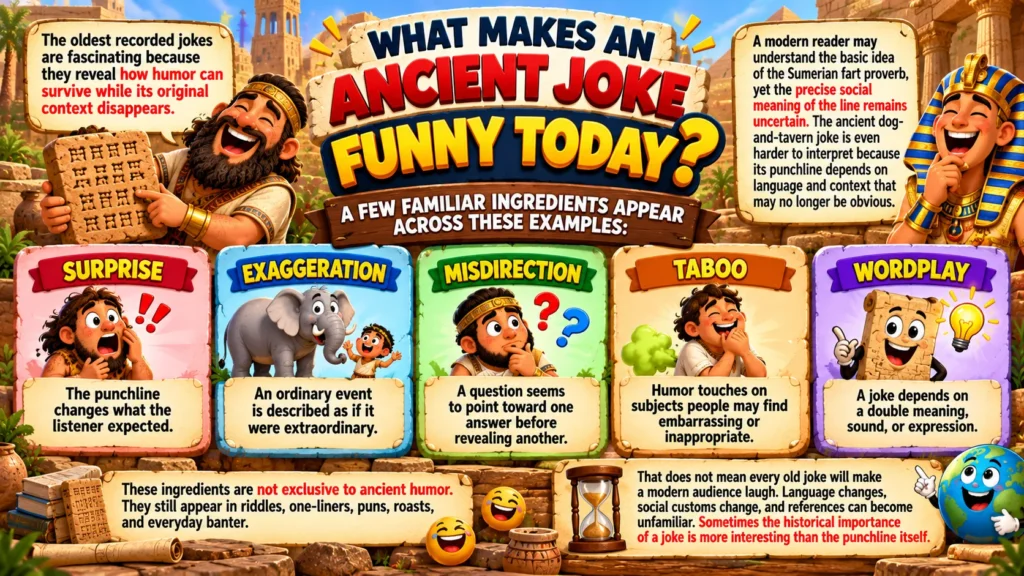
A few familiar ingredients appear across these examples:
- Surprise: The punchline changes what the listener expected.
- Exaggeration: An ordinary event is described as if it were extraordinary.
- Misdirection: A question seems to point toward one answer before revealing another.
- Taboo: Humor touches on subjects people may find embarrassing or inappropriate.
- Wordplay: A joke depends on a double meaning, sound, or expression.
These ingredients are not exclusive to ancient humor. They still appear in riddles, one-liners, puns, roasts, and everyday banter.
That does not mean every old joke will make a modern audience laugh. Language changes, social customs change, and references can become unfamiliar. Sometimes the historical importance of a joke is more interesting than the punchline itself.
Conclusion
The oldest recorded joke commonly identified by researchers is a Sumerian proverb about farting, preserved in ancient Mesopotamian writing around 1900 BC. Other early examples include the puzzling dog-and-tavern joke, an Egyptian gag about entertaining a pharaoh, and a suggestive Old English riddle.
Not every ancient punchline makes sense to modern readers, but these surviving examples show that people were recording humor thousands of years ago. From toilet jokes and clever riddles to modern one-liners and playful roasts, comedy continues to find new ways to surprise people.
And if the oldest recorded joke teaches us anything, it is that humor does not always need to be complicated. Sometimes, a simple observation is enough to make a joke memorable for thousands of years.
What is the oldest joke in the world?
The oldest recorded joke commonly identified by researchers is a Sumerian proverb dating to around 1900 BC. It jokes about a young woman farting in her husband’s lap and is widely known as the oldest recorded fart joke.
Who made the world’s oldest joke?
We do not know who originally created it. The proverb survives in ancient written material, but the name of its author and the identity of the first person who told it are unknown.
Where was the oldest joke found?
The famous Sumerian fart proverb is associated with tablets from the Old Babylonian period in ancient Mesopotamia, in the region of modern-day Iraq.
How old is the oldest recorded joke?
It is commonly dated to approximately 1900 BC, making it nearly 4,000 years old. The underlying material may be older, with some accounts suggesting it could date as far back as 2300 BC.
Is the oldest joke really about farting?
Yes. The best-known translation of the Sumerian proverb refers to a young woman farting in her husband’s lap. Its wording is frequently quoted as an example of how toilet humor appears in ancient written records.
What is the oldest dog joke in the world?
A Sumerian proverb about a dog entering a tavern is often described as the oldest recorded bar joke. Its English translation is difficult to interpret, and scholars have proposed different explanations for what the punchline might mean.
What is the oldest Egyptian joke?
One of the best-known early Egyptian jokes asks how to entertain a bored pharaoh. The punchline involves sending young women dressed in fishing nets down the Nile so the ruler can go fishing. Popular accounts date this joke to around 1600 BC.
What is the oldest English joke?
A bawdy riddle preserved in the Exeter Book, an Old English manuscript, is commonly cited as one of the oldest recorded English jokes. It uses suggestive wording to mislead the listener before giving a key as the answer.
What is the oldest your mom joke?
There is no firmly established, universally accepted oldest your mom joke in the modern roast format. The ancient Sumerian proverb is a joke about a married woman, but it should not be presented as a verified example of the modern your mom joke tradition.
Why are some ancient jokes no longer funny?
Their wordplay, cultural references, and social assumptions may be unfamiliar today. In some cases, translators cannot confidently establish the original meaning. The ancient dog-and-tavern joke is a good example: its basic wording survives, but the intended punchline remains uncertain.