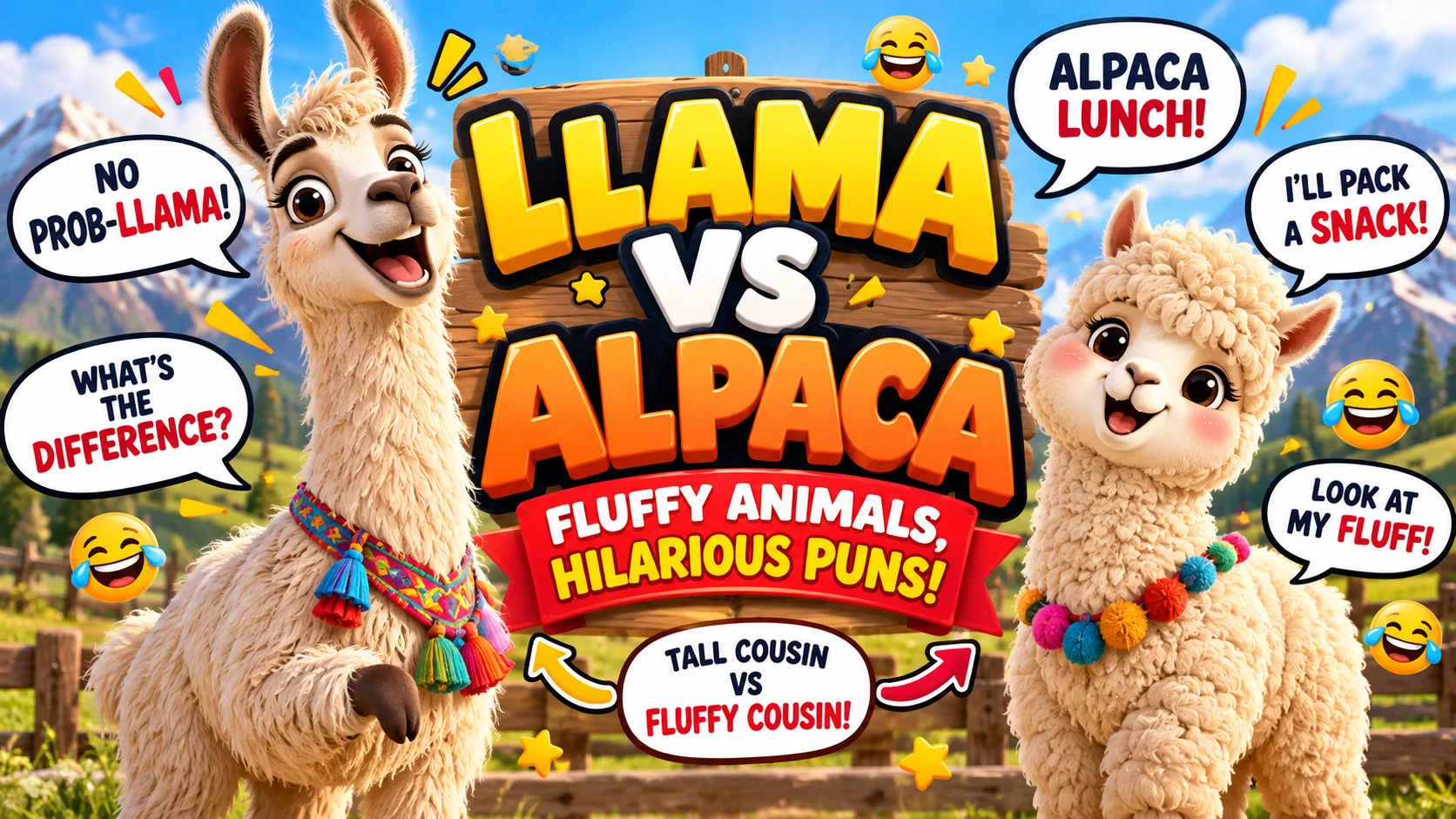
The difference between llama and alpaca joke takes a very common question and turns it into simple animal wordplay. Llamas and alpacas look similar enough that people regularly confuse them, which makes the question What’s the difference between a llama and an alpaca? a natural setup for humor.
The joke can go in several directions. Some versions use the animals’ names for wordplay, while others exaggerate their appearance, attitude, size, or famous fluffy coats. Llama jokes often play with words such as llama, while alpaca jokes frequently use alpaca in phrases such as I’ll pack a… The result is a whole category of lighthearted animal humor that works especially well for children, social media captions, family conversations, and joke collections.
There is also a useful fact behind the comedy: llamas and alpacas really are closely related, but they are not the same animal. Llamas are generally larger, with longer faces and longer, banana-shaped ears, while alpacas are smaller and have shorter, spear-shaped ears and finer fiber.
The Classic Difference Between Llama and Alpaca Joke
One popular approach to the difference between llama and alpaca joke is to pretend that identifying the animals is much easier than it really is.
A simple version goes:
What’s the difference between a llama and an alpaca?
About a lot of wool and a few good jokes.
Another playful approach turns the question into a pronunciation or wordplay joke:
How can you tell the difference between a llama and an alpaca?
Ask them. One will probably tell you.
The reason there is not one universally fixed punchline is that this question works more like a joke template. Once someone asks about the difference, the answer can be adapted into puns about their names, appearance, personalities, or wool.
Online llama and alpaca joke collections contain many variations, including jokes based on famous names, word substitutions, and exaggerated animal personalities.
What’s the Difference Between a Llama and an Alpaca Joke?
The phrase what’s the difference between a llama and an alpaca joke usually refers to humor built around the fact that these two animals are easy to mix up.
That gives comedians several directions to explore:
- Make the animals argue about which one is which.
- Pretend the llama is offended by being called an alpaca.
- Make a pun from the word llama.
- Turn alpaca into I’ll pack a.
- Exaggerate the llama’s larger size.
- Make fun of the alpaca’s extremely fluffy appearance.
- Compare their ears.
- Create a fake competition between the two animals.
- Use the question as a setup for a one-line punchline.
- Turn the difference into a social-media caption.
The best jokes do not need a complicated explanation. The audience already knows the two animals look similar, so the setup is immediately understandable.
Why the Llama and Alpaca Question Makes a Good Joke
The humor starts with confusion.
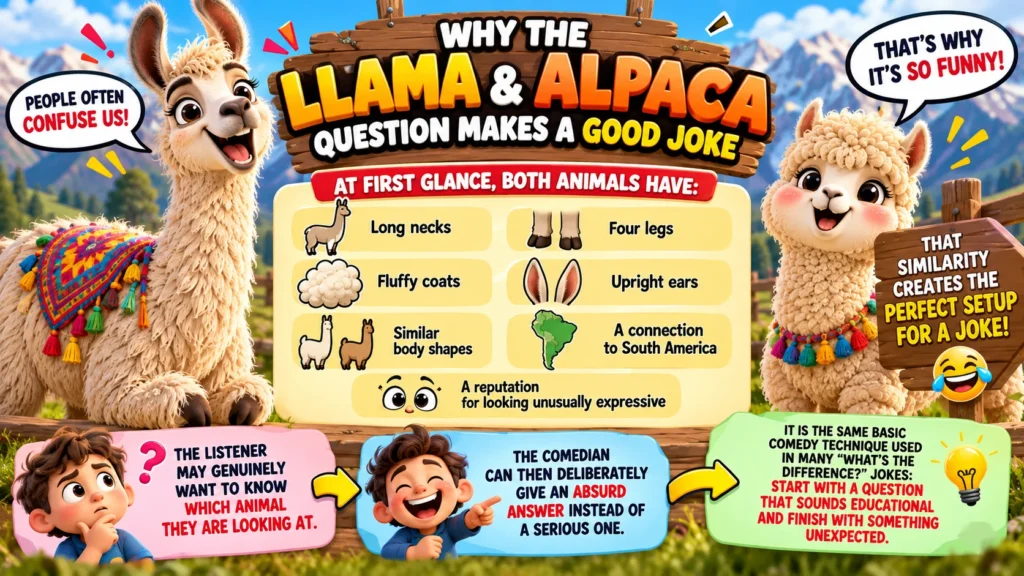
At first glance, both animals have:
- long necks
- four legs
- fluffy coats
- upright ears
- similar body shapes
- a connection to South America
- a reputation for looking unusually expressive
That similarity creates the perfect setup for a joke.
The listener may genuinely want to know which animal they are looking at. The comedian can then deliberately give an absurd answer instead of a serious one.
It is the same basic comedy technique used in many What’s the difference? jokes: start with a question that sounds educational and finish with something unexpected.
Jump into Other Related Article
- Shark Jokes | 60+ Funny Ones for Kids & Adults
- Potato Jokes | 90+ Puns, Riddles and Dad Jokes with Answers
- Moose Jokes | Funny Moose Jokes, Puns, Dad Jokes & One-Liners
The Real Difference Between a Llama and an Alpaca
Before getting deeper into the jokes, it helps to know what actually separates the two animals.
Llamas and alpacas are both domesticated South American camelids, but their physical characteristics and traditional uses differ.
Llamas are generally the larger of the two. Alpacas are smaller and are especially valued for their fine fiber. Llamas have longer faces and distinctive long ears, while alpacas have shorter faces and smaller ears.
A quick comparison looks like this:
| Feature | Llama | Alpaca |
| General size | Larger | Smaller |
| Face | Longer | Shorter and more rounded |
| Ears | Long and banana-shaped | Shorter and spear-shaped |
| Build | Stronger and heavier | Smaller and more compact |
| Fiber | Generally coarser | Generally finer and softer |
| Traditional use | Pack animal and other purposes | Primarily valued for fiber |
| Typical personality description | More alert and assertive | Often more timid and gentle |
These are broad characteristics rather than rules that apply identically to every individual animal.
Llama vs. Alpaca: The Size Joke
Size is one of the easiest differences to turn into comedy.
Llamas are substantially larger than alpacas. Recent reference material puts adult llamas at roughly 280–450 pounds, while alpacas are generally around 100–175 pounds.
That creates plenty of room for exaggerated jokes.
For example:
What’s the difference between a llama and an alpaca?
If you have to ask, let the llama stand next to the alpaca.
Or:
The llama is the one that looks like it ate the alpaca’s lunch.
The joke works because the audience already understands the basic size contrast.
Of course, the real difference is not simply big animal versus small animal. Both are distinct camelid species with their own characteristics.
The Ear Joke
The ears provide another easy way to create a difference between llama and alpaca joke.
Llamas generally have long, curved ears often described as banana-shaped. Alpacas have shorter, more pointed or spear-shaped ears.
That difference can become a visual joke:
How do you tell a llama from an alpaca?
Look at the ears. One looks ready to receive a radio signal.
Or:
The llama has banana ears. The alpaca has tiny antennas.
These are deliberately exaggerated descriptions rather than scientific definitions.
The visual difference, however, is genuinely useful when trying to identify the animals.
The Face Joke
Another reliable clue is the face.
Llamas generally have longer faces, while alpacas have shorter, rounder-looking faces. This is one of the reasons alpacas are often perceived as especially fluffy or cute.
That gives the joke writer another setup:
The llama looks like it has somewhere important to be. The alpaca looks like it just woke up from a very comfortable nap.
Or:
Llama: serious business.
Alpaca: maximum fluff.
The humor comes from giving animals human personalities based on their appearance.
Difference Between Alpaca and Llama Joke: The Wordplay Route
The difference between alpaca and llama joke can also be based entirely on their names.
Alpaca sounds like the beginning of the phrase I’ll pack a…
That creates a large number of possible puns.
For example:
What did the alpaca say before the trip?
I’ll pack a snack.
Or:
Going somewhere? Don’t worry. Alpaca.
This style of joke is common because the sound of alpaca naturally invites a sentence beginning with I’ll pack a.
Llama jokes have a similar advantage because llama can be incorporated into phrases involving llama, llama mia, or other playful substitutions.
Alpaca Puns That Explain the Joke Style
Alpaca humor often depends on turning the animal’s name into a phrase.
Some common examples include:
- Alpaca lunch.
- Alpaca suitcase.
- Alpaca snacks.
- Alpaca blanket.
- Alpaca the car.
- Alpaca my bags.
- Alpaca good mood.
- Alpaca this trip.
The basic structure is simple:
alpaca → I’ll pack a
That tiny sound change creates a large number of joke possibilities.
A published collection of llama and alpaca jokes includes several similar name-based puns, including Alpaca constructions and famous-name wordplay.
Llama Puns Have Their Own Style
Llama jokes also have a strong tradition of wordplay.
Popular examples include jokes based on phrases such as:
- Llama mia
- Dalai Llama
- Llama Del Rey
- Kendrick Llamar
- Barack Ollama
- Llamadeus Mozart
- No prob-llama
These work because the word llama can be inserted into familiar names or expressions.
A llama therefore becomes more than an animal in the joke. It becomes a word that can replace part of another phrase.
That is why llama humor can continue producing new jokes long after the basic animal joke has become familiar.
Why Alpaca and Llama Jokes Work for All Ages
The difference between llama and alpaca joke is generally family-friendly because the humor comes from wordplay and visual comparisons rather than offensive subjects.
That makes this type of joke useful for:
- children
- classroom activities
- animal-themed parties
- school newsletters
- family joke collections
- social-media captions
- animal farms
- educational content
- birthday cards
- simple meme designs
The animals themselves are already visually funny to many audiences. Add a short pun and the joke becomes easy to understand without additional context.
Funny Difference Between Llama and Alpaca Answers
If someone asks the question casually, you can answer with a deliberately silly comparison.
Here are some original-style examples:
- The llama looks like it owns the farm; the alpaca looks like it owns the sweater department.
- The llama carries the luggage; the alpaca becomes the luggage.
- The llama has the long ears; the alpaca has the luxury fleece.
- The llama looks ready for an adventure; the alpaca looks ready for a nap.
- The llama says move along; the alpaca says admire my fluff.
- The llama is built for carrying; the alpaca is built for cuddly-looking photographs.
- The llama is the tall cousin; the alpaca is the fluffy cousin.
- The llama brings the attitude; the alpaca brings the softness.
- The llama looks like a guard; the alpaca looks like a cloud with legs.
- The llama has the longer face; the alpaca has the bigger fan club.
These work best when delivered as playful exaggerations rather than literal facts.
The No Prob-Llama Connection
One of the most recognizable llama puns is:
No prob-llama.
It replaces part of problem with llama.
That joke is simple, but it demonstrates exactly why llama humor is so adaptable.
Once someone starts thinking of llama as a word that can replace part of another word, dozens of jokes become possible.
For example:
- No prob-llama.
- Llama tell you later.
- Llama know when you’re ready.
- Llama lot.
- Llama see what happens.
- Llama be honest.
The jokes are intentionally corny, which is precisely why they work as family-friendly animal puns.
The Alpaca Lunch Joke
The matching alpaca classic is:
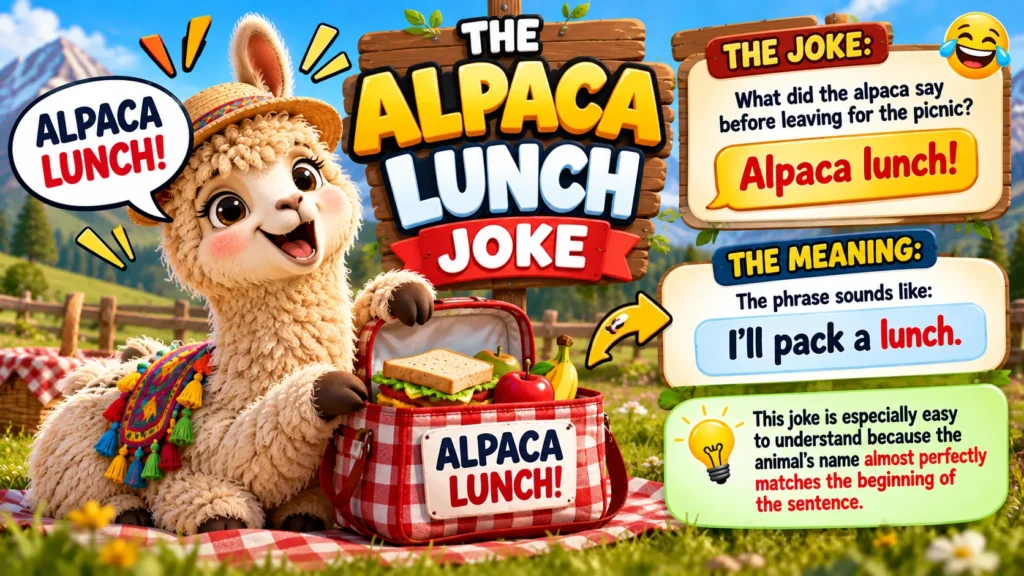
Alpaca lunch.
The phrase sounds like:
I’ll pack a lunch.
This joke is especially easy to understand because the animal’s name almost perfectly matches the beginning of the sentence.
A longer version could be:
What did the alpaca say before leaving for the picnic?
Alpaca lunch!
This type of joke has appeared in collections of llama and alpaca humor, where the animal name is turned into an ordinary phrase.
Why People Confuse Llamas and Alpacas
The humor has a real-world foundation because the animals genuinely resemble one another.
Both belong to the camelid family, and both are domesticated South American animals. Their shared ancestry helps explain why someone unfamiliar with them might struggle to identify them at first glance.
There are several clues that make identification easier:
- Look at overall size.
- Check the shape of the ears.
- Look at the length of the face.
- Compare the body build.
- Examine the coat and fiber.
- Consider what the animal is being used for.
Llamas are generally larger and more strongly built, while alpacas are smaller and particularly valued for their fiber.
Llama and Alpaca Joke About Their Personalities
Personality is another source of comedy.
Llamas are often described as more alert, independent, or protective, while alpacas are generally described as more timid or gentle.
That can easily become a fictional conversation:
Llama: Who are you looking at?
Alpaca: Nobody. I was just standing here.
Llama: Good.
Or:
The llama walks into a room like it owns the place. The alpaca walks in hoping someone compliments its fleece.
These jokes humanize the animals and give them exaggerated personalities.
They should be understood as humor, not as a universal description of every llama or alpaca.
The Spitting Joke
Llamas and alpacas are also famous for the idea that they spit.
That reputation gives joke writers another easy subject.
For example:
How does a llama end an argument?
With a very strong point and possibly a little spit.
Or:
Never argue with a llama. It might have a comeback you don’t want to wear.
Both animals can spit, particularly in social or defensive situations, although it is not accurate to assume that every llama or alpaca will randomly spit at people.
The joke simply exaggerates a behavior that audiences already associate with camelids.
Difference Between Llama and Alpaca Joke for Kids
This topic is especially suitable for children because the basic jokes are easy to understand.
A classroom-friendly version could be:
What did the alpaca say when it was hungry?
Alpaca lunch!
Or:
Why did the llama cross the road?
Because there was no prob-llama on the other side.
The jokes introduce children to wordplay without relying on complicated references.
They can also encourage kids to learn the actual difference between the animals after hearing the joke.
That creates a useful combination of humor and information.
Llama and Alpaca Meme Ideas
The difference between llama and alpaca joke is also easy to turn into a meme.
A split image could show:
LEFT: Llama
RIGHT: Alpaca
Then underneath:
Can you tell which is which?
The punchline can appear below the image.
Another format could show an extremely fluffy alpaca with the caption:
When you don’t know whether it’s a llama or alpaca, just compliment the fluff and hope for the best.
A llama image could use:
Not an alpaca. Please respect my professional status.
These formats work because the visual similarity between the animals provides the setup before the text delivers the joke.
The Difference Between Llama and Alpaca in One Quick Table
| Question | Llama | Alpaca |
| Which is usually bigger? | Llama | Alpaca is smaller |
| Which has longer ears? | Llama | Alpaca has shorter ears |
| Which has a longer face? | Llama | Alpaca has a shorter face |
| Which is strongly associated with pack work? | Llama | Less suited to heavy loads |
| Which is especially valued for fine fiber? | Less commonly | Alpaca |
| Which looks fluffier to many people? | Depends on coat | Often alpaca |
| Which one is more commonly confused with the other? | Both | Both |
The real differences make the joke easier to understand because the audience has actual characteristics to exaggerate.
The Question Behind the Joke
At its heart, the difference between llama and alpaca joke works because the question sounds serious:
What’s the difference?
The audience expects a factual answer.
Instead, the joke may provide:
One carries the luggage and the other says alpaca lunch.
That sudden switch from educational information to absurd wordplay creates the laugh.
It is a familiar comedy structure:
Serious question → unexpected answer → pun.
That structure is one reason the joke can be adapted to almost any format.
Why Alpaca Is So Useful for Puns
From a joke-writing perspective, alpaca is unusually useful because it sounds like a common sentence opening.
Alpaca → I’ll pack a
That means almost any object can become part of a joke:
- Alpaca lunch.
- Alpaca bag.
- Alpaca snack.
- Alpaca coat.
- Alpaca suitcase.
- Alpaca blanket.
- Alpaca camera.
- Alpaca sandwich.
The silliness comes from the fact that the listener knows exactly what the speaker means while still hearing the animal name.
Why Llama Is So Useful for Puns
Llama has a different advantage.
It can replace part of words or names:
problem → prob-llama
Dalai Lama → Dalai Llama
Llama Del Rey → Llama Del Rey
This makes llama humor particularly strong for parody names and short captions.
A joke collection can therefore contain both types:
Llama jokes: name and word substitutions.
Alpaca jokes: I’ll pack a constructions.
That gives the two animals their own recognizable comedy styles.
Popular Llama and Alpaca Joke Formats
If you are creating a collection around this topic, several formats work naturally:
- What’s the difference? jokes
- Knock-knock jokes
- Question-and-answer jokes
- Animal dialogue
- One-line puns
- Caption jokes
- Name parodies
- Spitting jokes
- Fluffy-animal jokes
- Size-comparison jokes
- Ear and face jokes
- Travel and packing puns
This variety prevents the article from feeling like the same joke repeated dozens of times.
Why the Joke Is Still Popular
Llama and alpaca humor has remained popular because the animals have become recognizable internet personalities in their own right.
Their unusual appearance makes them naturally suitable for memes and captions, while their names create easy opportunities for wordplay.
Online joke collections continue to use both animals for pun-based humor, including no prob-llama, alpaca lunch, famous-name parodies, and jokes about telling the two animals apart.
The difference between llama and alpaca joke therefore has two layers of appeal: people enjoy the animals themselves, and they enjoy the linguistic possibilities created by their names.
How to Tell a Difference Between Llama and Alpaca Joke
For the strongest delivery, ask the question naturally:
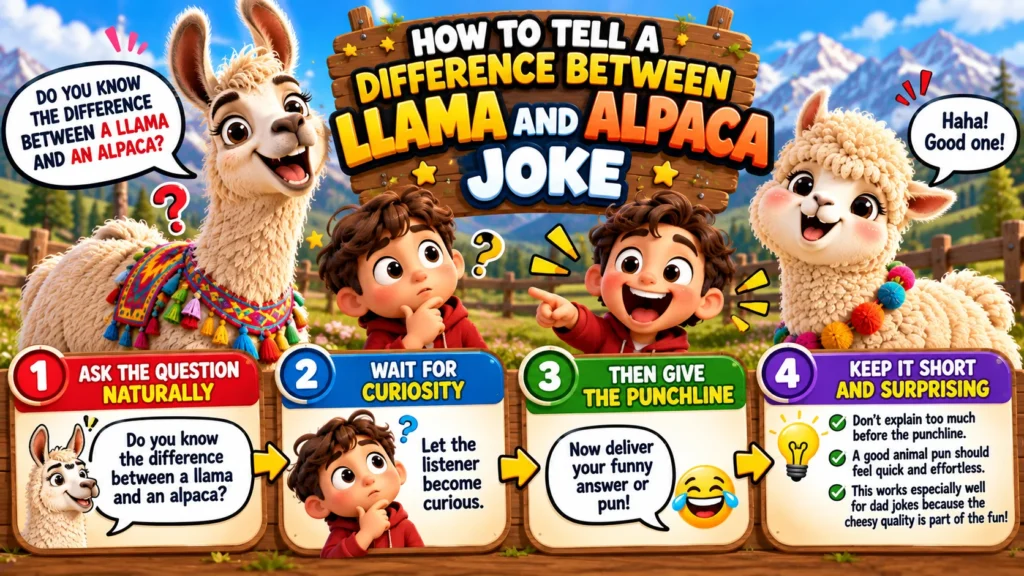
Do you know the difference between a llama and an alpaca?
Wait for the listener to become curious.
Then give the punchline.
The important part is not to explain too much beforehand. If you explain the wordplay before delivering it, the surprise disappears.
A good animal pun should feel quick and effortless.
That is particularly important with dad jokes because the intentionally cheesy quality is part of the experience.
Final Thoughts
The difference between llama and alpaca joke works because it combines a genuine point of confusion with easy animal wordplay. Llamas and alpacas really do look similar, but they have noticeable differences in size, ears, faces, fiber, and traditional uses. Llamas are generally larger and more strongly built, while alpacas are smaller and particularly valued for their fine fiber.
From there, comedy can go almost anywhere. Alpaca lunch turns the animal’s name into a sentence, while no prob-llama transforms a familiar word into a llama pun. Add jokes about fluffy coats, long ears, size, personality, or spitting, and the topic quickly becomes a complete collection of family-friendly animal humor. The best part is that the jokes remain simple enough for children while still giving adults plenty of intentionally cheesy wordplay to enjoy.
What is the difference between llama and alpaca joke?
The difference between llama and alpaca joke is a category of wordplay that uses the similarities and differences between the two animals as a setup. Many versions rely on their names, appearance, size, or personalities.
What’s the difference between a llama and an alpaca joke?
There is no single universal punchline. The question can lead to jokes about the llama being larger, the alpaca being fluffier, their different ears, or wordplay such as alpaca lunch and no prob-llama.
What is the difference between alpaca and llama joke?
It is essentially the same joke format with the animal names reversed. The humor usually comes from exaggerating the real differences between the two closely related camelids or turning their names into puns.
Are llamas and alpacas the same animal?
No. They are closely related South American camelids but are distinct animals. Llamas are generally larger, while alpacas are smaller and are especially valued for their fine fiber.
How can you tell a llama from an alpaca?
Look at the size, ears, and face. Llamas are usually larger and have longer, banana-shaped ears and longer faces. Alpacas are smaller and have shorter, spear-shaped ears and shorter faces.
Why are llama jokes so popular?
Llama is an easy word to incorporate into familiar names and phrases. Examples include no prob-llama, Llama Del Rey, and Dalai Llama, making the animal especially useful for puns.
Why is alpaca lunch a joke?
Alpaca lunch sounds like I’ll pack a lunch. The humor comes from replacing the beginning of the phrase with the animal name alpaca.
What is a good difference between llama and alpaca joke for kids?
A simple example is: What did the alpaca say before the picnic? Alpaca lunch! It is short, easy to understand, and uses harmless wordplay.
Do llamas and alpacas both spit?
Both can spit, especially in certain social or defensive situations, but it is not accurate to assume that they constantly spit at people. The behavior is often exaggerated in jokes and popular culture.
What is the funniest llama and alpaca pun?
There is no objectively funniest option, but No prob-llama and Alpaca lunch are among the most recognizable styles because both transform the animals’ names into familiar phrases.