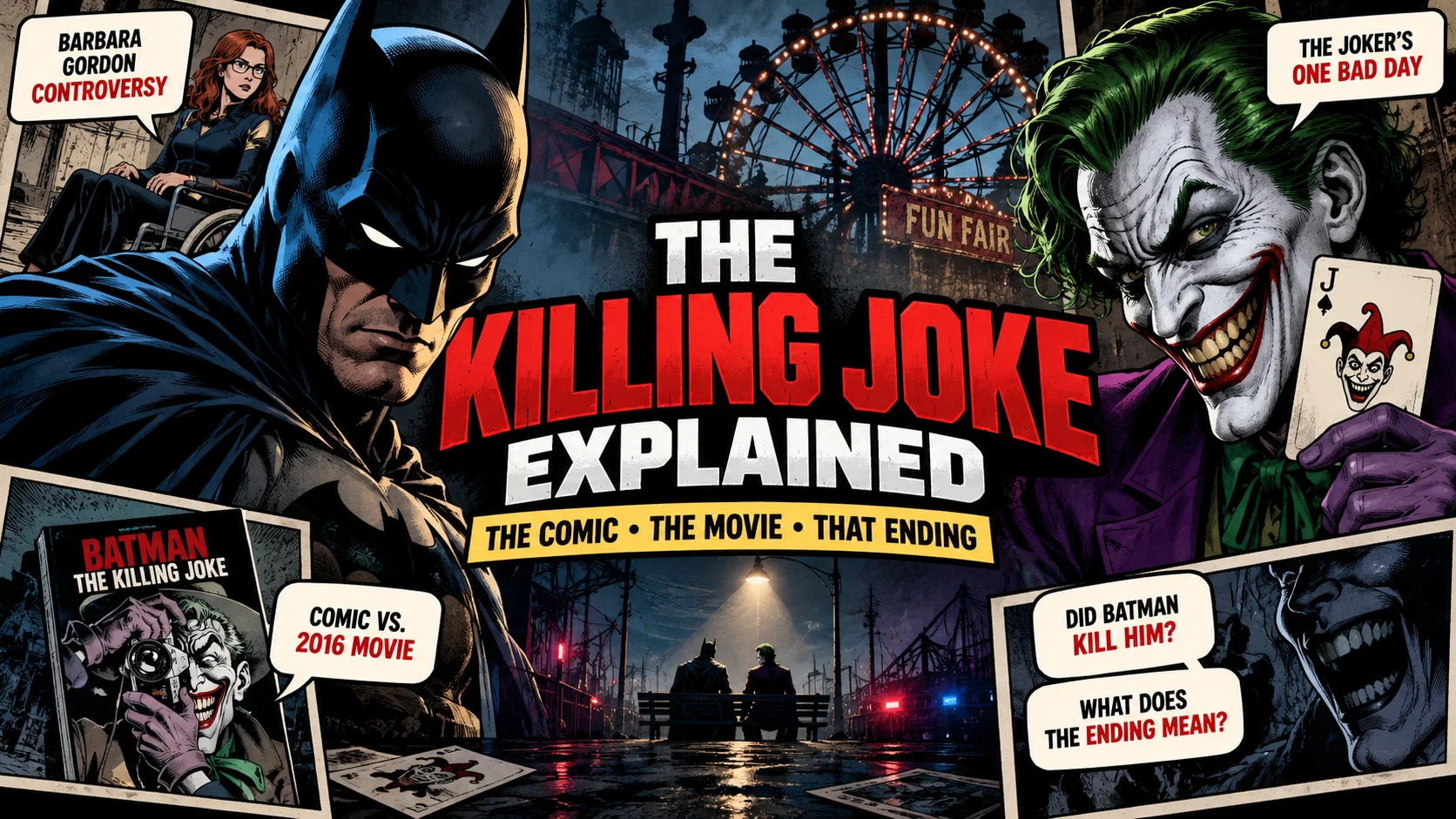
Batman: The Killing Joke is a 1988 DC oneshot by Alan Moore and Brian Bolland that redefined the Joker and remains the most argued about Batman story ever published. It is 48 pages long, it takes under an hour to read, and people have been fighting about its final page for nearly forty years. This guide covers what actually happens, what the Joker’s closing joke means, whether Batman kills him, how the 2016 animated film differs, and whether it is suitable for younger readers. Full spoilers follow.
What Is Batman: The Killing Joke?
The Killing Joke is a prestige format oneshot published by DC Comics in March 1988, written by Alan Moore and illustrated by Brian Bolland. It was originally conceived as a standalone story outside main continuity, but DC folded its events into canon, which is why its consequences stuck. The story is not a superhero fight it is a psychological argument between Batman and the Joker about whether sanity is a choice or an accident. It has stayed continuously in print since publication and sits alongside Watchmen, The Dark Knight Returns and Year One as one of the books that pushed superhero comics toward adult storytelling.
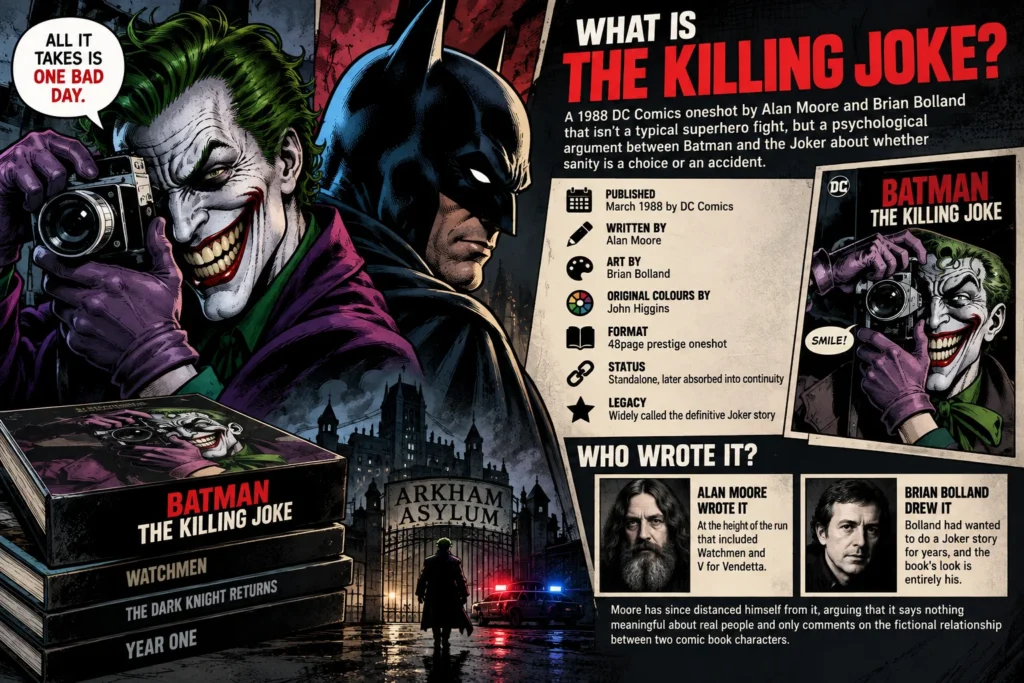
- Published: March 1988 by DC Comics
- Written by: Alan Moore
- Art by: Brian Bolland
- Original colours by: John Higgins
- Format: 48page prestige oneshot
- Status: intended as standalone, later absorbed into continuity
- Legacy: widely called the definitive Joker story
Who Wrote The Killing Joke?
Alan Moore wrote it, at the height of the run that included Watchmen and V for Vendetta. Brian Bolland drew it and had wanted to do a Joker story for years; the book’s look is entirely his. Moore has since distanced himself from it, arguing that it says nothing meaningful about real people and only comments on the fictional relationship between two comic book characters. That the writer himself considers it a lesser work has become part of the book’s mythology.
- Alan Moore wrote it; Brian Bolland drew it
- Moore has publicly semidisowned the book
- Bolland pitched a Joker story and got his wish
- Denny O’Neil edited it after Len Wein’s tenure
What Happens in The Killing Joke?
The Joker escapes Arkham Asylum with a thesis to prove: that anyone, no matter how decent, can be driven to madness by a single sufficiently terrible day. To test it, he targets Commissioner James Gordon. He shoots Barbara Gordon at her father’s front door, paralysing her, then photographs her in a degrading state and abducts Gordon, forcing him to view the images in a derelict funfair. Interwoven with this is a flashback origin: a failed standup comedian, desperate and broke with a pregnant wife, pulled into one robbery that goes catastrophically wrong. Gordon survives the ordeal with his principles intact, which quietly demolishes the Joker’s entire argument.
- The Joker escapes Arkham to prove his one bad day theory
- He shoots Barbara Gordon, paralysing her from the waist down
- He photographs her and uses the images to torment her father
- Gordon is held in an abandoned amusement park
- Flashbacks show a failed comedian pushed into a desperate crime
- Gordon refuses to break, disproving the Joker’s thesis
- Batman captures the Joker and the two end up laughing together
Barbara Gordon and the Batgirl Controversy
Barbara Gordon’s injury is the most criticised element of the book, and the criticism has not softened with time. She is shot, paralysed and degraded entirely to affect two men her father and Batman with no agency of her own in the story. Editorial approval for it was reportedly given in blunt and dismissive terms, which has followed the book ever since. What partly redeemed the decision came later, when writers turned the paralysed Barbara into Oracle, the information broker at the centre of the DC universe and one of comics’ most significant disabled characters.
- She has no agency in her own maiming it happens to affect others
- Frequently cited as a textbook example of fridging
- The editorial approval for it is infamous among comics historians
- She was later reinvented as Oracle, a landmark disabled hero
- Her paralysis stood in DC continuity for over two decades
The Killing Joke Ending Explained
The final page is the reason this book is still discussed. Batman has caught the Joker and offers, apparently sincerely, to help him. The Joker declines and tells a joke about two inmates escaping an asylum: one makes it across to the next rooftop and offers to shine a torch beam for the other to walk across, and the second refuses, because he is certain the first will switch the light off halfway. It is a joke about two damaged men who cannot save each other. Batman starts laughing, both men laugh together, and then the panels drop to their feet, the laughter stops, and a police siren approaches.
- Batman offers rehabilitation; the Joker refuses it
- The joke describes two escapees who cannot trust each other
- Both men laugh the only moment they ever share
- The final panels show only their feet
- The laughter stops abruptly and the light goes out
Did Batman Kill the Joker in The Killing Joke?
This is the single most searched question about the book, and there is no settled answer. Writer Grant Morrison popularised the theory on Kevin Smith’s podcast in 2013, arguing that Batman breaks the Joker’s neck as the joke ends, that this is why the laughter stops, why the light goes out, and why the book is called The Killing Joke. It is a genuinely elegant reading, and the fact that the last panels show only feet leaves room for it. Against it, the letterer Richard Starkings has said Bolland described the scene plainly as Batman laughing so hard he leans on the Joker for support, and the original script reportedly supports that too. Two pages earlier, Batman explicitly talks about the two of them not killing each other.
- Morrison’s reading: Batman snaps the Joker’s neck as the joke lands
- Supporting it: the abrupt end of laughter, the fading light, the title
- Against it: Bolland’s own description of the scene as shared laughter
- Against it: the original script does not describe a killing
- Against it: Batman rejects that outcome two pages earlier
- The honest answer: ambiguous by result, if not by intent
Jump into Other Related Article
- Funny Jokes | 60+ Jokes for Kids, Adults & Every Occasion
- Pasta Jokes | 60+ Funny Ones for Kids & Adults
- Old Jokes | Classic Jokes by Kid’s Age, Plus Old Age Humor
- What Does Lame Joke Mean? Full Definition & Origin
- Cheesy Jokes | 50+ Groan Worthy Ones (Plus Where Cheesy Comes From)
- Policeman Jokes | 50+ Funny Ones (UK Style Humor)
- A Joke That Is a Play on Words Is Called a Pun | Full Explanation
- Sports Jokes | 50+ Funny Ones (Plus the Greatest Sports Hoax Ever)
Does the Joker Die in The Killing Joke?
Not in any official sense. The Joker appears in countless stories published after 1988, so within DC continuity he plainly survives. The theory that he dies here only works if you treat the book as a hypothetical final Batman story, in the same way Moore’s Whatever Happened to the Man of Tomorrow? functioned as the last Superman story. Read that way, it is a beautiful idea. Read as canon, it simply is not what happened.
- The Joker appears in hundreds of later stories
- The death reading only works as a final story interpretation
- DC has never treated the ending as the Joker’s death
The Killing Joke Movie (2016)
Warner Bros. released an animated adaptation in 2016, directed by Sam Liu with a screenplay by Brian Azzarello and Bruce Timm as executive producer. It runs 76 minutes and became the first R rated DC animated film, a rating driven by the source material’s content rather than by added gore. Kevin Conroy and Mark Hamill returned as Batman and the Joker, roles they had defined since Batman: The Animated Series. The adaptation of the comic itself is close to panel for panel faithful. The problem is what was added to the front of it.
- Director: Sam Liu
- Screenplay: Brian Azzarello
- Executive producer: Bruce Timm
- Runtime: 76 minutes
- Rating: R the first R rated DC animated feature
- Released: digital July 2016, disc August 2016
Batman: The Killing Joke Cast
The voice cast is the strongest argument for watching the film. Hamill had publicly said he would return to the Joker if this book were adapted, which pushed the project forward. Conroy plays a colder, more withdrawn Batman than usual, which suits the material.
- Kevin Conroy Batman / Bruce Wayne
- Mark Hamill The Joker
- Tara Strong Batgirl / Barbara Gordon
- Ray Wise Commissioner James Gordon
- Maury Sterling Paris Franz
- John DiMaggio, Robin Atkin Downes, Nolan North, Brian George supporting roles
Why the 2016 Prologue Was So Controversial
Because the comic is short, the filmmakers added a roughly half hour prologue following Batgirl before the main story begins. It was intended to give Barbara more presence and agency ahead of what happens to her. Instead it gave her a sexual relationship with Batman that has no basis in the comics, which most critics and a large share of the audience felt undercut the exact problem it was meant to fix. Bruce Timm defended the choice in interviews at the time, acknowledging the team knew it was risky. It remains the main reason the film is rated far lower than the book it adapts.
- A ~30minute original prologue was added to extend the runtime
- It introduced a romantic and sexual storyline between Batman and Batgirl
- No version of that relationship exists in the source comic
- It was intended to give Barbara agency and widely read as doing the opposite
- The filmmakers publicly acknowledged the risk beforehand
- Reviews of the film are markedly worse than reviews of the comic
Brian Bolland’s Art and the 2008 Recolouring
Bolland’s artwork is the reason the book still looks contemporary. His line is precise and cold, his page layouts use mirrored compositions to link the Joker’s past to Batman’s present, and small visual rhymes carry meaning across decades of story time. John Higgins coloured the original edition in a heightened, almost psychedelic palette. For the 2008 Deluxe Edition, Bolland recoloured the book himself in a restrained scheme, using colour mainly to separate flashbacks from present. Which version is better is a genuine split among readers.
- Precise, controlled linework with heavy use of mirrored panels
- Visual echoes connect the Joker’s origin to the present day story
- Original 1988 colours by John Higgins are vivid and saturated
- Bolland recoloured the book himself for the 2008 Deluxe Edition
- The recolour uses restrained tones and marks flashbacks in colour
- Both versions remain in print and both have defenders
Parents Guide | Is The Killing Joke Suitable for Kids?
No. Both the comic and the film are made for adult readers, and the film’s R rating reflects that accurately. The book contains an on page shooting, a strongly implied sexual assault, sustained psychological torture and photographs used as an instrument of cruelty. The assault is never shown or named directly, which means younger readers may miss it entirely but that is an argument for caution rather than against it. Thirteen and up with an adult conversation attached is a reasonable floor; younger than that, choose almost any other Batman book.
- Contains an on page shooting and a paralysing injury
- Strongly implied sexual assault, never shown or stated outright
- Extended psychological torture of a captive character
- Nudity presented in a degrading, nonsexualised context
- The film is rated R for bloody images and disturbing content
- Recommended for older teens and adults only
Where to Read and Watch The Killing Joke
The comic is easiest to find as the Deluxe Edition, which includes Bolland’s recolouring, his afterword and the short story An Innocent Guy. Digital editions are available through DC’s own platform and the usual comics apps. The film has moved between streaming services over the years, so availability varies by country and by month.
- Comic: Batman: The Killing Joke The Deluxe Edition (print and digital)
- Extras: Bolland’s afterword and the backup story An Innocent Guy
- Film: 2016 animated feature, available on disc and via digital purchase
- Streaming: rotates between services check current listings
Conclusion
The Killing Joke endures because it asks a question it refuses to answer. The Joker argues that everyone is one bad day away from becoming him; Gordon survives his bad day and stays himself, which should settle the matter. Then Batman laughs, the light goes out, and the book hands the reader the ambiguity instead of a verdict. Its treatment of Barbara Gordon is a real flaw that no amount of craft excuses, and the 2016 film made that flaw worse rather than better. Read the comic first, decide the ending for yourself, and treat the movie as optional.
- The comic is essential; the film is optional
- The ending is ambiguous by design or by accident, but ambiguous either way
- Barbara Gordon’s treatment is the book’s genuine failure
- Read the Deluxe Edition for the recolour and the afterword
Who wrote The Killing Joke?
Alan Moore wrote it and Brian Bolland illustrated it, with original colours by John Higgins. DC published it in March 1988 as a 48page prestige oneshot.
Does Batman kill the Joker in The Killing Joke?
It is deliberately unclear. Grant Morrison has argued Batman breaks the Joker’s neck as the joke ends, but Brian Bolland has described the scene as the two men simply laughing together, and the original script supports that reading.
What happens to Barbara Gordon in The Killing Joke?
The Joker shoots her through the spine at her father’s home, paralysing her, then photographs her to torment Commissioner Gordon. She was later reinvented as Oracle, a major DC character.
What is the joke at the end of The Killing Joke?
Two inmates escape an asylum; one crosses to a neighbouring roof and offers to shine a torch beam for the other to walk across. The second refuses, certain the first will switch it off halfway. It is about two broken men who cannot trust each other enough to escape.
Is The Killing Joke movie faithful to the comic?
The adaptation of the comic itself is very close to the page. The controversy comes from an added thirty minute prologue that gives Batman and Batgirl a sexual relationship that appears nowhere in the source material.
How long does it take to read The Killing Joke?
About fortyfive minutes to an hour. It is a single 48page issue, not a multivolume series.