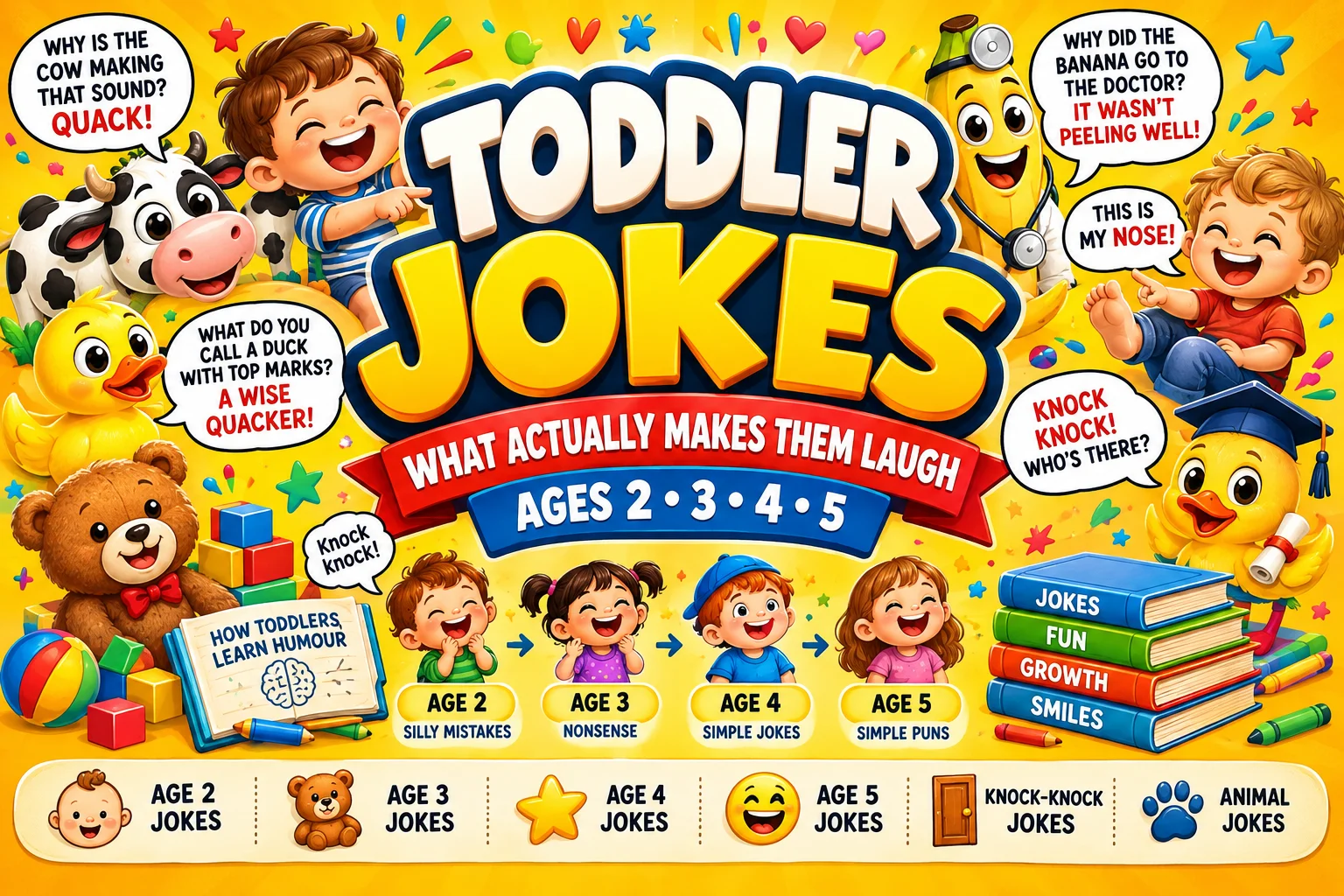
Most toddler joke lists give you fifty jokes and no idea which ones will work on your actual child. That matters more here than in any other joke category, because a two year old and a five year old find completely different things funny and the reason is developmental rather than a matter of taste. This page sorts the jokes by age, explains what researchers have found about when children start understanding humour, and answers the question every parent eventually asks why does my child’s knockknock joke make no sense at all?
What the Research Actually Says About Toddler Humour
There is proper science here, and it is more useful than any joke list. Researchers at the University of Bristol, led by Dr Elena Hoicka, built the Early Humour Survey the first tool to map how humour develops in the first four years of life. The study drew on nearly 700 children from birth to four years old, across the UK, US, Canada and Australia, and was published in Behavior Research Methods.
- The first study to map humour development month by month
- Involved nearly 700 children from birth to four years
- Data gathered across four English speaking countries
- Published in Behavior Research Methods in 2022
- Created a 20 item parent report measure covering ages 1 to 47 months
- Designed partly to inform early years education
They Joke More Than You Think
One finding is worth knowing before anything else. According to Hoicka, once children start producing humour, they are doing so roughly every three hours and she describes that as a conservative estimate, since parents may have missed instances or filled in the survey after bedtime.
- Children produce humour around once every three hours
- The researchers describe that figure as conservative
- Much of it is physical rather than verbal
- Most of it is invented rather than repeated
- They are practising, not performing
- Laughing at their attempts is more useful than correcting them
What Each Age Finds Funny
The study found a clear developmental sequence, and it maps almost exactly onto what parents notice.
- Oneyearolds tickling, chasing and funny bodily actions, reflecting motor development
- They also begin mislabelling objects and inventing words as jokes
- Twoyearolds misusing objects deliberately, saying strange things, inventing words
- Twoyearolds also discover taboo topics anything lavatorial is now comedy gold
- Three year olds playing with social rules, such as saying naughty words to be funny
- Threeyearolds show the first signs of understanding tricks and puns
- The study also found three year olds develop a mean streak, enjoying making fun of others
When Children Actually Get Puns
This is the finding that surprises most parents, and it explains a great deal. Hoicka has said children do not really understand knockknock jokes and puns until around the age of seven well beyond the toddler years. Everything before that is enthusiastic practice.
- Genuine pun comprehension arrives around age seven
- Toddlers attempt the format long before they understand it
- A threeyearold’s knockknock joke is rehearsal, not failure
- They are learning what lands and, gradually, why
- Correcting the structure removes the point of the exercise
- Laughing anyway is the developmentally useful response
Jokes for 2 Year Olds
At two, a joke is not a joke at all it is something obviously, deliberately wrong. The comedy is in the wrongness, and it has to be visible or audible. Nothing verbal will land yet.
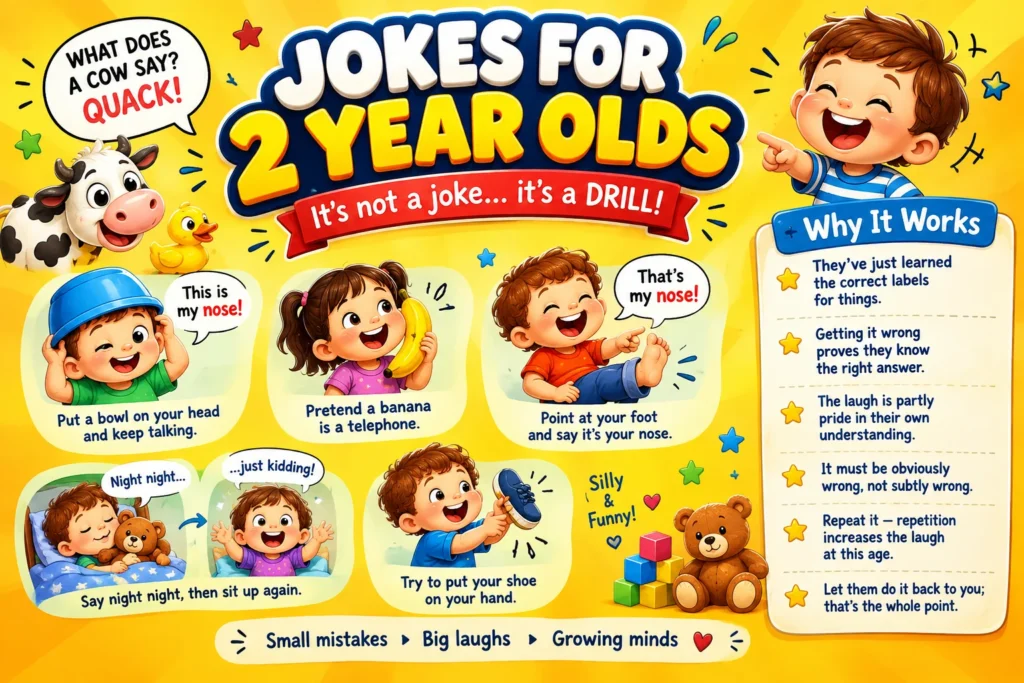
- Ask what a cow says, then answer quack yourself
- Point at your foot and announce that it is your nose
- Put a bowl on your head and carry on talking normally
- Pretend a banana is a telephone and have a serious conversation
- Ask where their nose is, then point at their elbow
- Try to put their shoe on your hand
- Say night night and then immediately sit up again
- Any word repeated in a silly voice will get a laugh
Why Deliberate Mistakes Work at This Age
A two year old has just worked out what things are called and what they are for. Getting it wrong on purpose is funny precisely because they now know better the joke is a small demonstration of their own knowledge, which is why they laugh so hard at it.
- They have just learned the correct labels for things
- Getting it wrong proves they know the right answer
- The laugh is partly pride in their own understanding
- It must be obviously wrong, not subtly wrong
- Repeat it repetition increases the laugh at this age
- Let them do it back to you; that is the whole point
Jokes for 3 Year Olds
Three is the age of naughty words, silly noises and the first attempted punchlines. They now understand that a joke is a kind of thing, even if they cannot build one yet.
- Knock knock. Who’s there? Cow. Cow who? Cows say moo, not who!
- What sound does a sleepy cow make? Moooozzzzzz.
- What’s a monkey’s favourite music? Anything with a good banana.
- Why did the teddy bear say no to pudding? He was already stuffed.
- What do you call a dog with no legs? It doesn’t matter, he won’t come anyway.
- What did one toe say to the other? Don’t look now, someone’s coming.
- Why did the biscuit cry? Because its mum was a wafer too long.
Jokes for 4 Year Olds
Four is where simple puns start to land, provided the double meaning uses words they already know well. Animals, food and body parts remain the safest territory.
- What do you call a duck that gets top marks? A wise quacker.
- What’s a cat’s favourite colour? Purrple.
- Why did the banana go to the doctor? It wasn’t peeling well.
- What has ears but cannot hear? A cornfield.
- Why did the picture go to jail? Because it was framed.
- What do you call a fish with no eyes? Fsh.
- Why can’t you give a snowman a balloon? He’d let it go and never catch it.
- What’s orange and sounds like a parrot? A carrot.
Jokes for 5 Year Olds
At five, most children can hold two meanings of a word in mind at once, which is when jokes start working the way adults expect. They will also want to tell them back to you, repeatedly, for weeks.
- Why did the maths book look so worried? It had a lot of problems.
- What do you call a bear caught in the rain? A drizzly bear.
- Why did the football team go to the bank? To get their quarter back.
- What’s a pirate’s favourite letter? Everyone says R, but he loves the C.
- Why did the scarecrow get a prize? He was the best in his field.
- What do you call cheese that isn’t yours? Nacho cheese.
- Why do bees have sticky hair? They use honeycombs.
- What kind of tree fits in your hand? A palm tree.
Toddler Knock Knock Jokes
This is the single biggest subsearch in the category, and it deserves a proper explanation as well as a list. Toddlers adore the format long before they can use it, because it involves turntaking and a guaranteed response from an adult.
- Knock knock. Who’s there? Boo. Boo who? Don’t cry, it’s only a joke.
- Knock knock. Who’s there? Lettuce. Lettuce who? Lettuce in, it’s cold out here.
- Knock knock. Who’s there? Cow says. Cow says who? No, a cow says moo.
- Knock knock. Who’s there? Banana. Banana who? Banana. Banana who? Orange. Orange who? Orange you glad I didn’t say banana?
- Knock knock. Who’s there? Tank. Tank who? You’re welcome.
- Knock knock. Who’s there? Spell. Spell who? WHO.
Why Your Toddler’s KnockKnock Joke Makes No Sense
Every parent hits this. Your child says knock knock, you say who’s there, and they say dog then laugh helplessly. It is not a failed joke. It is exactly what the research predicts, and it is genuinely good practice.
- They have grasped the shape of the format, not the mechanism
- The mechanism a pun in the final line arrives around age seven
- The turntaking is the part they are actually rehearsing
- Getting a guaranteed adult response is half the appeal
- Correcting the structure removes what they are learning
- Laughing is the useful response, even at knock knock dog
- They will produce hundreds of these before one accidentally works
Toddler Animal Jokes
Animals are the most reliable subject for this age group, because children already know the animal, the noise and usually a book about it.
- Why do cows wear bells? Their horns don’t work.
- What do you call a sleeping bull? A bulldozer.
- Where do sheep go for a haircut? The barber shop.
- What do you call a pig that does karate? A pork chop.
- Why don’t elephants use computers? They’re scared of the mouse.
- What time is it when an elephant sits on your fence? Time for a new fence.
- Why did the chicken join a band? It had the drumsticks.
Seasonal Toddler Jokes
Seasonal jokes get a much better reaction because the whole household is already talking about the same thing.
Halloween
- Why don’t skeletons ever fight? They don’t have the guts.
- What’s a ghost’s favourite pudding? I scream.
- What do you call a friendly monster? A paloween.
- Why was the little pumpkin so happy? It was feeling gourd.
Christmas
- What do snowmen have for breakfast? Snowflakes.
- Why was the snowman looking in the carrots? He was picking his nose.
- What do you call an elf who sings? A wrapper.
- Why did Santa go to school? To improve his homework.
Easter and Spring
- What do you call a rabbit that tells jokes? A funny bunny.
- How does the Easter Bunny travel? By hareplane.
- What’s a chick’s favourite subject? Eggsplaining things.
Thanksgiving and Valentine’s
- Why did the turkey join the band? It already had drumsticks.
- What did one strawberry say to the other? We’re in a jam now.
- What did the stamp say to the envelope? Stick with me and we’ll go places.
Simple Riddles for Toddlers
Riddles work from about four upwards, provided the answer is something concrete they can picture. Anything abstract will not land yet.
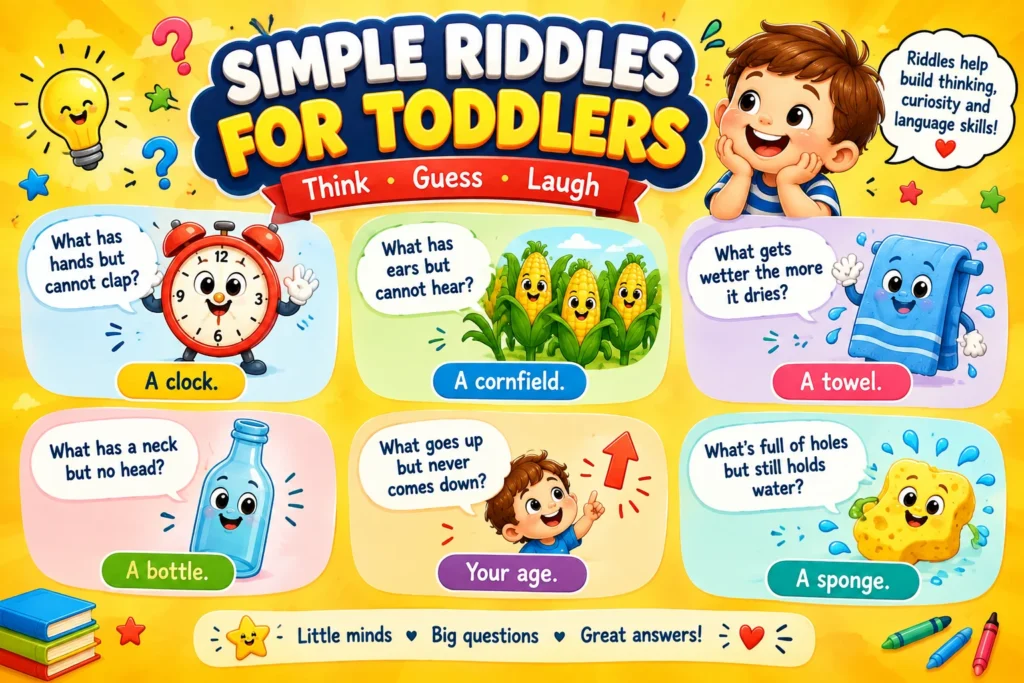
- What has hands but cannot clap? A clock.
- What has ears but cannot hear? A cornfield.
- What gets wetter the more it dries? A towel.
- What has a neck but no head? A bottle.
- What goes up but never comes down? Your age.
- What’s full of holes but still holds water? A sponge.
How to Tell a Joke to a Toddler
Delivery matters more here than with any other audience, because the child is reading your face far more than your words.
- Signal that it is a joke with your face and voice before the punchline
- Slow down much slower than feels natural
- Pause before the answer, then say it clearly
- Laugh first; they take their cue from you
- Repeat the same joke; repetition increases the laugh at this age
- Let them tell it back, badly, as many times as they want
- Never explain why it is funny that ends the game
- If it does not land, move on without comment
What Not to Do
A few things reliably backfire, and they are easy to avoid once named.
- Do not correct the structure of their attempted jokes
- Do not explain the pun; explanation removes the joke
- Do not tell jokes that require reading or spelling before school age
- Avoid anything that relies on sarcasm that arrives much later
- Avoid teasing that they cannot yet distinguish from criticism
- The research notes humour needs a positive setting; when it turns pushy, children read it as aggression rather than fun
Why Any of This Matters
Beyond the entertainment, there is a reason researchers built a tool to measure this at all. Humour in early childhood involves language, social rules, and understanding that another person can hold a different view of the same thing which is a substantial cognitive achievement. A child making a deliberate mistake to get a laugh is demonstrating that they know the correct answer and that they know you know it too.
- Joking requires knowing the right answer first
- It also requires understanding what the other person expects
- That is an early form of perspectivetaking
- Humour draws on language, social rules and emotional reading at once
- Researchers hope the survey may eventually help track development
- It is also one of the earliest ways children make an adult respond to them
Jump into Other Related Article
- April Fools’ Jokes | Ideas That Land, and How to Tell If Something Is a Prank
- Monthly Jokes: A Month Full of Laughs
- Dinosaur Jokes for Kids | 60+ Funny Ones They’ll Love
Conclusion
Toddler jokes work when they match the stage, not the child’s charm. At two, be obviously wrong about something and repeat it. At three, expect naughty words and nonsense punchlines. At four, simple puns about animals and food start landing. At five, they will tell you the same joke forty times and it will get slightly funnier each time for them and slightly less so for you. And when your three year old says knock knock dog and collapses laughing, remember that genuine pun comprehension does not arrive until around seven. They are not failing at the joke. They are practising it, roughly every three hours.
- Match the joke to the developmental stage, not to your taste
- Twoyearolds find deliberate, obvious mistakes hilarious
- Puns begin landing around four and are properly understood around seven
- Nonsense knockknock jokes are rehearsal, not failure
What jokes do 2 year olds find funny?
Not jokes as adults understand them. At two, the humour is in something being obviously and deliberately wrong saying a cow goes quack, putting a bowl on your head, or calling your foot your nose.
What jokes work for a 3 year old?
Silly noises, naughty words and attempted punchlines. Threeyearolds understand that a joke is a kind of thing and will start playing with social rules to get a laugh.
When do children understand puns?
Around age seven, according to Dr Elena Hoicka of the University of Bristol. Children attempt knockknock jokes and puns long before that, which is useful practice rather than a mistake.
Why does my toddler’s knock knock joke make no sense?
Because they have learned the shape of the format but not the mechanism. The turntaking is what they are practising, and a guaranteed adult response is most of the appeal.
How often do toddlers make jokes?
Research suggests that once children begin producing humour, they do so roughly every three hours and the researchers describe that as a conservative estimate.
What’s a good first joke for a toddler?
Knock knock. Who’s there? Cow. Cow who? Cows say moo, not who! It uses the format, an animal they know, and a punchline that does not require a pun.
Should I correct my child’s jokes?
No. Correcting the structure removes what they are actually practising. Laughing at knock knock dog is the more useful response.
What jokes should I avoid with toddlers?
Anything relying on sarcasm, reading or spelling, and any teasing they cannot distinguish from criticism. Research notes that humour needs a positive setting when it becomes pushy, young children read it as aggression.