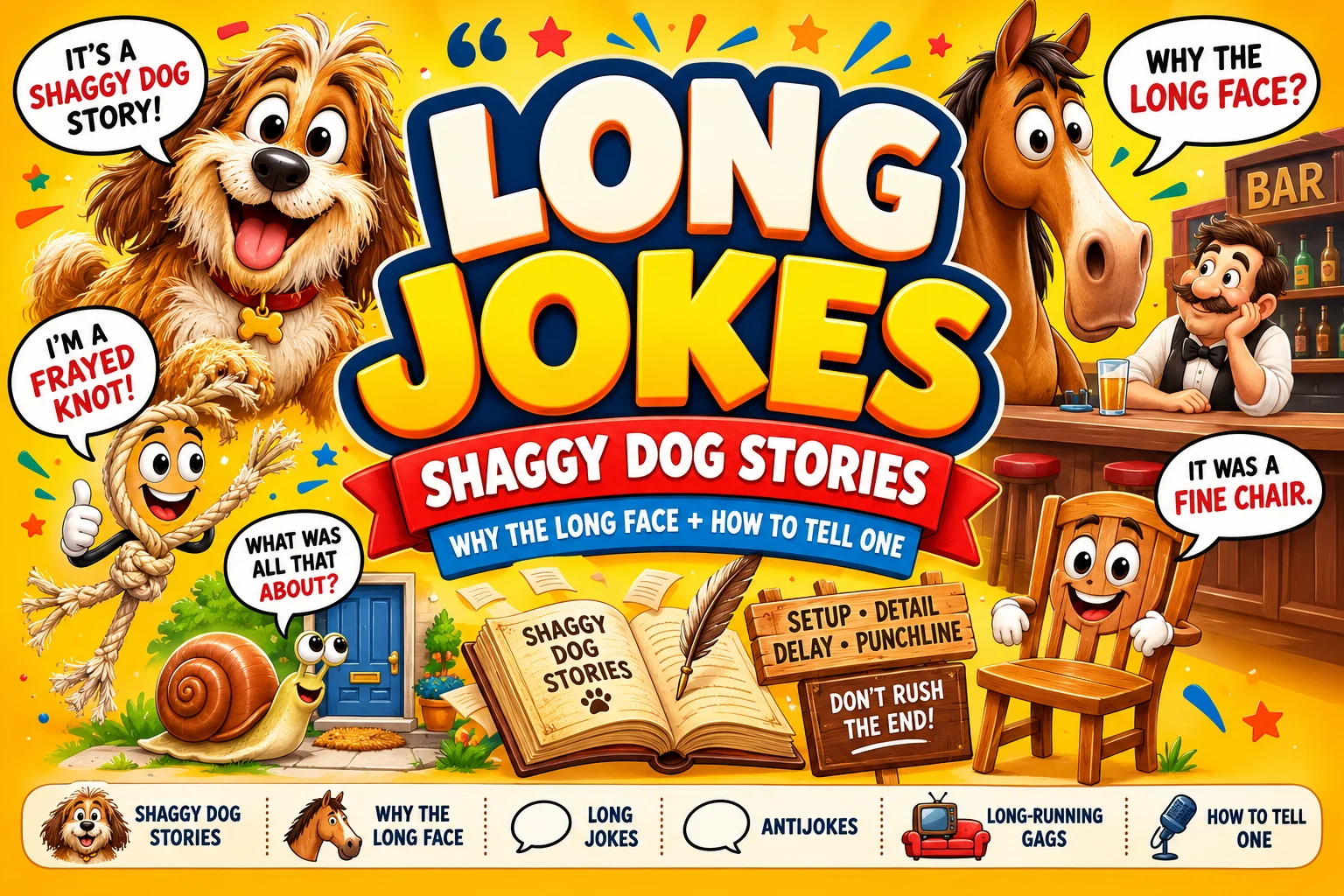
A long joke is a completely different craft from a oneliner. A oneliner either lands or it does not, and it costs the listener three seconds either way. A long joke asks for two or three minutes of somebody’s attention and then has to justify it which is why long jokes fail more spectacularly than any other kind, and why landing one feels so much better. This page has the best of them, explains the shaggy dog tradition properly, covers the why the long face joke and its extended version, and finishes with the delivery technique that actually matters.
What Makes a Long Joke Work?
A long joke works on investment. Every sentence you add increases what the listener has spent, and the payoff has to grow to match. That is the whole mechanism, and it explains both why long jokes are satisfying and why they are risky. A punchline that would be perfectly acceptable after ten seconds becomes an insult after three minutes. The best long jokes solve this in one of two ways either the payoff genuinely earns the buildup, or the buildup itself is funny enough that the payoff barely matters.
- The listener invests attention; the payoff must repay it
- A weak punchline after three minutes feels like a con
- The best ones make the journey funny, not just the destination
- Detail and digression are the point, not padding
- They require a captive audience a table, a car, a queue
- They cannot be rescued halfway through, so commit or don’t start
The Shaggy Dog Story Explained
The shaggy dog story is the purest longjoke form and it deserves its proper name. It is a joke built as an elaborate, detailed narrative that deliberately ends in an anticlimax a groanworthy pun, a flat nonanswer, or no real punchline at all. The joke is not the ending. The joke is that you sat through all of that for the ending. The form is named after an old story about an extraordinarily shaggy dog, and it has been a recognised comic genre for the best part of a century.
- A long narrative that ends deliberately in an anticlimax
- The disappointment is the payoff, not a failure of the joke
- Named after a classic story about a very shaggy dog
- Recognised as a distinct comic form for decades
- Works only on an audience that expects a proper punchline
- The teller’s straight face throughout is essential
Why the Long Face? The Joke and Its Long Version
This is the most searched long joke phrase, and the original is not long at all. A horse walks into a bar and the bartender says why the long face? That is it. Six words of setup and a fiveword punchline, working on the double meaning of a long face as both a literal description of a horse and an expression of sadness.
- The original a horse walks into a bar; the bartender asks why the long face
- It works on two meanings of long face at once
- The whole joke is under fifteen words
- It is one of the most widely known jokes in English
- Its brevity is exactly why an extended version exists
The Extended Version
Because the original is so well known, the long version inverts it. The horse walks in, the bartender asks why the long face, and the horse answers seriously at length. The stable has flooded. The vet bills have doubled. The foal wants to study dressage and has no idea what that costs. The mortgage on the paddock is up for renewal. The bartender listens patiently through all of it, nodding, refilling the drink, and when the horse finally stops the bartender leans in and says right, but why the long face? And the horse says it’s genetic. That was never the question.
- The extended version works because the short one is so familiar
- The horse takes the question literally seriously
- The comedy is in the bartender’s patience and the return to the pun
- It only lands if the audience already knows the original
- This is how most extended versions of famous jokes are built
Best Long Jokes and Shaggy Dog Stories
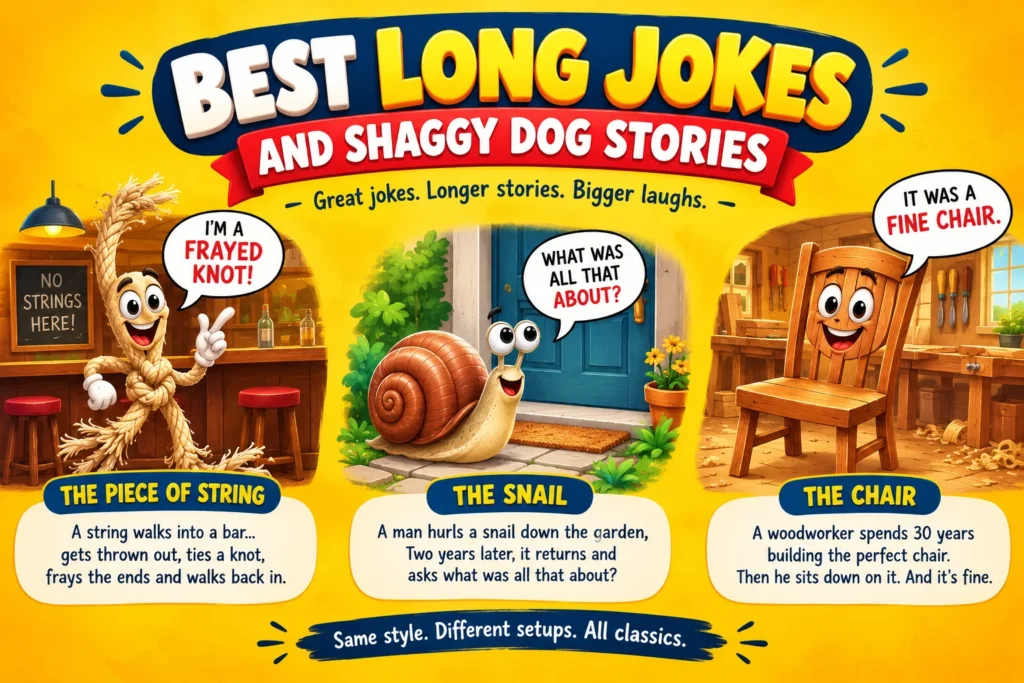
These are the classics of the form, kept as tight as they can be without losing what makes them work. Read the setup slowly and resist the urge to rush toward the ending.
The Piece of String
A piece of string walks into a bar. The bartender says they don’t serve string, and throws him out. The string thinks about this, ties himself into a tight knot, rubs the ends against the pavement until they fray, and walks back in. The bartender squints at him and asks aren’t you that piece of string? The string says no, I’m a frayed knot.
The Snail
A man hears a knock at his front door. He opens it and finds a snail on the step. He picks it up and hurls it as far as he can down the garden. Two years later, another knock. He opens the door. The same snail. It looks up at him and says what was all that about?
The Chair
A woodworker spent thirty years building the perfect chair. He selected the timber for four years. He dried it for six. He designed the joints, rejected them, and designed them again. He carved, sanded, oiled and polished. On the day it was finished he set it in the middle of his workshop, stood back, and looked at what three decades had produced. Then he sat down on it. And it was fine. It was a fine chair.
- The string joke ends in a pun and is the best known of the three
- The snail joke’s comedy is entirely in the two year delay
- The chair is a pure shaggy dog the anticlimax is the point
- All three require the teller to keep an absolutely straight face
- Never signal that the ending is coming
Long Jokes With No Punchline
A specific search asks for long jokes with no punchline, and that is a real and deliberate category rather than a mistake. These are antijokes; they use the full architecture of a long joke and then simply stop. They only work on people who know how a joke is supposed to end, because the entire effect depends on an expectation being built and then abandoned.
- Antijokes use the full structure and refuse the payoff
- The audience’s expectation is the material
- They fail completely on anyone unfamiliar with the form
- Delivery must be identical to a real joke throughout
- Never explain that it was intentional that kills it
- The chair story above is one; the anticlimax is the joke
Short Riddles About Long Things
Not everything in this search is a long joke, a good portion is short jokes about long things, and those have fixed answers people are trying to remember.
- Why do giraffes have long necks? Because their feet smell.
- How long does an owl live? Owl live forever.
- Why are daddy long legs called that? Nobody has ever asked about the rest of the family.
- What do trees say after a long winter? What a relief.
- How long is a piece of string? Twice the distance from the middle to the end.
- What’s the longest word in the dictionary? Smiles there’s a mile between the first and last letters.
- How long should you microwave fish at work? Never. This is not a joke.
How to Tell a Long Joke Without Losing the Room
Delivery matters more here than in any other format, because you are asking for something a oneliner never asks for time. The rules below are the difference between a story people enjoy and one they endure.
- Read the room first long jokes need a captive, relaxed audience
- Never announce it as a long joke; that starts a clock in their heads
- Commit fully from the first sentence, with no hedging
- Add specific detail vague detail feels like padding, specific detail is funny
- Keep the pace steady; do not speed up as you approach the end
- Never explain a detail you have already given
- Deliver the anticlimax exactly as flatly as everything before it
- If someone interrupts with the ending, let them have it and move on
- Never tell two long jokes in a row to the same people
- If it dies, do not defend it that doubles the damage
Why Just Get to the Point Is the Real Risk
The failure mode of a long joke is not a bad punchline. It is the moment somebody stops listening and starts waiting, because from that point nothing you say can recover them. That moment usually arrives when the detail becomes repetitive rather than escalating. Each new element must add something new, a fresh absurdity, a new complication not simply more of the same.
- Listeners stop listening the moment detail stops escalating
- Repetition feels like padding; escalation feels like craft
- Once someone is waiting rather than listening, they are gone
- Watch faces, not the ceiling, while you tell it
- Cut ruthlessly if you feel the room drifting
LongRunning Jokes The Simpsons Opening
A separate group of searches asks about longrunning jokes rather than long jokes, and the most searched example is the opening sequence of The Simpsons. It contains several gags that have run for decades and change every episode Bart writing lines on the classroom blackboard, Lisa’s saxophone solo, Maggie being scanned at the supermarket checkout, and above all the couch gag, where the family arrives at the sofa to find something different every time. The joke is not any individual version. The joke is that it has never once repeated the same way for that long.
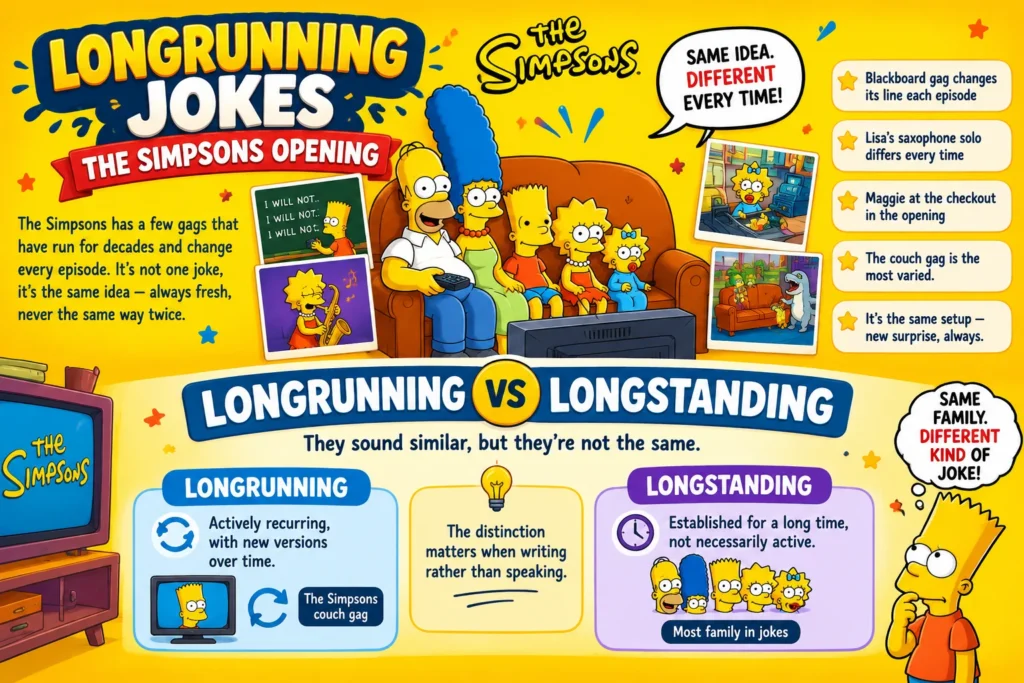
- The blackboard gag changes its punishment line each episode
- Lisa’s saxophone solo differs every time
- Maggie is scanned at the checkout in the opening
- The couch gag is the best known and most varied
- The humour comes from the sheer duration of the commitment
- Some couch gags have run longer than the episodes’ cold opens
LongRunning vs LongStanding
These two phrases get mixed up constantly, and they mean slightly different things. A longrunning joke is one that keeps being performed it recurs, it gets new versions, it is active. A longstanding joke is one that has simply existed for a long time within a group, whether or not anyone still tells it. Most family inj okes are longstanding; the Simpsons couch gag is longrunning.
- Longrunning actively recurring, with new versions over time
- Longstanding established for a long time, not necessarily active
- Family in jokes are usually longstanding
- Television running gags are longrunning
- The distinction matters when writing rather than speaking
How Long Is…? Searches That Aren’t Jokes
A number of searches in this area are people asking about duration rather than looking for humour, and it is worth separating them out.
- Questions about a film’s runtime that happen to have joke in the title
- Questions about the length of comedy specials or festival shows
- Questions about how long a species actually lives, minus the pun
- Idiom questions about what a running joke or in joke means
- Grammar and phonics questions that happen to contain the word
Is Joke a Long or Short Vowel?
This one is a genuine phonics question rather than a joke, and it turns up often enough to answer. Joke contains a long O. The word follows the split digraph pattern a vowel, a consonant, then a silent E where the final E makes the earlier vowel say its own name. Compare it with jok without the E, which would take a short O sound.
- Joke contains a long O sound
- The silent E at the end creates the long vowel
- This is the split digraph or magic E pattern
- Compare hop and hope, not and note, rob and robe
- The E is never pronounced; it only changes the vowel
Jump into Other Related Article
- Food Jokes: Deliciously Funny Jokes That Will Make You Hungry
- Monthly Jokes: A Month Full of Laughs
- Weekly Jokes: A Funny Joke for Every Day of the Week
- Funny Jokes That Will Make You Laugh
- Animal Jokes: Funny Animal Jokes That Will Make You Laugh
Conclusion
A long joke is the only kind of joke that can genuinely waste somebody’s time, which is exactly why a good one is worth so much more than a good one liner. Learn the string joke for a general audience, the snail for anyone who appreciates a delay, and the extended why the long face for people who already know the short version. Then remember the two rules that matter more than the material never announce that a long joke is coming, and deliver the anticlimax exactly as flatly as everything that preceded it. The moment you signal that a payoff is due, you have promised something the form is designed not to deliver.
- The listener’s invested attention is the whole mechanism
- Shaggy dog stories end in anticlimax by design
- Escalating detail holds a room; repeated detail loses it
- Never announce a long joke before telling it
What is the why the long face joke?
A horse walks into a bar and the bartender asks why the long face. It works on two meanings at once a horse’s literal long face and the expression for looking miserable.
What is a shaggy dog story?
A long, detailed joke that deliberately ends in an anticlimax rather than a strong punchline. The disappointment is the intended payoff, and the form has been recognised for decades.
What is a good long joke to tell?
The piece of string, which ends in a pun, and the snail, which turns entirely on a two year delay. Both are short enough to remember and long enough to count.
Why do giraffes have long necks?
Because their feet smell. It is a short joke about a long thing, and one of the most searched in this group.
What is the long running joke in The Simpsons opening?
Several Bart’s blackboard lines, Lisa’s saxophone solo, Maggie at the checkout, and the couch gag, which has arrived differently in almost every episode for decades.
Is a joke a long or short vowel?
Long. The silent E at the end creates the long O sound, following the split digraph pattern seen in hop and hope, or not and note.
What’s the difference between a longrunning and a longstanding joke?
A longrunning joke actively recurs with new versions over time. A longstanding joke has simply existed within a group for a long while, whether or not anyone still tells it.