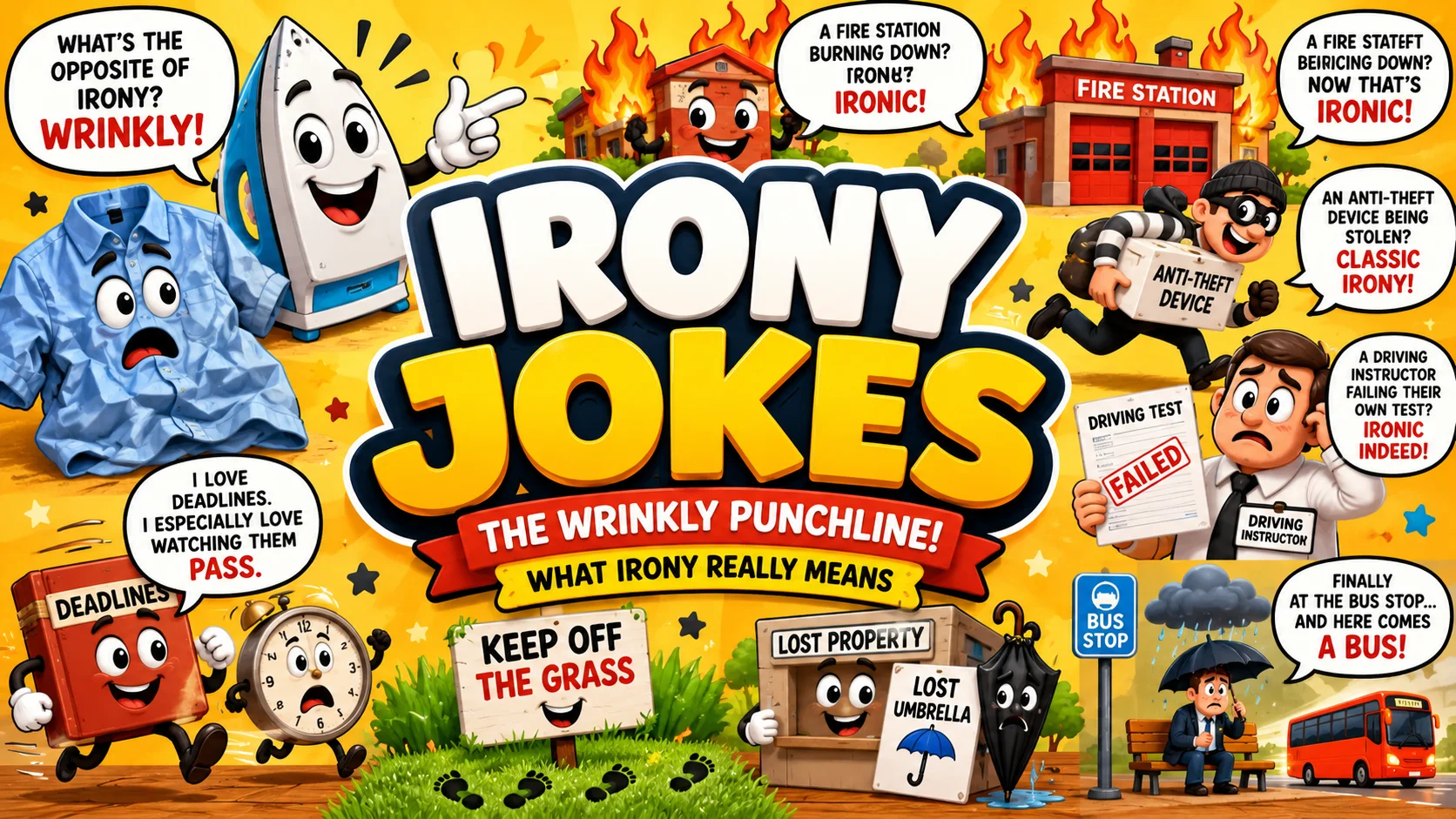
Two different groups arrive at this page. One wants the joke specifically the one about the opposite of irony, which has a fixed and very satisfying answer. The other wants to know what irony actually means, because they suspect they have been using the word wrong for years. Both are covered here, along with genuinely irony jokes, and an honest look at the most famous argument in the English language about whether something counts as irony at all.
What’s the Opposite of Irony?
Wrinkly. That is the joke, and it is one of the bestconstructed puns in English because it works on two completely separate levels at once. Irony sounds like irony, meaning full of iron or resembling iron, and an iron is the device that removes wrinkles. The punchline is therefore the opposite of ironed rather than the opposite of irony, and the listener has to travel through both meanings to get there.
- Q What’s the opposite of irony? A Wrinkly.
- It works on irony heard as irony
- An iron removes wrinkles, so wrinkly is the opposite of ironed
- The joke deliberately answers a different question than the one asked
- That misdirection is what makes it satisfying rather than groanworthy
- It is, appropriately, not itself an example of irony
What Irony Actually Means
This is the part people genuinely want, because irony is one of the most misused words in English the linguist Steven Pinker has said as much directly. The confusion is understandable, because there are several distinct types and they behave differently.
Verbal Irony
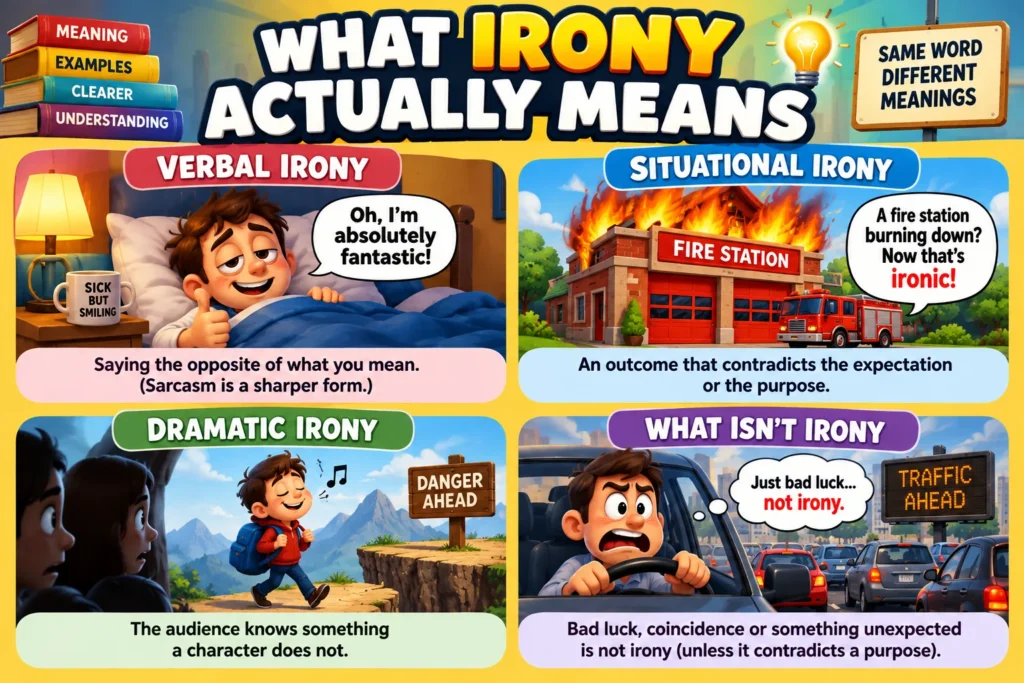
Saying the opposite of what you mean, and relying on the listener to recognise it. If you are lying in bed feeling awful and someone asks how you are, answering absolutely fantastic is verbal irony. Sarcasm is a subtype of this sharper, and usually aimed at someone.
- Saying the opposite of what you actually mean
- Depends entirely on the listener recognising the gap
- Sarcasm is a pointed subtype of verbal irony
- Tone usually carries the signal, which is why it fails in text
- This is what most people mean when they say irony
Situational Irony
An outcome that is strikingly at odds with what was expected or intended. A fire station burning down. An antitheft device being stolen. A driving instructor failing their own test. The key is that the outcome contradicts the purpose, not merely the preference.
- An outcome that contradicts the expectation or the purpose
- A fire station catching fire is the textbook example
- The contradiction must be structural, not just unlucky
- This is the type most arguments are about
Dramatic Irony
The audience knows something a character does not. It is the engine of almost every thriller and most tragedies, and it produces tension rather than laughter you watch someone walk toward something you can see and they cannot.
- The audience knows what the character does not
- Produces tension rather than humour
- Drives most thrillers, horror and tragedy
- Not usable in conversation it requires an audience and a story
What Isn’t Irony
This is the part that causes all the trouble. Bad luck is not irony. Coincidence is not irony. Something merely being unexpected is not irony. A traffic jam when you are late is unfortunate; it becomes ironic only if you were speeding to a road safety lecture.
- Bad luck alone is not irony
- Coincidence alone is not irony
- Surprise alone is not irony
- The outcome must contradict a purpose or expectation, not just annoy you
- Add a purpose to any misfortune and it usually becomes ironic
The Alanis Morissette Argument
No discussion of irony survives ten minutes without this, so it is worth handling properly rather than repeating the usual verdict. Morissette’s 1996 single Ironic, from the album Jagged Little Pill, lists a series of situations and asks whether they are ironic. The standard criticism is that almost none of them are rain on a wedding day, a traffic jam when you are late, a free ride when you have already paid. Those are unfortunate, the argument goes, not ironic.
- The song lists situations and asks if they are ironic
- The common criticism is that most are simply unfortunate
- It has become the standard punchline in any irony discussion
- The debate is now nearly as famous as the song
- Weird Al referenced it directly in Word Crimes
The One Line Nobody Disputes
There is a genuine example in the song, and it is the plane crash line a man afraid of flying who, as the aircraft goes down, thinks that this is nice. That is verbal irony, specifically sarcasm, and Songfacts identifies it as the one unambiguously ironic statement in the lyrics.
- The plane crash line is genuine verbal irony
- The character means the opposite of what he thinks
- It is sarcasm, which is a recognised form of irony
- Critics who say nothing in the song is ironic are overstating
The Counterargument Everyone Skips
Here is where the standard verdict gets shakier. The Oxford English Dictionary includes a definition of irony as a state of affairs seemingly contrary to what was expected, with an outcome cruelly or strangely at odds with assumptions. As Salon argued, that definition covers most of the song’s examples perfectly well this is situational irony, and by the dictionary’s own account, Morissette was largely right. The critics were applying only the verbal definition.
- The OED recognises situational irony explicitly
- That definition covers most of the song’s examples
- Critics were applying only the verbalirony definition
- The man who won the lottery and died the next day fits it cleanly
- Dictionaries record usage; usage has changed
- The consensus that she was wrong is itself contested
What Morissette Has Said
She has handled the whole thing with more grace than her critics. Asked by The Times in June 2008 whether she had worked out the meaning of irony, she said she had but noted that dictionaries now include coincidence and bad luck too, and described herself as the smartest stupid person you will ever meet. In 2015 she performed an updated version on television with a line acknowledging the irony of singing Ironic when there are no ironies in it.
- She has openly acknowledged the criticism for decades
- She has also pointed out that dictionaries include broader senses
- A 2015 televised update included a selfaware line about it
- She has described herself as obsessed with linguistics
- Taking the joke well is arguably the most ironic outcome available
Genuinely Ironic Jokes
These are jokes where the irony is real rather than claimed. Each depends on an outcome contradicting a purpose, which is what separates them from coincidence.
- A fire station burning down.
- The antitheft device that got stolen from outside the shop.
- A keep off the grass sign you can only read by walking on the grass.
- The book on procrastination that arrived three weeks late.
- A driving instructor who failed their own test.
- The spelling bee whose winning word was misspell.
- A lost property office that lost the umbrella.
- The selfhelp section is at the back, so you have to ask for help finding it.
- A gym with a broken lift, so everyone takes the stairs as intended.
- A nosmoking sign that has been burned.
Ironic OneLiners
Shorter, drier and usable in conversation. These lean on verbal irony rather than situational, so delivery carries most of the weight.
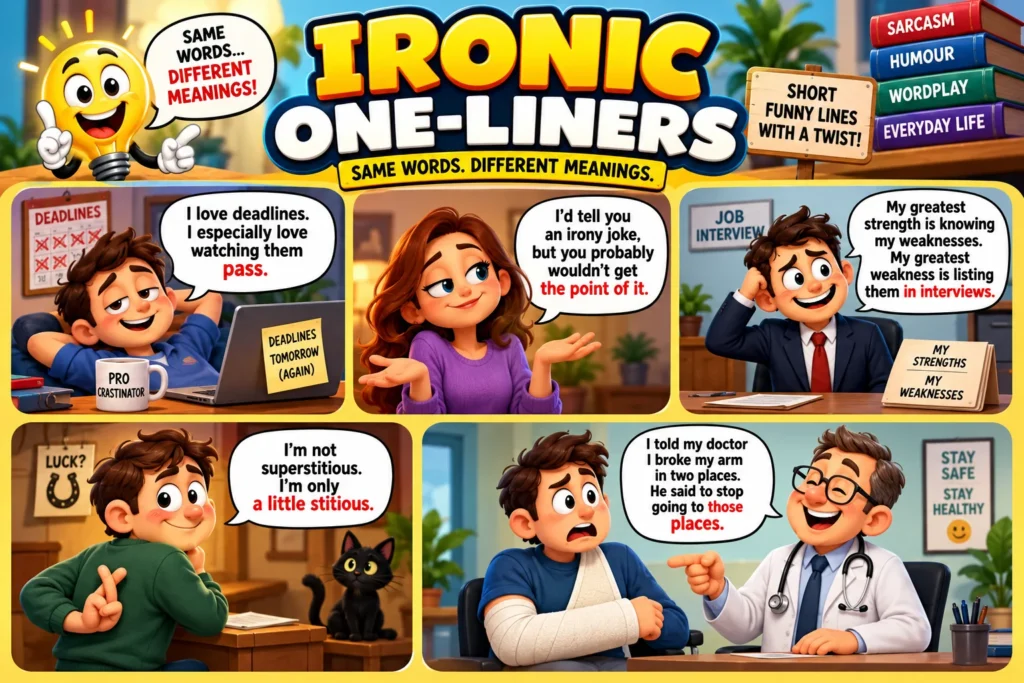
- I love deadlines. I especially love watching them pass.
- I’d tell you an irony joke, but you probably wouldn’t get the point of it.
- My greatest strength is knowing my weaknesses. My greatest weakness is listing them in interviews.
- I always finish what I st
- I’m not superstitious. I’m only a little stitious.
- I told my doctor I broke my arm in two places. He said to stop going to those places.
Why Irony Fails in Writing
There is a practical reason irony causes more arguments than any other comic device, and it explains why the internet is full of people accusing each other of not getting jokes. Verbal irony is carried almost entirely by tone. Strip out the voice, the face and the timing, and there is nothing left to signal that you meant the opposite which is exactly what happens in text.
- Verbal irony is carried by tone, which text removes
- Without vocal signals, the reader takes the words at face value
- This is why sarcasm marks and emoji exist at all
- Written irony needs shared context to survive
- Strangers online have no context, so it fails constantly
- Situational irony survives writing; verbal irony frequently does not
The Bus Stop Joke
A specific search asks for a bus stop irony joke to be explained, and honesty is more useful here than invention several versions circulate and none is canonical. The common thread is a situation at a bus stop where the outcome contradicts the purpose of waiting there which is situational irony rather than a pun with a fixed punchline.
There is also a lesson in the search itself. A joke that sends people looking for an explanation has usually already failed, because irony that needs explaining is indistinguishable from a plain statement. That is the risk the entire device carries.
- Multiple versions circulate with no canonical original
- The common structure is situational irony at a bus stop
- A joke requiring an explanation has generally failed
- Explained irony stops functioning as irony
- If you cannot find one version everyone agrees on, there isn’t one
Jump into Other Related Article
- Food Jokes: Deliciously Funny Jokes That Will Make You Hungry
- Joke of the Day | 50+ Funny Jokes for Every Mood
- Dad Jokes | 60+ Funny, Corny OneLiners (Plus Their Surprising History)
- April Fools’ Jokes | Ideas That Land, and How to Tell If Something Is a Prank
Conclusion
The opposite of irony is wrinkly, and that joke works precisely because it refuses to answer the question it was asked. Everything else on this page is about a genuine confusion irony has several types, most arguments about it involve people using different definitions, and the most famous accusation of misusing the word turns out to be considerably weaker than its reputation. If you want one rule to carry away, use this bad luck plus a contradicted purpose equals irony. Bad luck on its own is just a Tuesday.
- The opposite of irony is wrinkly the joke misdirects deliberately
- Verbal, situational and dramatic irony behave differently
- The Alanis criticism applies only one definition of three
- Bad luck plus a contradicted purpose is the working test
What’s the opposite of irony?
Wrinkly. The joke works because irony sounds like irony, and an iron removes wrinkles so the punchline answers a different question than the one asked.
What does irony actually mean?
It has three main forms. Verbal irony is saying the opposite of what you mean. Situational irony is an outcome that contradicts its purpose. Dramatic irony is the audience knowing something a character does not.
Is bad luck the same as irony?
No. Bad luck alone is just misfortune. It becomes ironic when the outcome contradicts a purpose or expectation a traffic jam is bad luck, but a traffic jam on the way to a road safety lecture is ironic.
Is Alanis Morissette’s Ironic actually ironic?
More than its reputation suggests. The plane crash line is genuine verbal irony, and the Oxford English Dictionary’s definition of situational irony covers most of the other examples. Critics applying only the verbal definition overstated the case.
What is a genuinely ironic joke?
One where an outcome contradicts a purpose a fire station burning down, an antitheft device being stolen, or a book on procrastination arriving late.
Why does irony fail so often in writing?
Because verbal irony is carried by tone. Remove the voice and the face and nothing signals that you meant the opposite, which is why online arguments about irony never end.
What is the bus stop irony joke?
Several versions circulate and none is canonical. The shared structure is situational irony at a bus stop. A joke that requires an explanation has usually already failed, which is a risk irony carries generally.