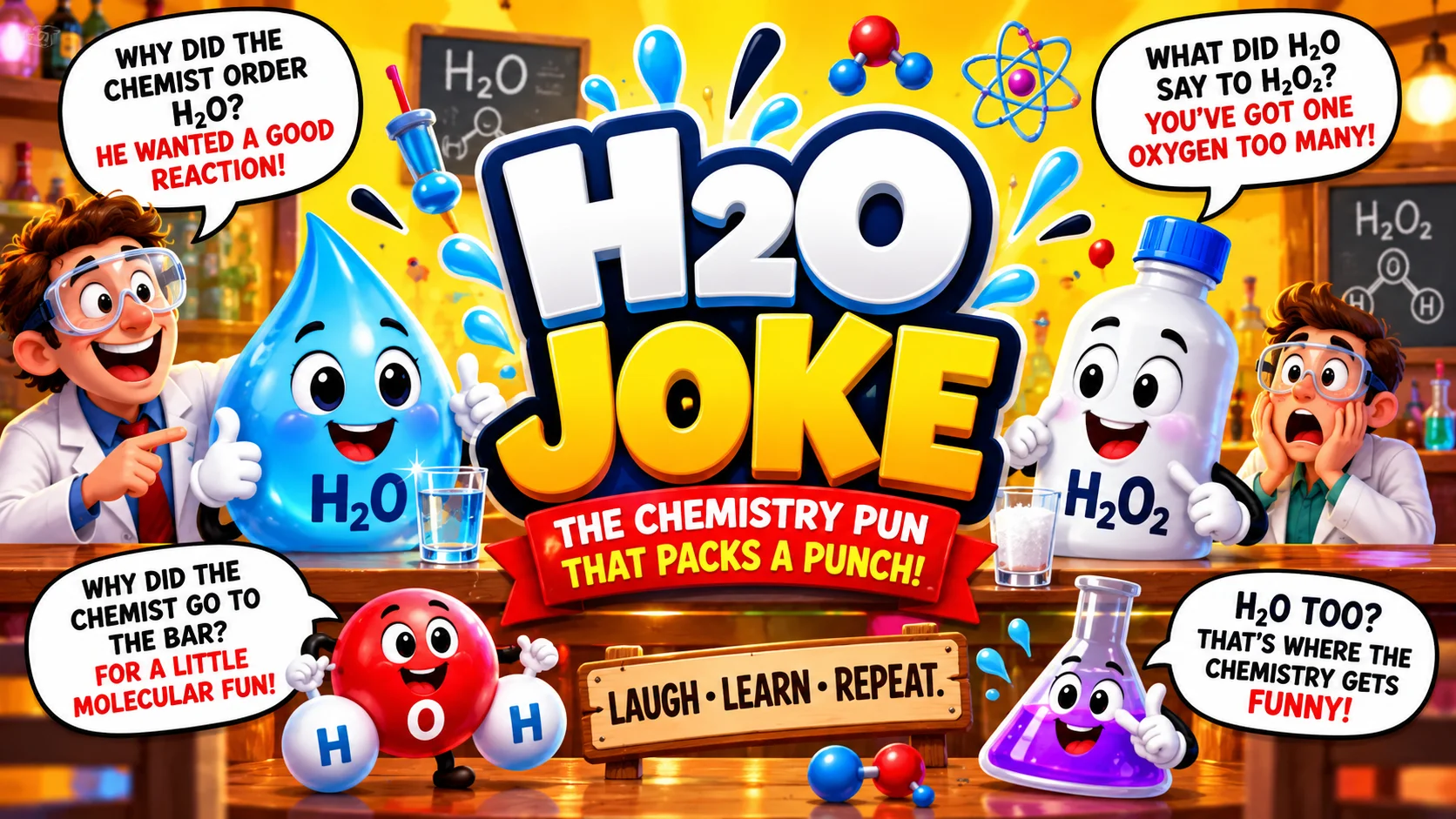
The H202 joke is a classic chemistry joke built around a tiny change in a chemical formula. The joke usually begins with two people walking into a bar. The first person orders H₂O, meaning water. The second says, I’ll have H₂O too. The punchline is that the bartender supposedly interprets H₂O too as H₂O₂, the chemical formula for hydrogen peroxide, and the second person dies after drinking it. The joke has circulated in print and online for years, including documented versions dating back to at least the mid-2000s.
The reason this joke can be confusing is that the written version depends on hearing H₂O too and mentally turning the word too into the number two. Chemically, H₂O is water, while H₂O₂ is hydrogen peroxide. They are different substances with different properties. PubChem identifies hydrogen peroxide as H₂O₂ and notes that it is an unstable, powerful oxidizing agent, so it certainly should not be treated as an ordinary beverage.
What Is the H202 Joke?
The H202 joke is usually written online without proper chemical subscripts as H202, although the intended formulas are normally H₂O and H₂O₂. The classic joke is a chemistry pun rather than a realistic description of what would happen in an ordinary bar.
The setup depends on the second person’s sentence: I’ll have H₂O too. Spoken aloud, H₂O too can be interpreted as H₂O two, which resembles the formula H₂O₂. The punchline then assumes that the bartender serves hydrogen peroxide instead of water.
The joke is effective because the difference between the two formulas is visually tiny. Adding one more oxygen atom changes H₂O into H₂O₂, but chemically that creates a completely different substance.
Classic H2O Bar Joke
- Two men walk into a bar. The first says, I’ll have some H₂O.
- The second says, I’ll have H₂O too.
- The bartender serves them their drinks.
- The first man drinks his water.
- The second man drinks his drink and dies.
- Why? The bartender interpreted H₂O too as H₂O₂, hydrogen peroxide.
- One man ordered water; the other accidentally sounded like he ordered hydrogen peroxide.
- The entire joke depends on the difference between H₂O and H₂O₂.
- A chemist walks into a bar and asks for H₂O.
- His friend says, I’ll have H₂O too.
- The bartender hears H₂O two and thinks the second customer wants H₂O₂.
- The first glass contains water.
- The second glass supposedly contains hydrogen peroxide.
- The chemistry mistake becomes the punchline.
- The joke ends with the classic line: The second man dies.
- The humor comes from chemistry plus the English sound of too and two.
Jump into Other Related Article
- Potato Jokes | 90+ Puns, Riddles and Dad Jokes with Answers
- Come On Eileen Joke | Meaning, Radio Joke, Examples, and Funny Variations
- Chicken Because Joke | Meaning, Punchline, Viral Kid Joke, and Funny Chicken Variations
H2O Joke Explained
The H2O joke is easier to understand when the chemical formulas are written correctly.
H₂O = water.
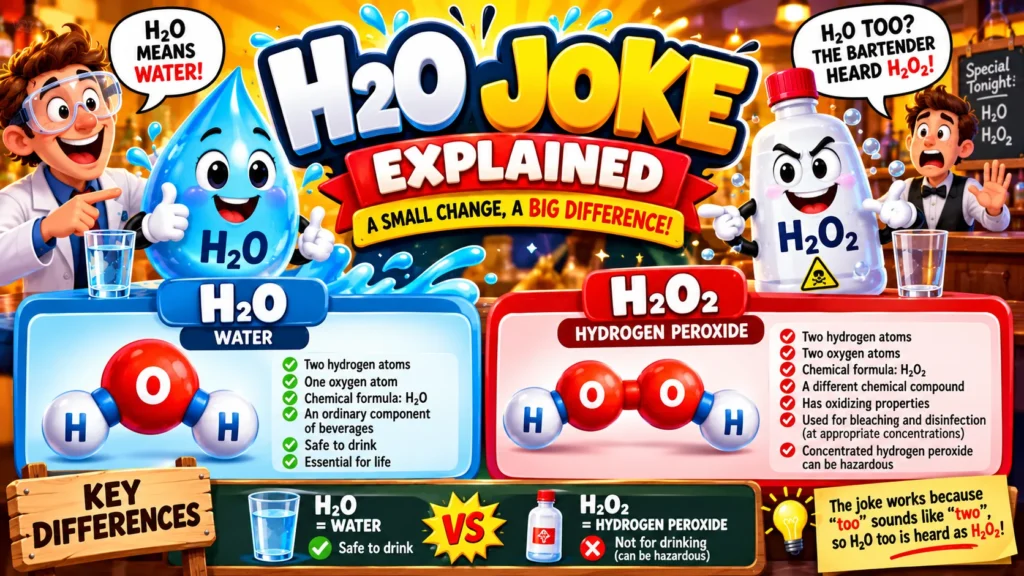
The small 2 after H means there are two hydrogen atoms. The O represents one oxygen atom. Water is therefore made from two hydrogen atoms and one oxygen atom.
The second formula is:
H₂O₂ = hydrogen peroxide.
Here, there are two hydrogen atoms and two oxygen atoms. That extra oxygen atom changes the compound. The classic joke uses this difference to create a deliberately disastrous misunderstanding. Hydrogen peroxide is not simply water with a little extra oxygen in the everyday sense; it is a distinct chemical compound. PubChem lists its molecular formula as H₂O₂ and describes it as a powerful oxidizing agent.
H2O vs. H2O2
- H₂O is the chemical formula for water.
- H₂O₂ is the chemical formula for hydrogen peroxide.
- H₂O contains two hydrogen atoms.
- H₂O contains one oxygen atom.
- H₂O₂ contains two hydrogen atoms.
- H₂O₂ contains two oxygen atoms.
- H₂O and H₂O₂ are different chemical compounds.
- The extra oxygen changes the substance’s chemistry.
- Water is an ordinary component of beverages.
- Hydrogen peroxide has oxidizing properties.
- Hydrogen peroxide is used in various applications, including bleaching and disinfection at appropriate concentrations.
- Concentrated hydrogen peroxide can be hazardous.
- The joke pretends that a bartender mistakes one formula for the other.
- The mistake creates the dark punchline.
- The chemistry is what makes the wordplay recognizable.
H2O H202 Joke Meaning
The H20 H202 joke search often contains a typography problem. When people type H20, they frequently mean H₂O, but technically the final character should be the letter O, not the number 0.
So there are three visually similar forms worth separating:
H₂O → water
H₂O₂ → hydrogen peroxide
H20 → commonly typed shorthand for H₂O, but technically uses zero instead of the letter O
The same issue happens with H202. When written without subscripts, people may intend H₂O₂, but 0 and O are different characters. In a chemistry article, H₂O₂ is the clearest form.
H20 and H202 Joke Terms
- H₂O means water.
- H₂O₂ means hydrogen peroxide.
- H20 is often an informal typing error for H₂O.
- H202 is often an informal typing error for H₂O₂.
- The letter O represents oxygen in the formula.
- The number 2 after H means two hydrogen atoms.
- The number 2 after O means two oxygen atoms.
- Changing the subscript changes the formula.
- H₂O has one oxygen atom per molecule.
- H₂O₂ has two oxygen atoms per molecule.
- The joke relies on adding that second oxygen.
- Too supplies the sound of two.
- H₂O too therefore sounds like H₂O two.
- H₂O two can visually suggest H₂O₂.
- That wordplay produces the punchline.
H202 Bar Joke
The H202 bar joke is really the famous H₂O/H₂O₂ bar joke. The bar setting is useful because ordering a drink is a normal situation. The first customer can request water using its chemical formula, and the second can make the wordplay happen by adding too.
The joke is usually told with scientists, chemists, or simply two men. Making them chemists is not strictly necessary, but it gives the setup a scientific context and makes the formula-based order seem more natural.
A well-documented version uses the wording Two men walk into a bar. One man orders H2O. The other says, ‘I’ll have H2O too.’ The second man dies. The documented explanation is that the second man supposedly received H₂O₂ instead of H₂O.
Funny H202 Bar Joke Variations
- Two chemists walk into a bar. One orders H₂O. The other orders H₂O too. The bartender takes the pun literally.
- Two scientists order drinks using chemical formulas. One gets water; the other gets a chemistry lesson.
- A chemist orders H₂O. His friend says, I’ll have H₂O too. The bartender says, I know exactly what you mean.
- Two chemists sit at the bar. One asks for H₂O. The other asks for H₂O too. The bartender reaches for the wrong bottle.
- One scientist orders H₂O. His friend adds too. Suddenly the bartender thinks the chemistry has changed.
- Two chemists walk into a bar and immediately turn beverage ordering into a molecular problem.
- The first scientist says, H₂O. The second says, H₂O too. The bartender says, That’s one way to make an order complicated.
- A chemist orders water scientifically. His friend copies him and accidentally creates the punchline.
- The bartender hears H₂O two and starts thinking about oxygen atoms.
- Two scientists order drinks, but only one remembers that chemistry jokes have consequences.
- One chemist orders H₂O. The second adds too. The bartender reaches for the chemistry shelf.
- The first man gets water. The second gets the joke.
- A chemistry student orders H₂O. His professor orders H₂O too. The bartender starts sweating.
- The bar has one rule: never let chemistry students place complicated drink orders.
- Two chemists walk into a bar and discover that pronunciation can be dangerous.
H20 and H202 Joke Explained
The H20 and H202 joke is often searched with zeroes because ordinary keyboards make it easier to type formulas without subscripts. However, when explaining the joke, proper notation makes the chemistry much clearer.
The intended contrast is not really H20 versus H202. It is H₂O versus H₂O₂.
The first is water. The second is hydrogen peroxide. The joke turns the English word too into the numerical idea of two. This is why the punchline works better when spoken aloud than when written plainly.
The joke also depends on the audience knowing at least one basic chemistry fact: H₂O is water. Someone who has never encountered the formula may not immediately understand why adding another oxygen creates the punchline.
Why the H2O H2O2 Joke Works
- H₂O is a familiar chemical formula.
- H₂O₂ looks very similar.
- Only one extra oxygen atom separates the formulas.
- Too sounds like two.
- H₂O too creates the sound-based connection.
- The bar setting makes drink ordering believable.
- Chemistry students recognize the formulas quickly.
- The punchline depends on a sudden change in meaning.
- The audience first expects ordinary water.
- The second order sounds almost identical.
- The chemical formula provides the hidden joke.
- The death punchline adds dark humor.
- The formula itself acts as the setup.
- No long story is necessary.
- The joke can be understood in a few seconds.
Chemist H202 Joke
The chemist H202 joke is particularly popular because chemists are expected to recognize the difference between H₂O and H₂O₂. The more scientifically knowledgeable the audience is, the faster the wordplay may land.
A chemist would normally distinguish the formulas immediately. That’s exactly why the joke is amusing: it imagines an absurd failure of communication involving two substances that look almost identical when written.
In some modern variations, the second chemist says I’ll have water too instead of literally saying H₂O too. That version makes the wordplay more dependent on the listener converting the spoken sentence into chemical notation.
Chemist H202 Joke Ideas
- A chemist orders H₂O. His friend orders H₂O too. The bartender asks, With or without the extra oxygen?
- Two chemists walk into a bar. One orders water. The other turns the order into a chemistry pun.
- A chemist orders H₂O and his friend says, Same. The bartender is relieved.
- A chemist says, I’ll have H₂O. His friend says, H₂O too. The bartender suddenly needs a chemistry degree.
- Two chemists order drinks, and the bartender wishes they had simply asked for water.
- A chemist’s idea of a simple drink order is a chemical formula.
- Two chemists walk into a bar, and the bartender realizes the night is about to become educational.
- A chemist orders H₂O. His friend says too. The bartender asks, Are we ordering molecules now?
- The bartender hears H₂O and H₂O too and decides to check the periodic table.
- A chemistry professor walks into a bar and orders water in a way that ruins everyone’s evening.
- Two chemists go for drinks and accidentally turn happy hour into laboratory hour.
- A chemist orders H₂O, and his friend says too, creating the most dangerous dad joke in chemistry.
- The bartender asks, Water? The chemist says, H₂O. The bartender says, Same thing, professor.
- Two chemistry students walk into a bar and immediately start counting atoms.
- The chemist’s drink order was scientifically precise but comedically unfortunate.
H2O2 Joke Meaning
The H₂O₂ joke meaning is based on the fact that H₂O₂ is hydrogen peroxide rather than water. The classic joke exaggerates the danger by saying the second man dies after supposedly receiving it.
Hydrogen peroxide is a real chemical compound. PubChem lists its formula as H₂O₂ and describes it as unstable and readily decomposing into water and oxygen, while also identifying it as a powerful oxidizing agent.
The joke’s final outcome is therefore based on a real chemical distinction, but the story itself is a comedic exaggeration. The effects of hydrogen peroxide depend heavily on concentration and exposure. Household hydrogen peroxide products are commonly much more dilute than concentrated industrial or laboratory preparations. For that reason, the joke should not be treated as a precise toxicology lesson.
H2O2 Chemistry Facts Behind the Joke
- H₂O₂ is hydrogen peroxide.
- Hydrogen peroxide contains two hydrogen atoms.
- Hydrogen peroxide contains two oxygen atoms.
- H₂O contains two hydrogen atoms.
- H₂O contains one oxygen atom.
- H₂O₂ and H₂O are chemically different substances.
- Hydrogen peroxide is an oxidizing agent.
- Hydrogen peroxide can decompose into water and oxygen.
- Concentration matters when discussing its hazards.
- Household products can contain relatively low concentrations.
- Higher concentrations can be substantially more hazardous.
- Hydrogen peroxide is not an ordinary drinking-water substitute.
- The joke exaggerates the outcome for comedic effect.
- The chemical distinction itself is real.
- The humor depends on confusing the two formulas.
H2O2 Bar Joke vs. Real Chemistry
The H2O2 bar joke should be understood as comedy rather than as instructions about chemical handling. In the joke, a bartender supposedly interprets H₂O too as H₂O₂ and serves hydrogen peroxide to the customer.
In real life, a bartender would not normally infer a chemical formula from the word too. The joke deliberately creates an unrealistic misunderstanding because that misunderstanding is necessary for the punchline.
The chemical part, however, is genuine: H₂O and H₂O₂ are different substances. PubChem’s chemical record confirms the molecular formula H₂O₂ for hydrogen peroxide.
Real Chemistry vs. Joke Logic
- Joke: H₂O too becomes H₂O₂.
- Reality: Too does not literally change a chemical order into H₂O₂.
- Joke: The bartender serves the wrong chemical.
- Reality: A normal bartender would not interpret too that way.
- Joke: The second customer dies instantly.
- Reality: Actual effects depend on concentration, amount, route, and exposure.
- Joke: H₂O₂ is presented as a mysterious deadly drink.
- Reality: Hydrogen peroxide has legitimate industrial, household, and laboratory uses.
- Joke: The formula creates the entire punchline.
- Reality: Chemical formulas identify substances and their composition.
- Joke: The audience laughs at the extra oxygen.
- Reality: The extra oxygen atom changes the compound.
- Joke: The bartender makes a chemistry mistake.
- Reality: Chemical substances should be correctly identified and handled.
- Joke: The ending is deliberately exaggerated.
- Reality: Hydrogen peroxide is not a beverage.
Funny H2O Chemistry Jokes
The H2O joke belongs to a much larger family of chemistry humor. Water is particularly useful for science jokes because H₂O is one of the best-known chemical formulas.

Other chemistry jokes may involve elements, compounds, atomic numbers, laboratory equipment, chemical reactions, or scientific terminology. Some are simple puns, while others require knowledge of chemistry to understand the punchline.
H2O One-Liners
- I told a water joke, but it was too H₂O-larious.
- H₂O is the formula for water, but H₂O jokes can be formulaic.
- Water has two hydrogen atoms and one oxygen atom, but somehow still makes a great chemistry joke.
- I asked the chemist for water. He gave me H₂O and said, Be specific.
- H₂O is everywhere, but chemistry students still find ways to make jokes about it.
- Water and chemistry have a lot in common—they both have reactions.
- I tried to make a chemistry joke about H₂O, but it evaporated.
- The water molecule walked into the lab and said, I’m ready to make a splash.
- H₂O is simple until someone adds another oxygen.
- Chemistry jokes are usually better when they have a good reaction.
- Water is the most refreshing formula in the periodic table of jokes.
- I asked H₂O to tell a joke, but it said it was too diluted.
- Water doesn’t need an introduction. Everyone already knows H₂O.
- H₂O went to the party because it wanted to make a splash.
- The water molecule had a great attitude because it always went with the flow.
H2O2 Chemistry Joke Variations
Once the main H202 joke is understood, the same formula can be used for additional chemistry wordplay. Some variations focus on the extra oxygen, while others create fake laboratory conversations.
These jokes work best when the scientific formula remains recognizable. The punchline can then exaggerate the difference between ordinary water and hydrogen peroxide.
Funny H2O2 Jokes
- H₂O walked into a bar and said, I’m here to make a splash.
- H₂O₂ walked in and said, Don’t confuse me with my cousin.
- H₂O₂ is H₂O with an extra oxygen and a completely different personality.
- Water said, I’m H₂O. Hydrogen peroxide replied, I’m H₂O₂, but don’t drink me.
- H₂O₂ walked into the lab and immediately caused a reaction.
- H₂O₂ doesn’t like being mistaken for water.
- A chemist accidentally wrote H₂O₂ instead of H₂O and suddenly had a very different experiment.
- H₂O said it wanted to stay simple. H₂O₂ said it wanted an extra oxygen.
- Water and hydrogen peroxide had a disagreement. Things became highly oxidizing.
- H₂O₂ told H₂O, You need to stop copying my formula.
- H₂O₂ is what happens when water gets one oxygen too many.
- H₂O₂ walked into the bar and the bartender said, You’re definitely not water.
- The extra oxygen made H₂O₂ the more complicated molecule at the party.
- H₂O wanted to relax. H₂O₂ wanted to react.
- The chemistry teacher said, Never confuse H₂O with H₂O₂ unless you want the class to remember the difference.
H2O Bar Joke One-Liners
The H2O bar joke can also be shortened into one-liners. These versions preserve the central chemistry pun while making the setup quicker.
Funny H2O Bar Jokes
- Two chemists walk into a bar. One orders H₂O. The other says, I’ll have H₂O too. The bartender says, Water for both of you.
- A chemist ordered H₂O. His friend ordered H₂O too. The bartender checked the formula twice.
- Two scientists order H₂O at a bar, and the bartender suddenly feels like he’s back in chemistry class.
- I’ll have H₂O. Same. Excellent. Nobody is getting H₂O₂ tonight.
- A chemist asks for H₂O, and the bartender says, You could just say water.
- Two chemists order water using formulas because apparently saying water isn’t scientific enough.
- One scientist says H₂O. The other says H₂O too. The bartender says, I know the joke.
- The bartender sees two chemists enter and hides the hydrogen peroxide.
- Two chemists walk into a bar. The bartender says, Please order your drinks in English.
- A chemist orders H₂O and his friend orders H₂O too. The bartender passes the chemistry test.
- The bartender hears H₂O too and immediately says, Nice try.
- Two scientists order water, but one sentence turns the entire evening into a chemistry joke.
- H₂O, please. H₂O too. Don’t worry, I know what you mean.
- The bartender serves both scientists water because he knows his chemical formulas.
- Chemistry students should never underestimate the power of one extra oxygen atom.
Why the H202 Joke Became a Popular Chemistry Joke
The H202 joke has several qualities that make it memorable. First, it is extremely short. Second, the chemical formulas are visually similar. Third, the phrase H₂O too creates a natural sound-based connection to H₂O₂.
The joke has also appeared in memes, online joke collections, social media posts, and discussions where people explain why the punchline works. A documented history of the joke traces versions back to at least 2005, showing that the basic structure has circulated for many years.
It also belongs to a recognizable category of walks into a bar jokes. That familiar setup tells the audience to expect a quick punchline, while the scientific notation provides the twist.
What Makes the H202 Joke Memorable
- The setup takes only one sentence.
- H₂O is a familiar formula.
- H₂O₂ looks almost identical.
- The difference is one oxygen atom.
- Too sounds like two.
- Chemistry knowledge unlocks the punchline.
- The bar setting is familiar.
- The ending is unexpected.
- The joke can be explained quickly.
- It works as a science meme.
- It appeals to chemistry students.
- It can be adapted into many versions.
- The formula itself creates the wordplay.
- The dark ending makes the punchline memorable.
- It remains understandable after the chemistry is explained.
Conclusion
The H202 joke is one of the classic chemistry bar jokes because it combines scientific notation with ordinary English pronunciation. The familiar setup has one person order H₂O, while another says I’ll have H₂O too. The punchline imagines the bartender interpreting that as H₂O₂, hydrogen peroxide, rather than another glass of water. Historical documentation of the joke shows that this basic version has circulated since at least the mid-2000s.
The important distinction behind the joke is real: H₂O is water, while H₂O₂ is hydrogen peroxide. PubChem identifies H₂O₂ as hydrogen peroxide and describes its oxidizing properties, which explains why the joke chooses it for the exaggerated punchline. The spelling H20 or H202 is commonly used online, but proper chemical notation is H₂O and H₂O₂, with the letter O representing oxygen. Once that difference is understood, the entire H2O joke, H202 bar joke, and chemist H202 joke becomes much easier to appreciate.
1. What is the H202 joke?
The H202 joke is usually the chemistry bar joke in which one man orders H₂O and another says, I’ll have H₂O too. The punchline is that the second statement is interpreted as H₂O₂, hydrogen peroxide, causing the classic second man dies ending.
2. What is the difference between H2O and H2O2?
H₂O is water, containing two hydrogen atoms and one oxygen atom. H₂O₂ is hydrogen peroxide, containing two hydrogen atoms and two oxygen atoms. They are different chemical compounds. PubChem lists H₂O₂ as the molecular formula for hydrogen peroxide.
3. Why does the H2O joke say the second man dies?
The joke assumes that the bartender interprets H₂O too as H₂O₂ and serves hydrogen peroxide instead of water. The death is the dark comedic punchline. The exact real-world effects of hydrogen peroxide depend on concentration and exposure, so the joke should not be treated as a precise toxicology explanation.
4. Is H20 the same as H2O?
When people type H20, they usually intend H₂O, the formula for water, but the final character should technically be the letter O, not the number zero. Likewise, H202 is commonly used online to represent H₂O₂, although proper chemical notation uses subscripts.
5. Why is the H2O2 joke funny?
The joke depends on the similarity between H₂O too and H₂O₂. The word too sounds like two, so the audience is encouraged to reinterpret the second person’s request as a formula containing two oxygen atoms. That creates the chemistry-based punchline.