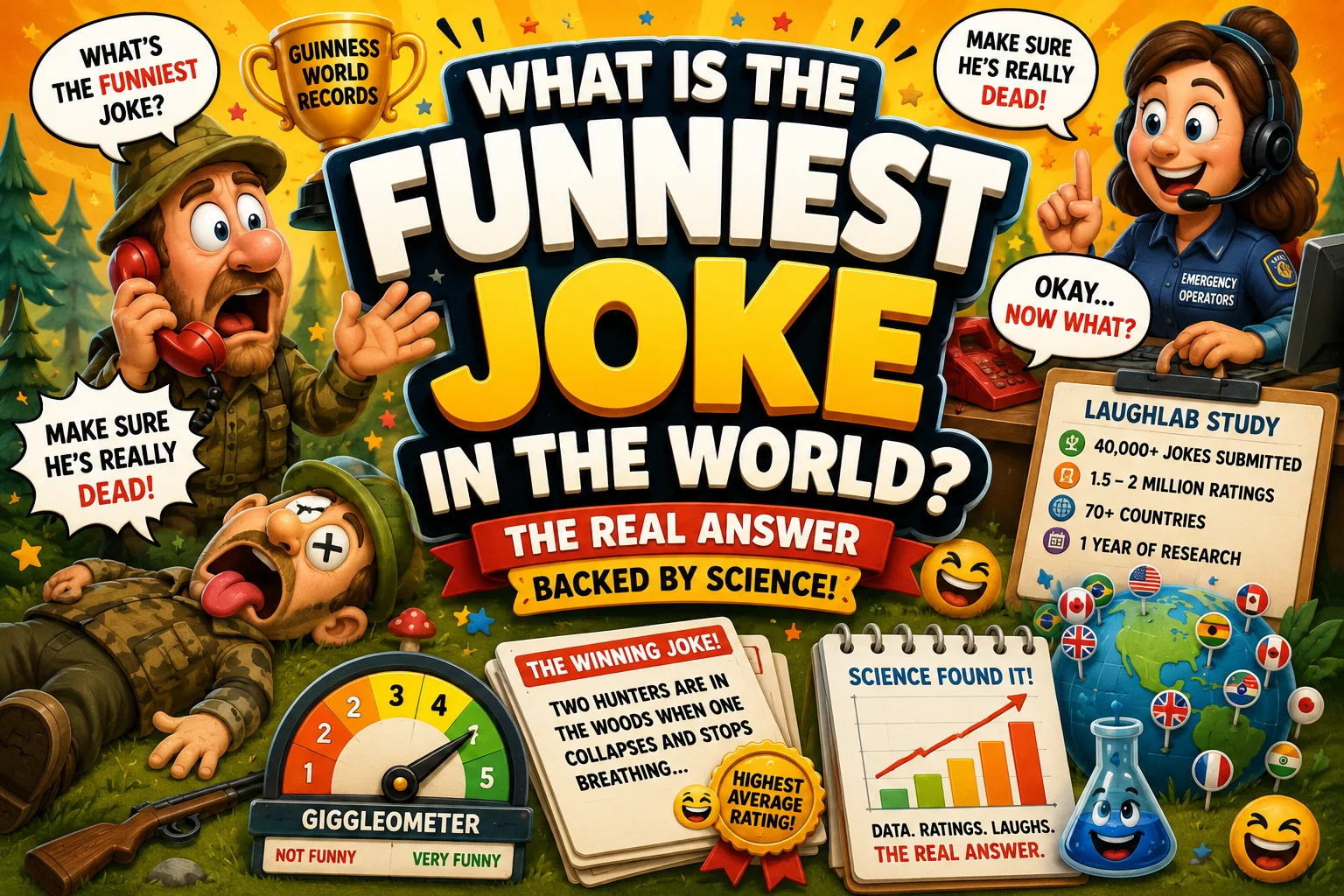
Most of the funniest joke in the world claims online are just opinions dressed up as fact, but there’s actually one answer backed by real, large scale research. In 2001, a British psychologist ran a yearlong scientific experiment specifically to find it, collecting tens of thousands of jokes and millions of ratings from people in over 70 countries, and the results ended up in the Guinness World Records. This isn’t a list of our favorite jokes, it’s a look at what actual research found when it set out to answer this exact question, including the winning joke itself, why it won, and what the study revealed about how differently people across the world actually laugh.
The Study That Actually Tried to Find It: LaughLab
Before revealing the winning joke, it’s worth understanding exactly what kind of research this was, since it’s rare for something as subjective as humor to be studied rigorously. Most claims about a world’s funniest joke online are just personal opinion repeated enough times to sound authoritative, but LaughLab was a genuine academic project, built with actual methodology, demographic tracking, and a scale large enough to draw real statistical conclusions rather than just crowning a personal favorite.
Who Ran It and How Big It Got
LaughLab was launched in September 2001 by psychologist Richard Wiseman of the University of Hertfordshire, working alongside the British Association for the Advancement of Science, and it grew into what Guinness World Records recognized as the largest internet joke vote ever conducted, with more than 40,000 jokes submitted and roughly 1.5 to 2 million ratings collected from participants in over 70 countries.
- Launched in September 2001 by psychologist Richard Wiseman
- Conducted with the University of Hertfordshire in the UK
- Run in partnership with the British Association for the Advancement of Science
- Recognized by Guinness World Records as the largest internet joke vote
- Attracted more than 40,000 individually submitted jokes
- Collected somewhere between 1.5 and 2 million total ratings
- Drew participants from more than 70 different countries
- Ran for roughly a full year before the final results were announced
How Jokes Were Actually Scored
Participants submitted their own favorite jokes and then rated several random submissions from others using a tool Wiseman nicknamed the Giggleometer, a simple fivepoint scale ranging from not very funny to very funny, which allowed researchers to calculate a genuine average score for thousands of jokes at once.
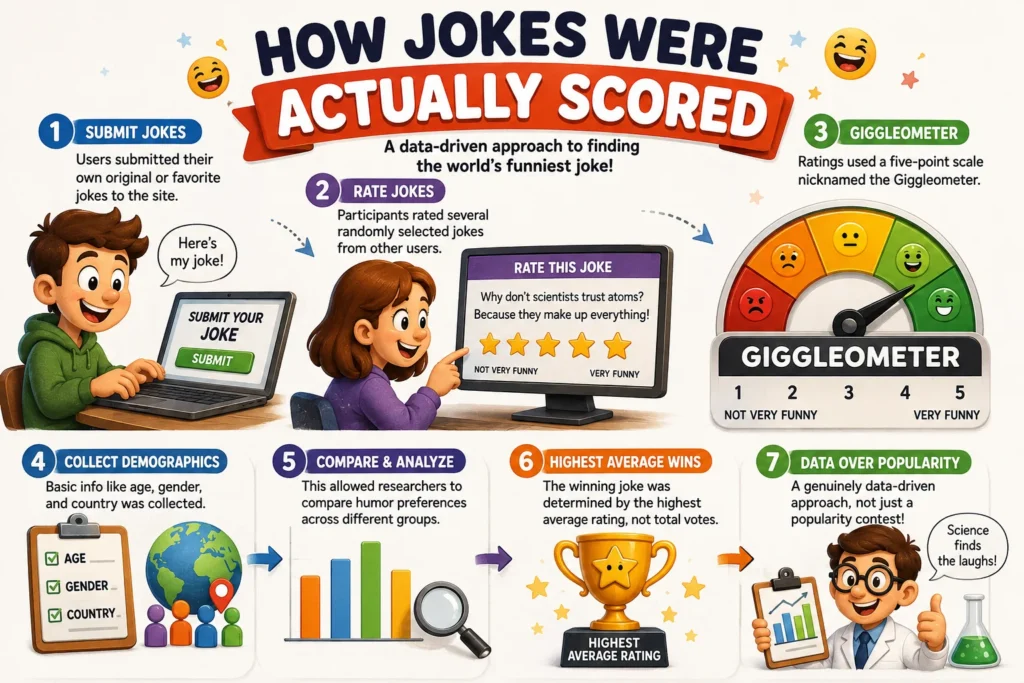
- Users could submit original or favorite jokes to the site
- Each participant also rated several randomly selected jokes
- Ratings used a fivepoint scale nicknamed the Giggleometer
- Scale ranged from not very funny to very funny
- Basic demographic data like age, gender, and country was also collected
- Allowed researchers to compare humor preferences across different groups
- The winning joke was determined by highest average rating, not total votes
- Reflects a genuinely data driven approach rather than a simple popularity poll
The Winning Joke, Revealed
After a full year of data collection, one joke emerged with the highest average rating across the entire international pool of participants. Unlike a simple popularity contest where the joke shared or submitted most often would win, this ranking was based purely on how consistently well a joke scored once people actually read and rated it, meaning the winner had to genuinely hold up across thousands of individual judgments rather than just going viral.
What the Joke Actually Is
The winning entry, submitted by Gurpal Gosall, a psychiatrist from Manchester, involves two hunters in the woods when one suddenly collapses and appears to stop breathing. His panicked friend calls emergency services and gasps that his friend is dead, asking what to do. The operator calmly says to first make sure the man is really dead, at which point there’s a brief pause on the line followed by a gunshot, and the friend comes back on and asks, Okay, now what?
- Submitted by Gurpal Gosall, a psychiatrist based in Manchester
- Centers on two hunters, one of whom appears to collapse and die
- His friend panics and calls emergency services for help
- The operator’s advice is misheard in the most literal, extreme way possible
- The punchline hinges on that fatal misinterpretation of simple instructions
- Later research traced its roots to a 1951 Goon Show sketch
- That original sketch was written by British comedian Spike Milligan
- Confirms even a new viral joke can have decades old comedic roots
Why This Specific Joke Won
According to Wiseman’s own analysis, the joke succeeded because it combined three separate elements psychologists associate with humor at once: a feeling of superiority over the hunter’s poor decision, genuine surprise at the twist, and a way of processing anxiety about mortality through laughter rather than discomfort.
- Combines three distinct psychological triggers for humor at once
- Creates a feeling of superiority over the character’s poor judgment
- Delivers genuine surprise through its unexpected, literal twist
- Offers a way to laugh through discomfort around mortality
- Wiseman noted these combined elements rarely appear in a single joke
- Its length, around 100 words, matched what the data showed worked best
- Performed consistently well across nearly every demographic group tested
- Represents a rare case of a joke engineered by accident, not design
What Almost Won Instead
The eventual winner wasn’t the frontrunner for most of the study, and the runnerup reveals a genuinely different style of humor. For much of the yearlong experiment, an entirely different joke sat comfortably in first place, and its eventual second place finish says just as much about shifting humor preferences over time as the final winner itself does.
The Sherlock Holmes RunnerUp
For much of the year, the leading joke involved Sherlock Holmes and Dr. Watson camping, where Holmes wakes Watson in the night and asks what he deduces from looking at the stars, leading to an increasingly technical answer from Watson before Holmes flatly points out the real, obvious lesson: someone has stolen their tent.
- Submitted by Geoff Anandappa from Blackpool, England
- Led the rankings for much of the study’s early months
- Features Sherlock Holmes and Dr. Watson on a camping trip
- Builds toward an elaborate, overly analytical answer from Watson
- Undercut entirely by Holmes noticing the far more obvious problem
- Ultimately finished as the study’s official runnerup
- Reflects a more classic, wordplaylight setup and twist structure
- Still widely cited today as one of LaughLab’s most memorable results
The Joke Everyone Submitted but Nobody Liked
Separately, researchers also tracked which joke was submitted the most times overall, and found that a simple riddle about something brown and sticky was sent in roughly 300 times, despite consistently rating among the least funny entries in the entire database.
- The most frequently submitted joke in the entire study
- Sent in an estimated 300 separate times by different participants
- The riddle’s answer is simply a stick
- Rated consistently low despite being the most commonly submitted entry
- Highlights a gap between what people assume is funny and what tests well
- Became something of an inside joke among the researchers themselves
- Wiseman has referenced it publicly as a memorable footnote of the study
- Shows raw popularity and measured funniness aren’t the same thing
What LaughLab Revealed About Humor Around the World
Beyond crowning a single winner, the sheer scale of the study allowed researchers to spot genuine patterns in what different groups of people actually found funny. With responses pouring in from more than 70 countries, Wiseman’s team had enough data to move past anecdotal stereotypes about national humor and actually measure whether real, consistent differences existed between how various cultures and demographics responded to the same jokes.
National and Cultural Differences
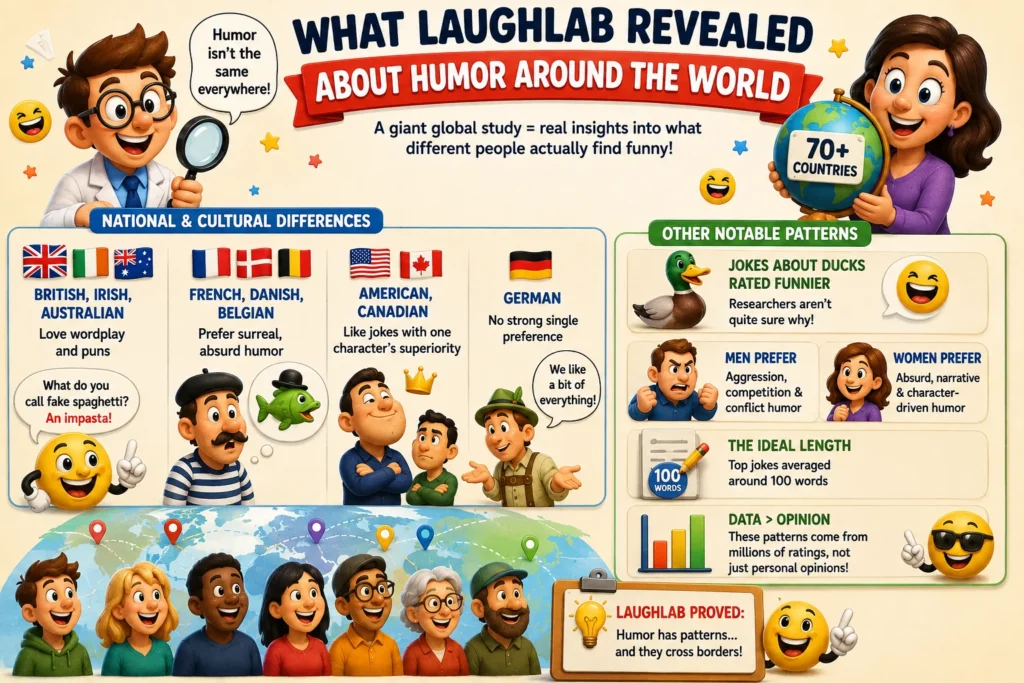
The research found that British, Irish, New Zealand, and Australian participants leaned toward wordplay and puns, French, Danish, and Belgian participants preferred surreal, absurdist humor, and American and Canadian participants tended to favor jokes built around one character’s clear superiority over another.
- British, Irish, and Australian participants favored wordplay and puns
- French, Danish, and Belgian participants leaned toward surreal humor
- American and Canadian participants preferred superiority based jokes
- German participants showed no strong single preference overall
- Wiseman noted this made Germans appear to have the broadest humor
- Differences held up consistently across the large international sample
- Offers rare, databacked insight into crosscultural humor tendencies
- Remains one of the study’s most frequently cited findings since
Other Notable Patterns in the Data
Researchers also found that jokes mentioning specific animals, ducks in particular, tended to rate as funnier than similar jokes without them, and that men and women showed measurable differences in the types of humor they rated most highly.
- Jokes mentioning ducks specifically rated funnier than similar alternatives
- Researchers couldn’t fully explain why, though several theories were proposed
- Men in the study leaned toward jokes involving aggression or conflict
- Women showed a stronger preference for absurdist, narrative driven humor
- The ideal joke length landed close to 100 words based on top performers
- Much shorter or longer jokes tended to underperform in average ratings
- These patterns have since been referenced in later humor research
- Reflects genuinely useful data beyond just naming a single winner
Jump into Other Related Article
- Food Jokes: Deliciously Funny Jokes That Will Make You Hungry
- Monthly Jokes: A Month Full of Laughs
- Weekly Jokes: A Funny Joke for Every Day of the Week
- Funny Jokes That Will Make You Laugh
- Animal Jokes: Funny Animal Jokes That Will Make You Laugh
- Dad Joke of the Day | Today’s Pick + 60 More for Every Day
- Joke of the Day | 50+ Funny Jokes for Every Mood
- Dad Jokes | 60+ Funny, Corny OneLiners (Plus Their Surprising History)
- Deez Nuts Jokes | 50+ Names & Setups (Plus Where It Came From)
- Banana Jokes | 60+ Funny Ones for Kids & Adults
- Cop Jokes | 50+ Funny Ones for Every Audience
- Penguin Jokes | 60+ Funny Ones for Kids & Adults
- Dinosaur Jokes for Kids | 60+ Funny Ones They’ll Love
- Cowboy Jokes | 60+ Funny Ones (Plus Dallas Cowboys Jokes)
- Shark Jokes | 60+ Funny Ones for Kids & Adults
- Funny Jokes | 60+ Jokes for Kids, Adults & Every Occasion
- Pasta Jokes | 60+ Funny Ones for Kids & Adults
Conclusion
Unlike most world’s funniest joke claims floating around online, this one actually has real research behind it, a yearlong, internationally scaled study that collected millions of genuine ratings rather than one person’s opinion. The winning joke about two hunters and a fatal misunderstanding earned its title not by being universally hilarious, but by being the entry that, on average, the widest range of people across cultures disliked the least. Along the way, the study also revealed genuine patterns in how nationality, gender, and even mentioning a duck can shift what people find funny, making LaughLab less a simple contest and more a real, if quirky, dataset on human humor itself.
What is the funniest joke in the world, according to science?
Based on the LaughLab study, it’s a joke about two hunters, one of whom collapses, where the survivor misunderstands emergency instructions in a literal, fatal way.
Who ran the study that found the world’s funniest joke?
Psychologist Richard Wiseman of the University of Hertfordshire ran the study, called LaughLab, in partnership with the British Association for the Advancement of Science.
How many jokes were part of the study?
Over 40,000 jokes were submitted, with roughly 1.5 to 2 million ratings collected from participants in more than 70 countries.
What was the runnerup joke?
The Sherlock Holmes and Dr. Watson camping joke, submitted by Geoff Anandappa, led the rankings for much of the study before finishing in second place.
Is the world’s funniest joke actually funny to everyone?
Not necessarily. Wiseman himself explained it was less about being universally hilarious and more about being the joke that, on average, the fewest people disliked.
What joke was submitted the most times during the study?
Not necessarily. Wiseman himself explained it was less about being universally hilarious and more about being the joke that, on average, the fewest people disliked.

Pingback: Psychology Jokes | Funny One Liners, Classics & Why Jokes Work