Elephant jokes are not simply jokes that happen to feature elephants. They are a documented comic genre with a formula, a peak era and a name and understanding that formula explains why so many of them sound almost identical. This page covers the two great elephant joke sequences with all their answers, the ant and elephant tradition, and the story behind the phrase white elephant, which almost everybody repeats and which turns out to have no historical evidence behind it at all.
What an Elephant Joke Actually Is
This is worth establishing first, because it reframes everything that follows. An elephant joke is not a topic it is a recognised joke cycle, defined by Wikipedia’s entry on the genre as almost always an absurd riddle or conundrum, frequently arriving in sequences. The elephant is not the subject so much as the excuse.
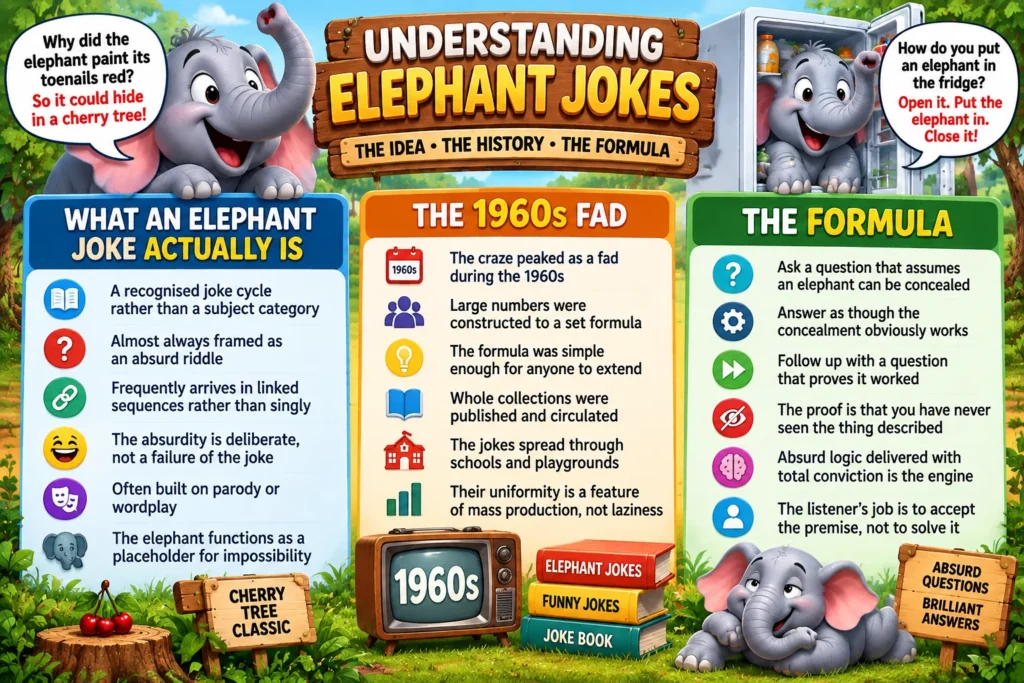
- A recognised joke cycle rather than a subject category
- Almost always framed as an absurd riddle
- Frequently arrives in linked sequences rather than singly
- The absurdity is deliberate, not a failure of the joke
- Often built on parody or wordplay
- The elephant functions as a placeholder for impossibility
The 1960s Fad
Elephant jokes exploded as a craze in the 1960s, and the scale of it is what makes them a genuine cultural phenomenon rather than just old jokes. People produced them in enormous numbers by following a set formula which is precisely why so many of them share the same shape and rhythm.
- The craze peaked as a fad during the 1960s
- Large numbers were constructed to a set formula
- The formula was simple enough for anyone to extend
- Whole collections were published and circulated
- The jokes spread through schools and playgrounds
- Their uniformity is a feature of mass production, not laziness
The Formula
Once you see the structure, you can build them indefinitely, which is exactly what happened. The pattern rests on treating an elephant as though it were small, invisible or ordinary, and then answering the question with complete seriousness.
- Ask a question that assumes an elephant can be concealed
- Answer as though the concealment obviously works
- Follow up with a question that proves it worked
- The proof is that you have never seen the thing described
- Absurd logic delivered with total conviction is the engine
- The listener’s job is to accept the premise, not to solve it
The Cherry Tree Classic
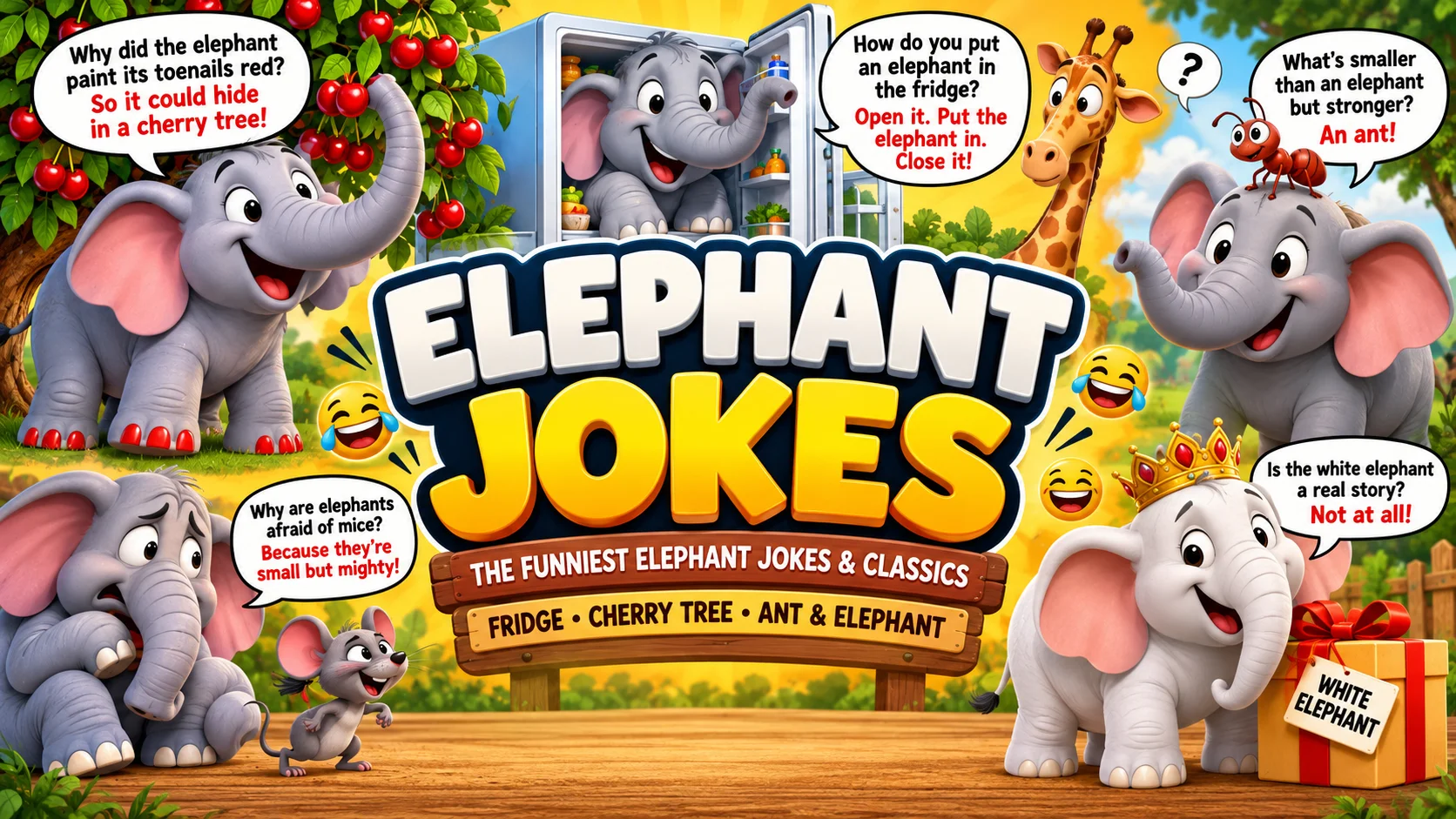
This is the canonical elephant joke, cited as the defining example of the entire genre. Why did the elephant paint its toenails red? So that it could hide in a cherry tree.
- Q Why did the elephant paint its toenails red? A So it could hide in a cherry tree.
- It is cited as the standard example of the genre
- The logic is absurd but internally consistent
- Red toenails, red cherries, therefore invisibility
- No part of it survives a second’s thought, which is the point
The FollowUps
The cherry tree joke almost never travels alone, and the followups are what make the genre distinctive. Each one proves the previous joke by pointing to the absence of evidence.
- Q Have you ever seen an elephant in a cherry tree? A No? Then it works.
- Q Why do elephants have flat feet? A From jumping out of cherry trees.
- Q How do you know an elephant has been in a cherry tree? A By the footprints in the branches.
- Q Why did the giraffe paint its toenails red? A It heard the elephant’s plan and wanted in.
- Each answer treats the previous absurdity as established fact
- The absence of evidence is presented as proof
- This chain structure is the genre’s signature
The Elephant in the Fridge Sequence
This is by far the most searched elephant joke, and it is not one joke but four questions asked in order. It circulates widely as an informal reasoning puzzle, and the point is not any individual answer it is whether you carry information from one question to the next.
The Four Questions
- 1. How do you put an elephant in the fridge? Open the fridge, put the elephant in, close the fridge.
- 2. How do you put a giraffe in the fridge? Open the fridge, take the elephant out, put the giraffe in, close the fridge.
- 3. The lion king holds an animal conference. Every animal attends except one. Which? The giraffe is still in the fridge.
- 4. You must cross a river full of crocodiles, with no boat. How? Swim. All the crocodiles are at the animal conference.
Why It Works as a Test
Each question is trivially easy on its own. The difficulty is entirely in memory and sequence most people answer question two without removing the elephant, and most people who get question two right still forget the giraffe by question three. It has been used informally in interviews and training sessions for exactly that reason.
- Every individual question is straightforward
- The difficulty lies in carrying information forward
- Most people fail question two by forgetting the elephant
- Most people fail question three by forgetting the giraffe
- It tests sequential reasoning rather than cleverness
- Children frequently outperform adults on it
How to Deliver It
The sequence collapses if you rush, and it collapses entirely if you let the listener answer question one out loud with too much confidence.
- Ask the questions one at a time and wait for each answer
- Do not correct wrong answers just give the right one and move on
- Never signal that the questions are connected
- The pause before question three is where it lands
- Delivered properly, most people get one out of four
- Never explain the trick afterwards
How Do You Know an Elephant Has Been in Your Fridge?
A separate and equally old joke, and one that belongs to the same absurd evidence family as the cherry tree.
- Q How can you tell an elephant has been in your fridge? A Footprints in the butter.
- Q How can you tell an elephant has been in your sandwich? A By the enormous bite.
- Q Why are elephants bad at hide and seek? A They always leave footprints in the butter.
- The joke assumes an elephant fits in a fridge without comment
- Accepting that premise is what makes the punchline work
Ant and Elephant Jokes
This is a substantial category in its own right, particularly popular in India, and it turns up in search in several languages. The comedy comes entirely from the size difference the ant is small enough to be invisible to the elephant, which lets the ant behave with complete confidence.
- Built entirely on the size contrast between the two animals
- The ant is consistently portrayed as the confident one
- The elephant is usually oblivious rather than cruel
- Especially popular in Indian joke traditions
- Circulates in several regional languages
- Works with young children because the visual is obvious
Examples
- Q Why did the ant sit on the elephant’s back? A It wanted to travel first class.
- Q What did the ant say when it fell off the elephant? A Nothing. It was in shock, and very small.
- Q Why did the elephant not notice the ant? A Same reason you have never noticed a specific grain of sand.
- Q How does an ant stop an elephant? A It doesn’t. That is the joke.
- Q Why did the ant challenge the elephant to a race? A Confidence unbacked by evidence is a personality.
Best Elephant Jokes and OneLiners
These are the general purpose ones, usable with any audience and requiring no sequence.
- Q How do you lift an elephant with one hand? A You’ll struggle to find an elephant with one hand.
- Q Why did the elephant eat a candle? A He wanted a light dinner.
- Q What do you call an elephant that doesn’t matter? A Irrelephant.
- Q What’s grey, has four legs and a trunk? A A mouse going on holiday.
- Q Why don’t elephants use computers? A They’re afraid of the mouse.
- Q What’s the difference between an elephant and a biscuit? A You can’t dip an elephant in your tea.
- Q Why did the elephant leave the circus? A He was tired of working for peanuts.
- Q How do you make an elephant float? A Two scoops of ice cream and a very large elephant.
- Q What do you give a seasick elephant? A Plenty of room.
- Q Where do elephants keep their clothes? A In the trunk.
Elephant Dad Jokes
The dad joke version leans on trunk, peanuts and irrelephant, delivered with total confidence and no followup.
- I told an elephant joke at work. It was completely irrelephant.
- I bought an elephant a suitcase. He already had a trunk, so it was awkward.
- Why don’t elephants ever get lost? They have excellent memory and terrible hiding skills.
- My elephant impression is not good, but it is very large.
- What’s the hardest part of an elephant joke? Getting it into the fridge.
- I asked an elephant to keep a secret. It never forgot, which was the problem.
Elephant Jokes for Kids
Simple words, a familiar animal and punchlines children can repeat exactly. These work in classrooms and on zoo trips.
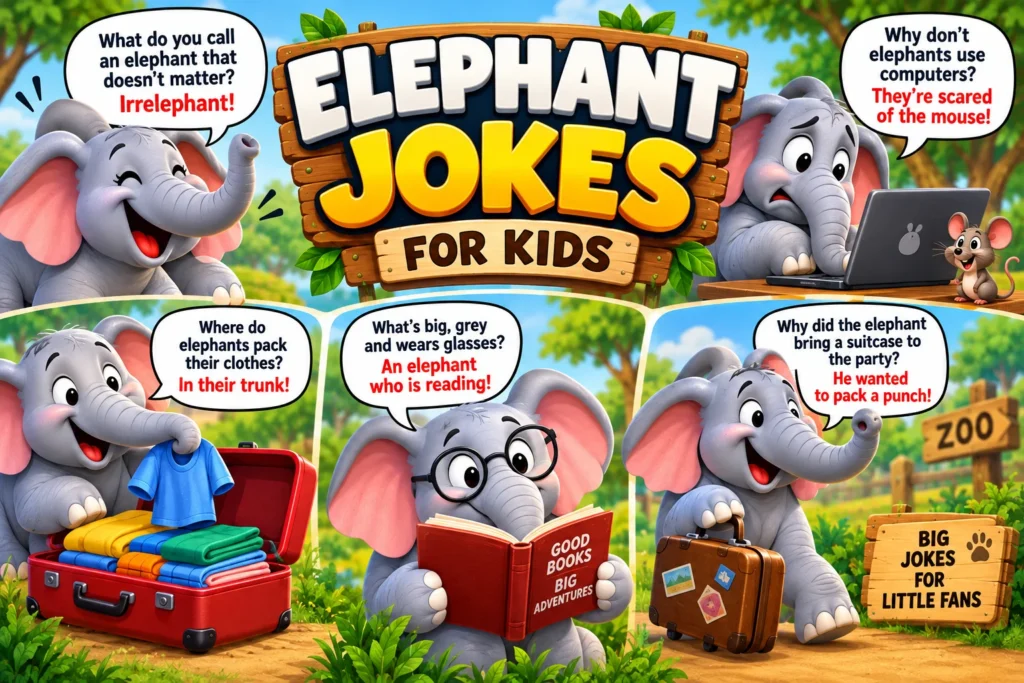
- Q What do you call an elephant that doesn’t matter? A Irrelephant.
- Q Why don’t elephants use computers? A They’re scared of the mouse.
- Q Where do elephants pack their clothes? A In their trunk.
- Q What’s big, grey and wears glasses? A An elephant who is reading.
- Q Why did the elephant bring a suitcase to the party? A He wanted to pack a punch.
- Q What time is it when an elephant sits on the fence? A Time to get a new fence.
How Do You Eat an Elephant?
One elephant question is not a joke at all but a management proverb, and it turns up in searches constantly. The answer is one bite at a time. It is used to describe breaking a large, intimidating task into small, achievable steps, and it is repeated in project management, therapy and productivity writing.
- Q How do you eat an elephant? One bite at a time.
- Not a joke a widely used proverb about large tasks
- Common in project management and productivity advice
- Also used in therapeutic contexts about overwhelming problems
- The elephant stands for anything that feels too big to start
- People searching it are usually after motivation, not comedy
The White Elephant The Story Everyone Tells Is Wrong
This is the most interesting thing on the page, and almost every source you will find gets it wrong. The story goes that the Kings of Siam would present a sacred white elephant to a courtier who had displeased them a gift too holy to refuse, sell, kill or work, but ruinously expensive to feed, which quietly bankrupted the recipient. It is a wonderful story. There is no historical evidence for it.
- The legend says Siamese kings used white elephants to ruin courtiers
- The gift could not be refused, sold, worked or neglected
- Its upkeep supposedly bankrupted the recipient
- The story appears in dictionaries, encyclopaedias and countless articles
- No historical record supports it
- Wikipedia’s own entry acknowledges there is no actual record of any such practice
What Actually Happened
The reality points in the opposite direction. White elephants were regarded as far too precious to give away at all. Word Histories notes that the Oxford English Dictionary’s account is mistaken, and offers a striking counterexample in 1568 the king of Pegu in what is now Myanmar went to war with the king of Siam, who had refused to sell him a white elephant. Nations fought to acquire these animals. They did not hand them out as punishments.
- White elephants were sacred and enormously valuable
- In Thai law any white elephant found had to be brought to the king
- In 1568 a war was fought over a refusal to sell one
- Thailand still maintains a royal elephant stable
- The white elephant appears on the ensign of the Royal Thai Navy
- The animal was a symbol of a monarch’s power and legitimacy
Where the Myth Came From
The phrase entered English as a figure of speech around 1851, well before anyone verified the story behind it. Earlier literal uses go back further a 1663 English translation describes the King of Siam mounted on a white elephant. Historians have suggested the ruinous gift version is a conflation of unrelated stories about lavish royal giftgiving, which then hardened into fact through repetition by prominent Victorian writers, including Dickens.
- The figurative use appears in English from around 1851
- Literal descriptions date back to at least 1663
- Prominent Victorian writers repeated and embellished the story
- It appears to conflate several unrelated giftgiving traditions
- Repetition by respected sources turned legend into reference book fact
- It is one of the most successful false etymologies in English
The Gift Exchange Game
The modern white elephant gift exchange where people bring wrapped joke presents and steal each other’s takes its name from that same legend. The joke gift is meant to be the burdensome, unwanted item nobody can politely get rid of, which is the one part of the story that survives intact regardless of its historical accuracy.
- Participants bring one wrapped gift of similar value
- Gifts are chosen in turn and can usually be stolen
- The humour depends on the gifts being deliberately useless
- The name comes from the legend, not from any verified history
- The burdensome present idea works whether or not the story is true
Jump into Other Related Article
- Barber Jokes | The Short Cut Riddle, the Barber Queue Pun, and Why the Pole Is Red and White
- Dinosaur Jokes for Kids | 60+ Funny Ones They’ll Love
- Kangaroo Jokes | The Riddles With Answers, Plus Real Facts That Make Them Better
- Shark Jokes | 60+ Funny Ones for Kids & Adults
Why Elephants Never Forget
Another search that is not really a joke. The saying reflects something genuine elephants have exceptional long term memory, particularly matriarchs who retain knowledge of water sources and migration routes across decades and can recognise individuals after very long separations. The joke versions play on the phrase rather than the biology.
- Elephants have genuinely strong long term memory
- Matriarchs retain water and route knowledge over decades
- They can recognise individuals after long separations
- The saying is exaggeration built on a real capability
- Most elephant memory jokes play on the phrase, not the science
Elephant Searches This Page Doesn’t Cover
A few terms in this cluster point at things other than animal jokes, and it is worth naming them rather than leaving people scrolling.
- Adult humour searches, which this page does not serve
- Jokes naming specific real public figures
- Regional language joke collections, which need a native language page
- If a search brought you here for one of those, this is not the page
Conclusion
Elephant jokes are one of the few comic categories with a documented history, a named formula and a decade when they took over. The cherry tree joke is the genre in miniature absurd, internally consistent, and proved by the fact that you have never seen it happen. The fridge sequence is the one to learn properly, because it works on almost everyone and takes thirty seconds. And keep the white elephant correction in reserve, because being able to say that the most repeated fact about the phrase has no evidence behind it, and that a war was once fought because a king refused to part with one, is worth more than any punchline on this page.
- Elephant jokes are a recognised joke cycle, not just a topic
- The 1960s fad produced them to a repeatable formula
- The fridge sequence tests memory, not cleverness
- The white elephant ruinous gift story has no historical evidence
How do you put an elephant in the fridge?
Open the fridge, put the elephant in, close the fridge. It is the first of a fourquestion sequence, and the trick is that each answer must be carried into the next question.
What is the full elephant in the fridge sequence?
Four questions put the elephant in the fridge; put the giraffe in the fridge, remembering to take the elephant out first; identify the animal missing from the lion king’s conference, which is the giraffe; and cross a crocodile river, which is safe because the crocodiles are at the conference.
Why did the elephant paint its toenails red?
So it could hide in a cherry tree. It is cited as the defining example of the elephant joke genre, and the followup asks whether you have ever seen an elephant in a cherry tree proving that it works.
What is an elephant joke?
A recognised joke cycle, almost always an absurd riddle and often part of a sequence. Elephant jokes were a fad in the 1960s, produced in huge numbers according to a set formula.
How do you eat an elephant?
One bite at a time. This one is not a joke but a widely used proverb about breaking overwhelming tasks into manageable steps.
Why is it called a white elephant gift?
From the legend that Siamese kings gifted sacred white elephants to ruin courtiers through upkeep costs. There is no historical evidence for this white elephants were considered far too valuable to give away, and in 1568 a war was fought after a king refused to sell one.
Do elephants really never forget?
The saying exaggerates something real. Elephants have exceptional long term memory, and matriarchs in particular retain knowledge of water sources and routes across decades and recognise individuals after long separations.
How do you lift an elephant with one hand?
You will struggle to find an elephant with one hand. The joke redirects the question from your hand to the elephant’s.

Pingback: 50 Tooth Jokes | Tooth Fairy, Kids & Dad Jokes
Pingback: 80+ Hot Dog Jokes | Funny, Clean, Adult & One Line
Pingback: 45 Funny Night Shift Jokes for Nurses & Shift Workers