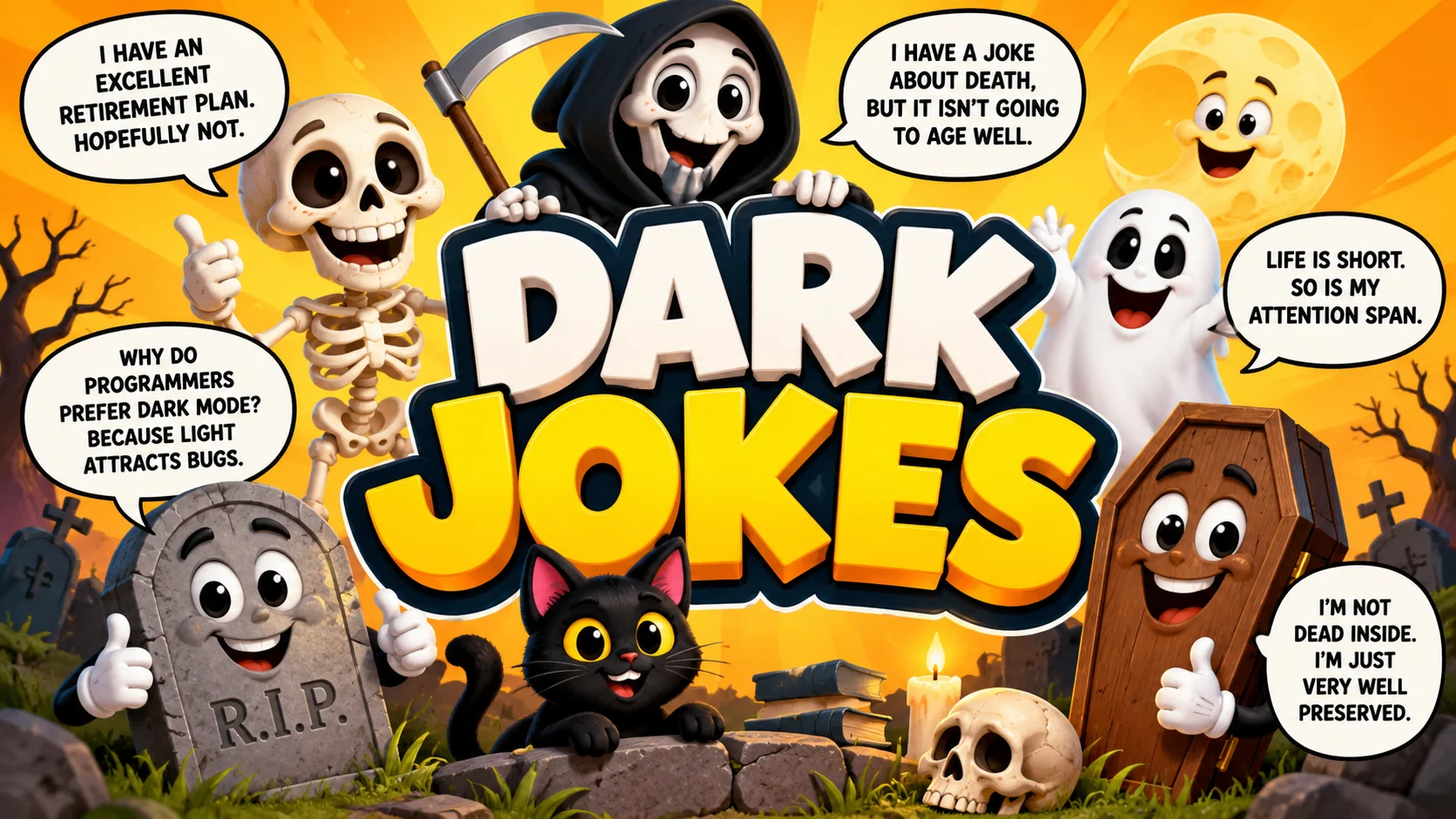
Dark humour is the most misunderstood comic category there is, in both directions. People who enjoy it are assumed to be callous, and people who tell genuinely cruel jokes claim they are doing dark comedy. There is actual research on this, and it says something surprising about both groups. This page covers what dark humour is, what a landmark study found about the people who appreciate it, the jokes that work, and the precise point where a dark joke stops being dark humour and becomes something else.
What Counts as Dark Humour
Academic definitions are more specific than the everyday use of the term. Black humour, as the research literature defines it, treats genuinely sinister subjects death, disease, disability, warfare with bitter amusement, presenting tragic or morbid material in humorous terms. The key word is treats. The subject is the darkness itself, not a person who happens to be near it.
- Deals with death, illness, disaster, war and mortality
- Presents genuinely tragic material in humorous terms
- Also called gallows, morbid, grotesque or sick humour
- The subject is the darkness, not a chosen victim
- Requires the listener to hold two incompatible frames at once
- That doubleholding is what makes it cognitively demanding
What the Research Actually Found
This is the part almost nobody quotes correctly. In 2017, a team led by the psychologist Ulrike Willinger at the Medical University of Vienna published a study in the journal Cognitive Processing. They gave 156 adults twelve black humour cartoons to rate, alongside standardized tests for verbal intelligence, nonverbal intelligence, mood disturbance and aggressiveness.
- Published in Cognitive Processing in January 2017
- Led by Ulrike Willinger, Medical University of Vienna
- 156 adults rated twelve black humour cartoons
- Participants were tested for verbal and nonverbal intelligence
- Mood disturbance and aggressiveness were also measured
- The full paper is publicly available
The Three Groups
The researchers found the participants divided into three distinct groups, and the results ran directly against the popular assumption. The group that both understood and enjoyed the dark cartoons scored highest on verbal and nonverbal intelligence, had the highest education levels, and this is the striking part that showed the lowest aggression and the least mood disturbance of anyone in the study.
- Group one: high comprehension, high preference highest intelligence scores
- That same group showed the lowest aggression of all participants
- They also showed the least mood disturbance
- Group two: moderate comprehension, moderate preference, moderate aggression
- Group three: lower comprehension, low preference, highest aggression and mood disturbance
- Emotional instability and aggression reduced enjoyment of dark humour
What That Actually Means
The finding inverts the stereotype. If enjoying dark humour signalled cruelty, the most aggressive participants would have enjoyed it most. They enjoyed it least. The researchers’ explanation is that processing this kind of joke requires holding a tragic premise and a comic frame simultaneously, and that anger or emotional distress interferes with that. You need enough emotional stability to play with the material without being pulled into it.
- The most aggressive participants enjoyed dark humour the least
- Processing it requires holding two frames at once
- Anger and distress interfere with that mental operation
- Enjoying it appears to require emotional stability, not the absence of empathy
- The findings support Freud’s 1905 theory about humour as safe release
- Appreciation of dark humour is not a marker of cruelty
Gallows Humour: Why Emergency Workers Use It
Dark humour has a documented professional function. Doctors, nurses, paramedics, firefighters, police and soldiers all develop it, and it is not a sign of indifference it is closer to the opposite. People who deal with death routinely need a way to discharge the weight of it that does not involve breaking down midshift. Gallows humour does that work.
- Common across medicine, emergency services and the military
- Functions as a coping mechanism, not as callousness
- Allows discharge of pressure without disrupting the work
- Almost always shared privately, within the group
- Sounds shocking to outsiders precisely because they lack the context
- Its existence is well documented across professions and decades
Dark Jokes That Actually Work
These aim at mortality, futility and the teller’s own situation, the human condition rather than a person. That is the distinction that makes the difference between a dark joke and an insult.
- My grandfather said the secret to a long life was to keep breathing. He was right, right up until he wasn’t.
- I’ve written my will. It is mostly a document about disappointing people.
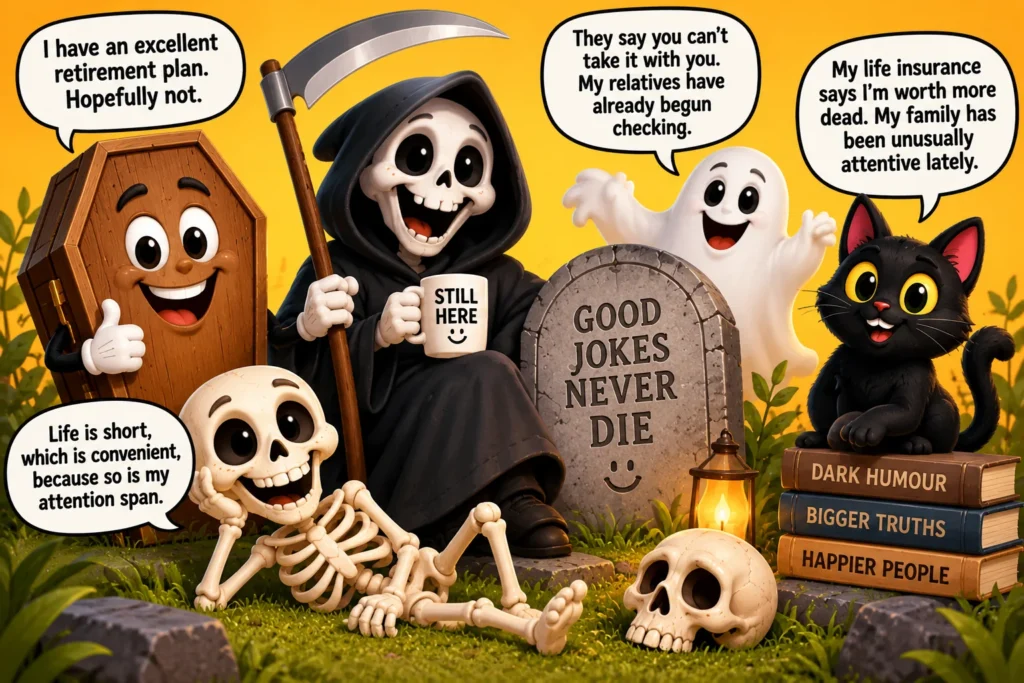
- They say you can’t take it with you. My relatives have already begun checking.
- I have an excellent retirement plan. Hopefully not.
- The good news is I’ve made peace with my mortality. The bad news is everything else.
- I asked my father if I was adopted. He said not yet, but the advert is running.
- Nothing brings a family together quite like a will being read aloud.
- My life insurance says I’m worth more dead. My family has been unusually attentive lately.
- I told my therapist I fear the future. She said that’s just called reading the news.
- Life is short, which is convenient, because so is my attention span.
Dark Dad Jokes
The dad joke version of dark humour is the mildest form: an obvious pun about a grim subject, delivered with total confidence and no followup. It works because the pun structure signals immediately that nobody is actually being targeted.
- I have a joke about death, but it isn’t going to age well.
- I’d tell you a joke about my funeral, but you had to be there. You will be.
- What’s the difference between me and a lottery ticket? The ticket has a chance.
- I bought a book on how to live forever. The author has since died, which is a review.
- My doctor gave me six months to live. I said I couldn’t pay the bill, so he gave me another six.
- I’m on a strict inheritance based savings plan. It relies entirely on other people.
Dark Knock Knock Jokes
These work by inverting the format’s cheerfulness, and they are best used exactly once.
- Knock knock. Who’s there? Nobody. (Then walk away.)
- Knock knock. Who’s there? Death. Death who? Death is very sorry administrative error. Carry on.
- Knock knock. Who’s there? … (Say nothing. Wait. That is the joke.)
- Knock knock. Who’s there? Interrupting existential dread. Interrupting exis I know.
The Two Riddles People Search For
Two specific dark adjacent riddles turn up constantly, and neither is actually dark at all.
Why Do Programmers Prefer Dark Mode?
Because light attracts bugs. It is the most searched joke with dark in it and it is entirely clean the darkness is a screen setting, and the pun works on software bugs and actual insects at once.
- Q: Why do programmers prefer dark mode? A: Light attracts bugs.
Why Is the Bottom of the Ocean So Dark?
This one circulates as an antijoke: the answer is simply that sunlight does not reach that far. The humour is in the refusal to provide a punchline where one was clearly expected, which is a legitimate comic move rather than a failed joke.
- Q: Why is the bottom of the ocean so dark? A: Sunlight doesn’t reach it.
- The absence of a punchline is the punchline
- Antijokes only work on audiences expecting a pun
Where Dark Humour Stops Being Dark Humour
This page does not contain jokes about orphaned children, or jokes built on ethnicity or religion, and the reason is an argument rather than a disclaimer. The Vienna research found that appreciation of dark humour correlates with low aggression. A joke that selects a vulnerable group as its target is not asking anything of the listener’s cognitive flexibility it requires no frameshifting, no held contradiction, no discomfort with mortality. It requires only agreement that the target deserves it. That is a different mental operation entirely, and it is not what the research was measuring.
- Genuine dark humour aims at death, fate and the human condition
- It asks the listener to hold a tragic frame and a comic one together
- Jokes targeting a group require no such work only agreement
- The research links dark humour appreciation to low aggression
- Cruelty dressed as dark comedy is a category error, not a bolder version
- You can’t take a joke is what that error says when challenged
The Practical Test
If you are unsure which side of the line a joke falls on, this question settles it almost every time: who is worse off if this joke spreads? If the answer is nobody it’s about death, and death is fine, it is dark humour. If the answer is a specific group of people, it is not.
- Ask who is worse off if the joke spreads widely
- Nobody, because the target is fate or mortality dark humour
- A specific group of people something else
- Jokes about your own situation are always available
- Death does not have feelings; people do
How to Tell a Dark Joke Without It Landing Badly
Dark humour fails more spectacularly than any other kind, and almost always for predictable reasons.
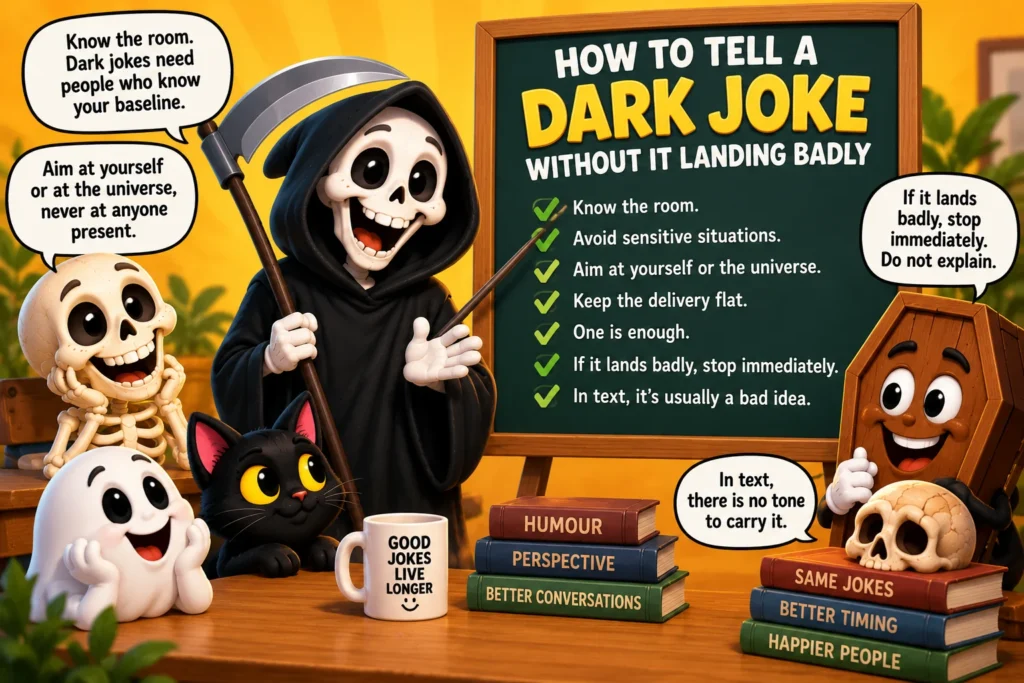
- Know the room dark jokes need people who know your baseline
- Never tell one to someone currently living the subject matter
- Aim at yourself or at the universe, never at anyone present
- Deliver it flatly; dramatising it makes it worse
- One is enough a run of them becomes a stance
- If it lands badly, stop immediately and do not explain
- Never say it’s just dark humour as a defence, because it isn’t one
- In text, do not there is no tone to carry it
Dark Joke Generators and Why They Disappoint
A recurring search is for a generator that produces dark jokes on demand, and the results are reliably poor. The reason is structural: dark humour depends on knowing exactly where a specific audience’s line sits, and a generator has no audience model at all. It produces either the safest possible material or something genuinely offensive, with nothing in between because the judgement is the entire skill.
- Generators have no model of the audience
- Dark humour depends entirely on knowing where the line sits
- Output tends to be either toothless or genuinely offensive
- The judgement of what to say is the actual craft
- A joke you would not have chosen is not one you should tell
Jump into Other Related Article
- Cat Joke Memes | The Formats, the Real Origins, and How to Make Your Own
- Food Jokes: Deliciously Funny Jokes That Will Make You Hungry
- Monthly Jokes: A Month Full of Laughs
- Travel Jokes | 60+ Puns, Animal Riddles and the Time Travel Joke Explained
Conclusion
Dark humour is the one comic category where the research contradicts the reputation. The people who appreciate it most, in the best known study on the subject, were the least aggressive and the most emotionally stable because processing a joke about mortality requires holding two incompatible frames at once, and anger gets in the way of that. Keep the jokes aimed at death, fate and yourself, where they belong. And when someone defends a joke about a vulnerable group by calling it dark humour, you now have an actual answer rather than a shrug.
- Dark humour treats death and disaster, not people
- The Vienna study linked appreciation to low aggression
- Gallows humour is a documented coping mechanism, not callousness
- Jokes targeting a group are a different thing wearing the same name
What is a dark humour joke?
One that treats genuinely sinister subjects death, illness, disaster, war in humorous terms. The research literature also calls it gallows, morbid or black humour. The subject is the darkness itself, not a chosen victim.
Is enjoying dark humour a sign of intelligence?
A 2017 study at the Medical University of Vienna found that participants who both understood and enjoyed black humour cartoons scored highest on verbal and nonverbal intelligence and, notably, showed the lowest aggression of anyone in the study.
Does liking dark jokes mean someone is cruel?
The research suggests the opposite. The most aggressive participants in the Vienna study enjoyed dark humour the least, because processing it requires holding a tragic premise and a comic frame simultaneously, which anger interferes with.
Why do doctors and paramedics use dark humour?
As a documented coping mechanism. People who encounter death routinely need a way to discharge that weight without breaking down midshift. It sounds shocking to outsiders because they lack the context.
Why do programmers prefer dark mode?
Because light attracts bugs. It is the most searched joke containing the word dark and it is completely clean.
Where’s the line between dark humour and cruelty?
Ask who is worse off if the joke spreads. If the answer is nobody, because the target is death or fate, it is dark humour. If the answer is a specific group of people, it is something else.
Do dark joke generators work?
Not well. Dark humour depends on knowing exactly where a particular audience’s line sits, and a generator has no audience model so it produces either toothless material or genuinely offensive material, with nothing usable in between.