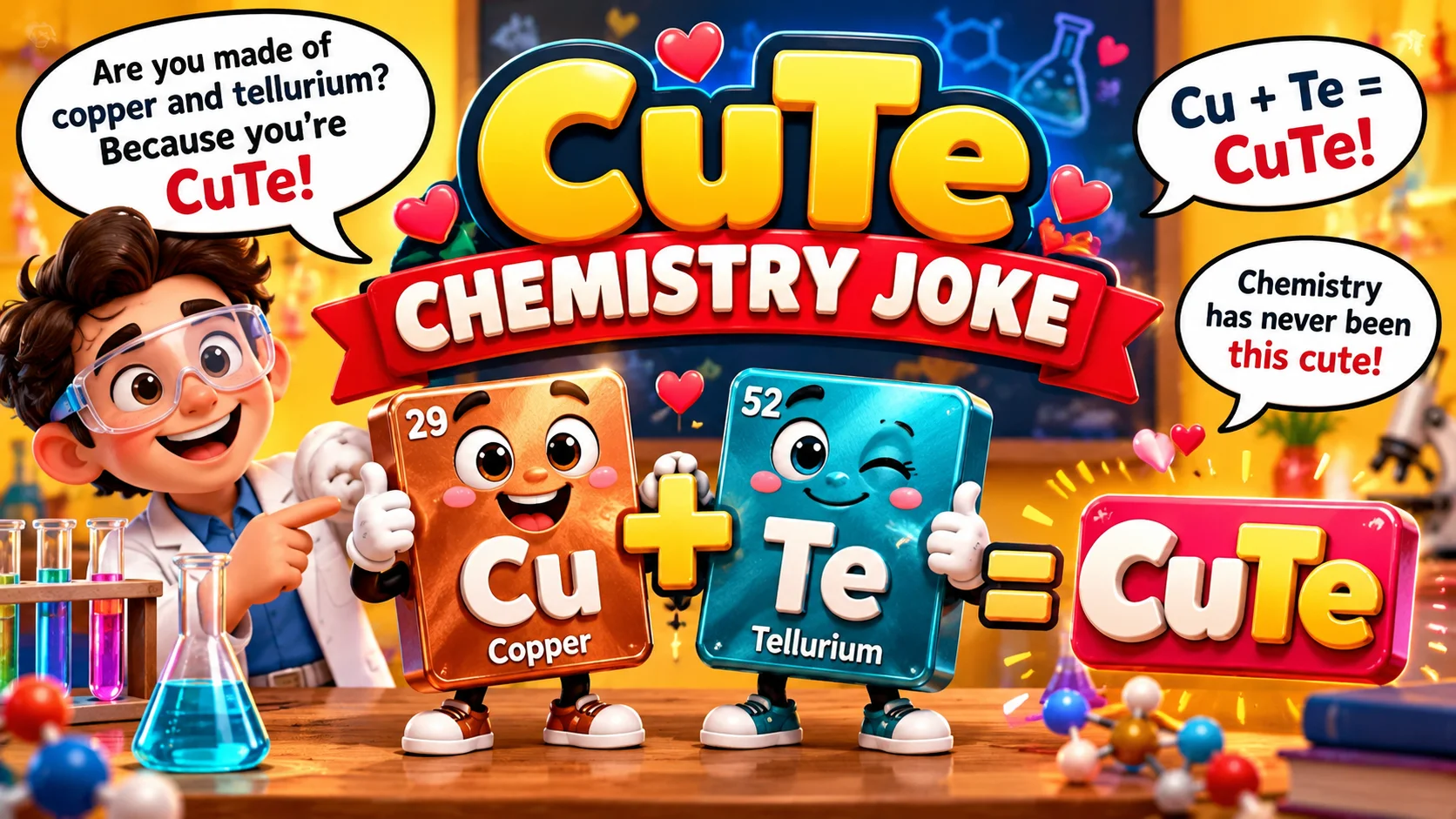
The Copper and Tellurium Joke
The copper and tellurium joke is a popular chemistry pick-up line built around two chemical symbols. It usually goes: Are you made of copper and tellurium? Because you’re CuTe. The joke works because copper has the chemical symbol Cu, while tellurium has the symbol Te. Put those symbols together and you get CuTe, which looks like the word cute.
That makes the line a simple chemistry-themed compliment. Instead of directly saying that someone is cute, the speaker disguises the compliment as a question about the periodic table. Chemistry students, science fans, and anyone familiar with element symbols can recognize the trick almost immediately. The same line appears in chemistry joke collections, pick-up-line lists, memes, and social-media discussions.
The appeal is not really the chemistry itself. The chemistry simply provides the setup for the wordplay. The punchline is the transformation of Cu + Te into CuTe.
How the Copper and Tellurium Joke Works
The joke depends on knowing the symbols of two elements:
- Copper = Cu
- Tellurium = Te
- Cu + Te = CuTe
- CuTe sounds like cute.
- Cute becomes the compliment at the end of the pick-up line.
The line therefore has two layers.
On the surface, the speaker is asking a chemistry question: Are you made of copper and tellurium?
The listener may initially expect an answer related to the physical or chemical properties of the elements.
Instead, the punchline changes the direction completely:
Because you’re CuTe.
That sudden shift is what makes the line a joke rather than an ordinary chemistry statement.
Copper and Tellurium Joke Meaning
The copper and tellurium joke meaning is quite straightforward once the element symbols are recognized.
Copper’s symbol is Cu, and tellurium’s symbol is Te. When the two symbols are placed beside each other, they spell CuTe. The capitalization makes the chemistry connection especially clear because chemical symbols use specific letter conventions.
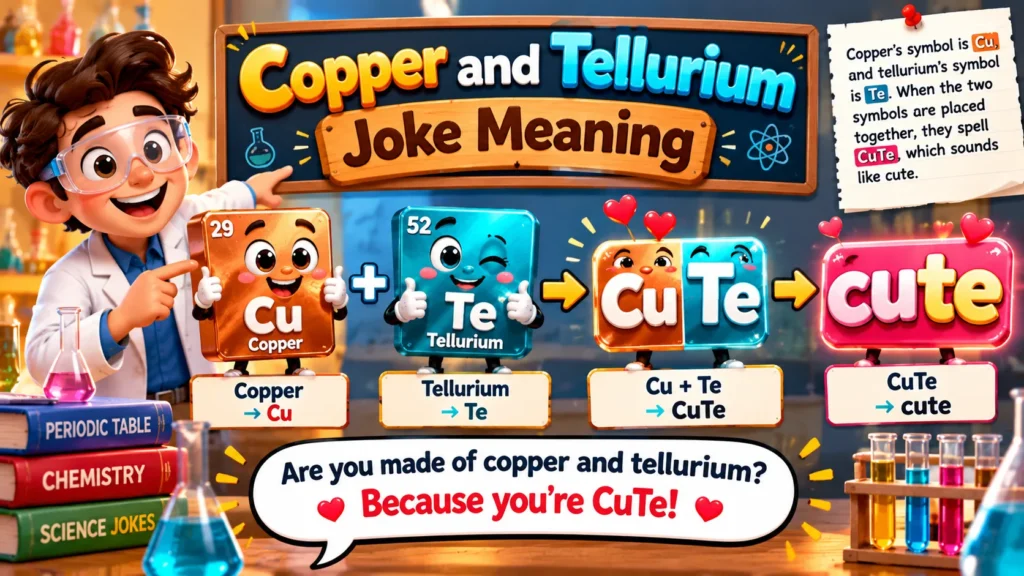
The wordplay can be broken down like this:
Copper → Cu
Tellurium → Te
Cu + Te → CuTe
CuTe → cute
So the speaker is essentially saying:
Are you made of copper and tellurium? Because you’re cute.
The chemistry version simply makes the compliment sound more clever and nerdy.
That is why the line is often described as a chemistry pick-up line rather than a traditional chemistry joke. It is designed to sound like a scientific question before revealing that the answer is actually a compliment. Chemistry joke collections list this exact structure among common science-themed pick-up lines.
Why CuTe Is the Punchline
The clever part is the capitalization.
Chemical symbols are not random abbreviations. Copper is represented by Cu, while tellurium is represented by Te. When those symbols are placed together, the result is:
CuTe
To someone familiar with chemistry, the capital letters immediately suggest element symbols. To everyone else, the result simply resembles the ordinary English word cute.
That gives the joke two interpretations at once:
- Chemistry interpretation: Cu and Te are element symbols.
- Wordplay interpretation: CuTe looks like cute.
- Romantic interpretation: The speaker is calling someone cute.
- Comedy interpretation: A scientific question turns into a compliment.
- Nerdy interpretation: The periodic table becomes a flirting tool.
This combination is what makes the line memorable.
The Original-Style Copper and Tellurium Pick-Up Line
The most recognizable version is short:
Are you made of copper and tellurium? Because you’re CuTe.
The line has become common enough to appear across chemistry joke websites and online conversations. A Chemistry Aid explanation explicitly identifies the joke as a play on the symbols Cu for copper and Te for tellurium, explaining that together they produce CuTe.
It also appears in chemistry-joke collections as a pick-up line. ThoughtCo, for example, includes the copper-and-tellurium line among its reader-submitted chemistry jokes.
The formula is effective because it is very short:
Question → chemistry setup → element symbols → wordplay → compliment
There is no unnecessary story. The punchline arrives almost immediately.
Why Chemistry Makes the Joke Better
Without the chemistry angle, saying you’re cute is simply a compliment.
The periodic table gives the same compliment a layer of wordplay.
That extra layer appeals especially to people who enjoy science humor because the listener gets a small reward for recognizing the symbols.
The joke can therefore work on several levels:
- A non-science reader can still understand the word cute.
- A chemistry student recognizes Cu and Te.
- A science fan appreciates the periodic-table reference.
- A person who likes pick-up lines gets the romantic angle.
- A pun lover recognizes the sound-based wordplay.
- A teacher can use it as a light classroom joke.
- A meme creator can turn the formula into a visual.
- A chemistry enthusiast can combine it with other element-based lines.
This is one reason the joke keeps appearing in lists of chemistry pick-up lines.
Copper and Tellurium Joke Variations
The original line is already short, but it can be adapted in several ways.
The Simple Version
Are you made of copper and tellurium? Because you’re CuTe.
This is the classic form and is easiest for a general audience.
The Chemistry Class Version
Are you Cu and Te? Because together you’re CuTe.
This version removes the question about being made of the elements and focuses directly on the symbols.
The Nerdy Version
I don’t need the whole periodic table to know you’re CuTe.
This version turns the chemistry reference into a more obvious compliment.
The Flirty Version
I think we have chemistry, but there’s one thing I know for sure: you’re CuTe.
This combines the CuTe pun with the broader phrase we have chemistry.
The Short Meme Version
Cu + Te = CuTe.
Sometimes the shortest version works best as a graphic or social-media caption.
Copper Tellurium Joke in Chemistry Memes
The copper tellurium joke is particularly suited to memes because the periodic table symbols can be displayed visually.
A meme can show two periodic-table squares:
Cu | Te
Then place the word:
CuTe
underneath them.
That makes the punchline understandable even before the reader sees the full sentence.
Common visual approaches include:
- Two periodic-table element boxes spelling CuTe.
- A chemistry classroom background.
- A student holding a periodic table.
- A laboratory-themed romantic card.
- A beaker or flask beside the phrase.
- A science-themed Valentine’s Day card.
- A chemistry notebook with Cu + Te = CuTe.
- Two element tiles placed next to a heart.
- A microscope or laboratory setup behind the joke.
- A simple blackboard-style chemistry graphic.
The visual format is useful because the joke is fundamentally about symbols forming a word.
Jump into Other Related Article
- Potato Jokes | 90+ Puns, Riddles and Dad Jokes with Answers
- 45 Gen Z Jokes That Actually Land (Plus Why Gen Z Humour Is So Weird)
Copper and Tellurium Joke for Valentine’s Day
The line also works naturally as a Valentine’s Day joke because the final word is a compliment.
Instead of using a traditional romantic message, a chemistry fan can write:
Are you made of copper and tellurium? Because you’re CuTe.
A card can then place Cu and Te in periodic-table-style boxes.
That creates a science-themed Valentine’s message without needing a long poem.
The format is especially suitable for:
- Chemistry students.
- Science teachers.
- STEM fans.
- Nerdy couples.
- Valentine’s Day cards.
- Classroom Valentine’s activities.
- Science club posts.
- Chemistry-themed memes.
- Social-media captions.
- Printable joke cards.
A chemistry-themed greeting-card version of the same concept is also available online, showing how the pun has moved beyond joke lists into visual gift and card formats.
Other Funny Chemistry Pick-Up Lines
The copper and tellurium joke belongs to a much larger category of science pick-up lines.
Many chemistry jokes work by combining element symbols, scientific vocabulary, and ordinary phrases.
Here are some examples:
- Are you fluorine, iodine, and neon? Because you’re F-I-Ne.
- Are you made of beryllium, gold, and titanium? Because you’re Be-Au-Ti-ful.
- Are you sodium? Because you’re Na-cho ordinary.
- Are we an exothermic reaction? Because you’re bringing the heat.
- Are you a carbon sample? Because I want to date you.
- Do you have 11 protons? Because you’re sodium fine.
- Is there a science room nearby, or am I just sensing the chemistry between us?
- I think we have chemistry.
- You must be an electron because you’re always on my mind.
- You and I would make a great chemical reaction.
The copper-and-tellurium line is especially simple because the element symbols produce an ordinary English word almost perfectly.
Several chemistry joke collections list CuTe alongside other element-based pick-up lines.
What Makes Chemistry Pick-Up Lines Funny?
Chemistry pick-up lines work by taking terminology that normally belongs in a classroom or laboratory and putting it into an unexpected social situation.
Instead of discussing chemical reactions, bonds, ions, or elements academically, the speaker uses them to flirt.
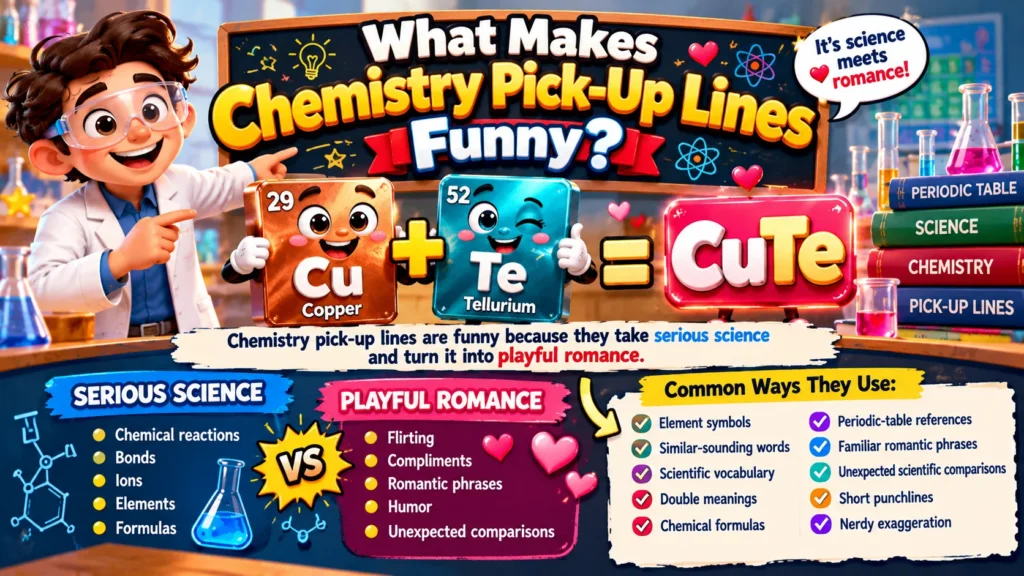
That creates a contrast between:
Serious science
and
Playful romance
The contrast is part of the humor.
The best chemistry lines are usually easy enough to understand without a chemistry degree.
They often rely on:
- Element symbols.
- Similar-sounding words.
- Scientific vocabulary.
- Double meanings.
- Chemical formulas.
- Periodic-table references.
- Familiar romantic phrases.
- Unexpected scientific comparisons.
- Short punchlines.
- Nerdy exaggeration.
The CuTe joke is a particularly clean example because the listener can understand the entire punchline from only two element symbols.
Copper and Tellurium: The Science Behind the Joke
Although the joke is primarily wordplay, the two elements themselves are real chemical elements.
Copper has the chemical symbol Cu and atomic number 29.
Tellurium has the chemical symbol Te and atomic number 52.
Their symbols are what matter for the joke.
The line does not depend on copper and tellurium actually forming some special substance that means cute. The humor comes from writing their symbols side by side.
That distinction is important because the joke is linguistic rather than a claim about the chemical behavior of the two elements.
The basic scientific facts are:
- Copper’s symbol is Cu.
- Copper’s atomic number is 29.
- Tellurium’s symbol is Te.
- Tellurium’s atomic number is 52.
- The symbols together produce CuTe.
- CuTe resembles the English word cute.
- The joke uses this resemblance as a compliment.
This is why the line can be scientifically recognizable without pretending that the phrase CuTe is a chemical formula for something called cute.
The Meaning of CuTe in the Joke
The capitalization CuTe is important because it makes the word look like two chemical symbols.
If written normally, cute is simply an adjective.
When written as CuTe, however, the reader can recognize:
Cu = copper
Te = tellurium
The capitalization therefore acts almost like the visual punchline.
A chemistry student may notice the element symbols immediately, while someone unfamiliar with the periodic table can still read the word as cute.
That dual readability is what makes the joke so effective in written form.
Copper and Tellurium Joke for Students
The line can also work as a light chemistry classroom joke.
Teachers or students might use it as an example of how chemical symbols can be combined to create wordplay.
It can be particularly useful when discussing:
- Chemical element symbols.
- Periodic-table abbreviations.
- Chemistry vocabulary.
- Science communication.
- Mnemonics.
- Classroom humor.
- Science-themed creative writing.
- STEM club activities.
The joke can also encourage students to search the periodic table for other combinations that resemble ordinary words.
That turns a simple joke into a small language exercise.
More Element Symbol Wordplay
The periodic table contains many symbols that can be combined into words or phrases, which is why chemistry lends itself so well to puns.
For example:
- Cu + Te = CuTe
- F + I + Ne = F-I-Ne
- Be + Au + Ti = Be-Au-Ti
- Ba + Be = BaBe
- Ne + Ar = NeAr
- Ac + He = AcHe
- S + He = SHe
Not every combination produces a perfect English word, but the possibility itself creates plenty of material for science humor.
The same basic principle behind the copper-and-tellurium joke appears throughout chemistry joke collections: scientific symbols are treated as pieces of ordinary language.
How to Tell the Copper and Tellurium Joke
This joke does not need a complicated delivery.
In fact, the best approach is usually to ask the question seriously and let the listener expect a scientific answer.
Then deliver the punchline.
A simple delivery looks like this:
Are you made of copper and tellurium?
Pause.
Because you’re CuTe.
The short pause creates a small amount of anticipation.
If you immediately explain that Cu = copper and Te = tellurium, the joke becomes less effective for someone who already knows chemistry. Letting the listener discover the connection is usually more fun.
For someone unfamiliar with chemistry, however, the explanation can make the line more understandable.
Copper and Tellurium Joke Picture Ideas
A copper and tellurium joke can be especially effective as a visual because the punchline can be displayed directly through element tiles.
A strong joke graphic could show:
- A Cu periodic-table tile.
- A Te periodic-table tile.
- The two tiles placed side by side.
- A heart or smile beneath them.
- The phrase Because you’re CuTe!
- A clean chemistry-lab background.
- A Valentine’s Day design.
- A notebook or classroom theme.
- A cute cartoon scientist.
- A science-themed couple illustration.
The most important part is keeping Cu and Te visually separate enough that the viewer can understand the wordplay.
Why the Joke Has Stayed Popular
The copper and tellurium line has appeared repeatedly across chemistry joke collections and online discussions over the years. It has also been reposted in social-media communities where people discuss cheesy or memorable pick-up lines.
Its continued popularity makes sense because it has several useful qualities.
It is:
- Short.
- Easy to remember.
- Easy to write.
- Easy to turn into a meme.
- Appropriate for a broad audience.
- Recognizable to chemistry students.
- Easy to explain.
- Naturally complimentary.
- Suitable for cards.
- Suitable for social media.
It also has the advantage of being both a science joke and a pick-up line, so it can appeal to two different types of readers at the same time.
The Copper and Tellurium Joke in One Line
If you want the shortest possible version, the whole joke can be reduced to:
Are you made of copper and tellurium? Because you’re CuTe.
That is the complete setup and punchline.
The first half creates the chemistry expectation.
The second half delivers the wordplay.
Everything else in longer versions is simply context, explanation, or decoration.
Conclusion
The copper and tellurium joke is a simple chemistry pun that turns two real element symbols into a playful compliment. Copper gives the joke Cu, tellurium gives it Te, and the combination creates CuTe, which reads as cute. That small piece of wordplay is enough to transform an ordinary compliment into a science-themed pick-up line.
Its popularity comes from its simplicity. You do not need an advanced chemistry background to understand the punchline, but knowing the periodic table makes the joke more satisfying. That combination of science, wordplay, and flirting has helped the line appear in chemistry joke collections, memes, cards, and online conversations. In short, it is a perfect example of how a couple of element symbols can create a surprisingly effective little joke.
What is the copper and tellurium joke?
The copper and tellurium joke is a chemistry pick-up line that says, Are you made of copper and tellurium? Because you’re CuTe. Copper has the symbol Cu and tellurium has the symbol Te, producing CuTe, which sounds like cute.
What is the copper and tellurium joke meaning?
The copper and tellurium joke meaning is that the speaker is calling someone cute using chemical symbols. Cu represents copper and Te represents tellurium, and together they spell CuTe.
What is the copper tellurium joke?
The copper tellurium joke is another way of referring to the same CuTe chemistry pun. It turns the symbols for copper and tellurium into the word cute.
What are the symbols for copper and tellurium?
Copper has the symbol Cu, while tellurium has the symbol Te. When placed together, they create CuTe, which is the basis of the joke.