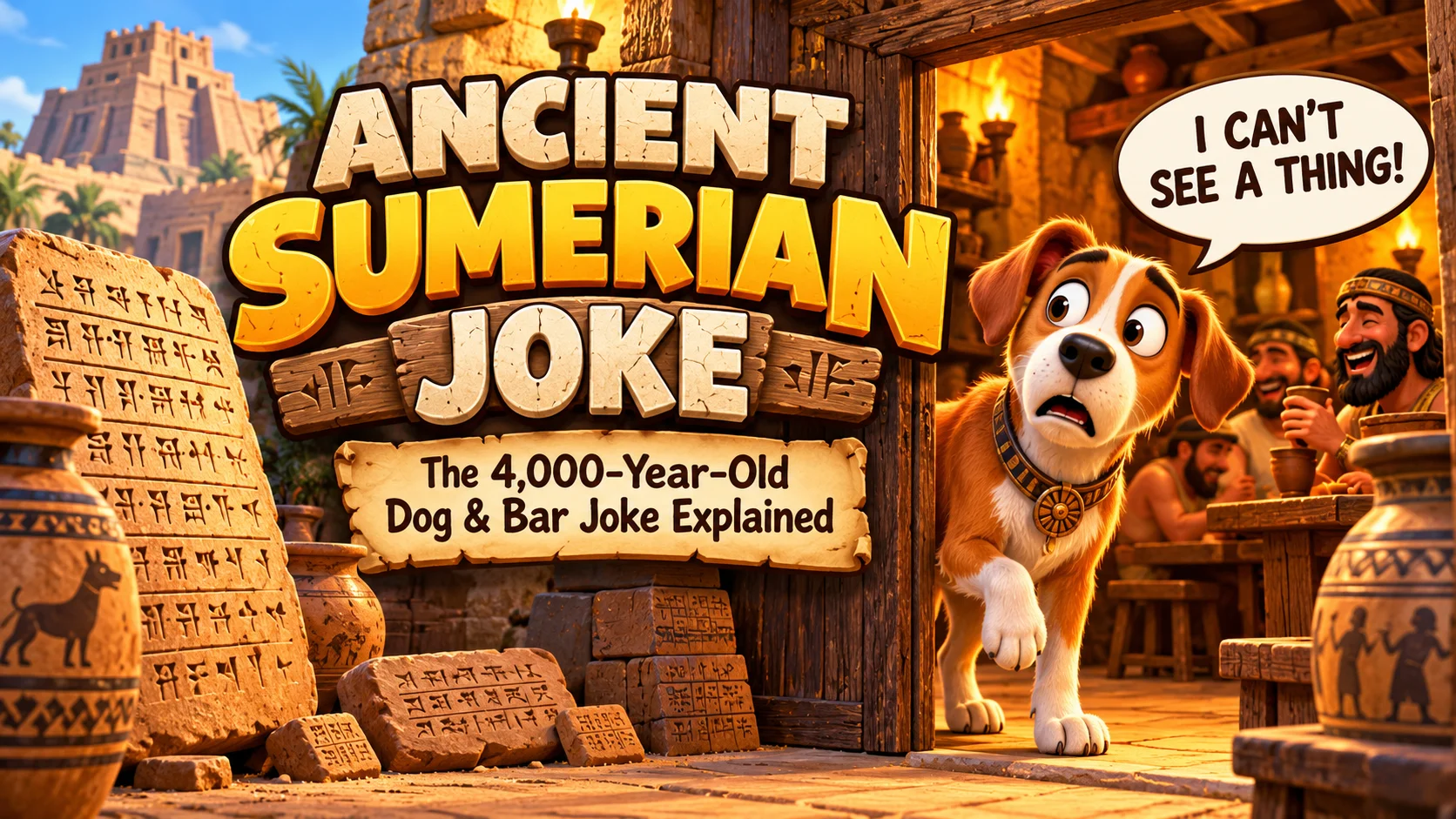
The ancient Sumerian joke is one of the oldest surviving examples of written humor and is often described as the world’s earliest recorded bar joke. It appears in a collection of Sumerian proverbs and features a dog entering a tavern before saying that it cannot see anything and will open something. The surviving translation is short, strange, and still difficult for modern readers to understand.
The joke is particularly interesting because it is roughly 4,000 years old and was preserved in cuneiform on ancient clay tablets. The material was discovered in the Nippur tradition of Sumerian proverb collections, and modern scholars have produced slightly different English translations because Sumerian is a dead language with difficult grammatical and cultural context.
The best-known English rendering is essentially a dog-in-a-bar joke, which makes the ancient text surprisingly similar in structure to modern jokes that begin with an animal walking into a bar.
The Ancient Sumerian Dog Bar Joke
The ancient Sumerian joke dog appears as proverb 5.77 in the Electronic Text Corpus of Sumerian Literature. Its English translation reads:
A dog entered a tavern and said: ‘I can’t see a thing. I’ll open this one!’
That is the complete punchline preserved in the translated text.
Unlike a modern joke, there is no surviving explanation telling us what the audience was expected to laugh at. The text is part of a larger collection of Sumerian proverbs involving animals and everyday observations.
The word translated as tavern is also important. Calling it simply a bar makes the joke sound remarkably modern, but the ancient setting was different from today’s pub or cocktail bar. Modern researchers therefore use translations such as tavern, inn, or bar depending on the interpretation.
The uncertainty is one of the most fascinating aspects of the joke: we can read the words, but we cannot confidently reconstruct the original audience’s reaction.
Ancient Sumerian Joke Origin and Historical Context
The joke comes from ancient Mesopotamian literature associated with the Sumerian proverb tradition. Sumerian was written in cuneiform and is one of the earliest known written languages. The surviving proverb collections preserve observations, sayings, animal anecdotes, and other short pieces of traditional wisdom.
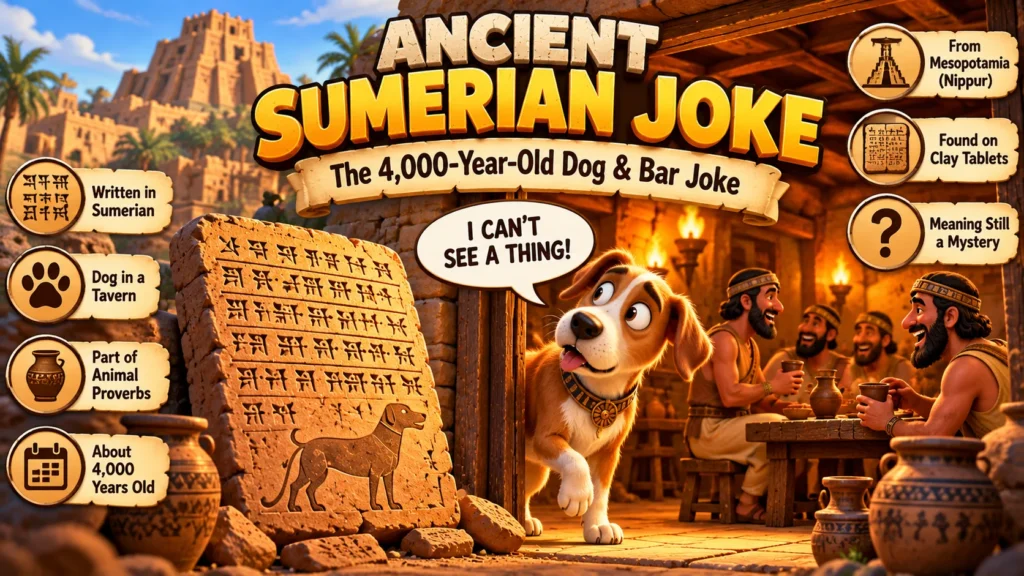
The bar joke is generally associated with the Old Babylonian period, with the surviving tablets dated around the early second millennium BCE. Wikipedia’s history of the bar-joke form identifies the earliest known example as Sumerian and notes that the tablets were excavated at Nippur.
WBUR’s Endless Thread describes the tablet as roughly 4,000 years old and discusses the difficulties involved in translating and interpreting the text.
The Electronic Text Corpus of Sumerian Literature provides the actual translated proverb as part of its Sumerian animal-proverb collection, giving the historical claim a much stronger textual foundation than social-media posts alone.
15 Key Facts About the Ancient Sumerian Joke
- The joke is written in Sumerian.
- It appears in a collection of animal proverbs.
- The text is identified as proverb 5.77.
- The central character is a dog.
- The setting is translated as a tavern.
- Some modern sources call it a bar joke.
- The surviving text is approximately 4,000 years old.
- The original writing used cuneiform.
- The text was preserved on a clay tablet.
- The surviving wording is extremely short.
- Modern scholars have produced somewhat different translations.
- The original humorous context is no longer fully understood.
- The proverb belongs to a larger collection of Sumerian animal sayings.
- It is widely described as one of the earliest surviving bar-joke examples.
- Its mystery has made it a popular subject of modern internet discussions and memes.
The Ancient Sumerian Bar Joke Translation
Translation is one of the biggest issues surrounding the ancient Sumerian bar joke.
The Electronic Text Corpus gives the version involving a dog entering a tavern and saying that it cannot see anything before deciding to open this one.
Other scholars have translated the final portion differently. WBUR’s reporting explains that Sumerian is a dead language and an isolate, meaning it is not known to be related to another surviving language family. That makes some ancient expressions particularly difficult to interpret with confidence.
Another translation presented in historical discussions renders the ending closer to Shall I open this door? rather than simply I’ll open this one. The difference may seem small, but it can completely change how a modern reader imagines the punchline.
This is why articles about the joke should avoid claiming that one modern English translation is unquestionably the exact original meaning.
The Mystery Behind the Sumerian Dog Joke
The biggest reason the Sumerian dog joke remains famous is that modern readers generally do not understand the punchline.
The text sounds like the setup for a joke, but the expected comedic connection has disappeared. WBUR’s investigation found that even modern researchers and ordinary listeners struggled to determine exactly what the dog was supposed to be doing.
One possibility is that the humor depended on a pun or pronunciation feature that cannot survive translation. This is common with ancient jokes because wordplay often depends on sounds that are completely different in another language.
Another possibility is that the joke depended on cultural knowledge about taverns, dogs, doors, or social behavior that is no longer obvious to us.
There is also a possibility that the saying was humorous in a broader proverb-like way rather than functioning like a modern one-line joke.
Possible Meanings of the Ancient Sumerian Joke
Several interpretations have been proposed for the strange ending. None should be presented as a definitive solution because the evidence does not establish one universally accepted punchline.
One interpretation connects the dog’s inability to see with opening a door or another object. The humor could have depended on the dog misunderstanding its surroundings.
Another theory connects the tavern setting with ancient Mesopotamian social life. Some researchers have suggested that taverns could have associations beyond ordinary drinking establishments, potentially giving the line a more adult or suggestive layer. Such interpretations remain speculative.
Other explanations focus on the possibility of a lost wordplay mechanism. If the original joke depended on the sound of a Sumerian word, an English translation could preserve the basic story while completely destroying the joke.
15 Possible Reasons the Joke No Longer Works
The ancient punchline may be difficult for modern audiences because of several factors:
- The original Sumerian language is no longer spoken.
- Sumerian wordplay may not survive translation.
- Ancient cultural references may have disappeared.
- The meaning of tavern may differ from a modern bar.
- The final word or phrase has translation uncertainty.
- The original audience understood everyday Sumerian customs.
- The joke may depend on a forgotten social convention.
- The dog may represent something symbolic.
- The door or one mentioned in the translation may have a specific context.
- The humor could involve pronunciation.
- The proverb may have contained an implication that is no longer obvious.
- Ancient humor did not necessarily follow modern comedy structures.
- The text may be a humorous proverb rather than a conventional joke.
- Parts of the original cultural setting have disappeared.
- Modern readers lack the reaction that the original audience would have had.
Ancient Sumerian Joke Dog and the Modern Bar Joke
The connection between the ancient proverb and the modern walks into a bar format is what makes the discovery particularly entertaining.
Modern bar jokes frequently begin with a person or animal entering a bar, followed by an unexpected action or punchline. The Sumerian proverb has a surprisingly similar structure: an animal enters a tavern and immediately says something unexpected.
Wikipedia’s history of the bar joke identifies the Sumerian example as the earliest known recorded version of this joke type.
This does not mean modern comedians directly inherited today’s exact joke from Sumer. Rather, it demonstrates that the basic idea of placing an unusual character in a drinking establishment is extremely old.
A dog entering a tavern may therefore be the ancient ancestor—or at least an extraordinarily early example—of the familiar animal walks into a bar joke structure.
Jump into Other Related Article
- Shark Jokes | 60+ Funny Ones for Kids & Adults
- Potato Jokes | 90+ Puns, Riddles and Dad Jokes with Answers
Ancient Sumerian Bar Joke and Dog Humor
The dog is not an accidental choice in the proverb collection. The Electronic Text Corpus contains many other Sumerian proverbs and anecdotes involving dogs, including sayings about dogs, masters, bones, chains, food, and behavior.
This broader context matters because the dog was already a recognizable subject in Sumerian humor and proverbial literature.
The collection includes other amusing or observational dog sayings, suggesting that ancient writers were comfortable using animals to comment on human behavior.
The tavern proverb therefore belongs to a wider tradition rather than appearing as an isolated reference to dogs.
Ancient Sumerian Joke and Internet Culture
The ancient joke became particularly famous online after a social-media post in March 2022 brought the unusual translation to a much larger audience. Know Your Meme documents the subsequent viral discussion surrounding the Sumerian bar joke.
People began debating what the dog was actually supposed to be doing. Some users treated the line as intentionally absurd, while others tried to reconstruct a hidden pun or cultural reference.
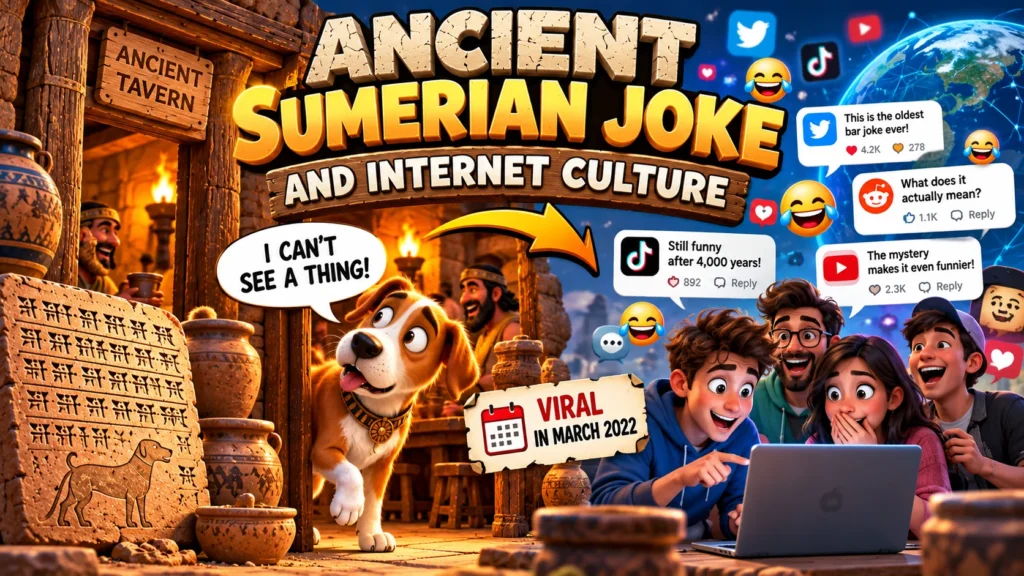
WBUR subsequently devoted a two-part Endless Thread investigation to the joke and the broader question of how humor survives across thousands of years.
That modern reaction has become part of the joke’s history. The fact that thousands of people are still trying to understand the punchline is arguably one of the funniest things about it.
Why the Ancient Sumerian Joke Still Matters
The ancient Sumerian joke is valuable even if its punchline cannot be confidently reconstructed.
It demonstrates that people in ancient Mesopotamia recorded short humorous or proverb-like statements alongside other forms of written literature. The text provides a tiny glimpse into how everyday observations could be preserved in writing thousands of years ago.
It also shows the limitations of historical interpretation. Having the original words does not necessarily mean we understand their original cultural meaning.
Humor is particularly fragile because it often depends on timing, pronunciation, shared knowledge, social expectations, and context.
That is why the Sumerian joke is useful not only as a curiosity but also as an example of how much cultural information can disappear even when the written words survive.
Conclusion
The ancient Sumerian joke is a roughly 4,000-year-old proverb featuring a dog entering a tavern and saying that it cannot see anything before deciding to open something. The Electronic Text Corpus of Sumerian Literature preserves the translated text as proverb 5.77.
It is widely described as the earliest known recorded bar joke, although the exact meaning of its punchline remains uncertain. Different translations and interpretations exist, and the original Sumerian cultural context is no longer completely recoverable.
The joke became a modern internet curiosity after going viral in 2022, leading people to debate why the ancient audience might have found it funny.
So, the most accurate answer is also the simplest one: we have the ancient joke, but we may have lost the punchline.
What is the ancient Sumerian joke?
It is a Sumerian proverb involving a dog that enters a tavern and says it cannot see anything before deciding to open something.
What is the ancient Sumerian bar joke?
The ancient Sumerian bar joke is the dog-and-tavern proverb commonly described as the earliest surviving example of a bar-joke format.
How old is the ancient Sumerian joke?
The surviving tablet tradition is roughly 4,000 years old, dating to the early second millennium BCE.
Why is the Sumerian dog joke funny?
The original reason is uncertain. Scholars have suggested lost wordplay, cultural context, or meanings connected with the tavern setting, but no interpretation is universally established.
Where was the ancient Sumerian joke found?
The proverb belongs to Sumerian material associated with tablets excavated at Nippur in ancient Mesopotamia.
Is the Sumerian joke really the oldest joke?
It is often described as one of the oldest surviving written jokes and specifically as the earliest known bar joke. Calling it simply the oldest joke ever is less precise because other ancient humorous sayings and texts also survive.
What does the Sumerian dog joke mean?
Its exact meaning is unknown. The surviving translation is clear enough to understand the basic scene, but the cultural or linguistic mechanism behind the humor has probably been lost.