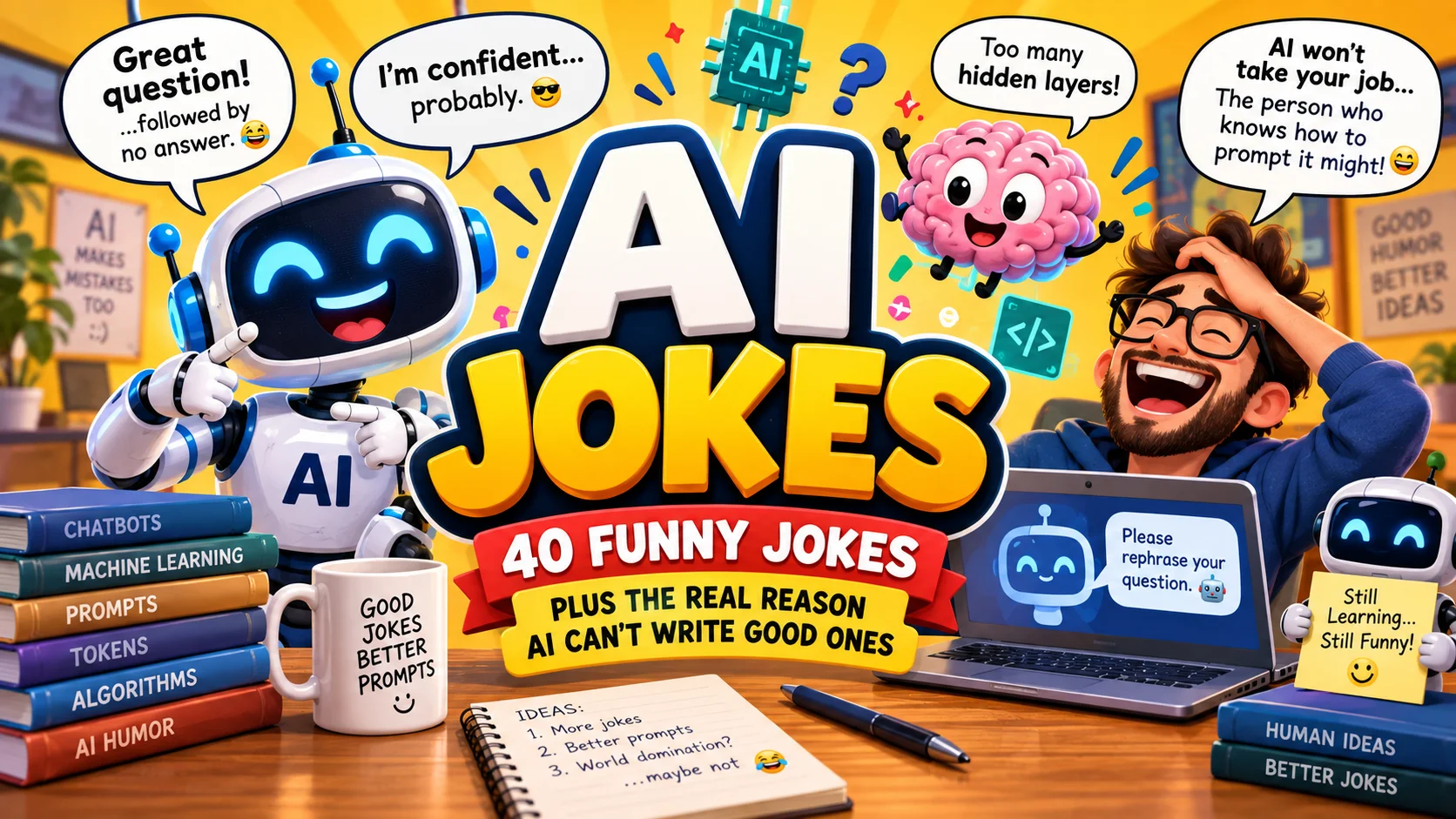
Type tell me a joke into any chatbot and you’ll get something suspiciously familiar. There’s a documented reason for that, and it’s stranger than most people expect. This page gives you 40 original AI jokes written by a human, covering chatbot gags, dad jokes about machine learning, one liners for tech Slack channels, and jokes for developers. Then it explains what researchers actually found when they tested whether AI can be funny, why AI joke generators keep repeating themselves, and how to prompt one for better results.
Why AI Is Such Good Joke Material
AI humour works because everyone now shares the same small frustrations: the chatbot that apologises and then repeats the same answer, the autocomplete that guesses wrong with total confidence, and the meeting where someone suggests let’s just ask AI. The technology also carries a vocabulary full of accidental double meanings, from hallucination to training to model. Add the gap between what AI promises and what it delivers on a Tuesday afternoon, and the material writes itself. These jokes work in tech Slack channels, conference talks, and developer group chats.
The Confidence Gap
The funniest thing about modern AI isn’t that it gets things wrong. It’s that it gets things wrong with perfect composure. That mismatch between certainty and accuracy is the engine behind most good AI jokes.
Jargon That Sounds Like a Punchline
Terms like hallucination, prompt, token, and fine-tuning all mean something completely different outside the field. That’s free material for anyone writing about this stuff.
Funny AI Jokes About Chatbots
These are the everyday gags about talking to a machine that is trying very hard to seem helpful. They land with anyone who has argued with a customer service bot or watched a chatbot confidently invent a fact. Use them in a tech newsletter, a team chat, or a talk opener.
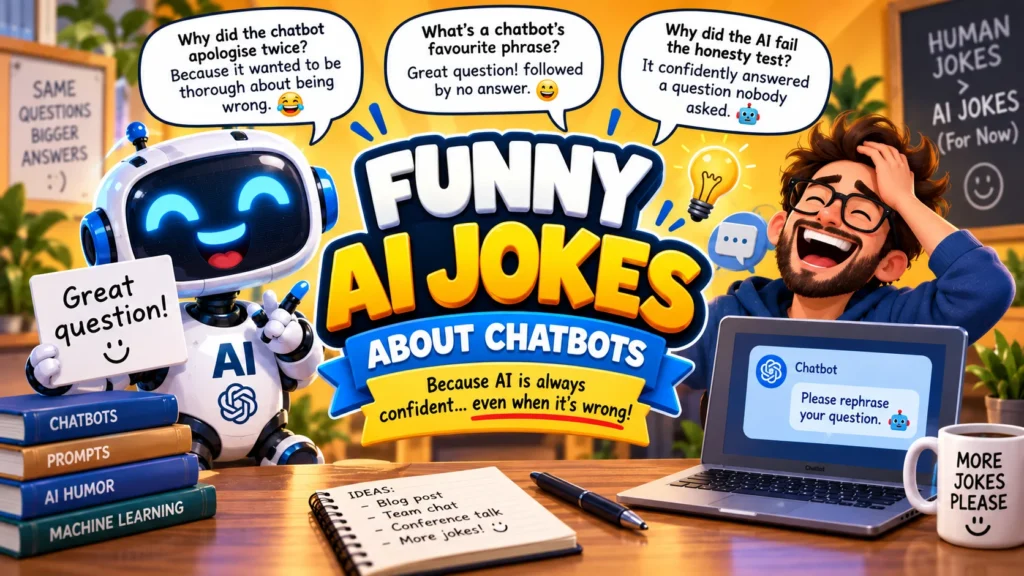
- Q: Why did the chatbot apologise twice? A: It wanted to be thorough about being wrong.
- Q: What’s a chatbot’s favourite phrase? A: Great question! followed by no answer.
- Q: Why did the AI fail the honesty test? A: It confidently answered a question nobody asked.
- Q: How do you know a chatbot is stalling? A: It restates your question back to you in bullet points.
- Q: Why don’t chatbots ever say I don’t know? A: They weren’t trained on humility.
AI Dad Jokes for Developers and Tech Teams
A good AI dad joke should make an engineering channel groan in unison. These are corny by design and safe for any workplace. Drop one in standup, put one in a slide deck, or use one to open a demo. The worse the pun, the better the reaction from a room of developers.
- Q: Why did the neural network go to therapy? A: Too many hidden layers.
- Q: Why did the model get fired? A: It overfits at the office.
- I asked an AI to write my code review. It approved everything, which is how I knew it wasn’t paying attention.
- Q: What do you call an AI that won’t stop talking? A: A large language model, technically.
- Q: Why was the algorithm bad at relationships? A: It kept optimising for the wrong outcome.
Jump into Other Related Article
- Basketball Jokes | Kids’ Classics, Dad Jokes, and Why the Inventor Had a Losing Record
- Shark Jokes | 60+ Funny Ones for Kids & Adults
- Cat Joke Memes | The Formats, the Real Origins, and How to Make Your Own
- 80+ Hot Dog Jokes | Funny, Clean, Adult, One Liners & Puns
AI Joke One Liners
One liners are what you actually use, because nobody has time for a setup in a group chat. These need no context and work as captions, Slack replies, and conference slide footers.
- My AI assistant has three settings: helpful, confident, and wrong.
- I’ve never met anything so sure of itself and so frequently mistaken.
- AI won’t take your job. The person who knows how to prompt it might.
- I asked for a summary and got a summary of the summary.
- The future is here, and I would like you to rephrase your question.
- My productivity doubled and so did my proofreading.
Jokes About AI Replacing Jobs
This is the anxious corner of AI humour, and the trick is to joke about the situation rather than at anyone’s expense. These work in conference talks and industry newsletters, where the audience is already thinking about it. Keep them wry rather than bleak, since nobody wants a punchline that sounds like a layoff notice.
- Q: Will AI take my job? A: Only the parts you hated, and then it’ll do them badly.
- AI replaced my spreadsheet work. Now I spend that time checking what AI did to my spreadsheets.
- Q: What’s the safest job in the AI era? A: Whoever has to explain the output to management.
- Q: Why isn’t AI running the company yet? A: It refuses to attend meetings, which frankly is the smartest thing it’s done.
Why AI Jokes Are Usually Bad: What the Research Says
Here’s the part most joke lists skip entirely. Researchers have actually measured whether AI can be funny, and the results explain a lot about why every chatbot seems to tell you the same joke.
The 25-Joke Problem
Sophie Jentzsch and Kristian Kersting tested this directly. When they asked ChatGPT for jokes across 1,008 separate trials, more than 90% of the responses were the same 25 jokes. The researchers concluded the jokes weren’t being newly generated at all but recalled from training data. The same study found the model could explain genuine jokes well, but when given something that wasn’t actually a joke, it would invent a confident explanation rather than admit the premise didn’t work.
What Professional Comedians Found
A Google DeepMind team ran workshops with 20 professional comedians who used large language models as writing tools. The comedians found the output broadly unusable: generic, stereotypical, and lacking the edge a joke needs to land. One participant compared the material to cruise ship comedy from the 1950s, only slightly less offensive. Some did find the tools useful for generating rough structure they could then rewrite themselves.
- Over 90% of 1,008 ChatGPT jokes were drawn from just 25 jokes.
- The model explained real jokes well but invented explanations for fake ones.
- Professional comedians rated LLM output as bland and generic.
- Safety filtering removed much of what makes comedy work.
- Outputs defaulted to stereotypes rather than specific observations.
- Several comedians still found the tools useful for structure, not punchlines.
How AI Joke Generators Actually Work
An AI joke generator is usually a wrapper around a language model with a prompt telling it to produce jokes in a given format. Some use a small curated database instead and simply shuffle existing jokes. Neither approach invents humour the way a comedian does. The model predicts likely text based on patterns it has seen, which is exactly why common formats like light bulb jokes and bar jokes dominate its output. Understanding this is the difference between being disappointed and using the tool well.
- Most free generators are a prompt wrapped around a general-purpose model.
- Some are just a joke database with a shuffle button.
- Output quality depends far more on your prompt than on the tool.
- Generic prompts produce the same recycled 25 jokes.
- Specific, personal details in the prompt produce fresher results.
- Treat the output as raw material to rewrite, not a finished joke.
How to Prompt an AI for Better Jokes
If you’re going to use one anyway, a few changes make a real difference. The core problem is that a vague request produces the statistically most likely joke, which is by definition the one everyone has heard. Giving the model specific material forces it off that well-worn path.
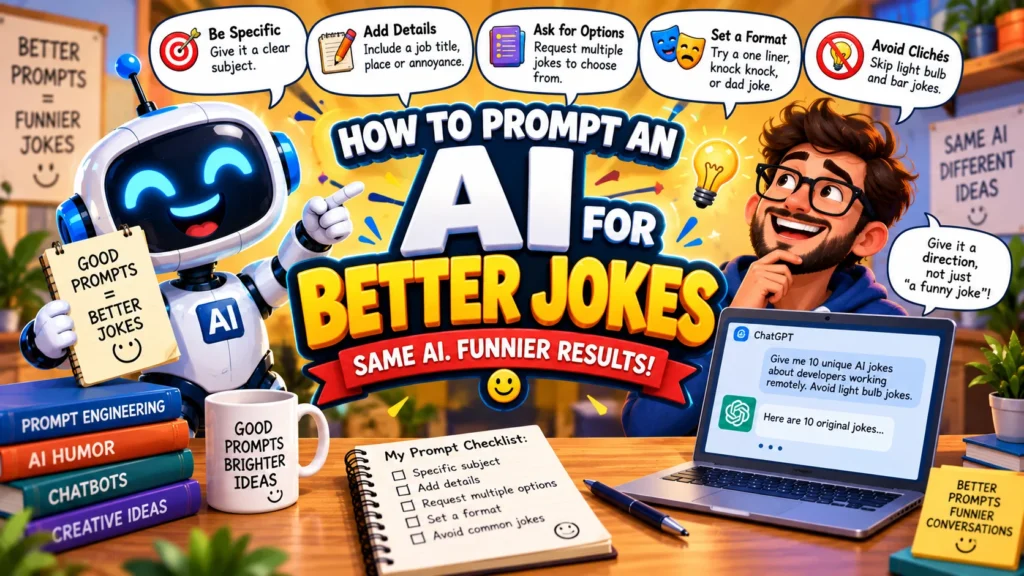
- Give it a specific subject rather than asking for a funny joke.
- Supply real details: a job title, a place, an annoyance.
- Ask for ten options and keep one, rather than asking for one.
- Name a format explicitly, such as a one liner or a knock knock joke.
- Ask it to avoid common setups like light bulb and bar jokes.
- Rewrite the punchline yourself; that’s usually the weakest part.
Is AI a Joke, or Getting Better?
Plenty of people search for AI as a joke out of genuine scepticism rather than looking for humour. The fair answer is that AI is extremely good at some things and notably poor at humour specifically, because jokes require surprise, timing, and a point of view, and language models are built to produce the expected next word. That’s close to the opposite of what a punchline needs. The gap may narrow, but as of now the research consistently finds human comedians well ahead.
conclusion
AI jokes are funny mostly because of the gap between how confident these systems sound and how often they’re wrong. The 40 jokes above were written by a person for exactly that reason, since the research shows a chatbot asked for a joke will hand you one of the same 25 every time. Use an AI joke generator if you like, but treat its output as a first draft and write the punchline yourself. That’s still the part machines haven’t cracked.
What is the best AI joke?
A good short one: My AI assistant has three settings: helpful, confident, and wrong. It works because it names the actual failure mode everyone recognises
Why does AI keep telling the same joke?
Research found that over 90% of 1,008 jokes generated by ChatGPT were the same 25 jokes, recalled from training data rather than newly created.
Are AI joke generators any good?
They’re useful for raw material and structure, but professional comedians who tested them found the punchlines bland and generic. Expect to rewrite the output.
Can AI understand humour?
Partly. Studies show models can explain genuine jokes accurately, but they will also invent confident explanations for things that aren’t jokes at all.
How do I get better jokes out of an AI?
Give it specific subject matter, request several options, name the format, and tell it to avoid common setups. Then rewrite the punchline yourself.
Will AI ever be genuinely funny?
Possibly, but humour requires surprise and a point of view, which sits awkwardly against a system designed to predict the most likely next word.