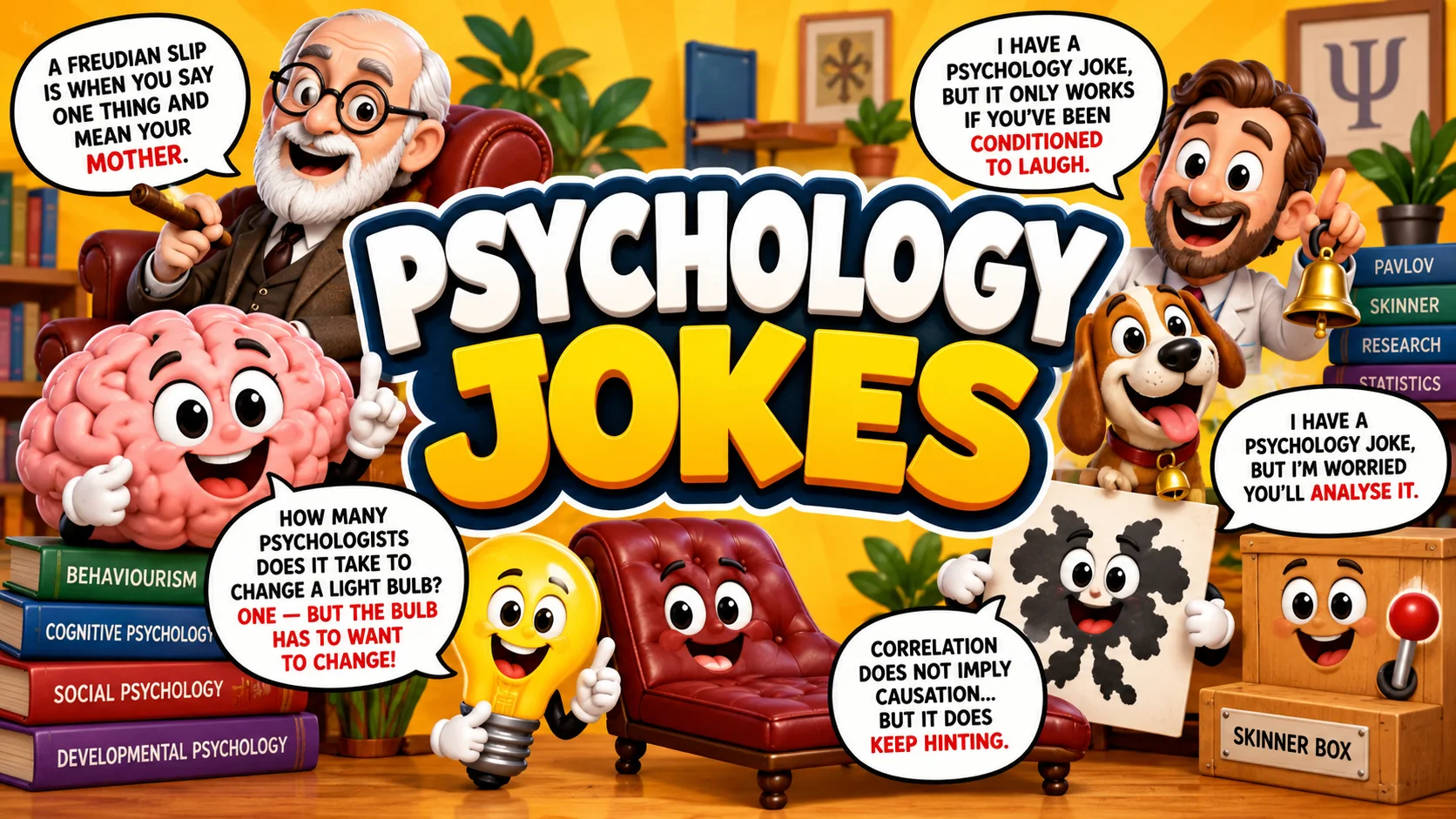
Psychology jokes are unusually good jokes, because the field has spent a century producing terminology that sounds like a punchline before anyone touches it. Ego, conditioning, denial, significance and repression all mean something specific to a psychologist and something funnier to everyone else. This page collects the best psychology jokes oneliners, Freud and Pavlov classics, therapy jokes and research humour and then explains what the research actually says about why any of it is funny. It also covers the penguin in the desert joke, which is the one most people are searching for.
Best Psychology Jokes and OneLiners
These are the general purpose psychology jokes: short, clean and usable in a lecture, a staff room or a group chat. They assume a little familiarity with the field but nothing beyond an introductory course. Say one, wait for the groan, and move on. The best of them work on two levels, which is exactly what a good discipline joke should do.
- How many psychologists does it take to change a light bulb? One but the bulb has to want to change.
- I have a psychology joke, but I’m worried you’ll analyse it.
- I have a psychology joke, but it only works if you’ve been conditioned to laugh.
- A Freudian slip is when you say one thing and mean your mother.
- Two behaviourists meet in the street. One says: You’re fine. How am I?
- Why don’t psychologists play hide and seek? Good luck hiding from someone who reads posture.
- I told my analyst about my shadow self. He said they’d been expecting it.
- The Rorschach test is the only exam where every answer is wrong and also about you.
- What’s a psychologist’s least favourite kind of music? Anything with unresolved tension.
- Cognitive dissonance is knowing this joke isn’t funny and telling it anyway, cheerfully.
Freud, Pavlov and Skinner Jokes
The three names everyone remembers from an introductory course are also the three that generate the most jokes, because each one comes with a single instantly recognisable idea. Freud gives you the unconscious and the mother, Pavlov gives you the bell, Skinner gives you the box and the reinforcement schedule. That shared shorthand means you can set up a joke in four words. These are the ones that circulate in every psychology department on earth.
Pavlov Jokes
Pavlov jokes work because conditioning is a simple idea with an obvious comic reversal the experimenter being conditioned instead of the dog. The most famous one in circulation has Pavlov sitting in a bar when the phone rings, and he suddenly says: I forgot to feed the dog. It is neat, it is short, and it is the joke every psychology student learns first.
- Pavlov is at a bar. The phone rings. He says: I forgot to feed the dog.
- Pavlov’s dog is now conditioned to hear this joke and sigh.
- Why did Pavlov’s beard ring? Because it was hard to condition.
Freud Jokes
Freud jokes rely on the assumption that everything means something else, usually about your parents. That assumption is itself the joke, which is why these still land even with people who think psychoanalysis has been superseded.
- A psychoanalyst tells you what everybody already knows, in language nobody understands.
- I dreamed about a cigar. My analyst says we should talk about it for four years.
- Freud walks into a bar and immediately assumes it is about his mother.
Skinner and Behaviourism Jokes
Behaviourist jokes are built on the deadpan idea that internal experience does not count. That framing makes them ideal for oneliners, because the punchline is always a refusal to acknowledge feelings.
- A behaviourist doesn’t ask how you feel. He asks what you did about it.
- I put my thoughts in a Skinner box. Nothing came out, but they press the lever regularly.
Therapy and Therapist Jokes
Therapy jokes are the most shared category, and the good ones are affectionate rather than mocking. They work best when the target is the format of the fifty minute hour, the silence, the question answered with another question rather than the person seeking help. Keep them warm; a therapy joke that punches at clients rather than at the process stops being funny immediately.
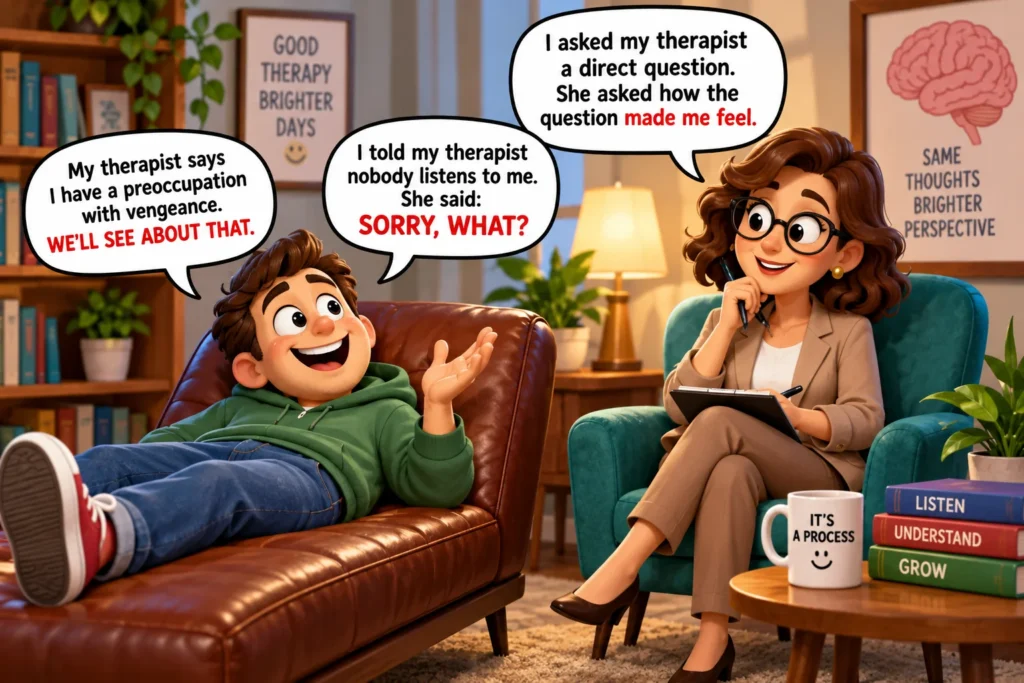
- My therapist says I have a preoccupation with vengeance. We’ll see about that.
- I asked my therapist a direct question. She asked how the question made me feel.
- The fiftyminute hour is the only psychological phenomenon everybody has personally verified.
- I told my therapist nobody listens to me. She said: Sorry, what?
- My therapist and I have a breakthrough every week. Mostly about the parking.
Research, Statistics and AP Psychology Jokes
Anyone who has taken a research methods course has an entirely separate joke vocabulary built out of p values, sample sizes and the phrase more research is needed. An AP psychology joke usually lives here too, because the exam is mostly definitions and brain anatomy. These are the jokes that get a laugh in a seminar and total silence anywhere else.
- Why was the value sad? It never got to be significant.
- Correlation does not imply causation, but it does keep hinting.
- My sample size was four. My conclusions were enormous.
- I studied all night for AP Psych and can now name every brain region except the one holding my notes.
- I’d climb Maslow’s hierarchy, but I’m still stuck at the wifi level.
- More research is needed is the academic version of no comment.
- The most replicated finding in psychology is that findings do not replicate.
The Penguin in the Desert Joke, Explained
This is the joke people search for by name, and it is not really about psychology it is a favourite example in psychology because of how cleanly it demonstrates how jokes work. A penguin is driving through the desert when his car starts smoking, so he takes it to a garage. While the mechanic works, he buys an ice cream and, having flippers rather than hands, makes a complete mess of eating it. The mechanic looks up and says it appears he has blown a seal. The penguin replies that no, it is just ice cream.
- The setup builds a plausible mechanical scenario
- Blew a seal has an obvious meaning in a garage
- The penguin’s reply forces a second, animal reading
- Your brain has to rebuild the whole sentence to get the joke
- That rebuild is the laugh it is incongruity resolution in one line
What Makes a Joke Funny? The Psychology
Humour research is a genuine field, and it has produced four major theories rather than one settled answer. Each explains part of the picture and none explains all of it, which is roughly what you would expect from something as varied as laughter. Knowing them is useful beyond trivia, because they tell you why a joke failed. Most dead jokes have simply broken one of these four rules.

IncongruityResolution Theory
This is the dominant account. A joke sets up an expectation, violates it, and then offers a second interpretation that makes the violation make sense. The laugh comes at the moment of resolution when your brain finds the alternative reading. The penguin joke above is a textbook demonstration, which is why it gets used so often.
- Setup creates an expectation
- Punchline violates it
- A second reading resolves the violation
- The laugh arrives at the moment of resolution
Benign Violation Theory
Proposed by researchers Peter McGraw and Caleb Warren, this theory holds that humour requires something to be simultaneously a violation wrong, threatening or unexpected and benign, meaning safe. Too benign and it is boring; too much of a violation and it is offensive. This explains why the same joke can kill in one room and horrify another: distance, timing and audience decide which side of the line it falls on.
- Humour needs a violation and a sense of safety at once
- Purely safe content is not funny, only pleasant
- Pure violation is not funny, only distressing
- Audience, timing and personal distance move the line
Superiority Theory
The oldest account, going back to classical philosophy, is that we laugh at the misfortunes or foolishness of others as a way of feeling briefly superior. It explains slapstick and mockery well and explains wordplay badly. It is also the theory that quietly warns you which jokes will cost you a friend.
- Laughter as a small assertion of superiority
- Explains mockery, slapstick and schadenfreude
- Explains puns and absurdism poorly
Relief Theory
Associated with Freud, this account treats laughter as the release of builtup psychological tension. It explains why people laugh at funerals, in hospitals and during genuine crises, and why taboo subjects generate such strong reactions.
- Laughter as a release of accumulated tension
- Explains nervous and inappropriate laughter
- Explains why taboo topics produce strong responses
Reverse Psychology Jokes
Reverse psychology is the one bit of the field that everyone thinks they can use, which is exactly why it rarely works. The jokes about it almost all rely on the audience knowing the trick and refusing to fall for it. Keep them short the whole gag is the reader realising what you are doing.
- Whatever you do, do not read this bullet point.
- Reverse psychology works on everyone except people who know about reverse psychology, which is now everyone.
- I told my child not to eat any vegetables. He is four, not stupid.
- Please do not share this article with anyone.
It’s Just a Joke: What That Phrase Usually Means
There is a real psychological literature behind the phrase people reach for after a joke lands badly. Saying it’s just a joke reframes a statement as play after the fact, which shifts responsibility for the reaction onto the listener rather than the speaker. Researchers studying disparagement humour have found that the humorous frame can make prejudiced content more socially acceptable, precisely because objecting to it looks humourless. None of that means jokes are dangerous or that people should stop making them it means the defence itself is worth recognising when you hear it.
- The phrase retroactively reframes a statement as play
- It shifts responsibility for the reaction onto the listener
- Disparagement humour research examines this specific effect
- Recognising the move is not the same as banning jokes
- A joke that needs the defence usually knew it was risky
Jump into Other Related Article
- Food Jokes: Deliciously Funny Jokes That Will Make You Hungry
- Monthly Jokes: A Month Full of Laughs
- Weekly Jokes: A Funny Joke for Every Day of the Week
- Funny Jokes That Will Make You Laugh
- A Joke That Is a Play on Words Is Called a Pun | Full Explanation
- Sports Jokes | 50+ Funny Ones (Plus the Greatest Sports Hoax Ever)
Is Psychology a Joke? Addressing the Criticism
A meaningful share of people searching psychology as a joke are not looking for humour at all, they are expressing scepticism, and it deserves a straight answer rather than a defensive one. The replication crisis was real: a large scale effort to reproduce published psychology findings succeeded far less often than the field expected, and several famous results have not held up. Evolutionary psychology draws particular criticism for producing hypotheses that are difficult to falsify. What follows from this is that psychology needed reform, not that it is worthless and much of that reform, including preregistration and open data, came from inside the field.
- The replication crisis exposed genuine methodological problems
- Several celebrated findings have failed to reproduce
- Evolutionary psychology is criticised for unfalsifiable hypotheses
- Preregistration and open data emerged as responses from within
- Scepticism about specific findings is healthy; blanket dismissal is not
Where Psychology Jokes Cross a Line
There is a clear difference between joking about the discipline and joking about the people it treats. Jokes about Freud, values, the fifty minute hour and the profession itself are fair game and always have been. Jokes that use a diagnosis as a punchline are a different thing, and they land badly for a good reason. Roughly one in four people will experience a mental health condition, so a joke about mental illness is almost always being told in front of someone it applies to. Keeping the target on the field rather than on patients costs nothing and keeps the material usable anywhere.
- Joke about the discipline, the jargon and the profession
- Do not use a diagnosis or a symptom as a punchline
- Self deprecating jokes are the teller’s own to make
- Assume someone in the room is personally affected
- A joke that needs a diagnosis to work usually is not the joke
Conclusion
Psychology jokes work because the field supplies both the vocabulary and the explanation for why the vocabulary is funny. Learn four or five classics: the light bulb, Pavlov’s phone, the behaviourists in the street and you will have something for any seminar, staff room or first date with someone in the field. Then read the theory section again, because knowing why a joke works is genuinely useful for writing new ones. Keep the target on the discipline rather than on people who are unwell, and the material stays funny in every room.
- Learn three or four classics rather than a long list
- Incongruity resolution explains most jokes you will tell
- Benign violation explains most jokes that fail
- Aim at the field, never at a diagnosis
What is the penguin in the desert joke?
A penguin’s car breaks down in the desert. While it is being repaired he eats an ice cream messily, and the mechanic says it looks like he blew a seal. The penguin replies that it is just ice cream.
What makes a joke funny according to psychology?
The leading account is incongruity resolution: a joke sets an expectation, breaks it, and offers a second reading that resolves the break. Benign violation theory adds that the content must feel both wrong and safe at the same time.
What is the best psychology joke?
The most repeated one is the light bulb joke: it takes one psychologist, but the bulb has to want to change. The Pavlov phone joke runs a close second.
What is a reverse psychology joke?
It is a joke that instructs the reader to do the opposite of what the teller wants, relying on the audience recognising the trick. Whatever you do, don’t read this as the standard form.
Is psychology a real science?
Yes, though it has had genuine methodological problems, including a replication crisis in which many published findings failed to reproduce. The field responded with reforms such as preregistration and open data sharing.
Are mental health jokes okay?
Jokes about the profession, the jargon and therapy as a format are widely accepted. Jokes that use a diagnosis or symptom as the punchline are not, since a large share of any audience is personally affected.