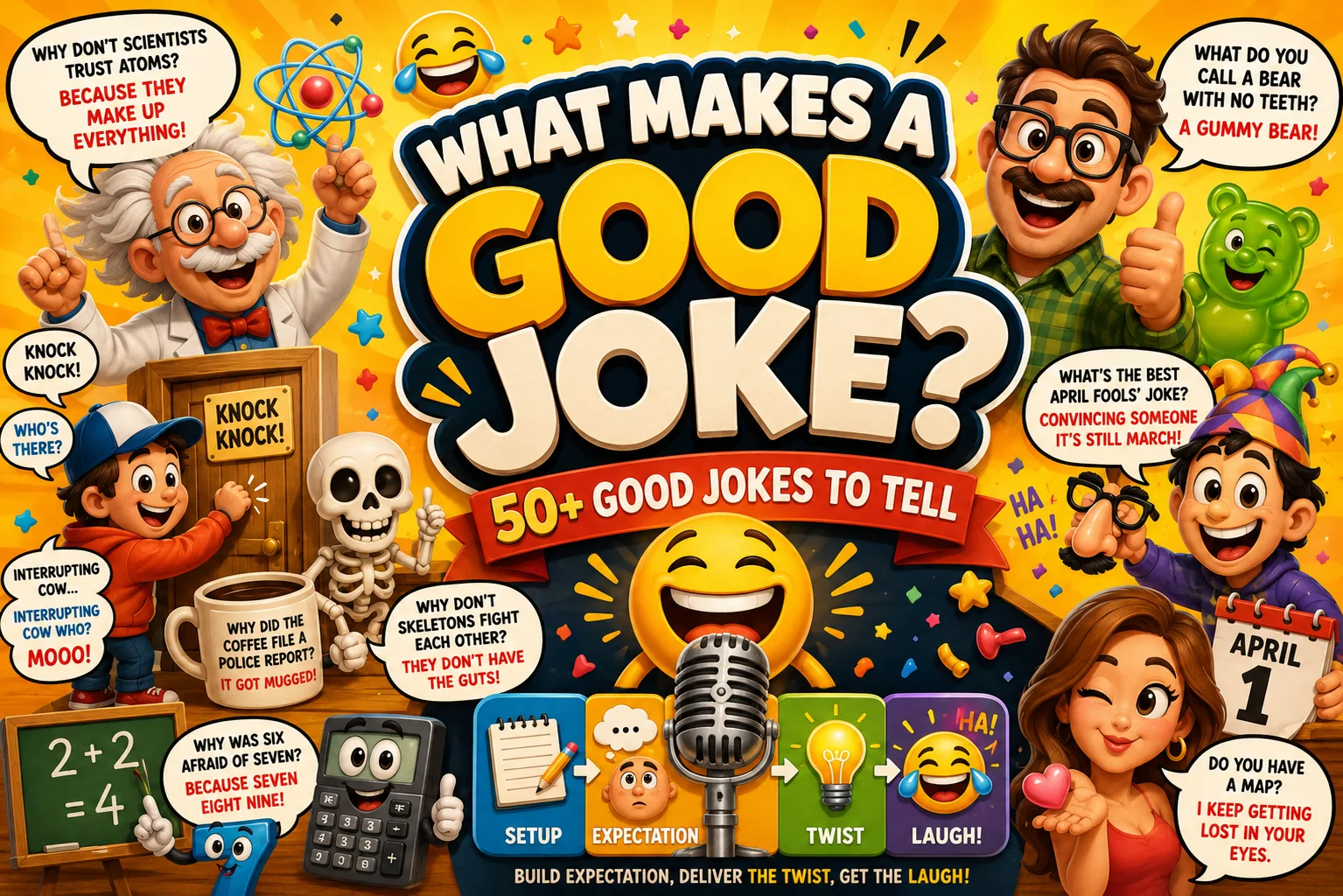
Asking what is a good joke is really two questions at once, what makes any joke actually work in the first place, and which specific jokes are worth having ready to tell. Philosophers have been seriously debating the first question since ancient Greece, and the answer they landed on still explains why certain jokes reliably get a laugh while others fall completely flat. In this guide, we’ll break down the actual theory behind what makes a joke good, then get into 50+ solid jokes worth keeping in your back pocket, from dad jokes and knock knocks to good ones specifically for April Fools’ Day, math class, or a first date.
What Actually Makes a Joke Good?
Before getting into specific jokes, it helps to understand the underlying structure that makes any joke work, and make it a good joke since this same pattern explains nearly every good joke ever told, regardless of topic or style.
The Setup, the Expectation, and the Twist
According to what’s known as Incongruity Theory, a concept traced back to Aristotle and later developed further by philosophers Immanuel Kant and Arthur Schopenhauer, a joke works by building a specific expectation in the listener’s mind through its setup, then violating that expectation with a punchline that still makes logical sense once you reinterpret it.
- Traced back to observations originally made by Aristotle
- Further developed by philosopher Immanuel Kant in 1790
- Expanded again by philosopher Arthur Schopenhauer in 1818
- A joke’s setup creates a specific, predictable expectation
- The punchline then violates that expectation unexpectedly
- The violation still has to make logical sense once reinterpreted
- Kant specifically described it as a strained expectation into nothing
- This same basic structure underlies nearly every classic joke format
Why the Twist Has to Still Make Sense
Later researchers, including linguist Victor Raskin in his 1979 Semantic Scriptbased Theory of Humor, refined this idea further by showing that a punchline works best when it’s compatible with two completely different interpretations at once, and the humor comes from the listener suddenly realizing the second, less obvious interpretation is the correct one.
- Formalized further by linguist Victor Raskin in 1979
- Known academically as the Semantic Scriptbased Theory of Humor
- A good punchline fits two different interpretations simultaneously
- The listener initially assumes the more obvious interpretation
- The humor hits when the second interpretation reveals itself
- Explains why a joke’s punchline must remain logically coherent
- A twist that makes no sense at all typically isn’t perceived as funny
- Helps explain why some clever jokes take a beat to actually land
Good Jokes to Tell
These are solid, generally reliable picks that work across most casual settings without much risk of falling flat, exactly the kind of jokes that hold up to Incongruity Theory’s basic structure.
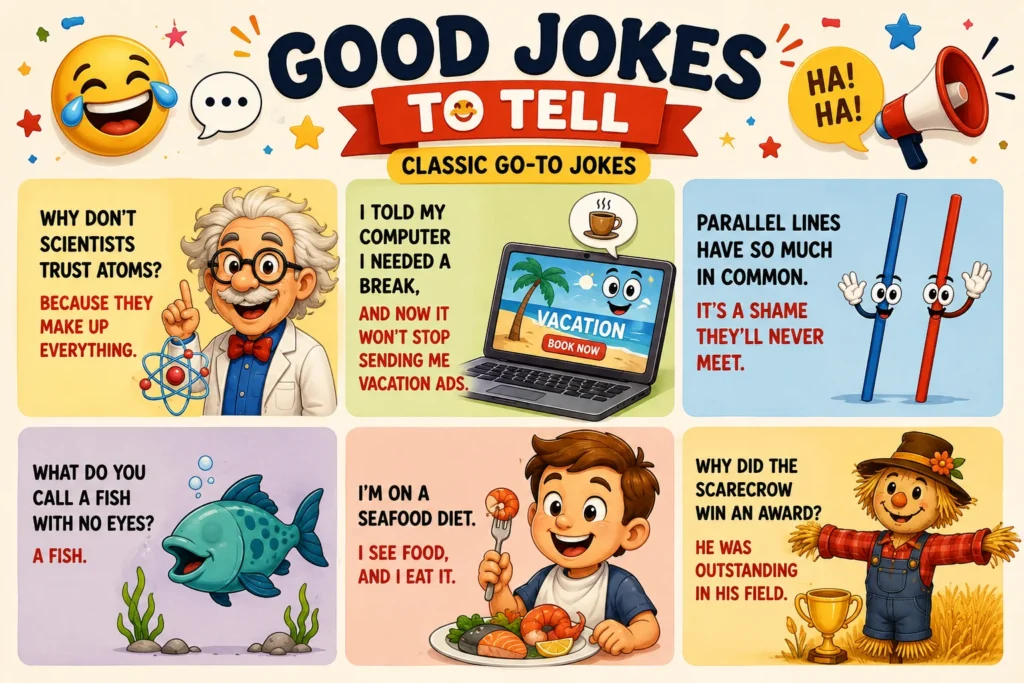
Classic GoTo Jokes
These lean on a clear setup and a punchline that genuinely rewards the listener once it clicks.
- Why don’t scientists trust atoms? Because they make up everything.
- I told my computer I needed a break, and now it won’t stop sending me vacation ads.
- Parallel lines have so much in common. It’s a shame they’ll never meet.
- What do you call a fish with no eyes? A fish.
- I’m on a seafood diet. I see food, and I eat it.
- Why did the scarecrow win an award? He was outstanding in his field.
Good Dad Jokes
A good joke for dads follows the exact same incongruity structure, just delivered with total, unearned confidence, which is part of what makes the groan feel so satisfying once the pun actually lands.
Reliable Groaners
- What do you call a bear with no teeth? A gummy bear.
- Why don’t skeletons fight each other? They don’t have the guts.
- I’m terrified of elevators, so I’ve been taking steps to avoid them.
- What do you call a can opener that doesn’t work? A can’t opener.
- Why did the coffee file a police report? It got mugged.
- I used to hate facial hair, but then it grew on me.
Good KnockKnock Jokes
The knockknock format works especially well with incongruity, since the built in call and response rhythm creates anticipation before the wordplay actually lands.
Reliable KnockKnocks
- Knock knock. Who’s there? Lettuce. Lettuce who? Lettuce in, it’s cold out here!
- Knock knock. Who’s there? Interrupting cow. Interrupting cow wh MOO!
- Knock knock. Who’s there? Olive. Olive who? Love you and I miss you!
- Knock knock. Who’s there? Boo. Boo who? Aw, don’t cry, it’s just a joke!
- Knock knock. Who’s there? Ken. Ken who? Can I come in already?
Good April Fools’ Jokes
Since April 1st comes with its own builtin expectation of pranks, jokes told that day get to lean even harder into misdirection than jokes told any other time of year.
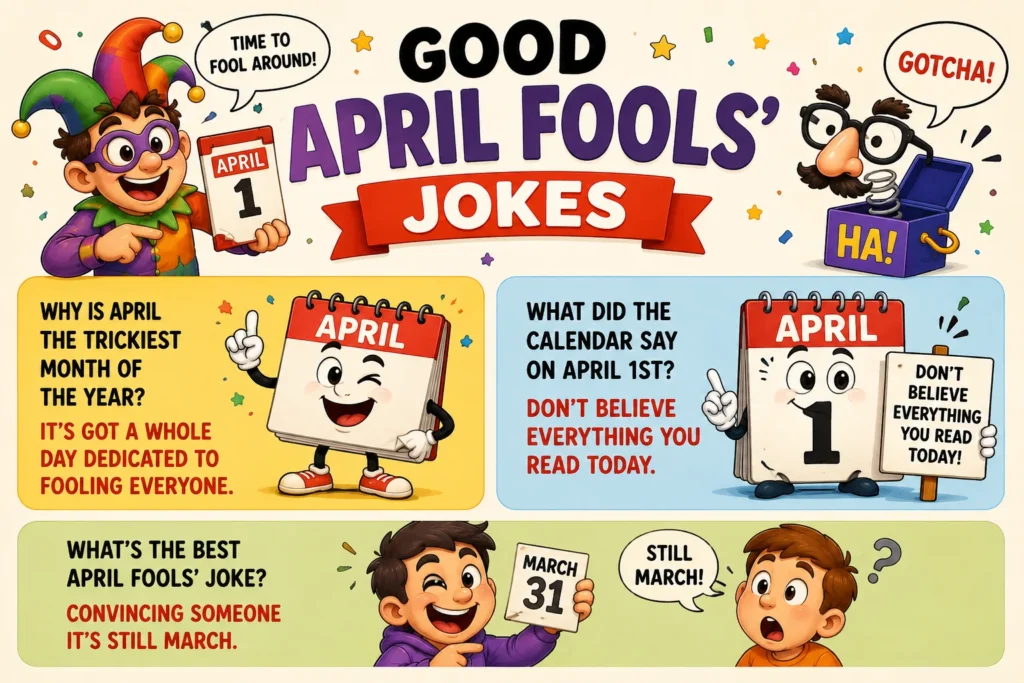
Solid April Fools’ Lines
- Why is April the trickiest month of the year? It’s got a whole day dedicated to fooling everyone.
- What did the calendar say on April 1st? Don’t believe everything you read today.
- What’s the best April Fools’ joke? Convincing someone it’s still March.
- Why did the prankster love April so much? One day a year, honesty takes a backseat.
Good Math Jokes
For anyone who wants a pun that rewards a bit of extra thinking, math offers some of the most reliable wordplay around, since the incongruity often hides in a double meaning within a single number or symbol.
Solid Nerdy Jokes
- Why was six afraid of seven? Because seven eight nine.
- What did the zero say to the eight? Nice belt.
- Why did the equal sign feel so humble? It was never less than or greater than anyone.
- I would tell you a chemistry joke, but I know I wouldn’t get a reaction.
A Good Joke to Tell a Girl
For a lighter, flirtier setting, a good joke to tell a girl is to lean into playful wordplay rather than a full setup and punchline structure, keeping the tone low pressure and easy to laugh off either way.
Playful, LowPressure Lines
- Are you a parking ticket? Because you’ve got fine written all over you.
- Do you have a map? I keep getting lost in your eyes.
- If I could rearrange the alphabet, I’d put U and I together.
- Are you made of copper and tellurium? Because you’re CuTe.
Jump into Other Related Article
- Food Jokes: Deliciously Funny Jokes That Will Make You Hungry
- Monthly Jokes: A Month Full of Laughs
- Weekly Jokes: A Funny Joke for Every Day of the Week
- Funny Jokes That Will Make You Laugh
- Animal Jokes: Funny Animal Jokes That Will Make You Laugh
- Dad Joke of the Day | Today’s Pick + 60 More for Every Day
- Joke of the Day | 50+ Funny Jokes for Every Mood
- Dad Jokes | 60+ Funny, Corny OneLiners (Plus Their Surprising History)
- Deez Nuts Jokes | 50+ Names & Setups (Plus Where It Came From)
- Banana Jokes | 60+ Funny Ones for Kids & Adults
- Cop Jokes | 50+ Funny Ones for Every Audience
- Penguin Jokes | 60+ Funny Ones for Kids & Adults
- Dinosaur Jokes for Kids | 60+ Funny Ones They’ll Love
- Cowboy Jokes | 60+ Funny Ones (Plus Dallas Cowboys Jokes)
- Shark Jokes | 60+ Funny Ones for Kids & Adults
- Funny Jokes | 60+ Jokes for Kids, Adults & Every Occasion
- Pasta Jokes | 60+ Funny Ones for Kids & Adults
Conclusion
A good joke genuinely isn’t random, it follows a structure philosophers have studied since Aristotle, building a clear expectation and then flipping it with a punchline that still makes sense once you catch it. With that in mind, the 50+ jokes above, from classic oneliners and dad jokes to knockknocks, April Fools’ picks, math puns, and a few flirtier lines, should give you something reliable no matter the audience or occasion. Understanding why a joke works is half the fun of telling a good one.
What actually makes a joke good?
According to Incongruity Theory, a joke works by building a specific expectation through its setup, then violating that expectation with a punchline that still makes sense once reinterpreted.
What’s a good joke to tell?
According to Incongruity Theory, a joke works by building a specific expectation through its setup, then violating that expectation with a punchline that still makes sense once reinterpreted.
What’s a good dad joke?
What do you call a bear with no teeth? A gummy bear is a classic example of the groan then laugh formula dad jokes are known for.
What’s a good knockknock joke?
Knock knock. Who’s there? Interrupting cow. Interrupting cow wh MOO! works especially well thanks to its builtin comedic timing.
What’s a good April Fools’ joke?
What’s the best April Fools’ joke? Convincing someone it’s still March plays well off the day’s builtin expectation of pranks.
What’s a good joke to tell a girl?
Playful, low pressure lines like Do you have a map? I keep getting lost in your eyes and work well without relying on a full setup and punchline structure.