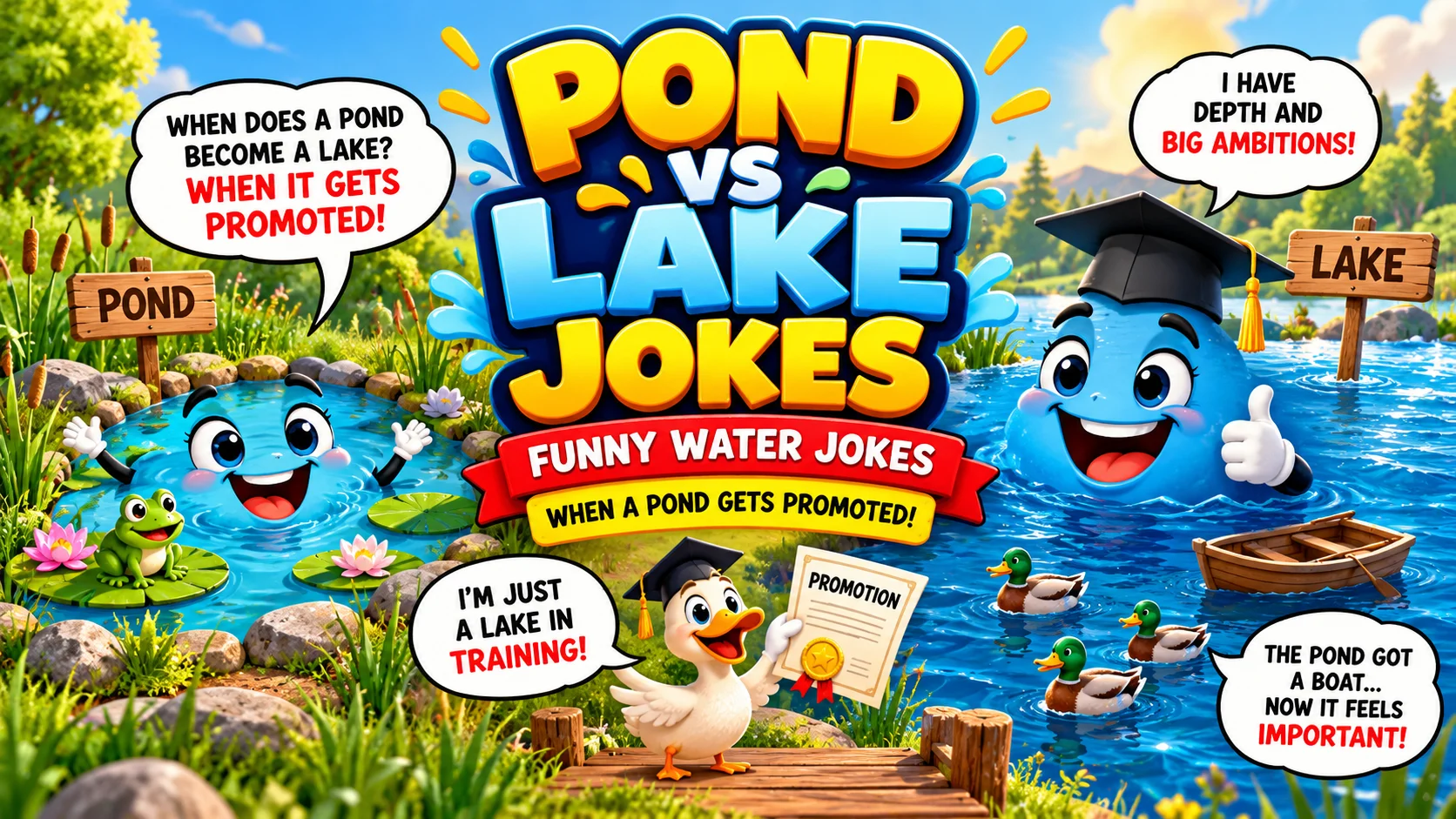
The difference between pond and lake joke takes an ordinary question about two types of water bodies and turns it into an opportunity for wordplay, exaggeration, and sometimes a surprisingly clever punchline. At first, What is the difference between a pond and a lake? sounds like a geography question. The joke version, however, can have a completely unexpected answer.
The humor works particularly well because there is no single universal scientific rule that always separates a pond from a lake. Size is commonly used as a general distinction, but depth, sunlight penetration, temperature, ecology, and local naming traditions can also matter. Some authorities and scientists use different criteria, which makes the subject naturally confusingand therefore perfect for jokes.
That uncertainty gives comedians plenty of room. One joke may say a pond becomes a lake when it gets promoted, while another might joke that a pond is simply a lake that has not received a fancy enough name. The difference between pond and lake joke TikTok trend also fits naturally into short-form comedy because the question creates an immediate setup and the answer can arrive in just a few seconds.
The Classic Difference Between Pond and Lake Joke
One playful version of the joke asks:
When does a pond become a lake?
When it gets promoted.
The punchline treats the name lake as though it were a job title or professional rank.
A pond does not actually receive a promotion, of course. The joke simply imagines that a body of water can move up the organizational ladder.
That gives the joke its deliberately silly logic:
- A small body of water starts as a pond.
- It works hard for years.
- Someone finally notices its achievements.
- It gets promoted.
- Suddenly, everyone calls it a lake.
This type of humor works because the answer is completely unrelated to the technical question while still sounding grammatically reasonable.
Why the Pond and Lake Question Is Perfect for a Joke
The question has an unusual advantage: there is genuine uncertainty behind it.
Most people assume the answer is simple:
A pond is small. A lake is big.
That is a useful rule of thumb, but it is not a universal scientific boundary. There is no single globally accepted measurement that automatically turns every pond into a lake. Mental Floss notes that even U.S. naming systems do not provide one universal scientific distinction, while limnologists may use characteristics such as depth, sunlight penetration, and temperature to discuss the difference.
That creates a perfect setup for comedy.
You can ask a serious-sounding question and then answer it with:
- a ridiculous rule
- a fake scientific explanation
- a wordplay punchline
- an exaggerated comparison
- a local naming joke
- or a completely arbitrary rule
The uncertainty makes the punchline feel more believable for a moment.
What Is the Real Difference Between a Pond and a Lake?
Before getting into more jokes, it helps to understand the actual subject.
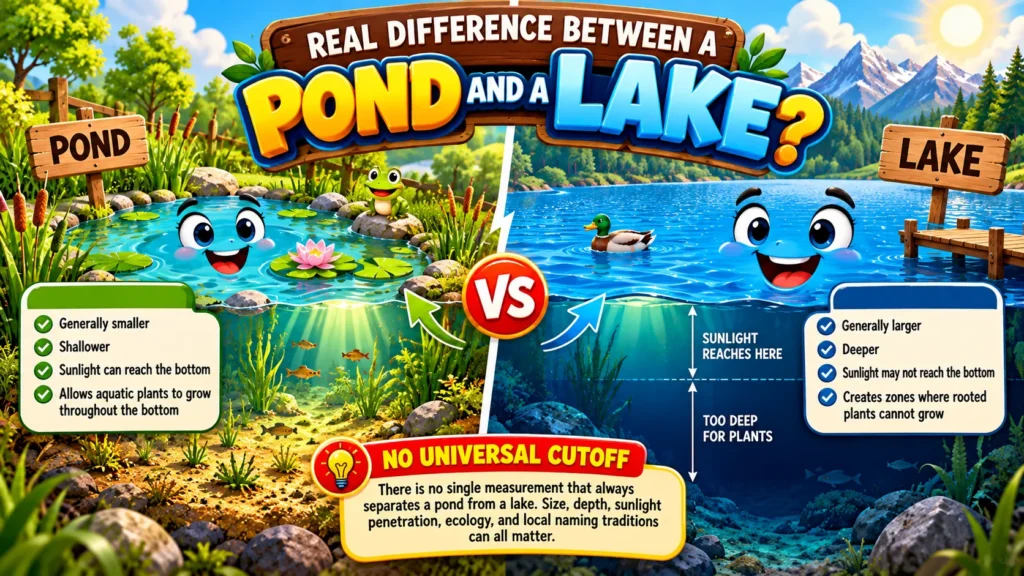
Ponds and lakes are both inland bodies of standing or relatively still water surrounded by land. Ponds are generally smaller and shallower, while lakes are usually larger and deeper. However, there is no universally accepted cutoff that applies everywhere.
Depth can be especially useful when discussing their ecology.
In a shallow pond, sunlight can often reach the bottom across much or all of the water. This allows rooted aquatic plants to grow throughout the bottom. In a deeper lake, sunlight may not reach the deepest areas, creating zones where rooted plants cannot grow.
So the real answer is more complicated than:
Pond = small. Lake = big.
And that complicated answer is exactly what makes the joke so much fun.
Why When It Gets Promoted Works
The difference between pond and lake joke about promotion uses a familiar human concept and applies it to nature.
People get promoted at work.
Bodies of water do not.
That mismatch creates the punchline.
Imagine a pond sitting in an office:
Manager: You’ve been doing excellent work.
Pond: Thank you.
Manager: We’re promoting you.
Pond: To?
Manager: Lake.
That absurd mental picture is the entire joke.
It also gives the joke a clean structure:
Question → unexpected human concept → water-related punchline.
Because the punchline is short, it works well as a one-liner.
The Size Joke
Another natural way to joke about the subject is to exaggerate the idea that a lake is simply a pond that became larger.
For example:
What is the difference between a pond and a lake?
A lake is a pond that really committed to growing.
Or:
A pond is just a lake before it hits its growth spurt.
These jokes play with the common assumption that size is the defining difference.
In reality, size is an important general distinction, but it is not an absolute rule. Different regions and naming traditions can use the terms differently.
The Who Named It? Joke
Another humorous answer is:
What’s the difference between a pond and a lake?
Whoever named it.
This is surprisingly close to the real issue.
Names are not always determined by one scientific formula. A body of water may historically be called a pond even if it is larger than another body of water called a lake. Mental Floss notes that naming conventions can be arbitrary, while examples from Maine show that very large bodies of water can retain the word pond in their established names.
The joke therefore works on two levels:
Comedy: Someone simply decided what to call it.
Reality: Naming traditions really can be inconsistent.
Difference Between Pond and Lake Joke TikTok Style
The keyword difference between pond and lake joke TikTok reflects how easily this subject can become short-form video content.
TikTok-style delivery does not require a long explanation. A creator can simply ask the question and then reveal an unexpected answer.
A basic format could look like this:
Text on screen:
What’s the difference between a pond and a lake?
Pause.
Punchline:
A pond gets promoted to lake.
Another version could show two water bodies and ask viewers to guess which one is a lake.
The creator could then reveal that the distinction is not always as straightforward as people assume.
That combination of humor and trivia makes the topic suitable for short videos.
The Pond vs. Lake Debate Makes Good Comedy
There is something inherently funny about a question that seems simple but has no universally accepted answer.
Ask:
How big does a pond have to become before it becomes a lake?
The obvious response is:
Big enough.
But then comes the problem:
How big is big enough?
There is no single number that works everywhere.
Some sources emphasize size and depth. Others focus on whether sunlight reaches the bottom. Still others point out that local naming traditions can override scientific conventions.
That ambiguity gives comedians an endless supply of fake answers.
Funny Fake Rules for Pond and Lake Jokes
A good way to create a difference between pond and lake joke is to invent a completely arbitrary rule.
For example:
- A pond becomes a lake when it gets its first boat.
- A pond becomes a lake when someone puts Lake on the sign.
- A pond becomes a lake when ducks start paying rent.
- A pond becomes a lake when people stop calling it cute.
- A pond becomes a lake when you need binoculars to see the other side.
- A pond becomes a lake when it gets a parking lot.
- A pond becomes a lake when someone names it after a person.
- A pond becomes a lake when it gets a vacation resort.
- A pond becomes a lake when someone takes a fishing vacation there.
- A pond becomes a lake when the ducks demand more space.
These are joke premises, not scientific definitions.
Their humor comes from treating ordinary human decisions as though they determine the classification of a natural water body.
The Boat Version
A popular style of pond-versus-lake humor involves boats.
A joke might say:
If you can swim across it, it’s a pond. If you need a boat, it’s a lake.
This sounds plausible enough to work as a joke, but it is not a scientific definition.
A very small lake can still be swimmable, and a pond can be large enough that someone would prefer a boat.
The humor is based on everyday perception rather than scientific classification.
It also highlights something people intuitively understand: lakes tend to feel larger because they provide more room for activities such as boating, fishing, and swimming.
The Across the Water Test
Another joke can make the distinction personal:
A pond is where you can see the other side. A lake is where you have to wonder what’s over there.
This is not a formal rule, but it captures the way people often perceive the two.
A small pond feels enclosed.
A large lake feels expansive.
That perception is one reason people naturally associate ponds with small, quiet spaces and lakes with larger recreational landscapes.
The actual science, however, is more complicated than simply checking whether you can see the opposite shore.
Why Depth Matters More Than People Think
Many people automatically answer the pond-versus-lake question with size.
But depth can be extremely important.
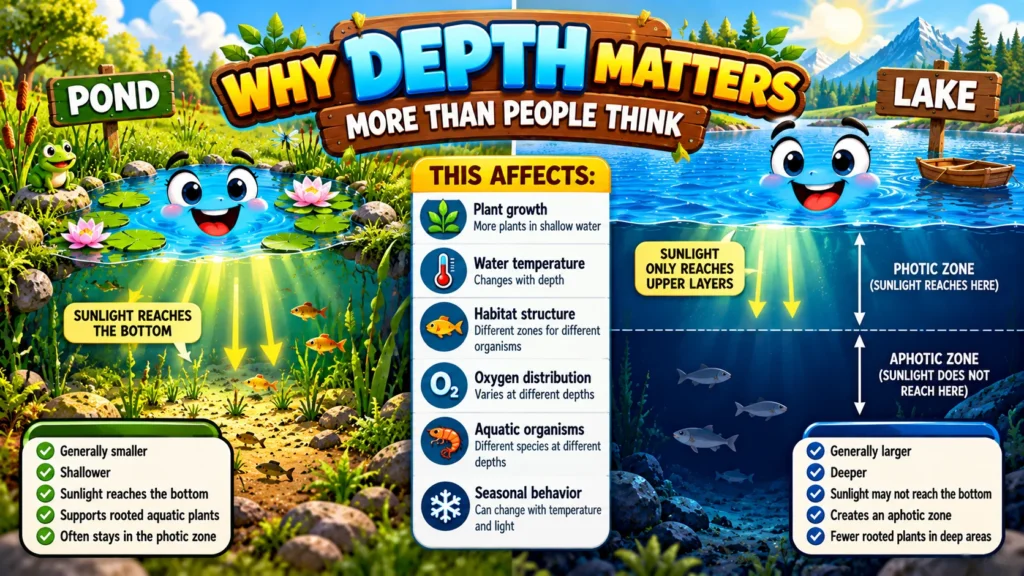
A shallow water body can allow sunlight to reach its bottom. That supports rooted aquatic plants across a much larger portion of the bed.
In deeper lakes, sunlight cannot penetrate to the bottom everywhere, creating an aphotic zone.
This affects:
- plant growth
- water temperature
- habitat structure
- oxygen distribution
- aquatic organisms
- seasonal behavior
HowStuffWorks explains that ponds tend to be shallower and can remain within the photic zone, while deeper lakes can develop areas where sunlight does not reach the bottom.
That makes the real answer much more interesting than the joke.
Pond and Lake Joke About Sunlight
The science also gives comedians another opportunity.
For example:
What’s the difference between a pond and a lake?
A pond lets the sunlight see the bottom. A lake keeps some secrets.
That is not a technical definition, but it turns a genuine ecological distinction into a playful line.
Another version could be:
A pond is transparent. A lake has trust issues.
The joke works because deeper lakes can contain areas where sunlight cannot reach the bottom.
Why a Pond Can Be Full of Life
Another misconception is that a pond is simply a smaller and less interesting version of a lake.
That is not necessarily true.
Ponds can support rich ecosystems containing:
- frogs
- turtles
- fish
- insects
- aquatic plants
- birds
- microorganisms
- amphibians
- invertebrates
Because many ponds are shallow enough for sunlight to reach the bottom, they can support substantial plant growth.
That provides another joke opportunity:
A pond may be small, but it has a surprisingly large guest list.
The joke treats the ecosystem like a crowded party.
Lake vs. Pond: The Temperature Joke
Water temperature can also differ between ponds and lakes.
Shallow ponds can have relatively uniform temperatures because sunlight affects much of the water column. Larger and deeper lakes can develop distinct temperature layers, particularly during certain seasons.
That leads to a playful line:
A pond knows how to keep things simple. A lake has layers.
Or:
A pond is one temperature. A lake has a whole wardrobe.
Again, these are jokes based on real concepts rather than literal scientific definitions.
The Pond Is Just a Small Lake Argument
Some people simplify the entire issue by saying:
A pond is just a small lake.
That is useful as casual shorthand, but it does not capture all the ecological distinctions scientists may consider.
At the same time, the opposite ideaevery large body of water is automatically a lakealso fails because names do not always follow a universal size rule.
This is why the subject remains a recurring source of debate.
And when people cannot agree on the definition, comedians naturally step in with:
It gets promoted.
Funny Pond and Lake One-Liners
If you want short jokes around the topic, here are some clean examples:
- A pond is a lake in training.
- A lake is just a pond with bigger ambitions.
- A pond got promoted and never looked back.
- Ponds keep things shallow; lakes like to go deeper.
- A lake has depth. A pond has potential.
- The pond wanted to become a lake, but it needed more experience.
- The lake told the pond, Don’t worry, you’ll grow into it.
- A pond is what happens when a lake takes a day off.
- The pond applied for a lake position and got promoted.
- Some ponds have lake-sized dreams.
These are original-style joke variations built around the basic pond-versus-lake concept.
Why Lake Sounds More Impressive
There is also a cultural reason the joke works.
The word lake often sounds grander than pond.
Compare:
Lake View Resort
with:
Pond View Resort
The second one sounds smaller and more intimate.
That difference in perception can become a joke:
A pond is what you call it when you want the water to stay humble.
Or:
The pond was technically impressive, but it preferred to remain modest.
This is not about scientific classification. It is about the emotional impression created by the words.
The Pond on Your Property Joke
A humorous observation found in an online discussion goes:
A pond is on someone else’s property. A lake is on your property.
The joke plays with perspective rather than geography.
If someone else owns a body of water, you might casually call it a pond.
If it is on your own enormous property, suddenly it becomes a prestigious private lake.
The underlying joke is about how people describe things differently depending on how they feel about them.
Why Local Names Can Make the Joke Better
Local naming traditions make the pond-versus-lake question even more confusing.
A body of water may have been given its name generations ago, and the name can remain even if modern ideas about size or depth would suggest a different classification.
Maine provides particularly striking examples, including large water bodies that retain pond in their names.
That gives rise to a simple joke:
What’s the difference between a pond and a lake? History.
Or:
The water doesn’t choose the name. The people do.
The second line is closer to reality than many of the deliberately silly answers.
Pond and Lake Joke for Kids
This topic works well for children’s jokes because the concepts are easy to visualize.
A child-friendly version could be:
Why did the pond want to become a lake?
It wanted a bigger future.
Another:
What did the pond say to the lake?
I’m still growing!
Or:
Why was the lake so confident?
It had plenty of depth.
The last joke uses depth both literally and as a metaphor for personality.
These jokes are simple enough for school activities, nature programs, family conversations, and children’s joke collections.
Jump into Other Related Article
- Shark Jokes | 60+ Funny Ones for Kids & Adults
- Mosquito Joke | Funny Mosquito Jokes, Puns, Dad Jokes & One-Liners
- Netflix Is a Joke | What the Festival Is, the 2026 Lineup and What’s Next
Pond and Lake Jokes for Social Media
The topic is also easy to turn into a caption.
For a pond photo:
Small water, big personality.
For a lake photo:
Same idea, bigger commitment.
For a comparison image:
Pond or lake? Don’t ask the water. It has no idea what people named it.
Another caption could be:
When your pond gets promoted to lake.
That last version is especially useful for memes because it gives the image a simple storyline.
How the Difference Between Pond and Lake Joke Works
The joke can be broken into three simple parts.
First: Ask a genuine-sounding question.
Second: Make the audience expect a factual answer.
Third: Replace the expected explanation with something ridiculous.
For example:
Setup:
What is the difference between a pond and a lake?
Expected answer:
Size and depth.
Punchline:
When the pond gets promoted.
That switch is what creates the laugh.
The audience understands the serious answer but receives the silly one instead.
The Joke Works Because the Real Answer Is Complicated
This is perhaps the strongest feature of the difference between pond and lake joke.
If there were a universally accepted rule saying:
Exactly 10 acres = lake.
then a joke could simply make fun of that number.
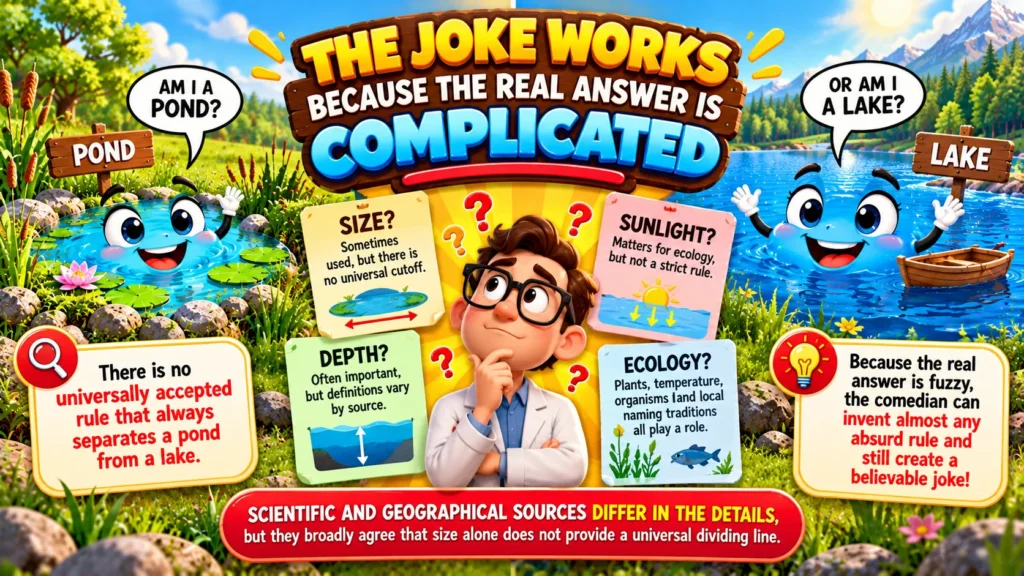
But because the real distinction is fuzzy, the comedian can invent almost any absurd rule and still create a believable setup.
Scientific and geographical sources differ in the details they emphasize, but they broadly agree that size alone does not provide a universal dividing line.
That uncertainty gives the joke room to breathe.
Difference Between Pond and Lake: Quick Reality Check
| Question | Pond | Lake |
| Usually smaller? | Yes | Usually larger |
| Usually shallower? | Yes | Usually deeper |
| Sunlight often reaches bottom? | Across much of the body | Not necessarily |
| Rooted plants across the entire bottom? | More likely | Less likely in deeper areas |
| Temperature layers? | Less pronounced in many shallow ponds | More common in deeper lakes |
| Universal size cutoff? | No | No |
| Naming always follows science? | No | No |
These are general tendencies, not absolute rules. The classification can vary by region, naming tradition, and the criteria being used.
Difference Between Pond and Lake Joke: The Best Simple Answer
If someone asks you for a quick joke, the easiest response is:
A pond becomes a lake when it gets promoted.
If you want something slightly more clever:
The difference between a pond and a lake is mostly confidence. A lake has enough to call itself a lake.
And if you want a joke that plays with the real scientific uncertainty:
What’s the difference between a pond and a lake? Ask three experts and you’ll get four answers.
That last style works particularly well because the classification really can depend on which criteria are being used.
Why This Joke Fits Dad-Joke Humor
The difference between pond and lake joke has the familiar characteristics of a classic dad joke:
- The setup sounds serious.
- The punchline is intentionally simple.
- The wordplay is harmless.
- The joke can be understood immediately.
- The answer is easy to remember.
- The listener may groan before laughing.
- It can be adapted into several variations.
- It works for both adults and children.
The joke does not need a dramatic story.
The question itself provides almost everything required.
That makes it ideal for casual conversations and short-form content.
Final Thoughts
The difference between pond and lake joke is funny because it takes a question that sounds scientific and gives it an unexpectedly human answer. When the pond gets promoted works by pretending that a body of water can receive a job title, while other versions play with size, boats, naming traditions, sunlight, and the way people perceive the words pond and lake. The subject also has a genuine factual twist: there is no single universal scientific boundary that always separates a pond from a lake. Size and depth are common considerations, but ecology, sunlight penetration, temperature, and local naming practices can all complicate the picture.
That combination of real uncertainty and simple wordplay gives the joke plenty of room for variation. Whether it appears as a classic one-liner, a difference between pond and lake joke TikTok video, a meme caption, or a family-friendly nature joke, the basic formula remains the same: ask a serious question, make the audience expect a technical answer, and then deliver something completely unexpected. Sometimes the best explanation is not that the pond got deeper or largerit simply got promoted.
What is the difference between pond and lake joke?
The difference between pond and lake joke is a humorous take on the question of how ponds and lakes differ. A popular-style punchline is, A pond becomes a lake when it gets promoted.
What is the funniest difference between a pond and a lake?
One simple joke answer is: A pond becomes a lake when it gets promoted. Other versions joke that a lake is simply a pond with bigger ambitions, a boat, or a more impressive name.
Is there a real scientific difference between a pond and a lake?
There is no single universally accepted definition that separates every pond from every lake. Ponds are generally smaller and shallower, while lakes tend to be larger and deeper, but other ecological factors can also be considered.
Does size determine whether something is a pond or lake?
Size is commonly used as a general guideline, but there is no universal size cutoff that works everywhere. Local naming conventions can also result in large bodies of water being called ponds and smaller ones being called lakes.
Why does depth matter when comparing a pond and a lake?
Depth affects whether sunlight can reach the bottom. Shallow ponds may receive sunlight across their entire bottom, while deeper lakes can contain areas where sunlight does not reach, creating different ecological zones.
What is the difference between pond and lake joke TikTok?
A difference between pond and lake joke TikTok video typically uses the question as a quick setup and delivers a short punchline. The pond gets promoted to lake concept can easily be turned into a few-second video or meme.
Can a pond become a lake?
There is no universal point at which every pond officially becomes a lake. A water body’s classification can depend on size, depth, ecological characteristics, and local naming conventions.
Are ponds and lakes both ecosystems?
Yes. Both can support aquatic ecosystems containing plants, fish, insects, amphibians, birds, and other organisms. Their depth and environmental conditions influence which species can live there.
Why do people usually think lakes are bigger than ponds?
In everyday language, lakes are generally associated with larger and deeper bodies of water, while ponds are associated with smaller and shallower ones. This is a useful general distinction even though it is not a universal scientific cutoff.
What is a good pond and lake dad joke?
A simple one is: When does a pond become a lake? When it gets promoted. It works because it turns the ordinary idea of classification into a workplace-style promotion joke.

Pingback: Monkey Bar Joke Explained: Funny Monkey and Penguin Jokes
Pingback: How Many Seconds in a Year Joke? 12-Second Answer