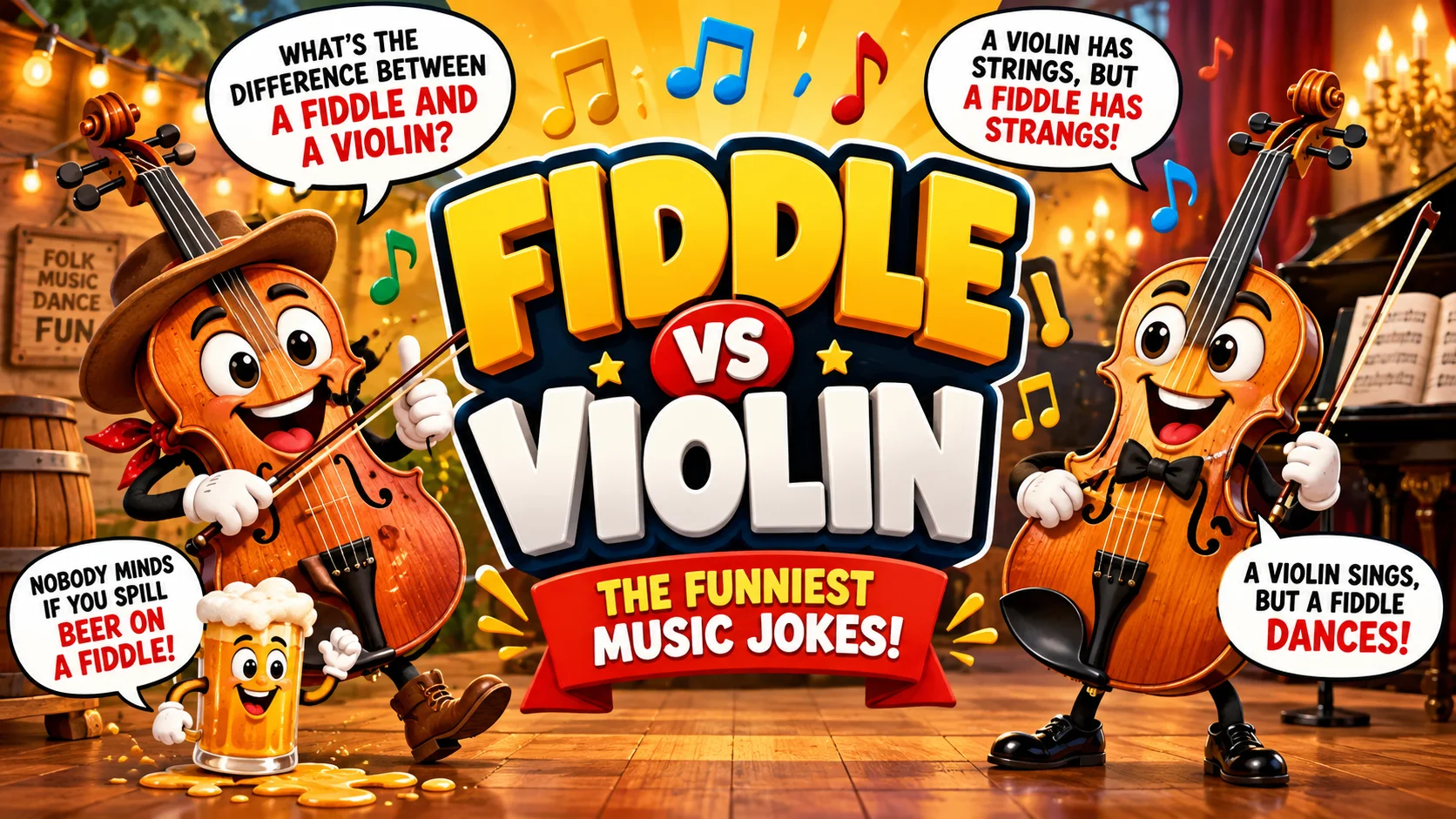
The difference between fiddle and violin joke is one of those classic music jokes that has been passed from musicians to audiences for generations. Ask someone, What’s the difference between a fiddle and a violin? and you may get a serious musical explanation—or a punchline about beer, price, clothing, strings, or the person holding the bow.
The reason this joke works so well is that there really is not a simple physical dividing line between a fiddle and a violin. In most contexts, the two words refer to the same type of four-stringed bowed instrument. The difference is largely connected with musical tradition, playing style, and context.
That makes the joke even more interesting. A question that sounds like it should have a technical answer becomes an opportunity for musicians to make fun of their own musical traditions.
The Classic Difference Between Fiddle and Violin Joke
One of the best-known versions goes like this:
What’s the difference between a fiddle and a violin?
Nobody minds if you spill beer on a fiddle.
That punchline has been documented in fiddle and folk-music discussions for years and appears in several versions online.
The joke creates an exaggerated contrast between two musical worlds.
A violin is associated in popular imagination with:
- orchestras
- concert halls
- classical music
- formal performances
- expensive instruments
- musicians dressed formally
A fiddle, meanwhile, is often associated with:
- folk music
- country music
- bluegrass
- traditional dances
- informal gatherings
- lively performances
The punchline exaggerates those associations by suggesting that spilling beer would be perfectly acceptable around a fiddle but disastrous around a violin.
Of course, the joke is not a literal rule about instruments. It is playful cultural humor.
What’s the Difference Between a Fiddle and a Violin Joke?
There is more than one punchline for the question What’s the difference between a fiddle and a violin?
Musicians have created many variations over the years. Some focus on money, some on clothing, some on pronunciation, and others on playing technique.
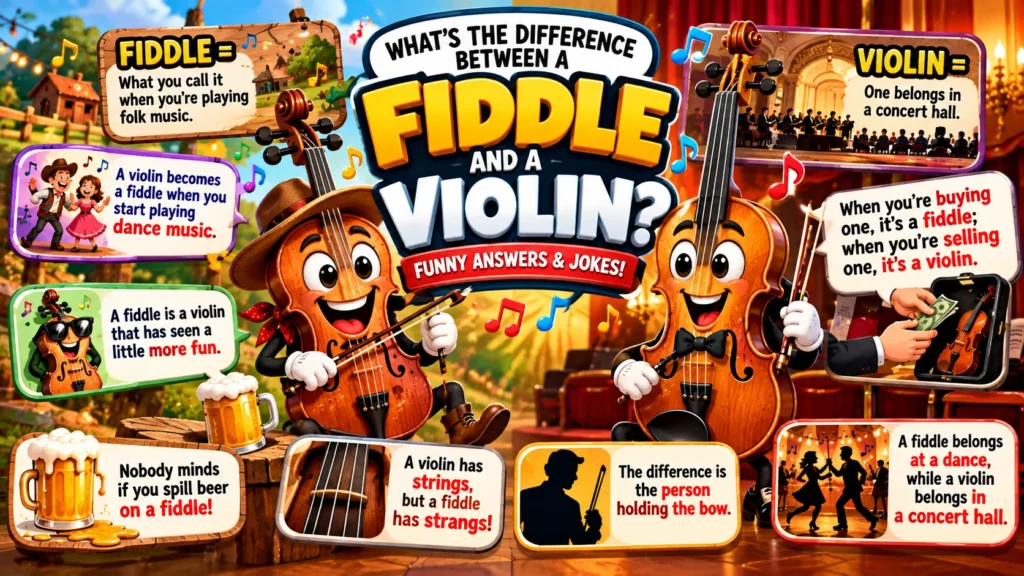
Common joke answers include ideas such as:
- A fiddle is what you call it when you’re playing folk music.
- A violin becomes a fiddle when you start playing dance music.
- A fiddle is a violin that has seen a little more fun.
- A violin has strings; a fiddle has strangs.
- The difference is the person holding the bow.
- One belongs in a concert hall, while the other belongs at a dance.
- When you’re buying one, it’s a fiddle; when you’re selling one, it’s a violin.
These jokes are not intended to provide scientific definitions. They exaggerate real cultural differences surrounding the instrument.
Vi Wickam’s collection of fiddle-and-violin jokes includes several versions based on buying and selling, beer, clothing, playing style, and even the famous strings versus strangs wordplay.
The Funniest Answer: Beer on the Fiddle
The beer version remains one of the most recognizable answers:
Nobody minds if you spill beer on a fiddle.
Why does that work?
Because the joke relies on a stereotype rather than an actual physical difference.
Classical violin performances are commonly imagined as formal events where musicians carefully protect their instruments. Folk and fiddle performances, by contrast, are often associated with social gatherings where people dance, eat, drink, and celebrate.
The joke takes that contrast and pushes it to an absurd extreme.
It essentially says:
Violin = formal and precious.
Fiddle = informal and ready for a party.
That is why the punchline can work even for someone who knows very little about string instruments.
The Strings and Strangs Fiddle Joke
Another popular version uses pronunciation:
A violin has strings, but a fiddle has strangs.
This is a deliberately exaggerated joke about regional accents.
The humor comes from pretending that the pronunciation of the word strings is somehow a technical difference between the instruments.
It is not.
Both instruments have strings. The punchline simply uses the sound of the word to create a silly distinction.
This type of joke is particularly common among musicians because it does not require the audience to understand complicated musical theory. The listener only needs to recognize the intentionally exaggerated pronunciation.
Difference Between Violin and Fiddle Joke: The Buying and Selling Version
Another classic answer changes depending on whether the instrument is being purchased or sold:
When you’re buying it, it’s a fiddle. When you’re selling it, it’s a violin.
This joke plays on the idea that the word violin sounds more prestigious or valuable, while fiddle sounds more casual.
Imagine a seller trying to make an instrument sound expensive.
They might call it a fine violin.
The same person might jokingly call it a fiddle when talking casually with friends.
The joke therefore turns marketing language into the punchline.
It is not saying that musicians actually use the terms this way. It is exaggerating the perceived difference in prestige between the words.
What’s the Real Difference Between a Fiddle and a Violin?
Here is where the joke ends and the serious answer begins.
In physical terms, a fiddle and a violin are generally the same instrument. Both typically have four strings, the same basic body shape, and the same standard tuning. Yamaha’s explanation similarly describes the fiddle as a colloquial name for the violin and emphasizes that the major distinction is musical approach rather than a fundamentally different instrument.
The terminology usually changes according to context.
A musician is more likely to say violin when discussing:
- classical repertoire
- orchestral playing
- chamber music
- formal technique
- classical performance
The word fiddle is more commonly associated with:
- folk music
- country music
- bluegrass
- traditional music
- dance music
- regional playing traditions
Dictionary.com likewise describes fiddle as an informal term for the violin and notes the common association between violin and classical music and fiddle and bluegrass or other folk traditions.
Is a Fiddle Actually a Different Instrument?
Usually, no.
That is one of the reasons the difference between fiddle and violin joke is so effective.
The same physical instrument can be called a violin in one setting and a fiddle in another.
A musician could play a classical piece and refer to the instrument as a violin. The same musician could later play a traditional dance tune and call that instrument a fiddle.
Lissa Schneckenburger, a professional fiddler, explains that there is no fundamental physical difference and that the terminology often follows the type of music being played.
There can, however, be differences in setup and playing preferences.
For example, some fiddlers may use:
- different strings
- different bridge setups
- fine tuners on more strings
- playing techniques designed for fast rhythmic passages
- techniques involving double or triple stops
These differences are not enough to create two completely separate instruments. They are better understood as differences in setup and musical approach.
Jump into Other Related Article
- Shark Jokes | 60+ Funny Ones for Kids & Adults
- Netflix Is a Joke | What the Festival Is, the 2026 Lineup and What’s Next
- Potato Jokes | 90+ Puns, Riddles and Dad Jokes with Answers
Why the Joke Has a Real Musical Idea Behind It
The difference between fiddle and violin joke is funny partly because it exaggerates something that actually exists.
Fiddle music and classical violin music can sound very different even when played on essentially the same type of instrument.
A fiddler may focus heavily on:
- rhythm
- danceability
- repeated melodic patterns
- ornamentation
- improvisation
- playing by ear
A classical violinist may focus more heavily on:
- written notation
- precise intonation
- orchestral coordination
- classical bowing techniques
- interpretation of composed works
- a particular concert sound
These are broad tendencies rather than absolute rules. There is considerable overlap between the two traditions. ABC Classic describes the distinction primarily as one of how the instrument is played, with traditional fiddle playing strongly connected to rhythm and dance traditions.
A Violin Sings, but a Fiddle Dances
Another memorable answer is:
A violin sings, but a fiddle dances.
This is a poetic version of the joke rather than a literal definition.
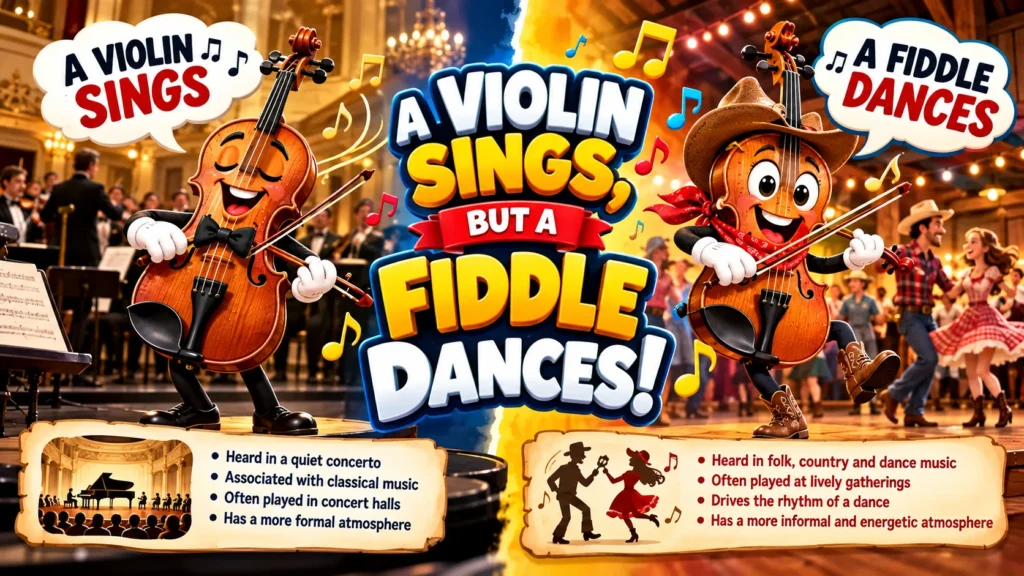
It captures the difference in musical atmosphere that many listeners associate with the two terms.
A violin can be heard in a quiet concerto, while a fiddle can be heard driving the rhythm of a country or folk dance.
But there is nothing stopping a violin from playing energetic music or a fiddle from playing a slow melody.
That is why the line works better as a joke than as a technical explanation.
Difference Between a Fiddle and a Violin Joke Reddit Versions
The phrase difference between fiddle and violin joke Reddit reflects how popular this question remains among online communities.
Reddit discussions frequently feature the classic beer punchline alongside newer variations. Recent joke discussions have included answers involving spilled beer, strings versus strangs, buying versus selling, price, and other deliberately exaggerated distinctions.
One reason Reddit is particularly suited to this joke is that the question invites people to add their own punchlines.
A musician can give a serious answer.
Another person can give a terrible pun.
Someone else can respond with an even older version.
The result is essentially an ongoing collection of fiddle jokes.
Why Musicians Keep Adding New Punchlines
The question is almost an invitation:
What’s the difference between a fiddle and a violin?
It has a built-in setup but no fixed requirement for the answer.
That means almost any exaggerated contrast can become a joke.
For example:
- Violin: played in a concert hall.
Fiddle: played where people are dancing. - Violin: carefully polished before a concert.
Fiddle: carefully polished after the party. - Violin: follows the score.
Fiddle: follows the dancer. - Violin: formal name.
Fiddle: nickname with attitude.
The humor comes from treating social and musical stereotypes as though they were physical laws.
Difference Between a Violin and a Fiddle Joke About Money
Money is another common subject.
A joke might say:
What’s the difference between a fiddle and a violin? About a few thousand dollars.
The implication is that the word violin makes the same instrument sound more expensive.
Again, this is not a pricing rule.
Instrument prices depend on factors such as:
- maker
- age
- condition
- materials
- craftsmanship
- provenance
- sound
- historical significance
Calling an instrument a fiddle does not automatically make it cheaper.
The joke simply plays with the perception that violin sounds more formal and prestigious.
The Tuxedo Version
Another variation answers the question with clothing:
The difference between a fiddle and a violin is a tuxedo.
The joke imagines the violin as an instrument that belongs in formal clothing and the fiddle as an instrument that belongs in a more relaxed environment.
Again, the instrument has not physically changed.
The imaginary difference is the setting.
This is a recurring theme across fiddle jokes: violin equals formal; fiddle equals informal.
The joke works because that stereotype is recognizable enough for the audience to understand immediately.
Difference Between Fiddle and Violin Joke TikTok Style
The phrase difference between fiddle and violin joke TikTok points toward a newer way of delivering the same old joke.
Short-form video is particularly suitable for this type of humor because the creator can ask the question, pause dramatically, and reveal the punchline in a few seconds.
A simple video structure could be:
On-screen text:
What’s the difference between a fiddle and a violin?
Pause.
Punchline:
You don’t spill beer on a violin.
The creator could then show a violin in a formal setting and a fiddle in a lively folk-music setting.
The joke itself does not need to be new to work in a new format. Short-form platforms simply give old jokes another way to circulate.
Fiddle Joke Variations for Musicians
Musicians can make the basic joke more specific by referring to how the instrument is played.
Here are some clean variations:
- A violin reads the music. A fiddle remembers it.
- A violinist follows the conductor. A fiddler follows the dancers.
- A violin plays the notes. A fiddle plays the groove.
- A violin may have sheet music. A fiddle may have a story.
- A violinist counts the measures. A fiddler counts the people dancing.
These are humorous generalizations, not strict rules.
Professional musicians often move between styles, and the same instrument can be used for both classical and traditional music.
Why the Question Has More Than One Correct Joke
Unlike a riddle with a single predetermined answer, the difference between fiddle and violin joke is a joke format.
There is no universally required punchline.
That is why you may see:
Nobody minds if you spill beer on a fiddle.
and somewhere else:
A violin has strings; a fiddle has strangs.
Both can work.
The joke is not really about discovering one secret fact. It is about finding an amusing way to exaggerate the cultural difference between the words.
The Joke Is Better Than the Literal Question
If someone genuinely asks about the difference, a musician should probably give the real explanation first.
The instrument itself is generally the same.
The terminology and playing context are where the meaningful distinctions appear.
But if the person asks:
What’s the difference between a fiddle and a violin?
and everyone is in a joking mood, the beer punchline is ready.
That is what makes the question so useful in comedy. It can function as either:
- a genuine music question
- a dad joke setup
- a musician’s inside joke
- a conversation starter
- a social-media caption
- a collection of competing punchlines
Funny Fiddle and Violin One-Liners
If you are looking for additional short jokes around the topic, these work well as light musical wordplay:
- Why did the violin bring a ladder? It wanted to reach the high notes.
- Why was the fiddle always invited to parties? It knew how to get everyone dancing.
- What does a violinist do when they need help? They pull some strings.
- Why was the fiddle never lonely? It always had a good string of friends.
- Why did the violin refuse to argue? It didn’t want to bow to pressure.
- What does a fiddler call a perfect dance tune? A string of good decisions.
- Why was the violin always prepared? It never forgot its notes.
These jokes use familiar musical vocabulary such as strings, bow, notes, and playing to create simple wordplay.
Fiddle vs. Violin: The Joke Compared With Reality
| Joke version | What the joke suggests | What is actually true |
| Nobody minds beer on a fiddle | Fiddles are informal | It is still the same basic instrument |
| A fiddle has strangs | The pronunciation is different | Both have strings |
| A fiddle dances | Fiddle music is energetic | Fiddle traditions often emphasize rhythm |
| A violin sings | Violin music is elegant | Violins are used in many musical styles |
| Buying a fiddle, selling a violin | Violin sounds more expensive | Price depends on the actual instrument |
| A fiddle is for folk music | Genre defines the name | Genre strongly influences terminology, but overlap exists |
| A violin needs a tuxedo | Violin playing is formal | Formal attire is about the performance setting |
The jokes exaggerate real associations, but none should be treated as a strict technical definition.
Why the Fiddle and Violin Question Never Gets Old
The question has survived because it combines a real point of curiosity with an almost unlimited supply of punchlines.
A beginner may genuinely wonder why two musicians use different names for what appears to be the same instrument.
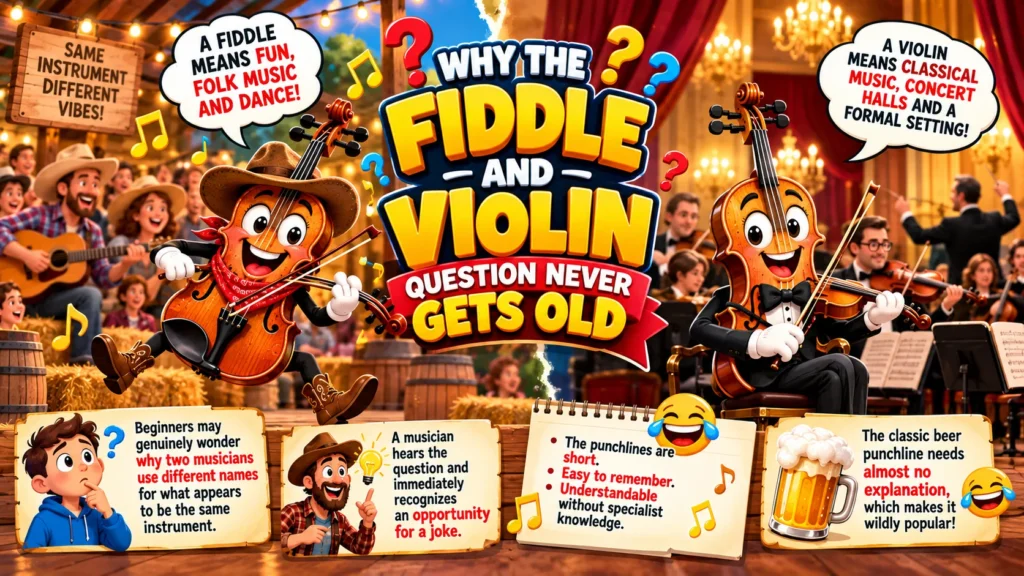
A musician hears the question and immediately recognizes an opportunity for a joke.
That creates a perfect comedy setup.
The best-known answers are short, easy to remember, and understandable without specialist knowledge. The classic beer punchline, for example, requires almost no explanation.
That is a major reason the difference between fiddle and violin joke continues to appear in musician communities, joke collections, social media, and casual conversations.
How to Tell the Difference Between Fiddle and Violin Joke
For the classic version, keep the delivery completely serious.
Ask:
What’s the difference between a fiddle and a violin?
Pause.
Then give the answer:
Nobody minds if you spill beer on a fiddle.
Do not explain the joke immediately.
The humor comes from allowing the listener to make the connection between a formal violin performance and a lively fiddle setting.
If they groan, the joke has probably worked exactly as intended.
Why This Is a Classic Dad Joke
The difference between fiddle and violin joke has nearly everything associated with traditional dad humor.
It is:
- short
- clean
- easy to repeat
- based on a familiar concept
- built around exaggeration
- predictable after the first telling
- suitable for musicians and nonmusicians
- flexible enough to support many punchlines
Most importantly, it does not need a complicated story.
The question itself is the setup.
Everything after that is just an excuse to deliver a terrible—or wonderfully cheesy—answer.
Final Thoughts
The difference between fiddle and violin joke works because it takes a genuine musical question and turns it into a playground for wordplay. The classic beer punchline is probably the version most people recognize, but there are countless alternatives involving strings, money, clothing, musical style, and the person holding the bow. The real-world answer is much less dramatic: a fiddle and a violin are generally the same basic instrument, while the name often changes according to musical tradition and context.
That combination of fact and humor is what keeps the joke useful. You can give the serious explanation to someone learning about string instruments, or give them the punchline if they are simply looking for a laugh. Whether the answer involves spilled beer, strangs, a tuxedo, or a clever comment about buying and selling, the question remains one of the easiest setups in musician humor.
What is the difference between fiddle and violin joke?
The classic joke asks, What’s the difference between a fiddle and a violin? One of the best-known answers is, Nobody minds if you spill beer on a fiddle. The joke exaggerates the difference between formal violin culture and informal fiddle traditions.
What is the difference between a violin and a fiddle joke?
It is essentially the same joke with the wording reversed. Difference between violin and fiddle joke refers to the same family of punchlines about the two names for the instrument.
What’s the difference between a fiddle and a violin joke answer?
A popular answer is that nobody minds spilling beer on a fiddle. Other versions say a fiddle has strangs, a fiddle dances while a violin sings, or that the difference depends on the person holding the bow.
Are a fiddle and a violin actually the same instrument?
Generally, yes. They are two names commonly used for the same basic four-stringed bowed instrument. The terminology often depends on the musical genre and playing context.
Why is a fiddle called a fiddle?
Fiddle is a longstanding informal or colloquial term for a violin. It is particularly common in folk, traditional, country, and bluegrass music.
What is the difference between fiddle and violin joke Reddit?
Reddit discussions contain several versions of the joke, including the beer punchline, the strings and strangs variation, price jokes, and buying-versus-selling jokes. Different communities often add their own answers.

Pingback: Henway Joke | Meaning, Answer, Origin & Funny variations
Pingback: How Do You Make Holy Water Joke? Meaning, Answer & Variations
Pingback: How Do You Organize a Space Party Joke? You Planet!