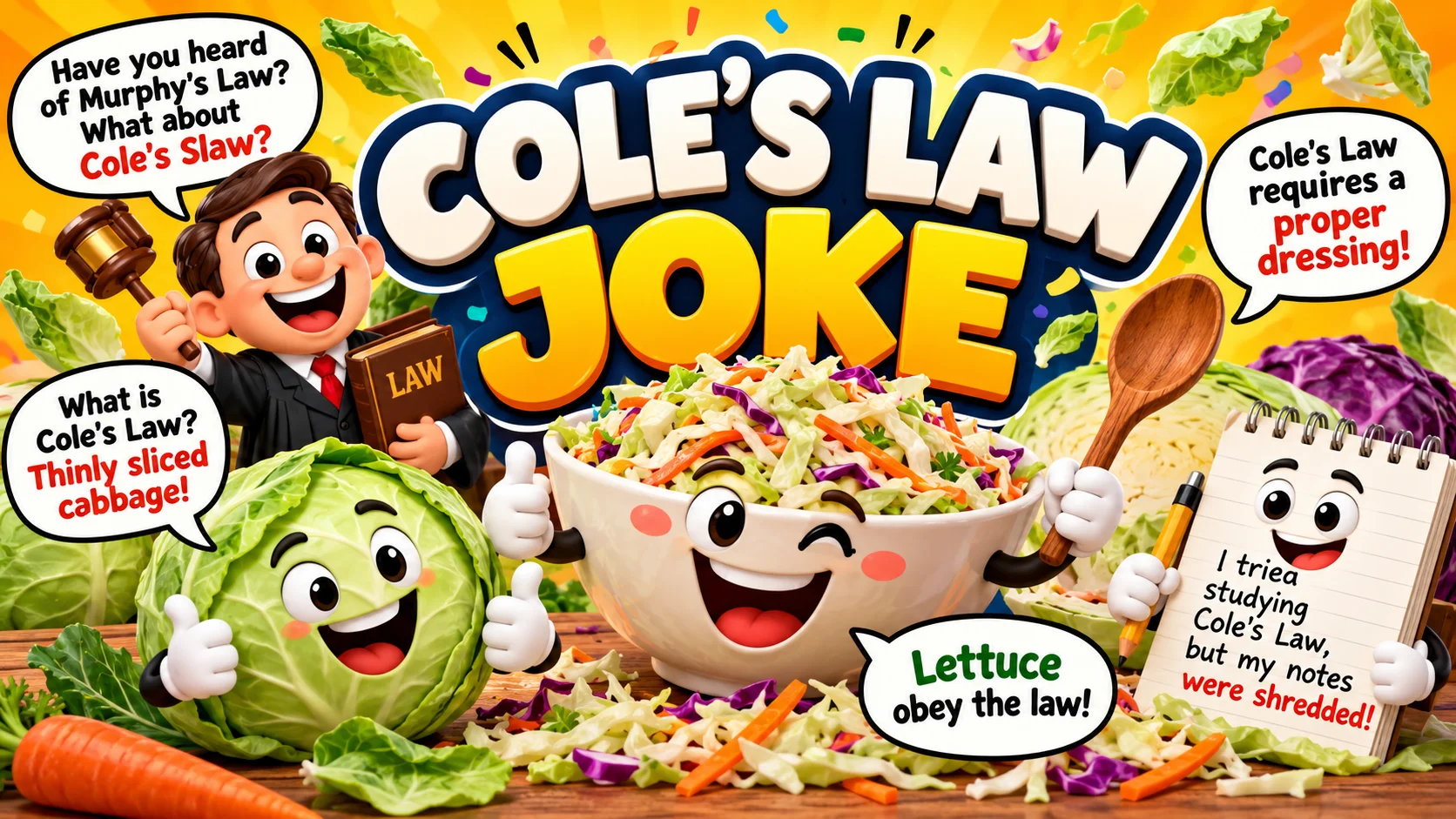
The Cole’s Law joke is a classic wordplay joke built around the similarity between Cole’s Law and coleslaw. Instead of describing an actual rule or principle, the punchline reveals that Cole’s Law is simply a dish made from shredded or thinly sliced cabbage, often served with a dressing.
The joke usually begins by mentioning Murphy’s Law, which is commonly summarized as the idea that if something can go wrong, it will go wrong. The listener is then asked whether they have heard of Cole’s Law.
The setup creates the expectation that another serious-sounding law is about to be explained.
Then comes the punchline:
It’s thinly sliced cabbage.
The humor comes from saying Cole’s Law aloud. When spoken naturally, it sounds very close to coleslaw. The joke works because the listener initially interprets law literally, while the punchline changes the meaning into a food pun.
This exact structure has circulated online for years. A 2018 Reddit post in r/Jokes uses the Murphy’s Law setup followed by the thinly sliced cabbage punchline, while later posts show the same joke continuing to circulate.
The Main Cole’s Law Punchline
The most recognizable version follows a simple question-and-answer structure:
Person 1: Have you heard of Murphy’s Law?
Person 2: Yes.
Person 1: What is it?
Person 2: If something can go wrong, it will go wrong.
Person 1: Right. Have you heard of Cole’s Law?
Person 2: No. What is it?
Person 1: Thinly sliced cabbage.
The punchline can also be expanded by describing the dish more specifically:
Cole’s Law is thinly sliced cabbage with dressing.
The joke is intentionally corny. Its entire mechanism depends on the listener recognizing that Cole’s Law → coleslaw is a sound-based pun.
A 2014 episode of A Way with Words specifically discussed the pun, presenting Cole’s Law and answering it with thinly sliced cabbage.
Why Cole’s Law Sounds Like Coleslaw
The coles law joke explained in its simplest form is a pronunciation pun.
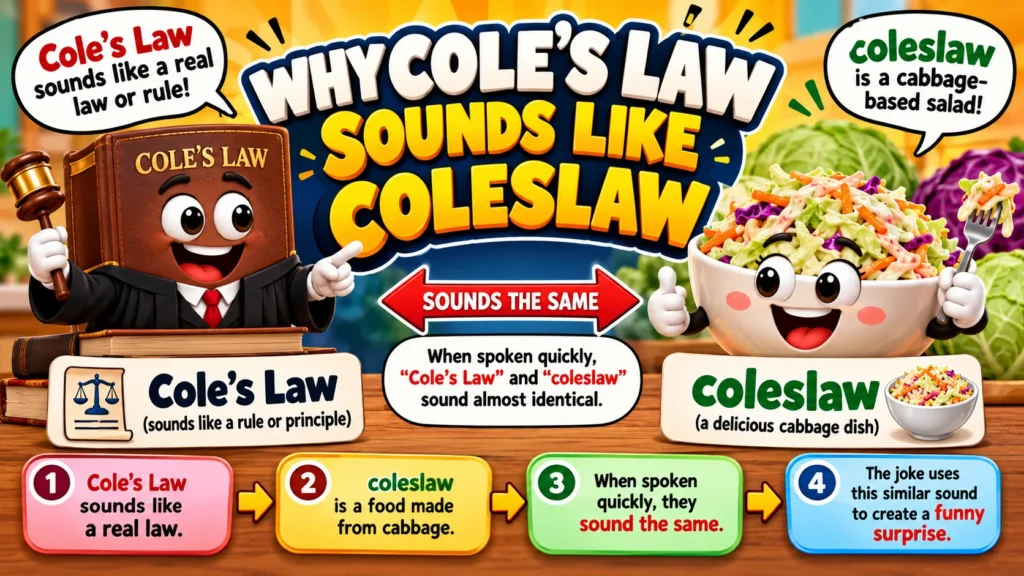
Written separately:
Cole’s Law
Written as the food:
coleslaw
When spoken quickly, the two phrases can sound extremely similar.
That similarity creates the joke because law normally refers to a rule, regulation, or principle, while coleslaw refers to a cabbage-based salad.
The joke therefore takes a familiar expression such as Murphy’s Law and invents a fake law whose name happens to sound like food.
The listener expects a definition involving some imaginary rule. Instead, the answer is something that could appear as a side dish at a meal.
That sudden change in category is what produces the humor.
Cole’s Law and Murphy’s Law
The Murphy’s Law Cole’s Law joke works because Murphy’s Law is already a familiar phrase.
Murphy’s Law is commonly expressed as the idea that something that can go wrong eventually will go wrong. That makes it a convenient setup for the joke because the word law sounds serious.
The joke then introduces another supposed law:
Murphy’s Law → things going wrong
Cole’s Law → coleslaw
The contrast is what makes the punchline work.
One is presented as a general principle about unfortunate events. The other is simply a playful name for a cabbage dish.
The joke does not claim that Cole’s Law is a genuine counterpart to Murphy’s Law. It deliberately pretends that the two belong to the same category for a few seconds before revealing the food pun.
This exact comparison appears repeatedly in online joke communities, including versions posted in 2022 and 2023.
The Meaning Behind the Cole’s Law Joke
The Cole’s Law joke meaning is straightforward:
Cole’s Law is a humorous way of saying coleslaw by pretending that the food is a law.
There is no complicated hidden message.
The joke combines:
- A familiar phrase
- A fake definition
- A sound-alike word
- A surprise change in meaning
- Food-related humor
- A deliberately corny delivery
The listener first hears Cole’s Law and may imagine that the speaker is about to introduce a new rule.
The final answer reveals that the law was actually slaw all along.
This is a form of phonetic wordplay, where the sound of a phrase is more important than its literal written meaning.
Why the Joke Is Considered a Dad Joke
The Cole’s Law joke is a natural example of a dad joke because it is deliberately simple and relies on an obvious pun.
Dad jokes often have several characteristics:
- A short setup
- Familiar vocabulary
- A predictable structure
- A pun or wordplay element
- An intentionally corny punchline
- A reaction that may involve groaning as much as laughing
Cole’s Law fits that pattern almost perfectly.
The joke does not require specialized knowledge about cabbage. The listener only needs to recognize the word coleslaw.
Its simplicity is part of the appeal.
In fact, one Reddit discussion about the joke includes people describing it as a classic dad-joke style gag and noting that versions have been circulating repeatedly.
Cole’s Law Joke in Its Shortest Form
The joke can be reduced to a very short exchange:
Have you heard of Cole’s Law?
No. What’s Cole’s Law?
Thinly sliced cabbage.
This version removes the Murphy’s Law setup entirely.
It works because the listener still has the same expectation: the word law sounds as though it should introduce a rule.
The answer immediately changes the interpretation.
Another short version is:
What’s Cole’s Law?
It’s a legal requirement to serve cabbage.
This variation adds another layer of absurdity by pretending that coleslaw is legally required.
The shorter version is useful for captions, joke lists, social-media posts, and quick conversations.
The Classic Murphy’s Law Version
The longer version usually gets a stronger setup because Murphy’s Law gives the listener context.
A clean family-friendly version can be presented like this:
Have you heard of Murphy’s Law?
Sure. If something can go wrong, it will go wrong.
Exactly. Have you heard of Cole’s Law?
No. What’s that?
Thinly sliced cabbage.
The humor depends on the final answer being delivered as if it were a completely serious definition.
If the speaker laughs before the punchline, the listener may figure out the trick too early.
The best delivery is often deliberately serious.
Cole’s Law Joke Explained Through Wordplay
The joke uses a sound-alike relationship rather than a traditional definition.
Consider the two expressions:
| Expression | Apparent Meaning | Actual Joke Meaning |
| Cole’s Law | A supposed rule | Coleslaw |
| Murphy’s Law | A principle about things going wrong | Actual familiar expression |
| Cole’s Law punchline | Something legal or philosophical | A cabbage dish |
| Law | Rule or principle | Part of the sound of slaw |
The trick is especially effective when the listener hears the phrase rather than seeing it written down.
On the page, the spelling Cole’s Law makes the joke slightly less obvious. When spoken, the similarity to coleslaw becomes much easier to hear.
Why the Cabbage Punchline Works
The phrase thinly sliced cabbage is funny in this context because it sounds like a dictionary definition.
The setup asks:
What is Cole’s Law?
The listener expects something like:
It is the principle that…
Instead, the speaker says:
Thinly sliced cabbage.
The answer is technically describing the food associated with coleslaw, but it completely ignores the listener’s assumption that law means a rule.
That mismatch is the heart of the joke.
Some versions add mayonnaise, carrots, vinegar, or dressing to make the description sound even more like a formal definition of coleslaw. Joke collections contain several variations describing Cole’s Law as shredded cabbage with dressing.
Cole’s Law as a Cabbage Joke
Because the punchline involves coleslaw, the joke naturally belongs to the wider category of cabbage jokes and food puns.
Once someone understands the original pun, it becomes easy to create related versions.
For example:
- Cole’s Law requires cabbage at every picnic.
- I tried to study Cole’s Law, but it was mostly shredded notes.
- Cole’s Law has a very strong dressing code.
- I passed Cole’s Law with flying colors, but failed the salad exam.
- Cole’s Law is the only law I enjoy eating.
- My knowledge of Cole’s Law is finely shredded.
- The judge dismissed the case because it was just a side salad.
- Cole’s Law has too many dressing requirements.
- I wanted to become a lawyer, but I ended up specializing in slaw.
- The evidence was chopped, shredded, and served cold.
These variations are built around the same food-and-law contrast.
Funny Cole’s Law Variations
The basic joke can be expanded into different formats without changing its central wordplay.
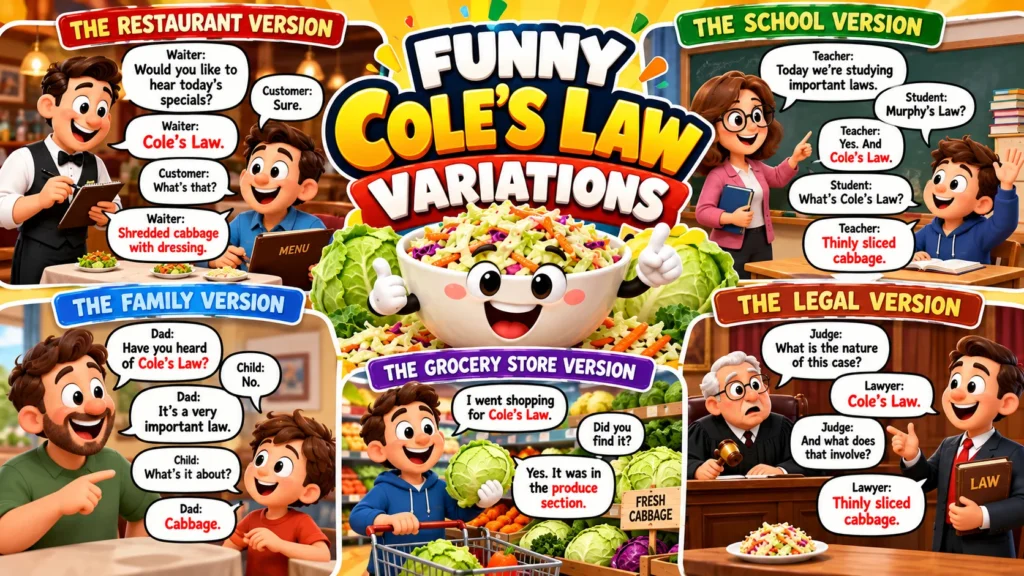
The Restaurant Version
Waiter: Would you like to hear today’s specials?
Customer: Sure.
Waiter: Cole’s Law.
Customer: What’s that?
Waiter: Shredded cabbage with dressing.
The School Version
Teacher: Today we’re studying important laws.
Student: Murphy’s Law?
Teacher: Yes. And Cole’s Law.
Student: What’s Cole’s Law?
Teacher: Thinly sliced cabbage.
The Family Version
Dad: Have you heard of Cole’s Law?
Child: No.
Dad: It’s a very important law.
Child: What’s it about?
Dad: Cabbage.
The Grocery Store Version
I went shopping for Cole’s Law.
Did you find it?
Yes. It was in the produce section.
The Legal Version
Judge: What is the nature of this case?
Lawyer: Cole’s Law.
Judge: And what does that involve?
Lawyer: Thinly sliced cabbage.
These versions preserve the original mechanism while giving the joke different settings.
Cole’s Law Joke and Other Law Puns
Cole’s Law is part of a broader style of humor where a familiar name or phrase is turned into a food-related pun.
For example, joke writers can play with words that sound like names, laws, or professional terms.
The appeal comes from making the listener temporarily accept an incorrect interpretation.
This is why Cole’s Law can work alongside jokes involving Murphy’s Law, Poe’s Law, or other familiar expressions.
The key difference is that Cole’s Law specifically depends on the sound of Cole’s Law resembling coleslaw.
Urban Dictionary entries also document multiple humorous definitions for Cole’s Law, including food-related wordplay and other parody uses. Because Urban Dictionary is user-generated, these entries are better understood as evidence of how the joke has been used online rather than as an authoritative record of its origin.
Jump into Other Related Article
- Ancient Sumerian Joke: The 4,000-Year-Old Dog and Bar Joke Explained
- Netflix Is a Joke | What the Festival Is, the 2026 Lineup and What’s Next
- Potato Jokes | 90+ Puns, Riddles and Dad Jokes with Answers
Cole’s Law Joke Origins and Online History
It is difficult to identify one definitive inventor of the Cole’s Law joke.
The format has circulated in multiple forms for many years. Online examples include Reddit posts, memes, joke collections, and discussions of the pun.
A Reddit post from March 2018 contains the familiar Murphy’s Law setup and the thinly sliced cabbage punchline. The post’s author said they remembered hearing the joke from their father, illustrating an important feature of traditional jokes: they often circulate orally before appearing online.
An episode of A Way with Words from 2014 also discussed the Cole’s Law pun, demonstrating that the expression was already recognizable in spoken language and language-humor contexts by then.
Because people can independently repeat a simple pun, it would be misleading to assign a definite origin without stronger historical evidence.
Is Cole’s Law a Real Law?
In the context of the Cole’s Law joke, no.
The joke uses law as part of a pun.
There is no ordinary legal rule called Cole’s Law that says people must eat cabbage.
There are, however, technical uses of similar terminology in specialized fields, so the phrase can occasionally appear outside the joke. That should not be confused with the popular coleslaw pun.
For ordinary joke searches, Cole’s Law is primarily understood as a humorous wordplay expression referring to coleslaw.
Cole’s Law vs. Murphy’s Law
The two expressions have very different purposes.
Murphy’s Law
Murphy’s Law is a familiar saying about the tendency for things that can go wrong to go wrong. It is commonly used when discussing mishaps, bad timing, or unfortunate circumstances.
Cole’s Law
Cole’s Law is a pun on coleslaw.
The comparison works because both expressions end in a word that sounds like law.
| Feature | Murphy’s Law | Cole’s Law |
| Category | Familiar maxim | Joke/pun |
| Main idea | Things can go wrong | Cabbage/coleslaw |
| Word law | Used literally in the expression | Used for wordplay |
| Humor | Can be humorous in context | Entirely based on the pun |
| Main punchline | If it can go wrong… | Thinly sliced cabbage |
The joke deliberately places these two phrases beside each other to make the transition from a serious-sounding principle to a food pun unexpected.
Cole’s Law Explained for Kids
The joke can also be adapted for children because the punchline is clean and easy to understand.
A child-friendly version could be:
Dad: Do you know Murphy’s Law?
Child: No. What’s that?
Dad: If something can go wrong, it will go wrong.
Child: What’s Cole’s Law?
Dad: Cabbage.
The joke can then be explained simply:
Cole’s Law sounds like coleslaw, which is a cabbage-based salad.
For younger children who may not know what coleslaw is, the joke may need a little context.
A child who knows that coleslaw is made from cabbage is more likely to understand the punchline immediately.
Cole’s Law and Coleslaw
Coleslaw is generally a salad made from shredded or finely cut cabbage, commonly combined with a dressing. Recipes vary considerably, so the exact ingredients are not fixed.
That flexibility is useful for the joke.
The punchline does not need to provide a complete recipe. Saying thinly sliced cabbage is enough to make the listener think of coleslaw.
Some joke versions mention:
- Shredded cabbage
- Thinly sliced cabbage
- Cabbage and carrots
- Mayonnaise
- Salad dressing
- Vinegar-based dressing
- A side dish
Online joke collections use several of these descriptions when presenting the Cole’s Law pun.
Best Way to Tell the Cole’s Law Joke
Delivery can make this simple joke work better.
A good approach is:
- Start with the familiar Murphy’s Law question.
- Explain Murphy’s Law normally.
- Ask whether the listener knows Cole’s Law.
- Pause before the answer.
- Give the cabbage description seriously.
- Let the listener recognize the sound-alike.
- Avoid explaining the pun immediately.
The pause is useful because it allows the listener to create an expectation about what Cole’s Law might mean.
The punchline then breaks that expectation.
If the joke is explained before the listener has a chance to catch the wordplay, some of its effect disappears.
More Cabbage and Coleslaw Jokes
If you enjoy the coles law joke, these related cabbage puns fit the same style:
- Why did the cabbage become a lawyer? It wanted to practice Cole’s Law.
- What does Cole’s Law require? A proper dressing.
- Why did the cabbage go to court? It had a case to slaw.
- Why was the cabbage so confident? It knew the law was on its side.
- What does a lawyer order with dinner? A side of Cole’s Law.
- Why did the salad hire an attorney? It needed legal dressing.
- What is a cabbage’s favorite subject? Cole’s Law.
- Why did the coleslaw pass the exam? It knew all the right laws.
- What happens when Cole’s Law goes to court? It gets chopped down to size.
- Why was the salad sitting in the courtroom? It was waiting for its dressing.
These are intentionally corny and work best as light food puns.
Why Cole’s Law Is a Classic Pun
The longevity of the Cole’s Law joke comes from its simplicity.
A good short pun often needs only three ingredients:
Recognition + expectation + surprise.
Cole’s Law provides all three.
First, the listener recognizes law as something associated with rules or principles.
Second, the Murphy’s Law setup strengthens that expectation.
Third, the punchline suddenly reveals that the supposed law is actually coleslaw.
The listener then mentally connects the sounds.
That moment of recognition is the joke.
Because the wordplay is so short, the joke can be reused in different settings without requiring a complicated story.
Why Some People Do Not Immediately Get the Joke
The Cole’s Law pun depends heavily on pronunciation and familiarity with coleslaw.
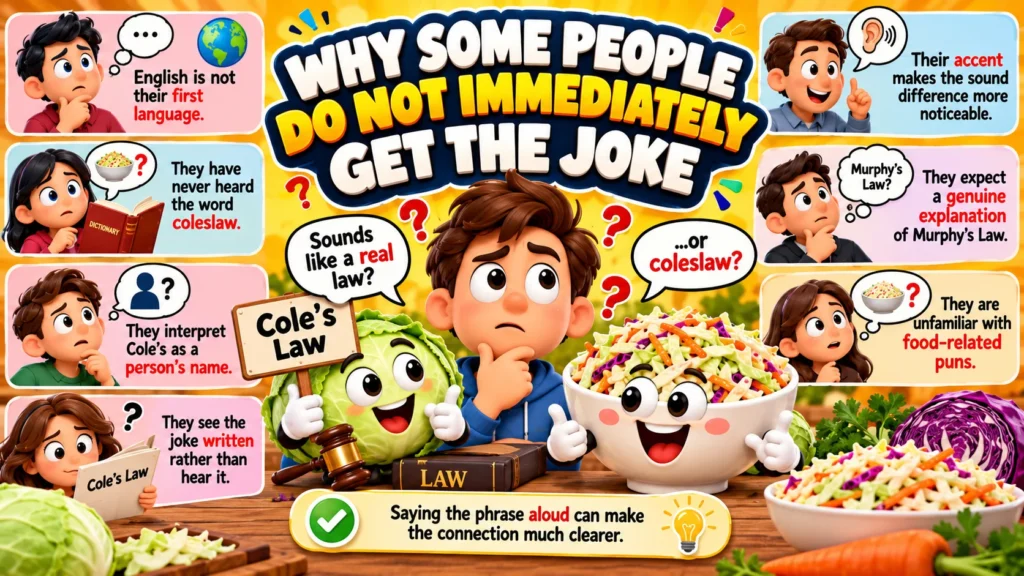
Someone may not immediately understand it if:
- English is not their first language.
- They have never heard the word coleslaw.
- They interpret Cole’s as a person’s name.
- They see the joke written rather than hear it.
- Their accent makes the sound difference more noticeable.
- They expect a genuine explanation of Murphy’s Law.
- They are unfamiliar with food-related puns.
This is why saying the phrase aloud can make the connection much clearer.
Online discussions about the joke include people explaining that the pun depends on hearing Cole’s Law as coleslaw.
Cole’s Law Joke for Social Media
The joke is also easy to turn into a social-media caption.
For example:
You’ve heard of Murphy’s Law.
But have you heard of Cole’s Law?
It’s thinly sliced cabbage. 🥬😂
Another format:
Me: I finally understand Murphy’s Law.
Dad: Good. Now learn Cole’s Law.
Me: What’s that?
Dad: Coleslaw.
Me: Please stop.
The joke also works as a meme because the setup can be placed above an image of cabbage or a bowl of coleslaw.
The simplicity makes it suitable for short-form humor without requiring a long explanation.
Cole’s Law Joke Search Intent
People searching for coles law joke, coles law joke explained, or Murphy’s Law Coles Law joke are generally looking for one of a few related things:
- The actual Cole’s Law punchline
- An explanation of the wordplay
- The connection to coleslaw
- The connection to Murphy’s Law
- A longer version of the joke
- Funny variations
- Cabbage-related puns
- The history of the joke
- Why the joke is considered a dad joke
- Examples suitable for social media
The core answer remains simple: Cole’s Law is a pun on coleslaw, with the joke pretending that the cabbage dish is a law.
Final Thoughts on the Cole’s Law Joke
The Cole’s Law joke is a straightforward but effective example of classic wordplay. Its humor comes from taking the familiar concept of Murphy’s Law, introducing the made-up Cole’s Law, and then revealing that the supposed law is actually coleslaw.
The best-known punchline describes it as thinly sliced cabbage, although other versions add carrots, mayonnaise, or dressing. The basic pun remains the same.
The joke has appeared in online joke communities, memes, language discussions, and social posts for years. A 2014 A Way with Words segment discussed the same pun, while Reddit examples from 2018 onward show its continued circulation.
Its appeal comes from being quick, clean, recognizable, and intentionally corny. It does not require a complicated story. The listener only needs to hear the phrase, expect a serious definition, and then realize that Cole’s Law sounds like coleslaw.
In other words, if Murphy’s Law is about things going wrong, Cole’s Law is about cabbage going right onto your plate. 🥬
What is the Cole’s Law joke?
The Cole’s Law joke is a pun in which Cole’s Law sounds like coleslaw. The punchline usually describes Cole’s Law as thinly sliced or shredded cabbage.
What is the punchline to the Cole’s Law joke?
The classic punchline is thinly sliced cabbage. Some versions describe it as shredded cabbage with dressing or mayonnaise.
How is Cole’s Law related to Murphy’s Law?
The joke uses Murphy’s Law as the setup. After discussing Murphy’s Law, the speaker asks whether the listener has heard of Cole’s Law, creating the expectation of another serious principle. The punchline reveals that it means coleslaw.
What does Cole’s Law mean?
In the joke, Cole’s Law means coleslaw. It is a humorous sound-alike rather than an ordinary legal rule.
Is Cole’s Law a real law?
Not in the context of the joke. Cole’s Law is a wordplay expression based on the sound of coleslaw.
Why is Cole’s Law funny?
The phrase sounds like the name of a serious law, but the punchline reveals that it refers to a cabbage dish. The unexpected change in meaning creates the humor.