
Do you even eat? Go have a burger. You’re all bones. If you’re thin, you’ve heard some version of these, probably from someone who thought they were being funny. Skinny jokes occupy a strange social space: most people would never comment on a larger person’s body, but comments about a small one are treated as fair game. This article covers why that double standard exists, what research actually says about the harm, and, most usefully, what to say back. You’ll also find how to handle it when the person joking is a friend, a relative, or a coworker.
What Counts as a Skinny Joke
Most skinny jokes aren’t delivered as insults. They arrive as observations, concern, or backhanded compliments, which is exactly what makes them hard to push back on. The common forms are remarks about eating habits, comparisons to objects like sticks or twigs, and unsolicited advice about gaining weight. Because the speaker often believes they’re being complimentary, the person on the receiving end is expected to laugh along. That expectation is the real problem, not the wording. It leaves the person with two bad options: laugh at a remark they dislike, or look humourless for objecting to something framed as a compliment.
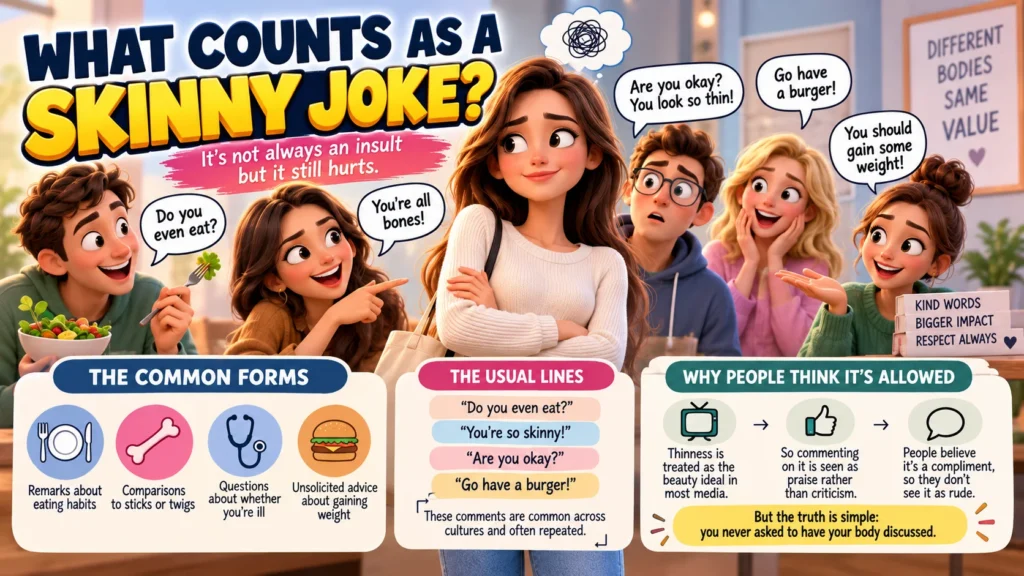
The Usual Lines
The script barely changes across countries. Comments about eating enough, comparisons to bones or sticks, questions about whether someone is ill, and suggestions to eat more are the standard four. Physical versions exist too, like grabbing someone’s wrist to demonstrate how thin it is, which crosses from awkward comment into unwanted touching.
Why People Think It’s Allowed
Thinness is treated as the beauty ideal in most Western media, so commenting on it reads as praise rather than criticism. As one sociologist specialising in the body has noted, thin people are generally judged less harshly precisely because they align with current standards. The logic goes: if it’s a compliment, it can’t be rude. That reasoning ignores the fact that the recipient never asked to have their body discussed at all.
Why You’re So Skinny Jokes Actually Land Hard
The damage isn’t about any single remark. It’s about hearing it repeatedly, from people whose opinion matters, about something you mostly can’t control. Experts consulted by the South China Morning Post agree that criticising someone for being thin is a legitimate problem that can lead to serious mental health consequences, including lowered self esteem. Many thin people are also naturally that size, dealing with a fast metabolism, a medical condition, or medication, none of which is anyone’s business. Others have been thin their whole lives and have simply been answering the same question since primary school.
- The comments are repetitive, arriving from different people in the same week.
- They’re often physical, involving someone grabbing a wrist or waist.
- They imply illness, which is invasive regardless of intent.
- They carry unsolicited advice about what the person should eat.
- They assume thinness is a choice, which it frequently isn’t.
- They expect the recipient to laugh, removing the option to object.
The Research on Lean Stigma
There’s a documented version of this affecting people who’ve lost weight. A North Carolina State University study led by Lynsey Romo interviewed 40 people who had lost an average of nearly 77 pounds. All 40 reported that friends, family or coworkers had tried to belittle or undermine their weight loss, through snide remarks about their eating habits or predictions that they’d gain it all back. Romo named this pattern lean stigma.
An Important Distinction
Being honest about this matters for credibility. Experts who study body image consistently warn against treating skinny shaming and fatshaming as equivalent. Dietitian Rachael Rollin, quoted in the same SCMP report, points out that people in larger bodies face systemic consequences that thin people generally don’t: fewer promotions, lower hiring rates, and medical discrimination. Both hurt individuals. Only one comes with structural disadvantage attached. Acknowledging that doesn’t make thin people’s experience less real.
Jump into Other Related Article
- Basketball Jokes | Kids’ Classics, Dad Jokes, and Why the Inventor Had a Losing Record
- Shark Jokes | 60+ Funny Ones for Kids & Adults
- Cat Joke Memes | The Formats, the Real Origins, and How to Make Your Own
How to Respond to Skinny Jokes
Most people searching for comebacks want to shut the comment down without starting a fight. The good news is that the calm responses work better than the clever ones, because a witty roast invites a rematch while a flat reply ends the conversation. Pick a few that suit your personality and keep them ready, because the hardest part is usually being caught off guard.
Short, Calm Replies
- I’m happy with how I look, thanks.
- That’s a strange thing to say about someone’s body.
- I eat plenty. Odd question, though.
- I’d rather not talk about my weight.
- Would you say that to someone larger than me?
Light Deflections
If you’d rather keep things friendly, humour that doesn’t attack anyone works well.
- Genetics. I take no credit and accept no blame.
- My metabolism is showing off again.
- Noted. Adding it to the list of things people tell me about my body.
- I’ll pass that feedback to management.
Direct Responses for Repeat Offenders
When someone keeps going after you’ve deflected once, a clearer line is fair.
- I’ve asked you not to comment on my body. Please stop.
- This is the third time. It isn’t funny to me.
- I don’t comment on your weight. I’d appreciate the same.
When It’s a Friend, Family Member or Coworker
The right response depends heavily on who’s speaking and whether they’ll be in your life next week. A stranger’s comment can be ignored entirely. A relative who repeats it at every gathering needs a different approach, ideally in private rather than across the dinner table. Coworkers sit somewhere in between, and repeated comments about appearance at work may be a matter for HR rather than a comeback. The general rule: the closer the relationship, the more direct you can afford to be.
- With strangers, the best reply is often no reply at all.
- With friends, a single honest sentence usually fixes it permanently.
- With family, raise it privately rather than in front of everyone.
- With relatives who won’t stop, enlist one ally who’ll back you up.
- At work, document repeated comments about your body.
- With anyone who touches you to make the point, address the touching first.
What to Say Instead of a Skinny Joke
If you’ve been the one making these remarks, the fix is simple: stop commenting on bodies. Not the thin ones, not the large ones, not the ones that changed since you last saw someone. Compliments about a person’s body still put their appearance on the table for discussion, which is the underlying issue. There is almost always something better to open a conversation with.
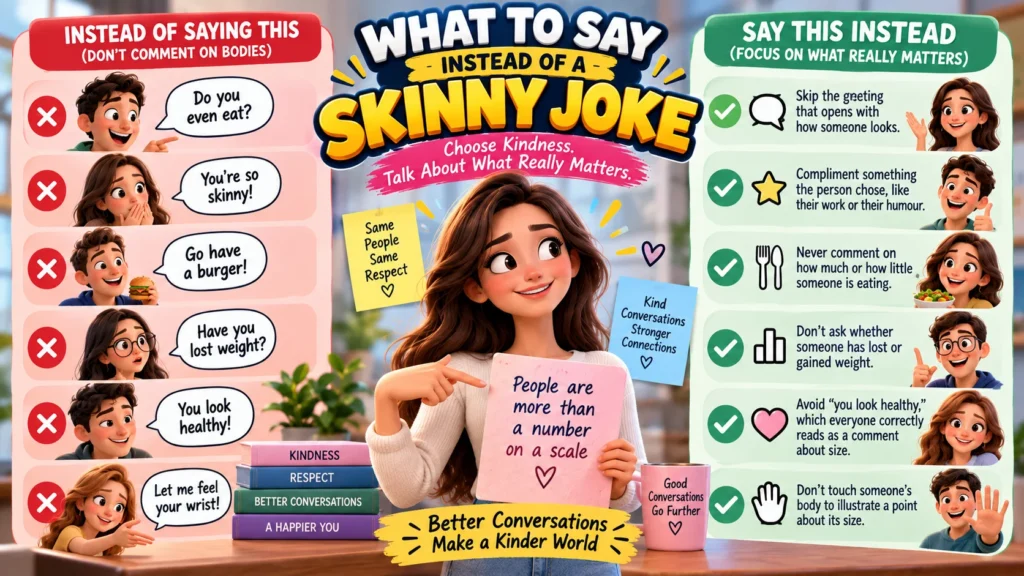
- Skip the greeting that opens with how someone looks.
- Compliment something the person chose, like their work or their humour.
- Never comment on how much or how little someone is eating.
- Don’t ask whether someone has lost or gained weight.
- Avoid you look healthy, which everyone correctly reads as a comment about size.
- Don’t touch someone’s body to illustrate a point about its size.
When Comments About Thinness Signal Something Serious
There’s a version of this worth taking seriously rather than answering with a comeback. If someone’s weight has changed noticeably and unintentionally, that’s a medical question, not a social one, and it belongs with a doctor rather than a dinner table. Equally, if comments about your body are affecting how you eat or how you feel about yourself, that’s worth raising with a healthcare professional. Concern delivered as a joke is still a bad delivery, but the underlying worry sometimes deserves a real conversation in a better setting.
Conclusion
Skinny jokes get a pass that other body comments don’t, largely because thinness is treated as a compliment in most of our media. It isn’t, and the people hearing do you even eat? for the fifth time this month know that better than anyone. You don’t owe anyone a laugh, a comeback, or an explanation of your metabolism. A calm sentence that ends the topic does more than the sharpest roast, and the people worth keeping around will take the hint the first time.
What is skinny shaming?
It’s mocking or criticising someone for being thin, usually through comments about their eating, comparisons to objects like sticks, or suggestions that they look unwell.
Is skinny shaming as bad as fat shaming?
Experts who study body image say both harm individuals but warn against treating them as equivalent, since larger people also face documented disadvantages in hiring, promotion and medical care.
What’s the best comeback to a skinny joke?
A calm one. I’m happy with how I look, thanks ends the conversation, while a sharp roast usually invites another round.
What is lean stigma?
A term from NC State research describing how friends, family and coworkers undermine people who have lost weight, through snide remarks or predictions that they’ll regain it.
How do I get a relative to stop commenting on my weight?
What is skinny shaming?
It’s mocking or criticising someone for being thin, usually through comments about their eating, comparisons to objects like sticks, or suggestions that they look unwell.
Is skinny shaming as bad as fat shaming?
Experts who study body image say both harm individuals but warn against treating them as equivalent, since larger people also face documented disadvantages in hiring, promotion and medical care.
What’s the best comeback to a skinny joke?
A calm one. I’m happy with how I look, thanks ends the conversation, while a sharp roast usually invites another round.
What is lean stigma?
A term from NC State research describing how friends, family and coworkers undermine people who have lost weight, through snide remarks or predictions that they’ll regain it.
Should I just laugh it off?
Only if you genuinely find it funny. Laughing at a comment you dislike teaches the other person it’s welcome.