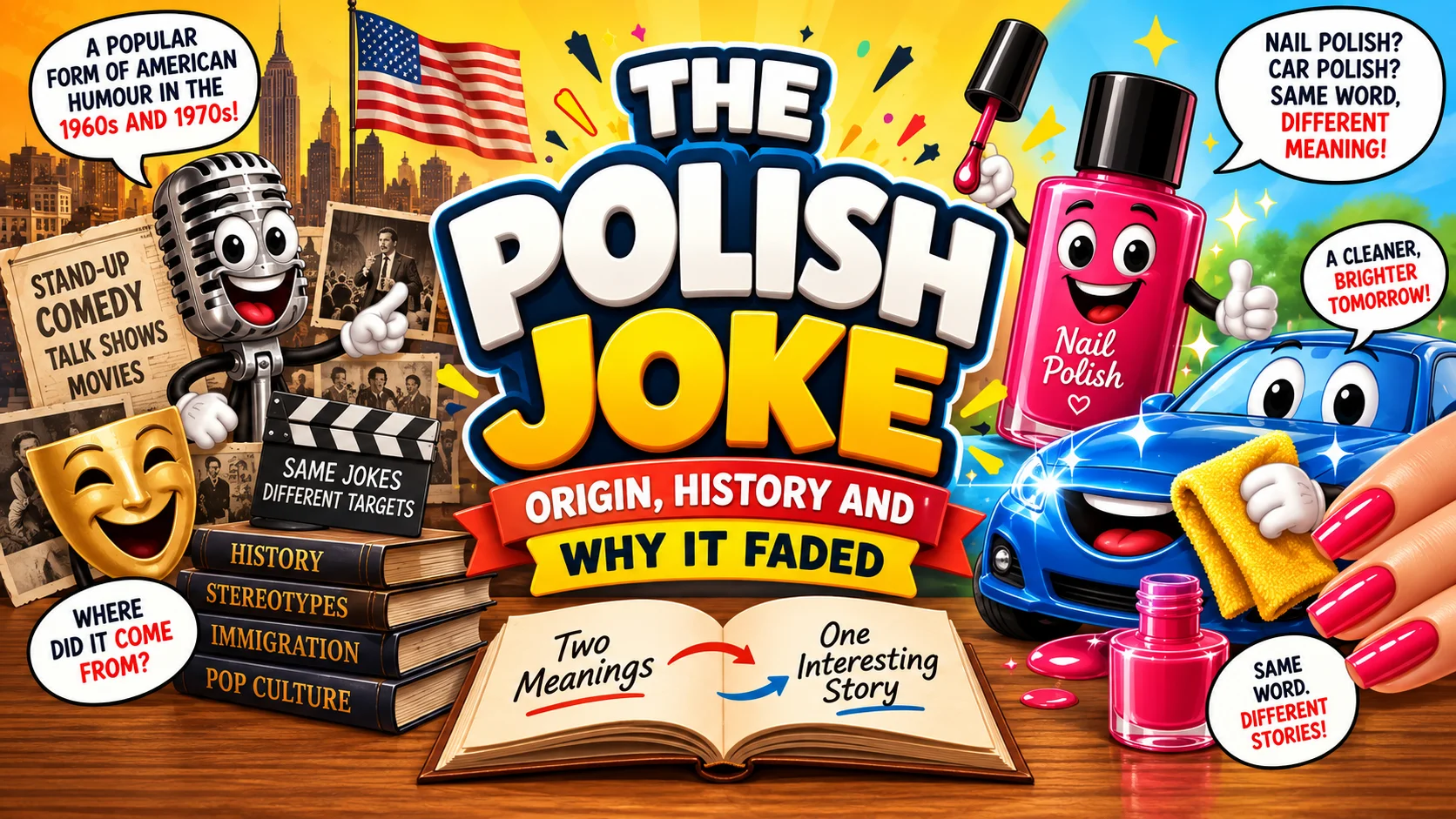
Search for polish joke and you’ll find two completely different things. One is a specific genre of American ethnic humour from the 1960s and 70s, built entirely on the idea that Polish people are stupid. The other is harmless wordplay about the stuff you put on your nails, your car, or your shoes. This article covers both, and it explains the first one rather than repeating it. You’ll learn where the genre came from, why humour scholars find it fascinating, which public figures got in trouble telling them, and why the whole cycle largely died out.
What Is a Polish Joke?
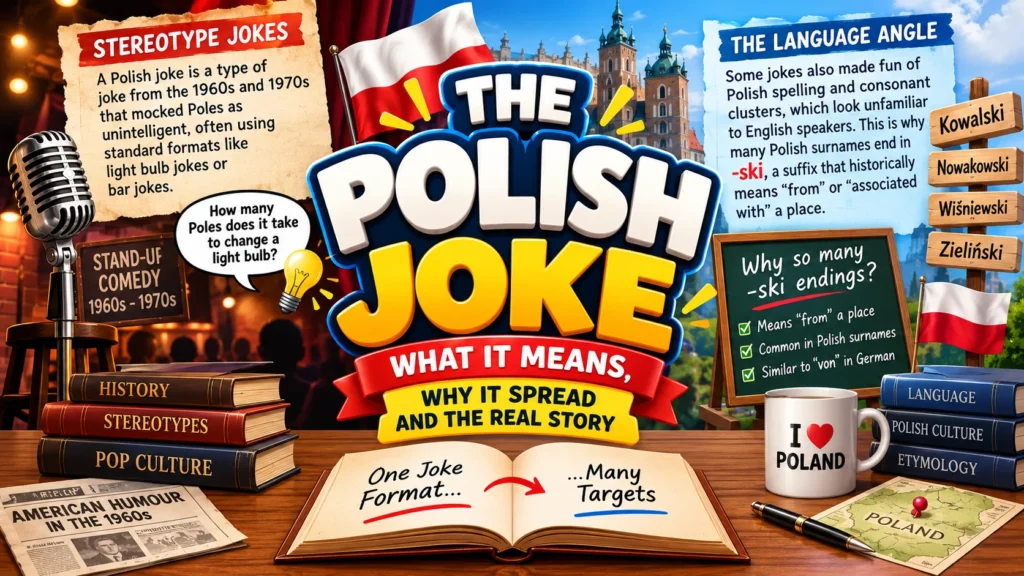
A Polish joke is a stereotype-based joke, told in English, designed to mock Poles as unintelligent or backward. Culture.pl describes the genre as jokes built on negative stereotypes that target Poles, Polish culture or Polish habits, frequently recycling standard joke formats like light bulb jokes and bar jokes, and often using a slur in place of the word Polish. The setups became so formulaic that an audience could predict the shape of the punchline before it arrived.
The Standard Formats
Almost every Polish joke borrowed an existing joke skeleton and swapped in a new target. The light bulb format, the walks into a bar format, and the riddle format all appeared. That reusability is exactly why the genre spread so fast and why the same jokes were later retargeted at other groups.
The Language Angle
A whole sub-genre mocked Polish spelling and its consonant clusters, which look unfamiliar to English speakers. This is also the source of the recurring question about why so many Polish surnames end in -ski. The real answer is mundane: the suffix historically indicated origin or association with a place, much like von in German.
Where the Polish Joke Came From
The genre’s origin is genuinely contested, and that disagreement is the interesting part. Two main explanations compete, and reputable sources support each. Understanding both tells you more about American immigration history than about Poland. What everyone agrees on is the timing: the jokes exploded in the United States in the early 1960s and peaked through the 1970s.
The American Immigration Explanation
Slate, writing about the work of humour scholar Christie Davies, notes that Polish Americans became joke targets after large numbers fled persecution in the 18th and 19th centuries and took up menial work in their new country. Newly arrived, working physical jobs, and speaking limited English, they fitted the pattern every society uses when picking a target.
The Imported Prejudice Explanation
The competing account traces the stereotype to Europe. Wikipedia’s account notes that anti-Polish stereotypes were amplified by National Socialist propaganda that portrayed Poles as dirty and inferior in order to justify Nazi crimes against them, and that some Polish jokes reached America with German displaced persons in the late 1940s. Davies, by contrast, argued the American versions were a separate phenomenon that did not carry Old World hatreds.
Why Every Country Has Its Own Version
This is the most useful thing to understand about the genre: it isn’t about Poland at all. Christie Davies spent decades documenting that nearly every culture has its own equivalent, because every country mocks a group it has labelled as simpletons and outsiders. The pattern is ancient too. The oldest surviving joke book, the Greek Philogelos, devotes nearly a quarter of its 265 jokes to people from cities with reputations for stupidity. The target changes; the joke does not.
- The format is portable and gets reused on whichever group is currently newest or lowest-status.
- The target is usually an outsider group rather than a powerful one.
- Davies traced dumb-blonde jokes from the US to Croatia, France, Germany, Hungary, Poland and Brazil.
- He also found the American lawyer joke cycle of the 1980s failed to spread abroad.
- Poland itself has internal versions aimed at regional groups.
- Recognising the pattern is what makes the genre look less funny and more mechanical.
When Polish Jokes Reached Mainstream Media
The genre did not stay in bars. Culture.pl notes that Polish jokes ran through stand-up comedy, talk shows including The Tonight Show, and films for decades, and points to Stanley Kowalski in A Streetcar Named Desire as an early screen image that hardened the stereotype of the coarse Polish-American labourer. That mainstream exposure is what turned a bar-room format into a nationally recognised genre, and it’s also why Polish-American organisations began pushing back.
Public Figures and Backlash
Several well-known Americans, including media executives and politicians, faced public criticism for telling Polish jokes on the record. The outcome was almost always the same: an apology, a news cycle, and a slow shift in what was acceptable in public. Wikipedia records that from the late 1960s onward, Polish American organisations worked continuously to challenge the negative stereotyping of Poles in US media.
The Official Complaints
Pushback also came from Poland itself. Culture.pl notes that the Polish Ministry of Foreign Affairs has at times formally complained about specific Polish jokes appearing on television.
Why the Genre Largely Faded
Polish jokes are far rarer today than in 1975, and several forces caused that. The most important was simply that the stereotype stopped matching reality. Poland joined NATO and the European Union, Polish migration patterns changed, and the image of the unskilled newcomer no longer held. Public standards shifted too, and ethnic mockery moved from mainstream television to the margins.
- Poland’s international standing changed dramatically after 1989.
- Research on EU labour migration found the Polish stupidity stereotype far less active, with Polish migrants instead stereotyped as hard-working.
- Broadcast standards tightened and networks stopped airing ethnic jokes.
- Polish-American advocacy made the cost of telling them publicly much higher.
- Comedy audiences moved on; the format simply stopped landing.
- Newer joke cycles absorbed the same structures with different targets.
Jump into Other Related Article
- Basketball Jokes | Kids’ Classics, Dad Jokes, and Why the Inventor Had a Losing Record
- Shark Jokes | 60+ Funny Ones for Kids & Adults
- Cat Joke Memes | The Formats, the Real Origins, and How to Make Your Own
The Other Polish Joke | Nail and Car Polish Puns
Here’s the split most search results miss. A large share of people searching this phrase want wordplay on polish as a substance, not a nationality. These puns are entirely harmless, and the cosmetics industry leans into them heavily. OPI, one of the best-known nail lacquer brands, even sells a shade called OY! Another Polish Joke! You’ll also find car polish gags, shoe polish puns, and nail salon captions built on the same double meaning.
- Nail technicians use polish joke as a standing pun in salon marketing.
- Car detailing accounts build captions around buffing and shine.
- Polish remover puns play on the idea of undoing a joke.
- Shoe-shine humour uses the same word in a third sense.
- These puns carry none of the ethnic baggage of the older genre.
Polish Joke as a Piece of Theatre
The phrase also names a well-regarded American play. Polish Joke by David Ives premiered at Manhattan Theatre Club in 2003, directed by John Rando. It follows Jasiu, a Polish-American man told by his uncle that being Polish is a curse, who spends the play trying and failing to escape his own heritage. Ives, who is himself Polish and grew up in a Polish-speaking household, uses the play to raise a range of stereotypes and then dismantle them, ending on pride in Polish identity. The script appears in the collection Polish Joke and Other Plays.
What to Say If Someone Tells You One
Plenty of people still hear these jokes from older relatives or coworkers who don’t realise the genre’s history. You don’t need a lecture to handle it, and confrontation usually backfires. A short, calm response works better than an argument.
- I’ve never actually found those ones funny ends it without escalating.
- Asking where the joke came from often does the work for you.
- Mentioning that every country has the same joke defuses it quickly.
- Changing the subject is a legitimate option.
- For workplace settings, raising it privately with the person is usually the better first step.
conclusion
The Polish joke was never really about Poland. It was a portable, reusable format that American culture attached to whichever group had most recently arrived and had the least power to object, and Poland’s turn ran from roughly 1960 to the 1980s. Scholars studying it learned more about the societies telling the jokes than about the people in them. Today the phrase more often points to a nail polish pun or a David Ives play than to an ethnic slur, which is a reasonable place for it to have landed.
What is the origin of the Polish joke?
The genre spread widely in the US in the early 1960s. One explanation ties it to Polish immigrants taking low-status jobs in America; another traces the stereotype to European, and later Nazi, anti-Polish propaganda. Scholars still disagree.
Why do Polish surnames end in -ski?
The suffix historically indicated origin or association with a place or estate, similar to von in German. It has nothing to do with the joke premise.
Why does every country have a version of the Polish joke?
Humour scholar Christie Davies documented that nearly every culture mocks some group it labels as simpletons and outsiders. Only the target changes.
Are Polish jokes still common?
Far less so. Poland’s international position changed after 1989, broadcast standards tightened, and research on EU migration found the stupidity stereotype largely inactive.
What is Polish Joke by David Ives?
A 2003 comedy that premiered at Manhattan Theatre Club, about a Polish-American man trying to escape his heritage. Ives is Polish-American and uses the play to take stereotypes apart.