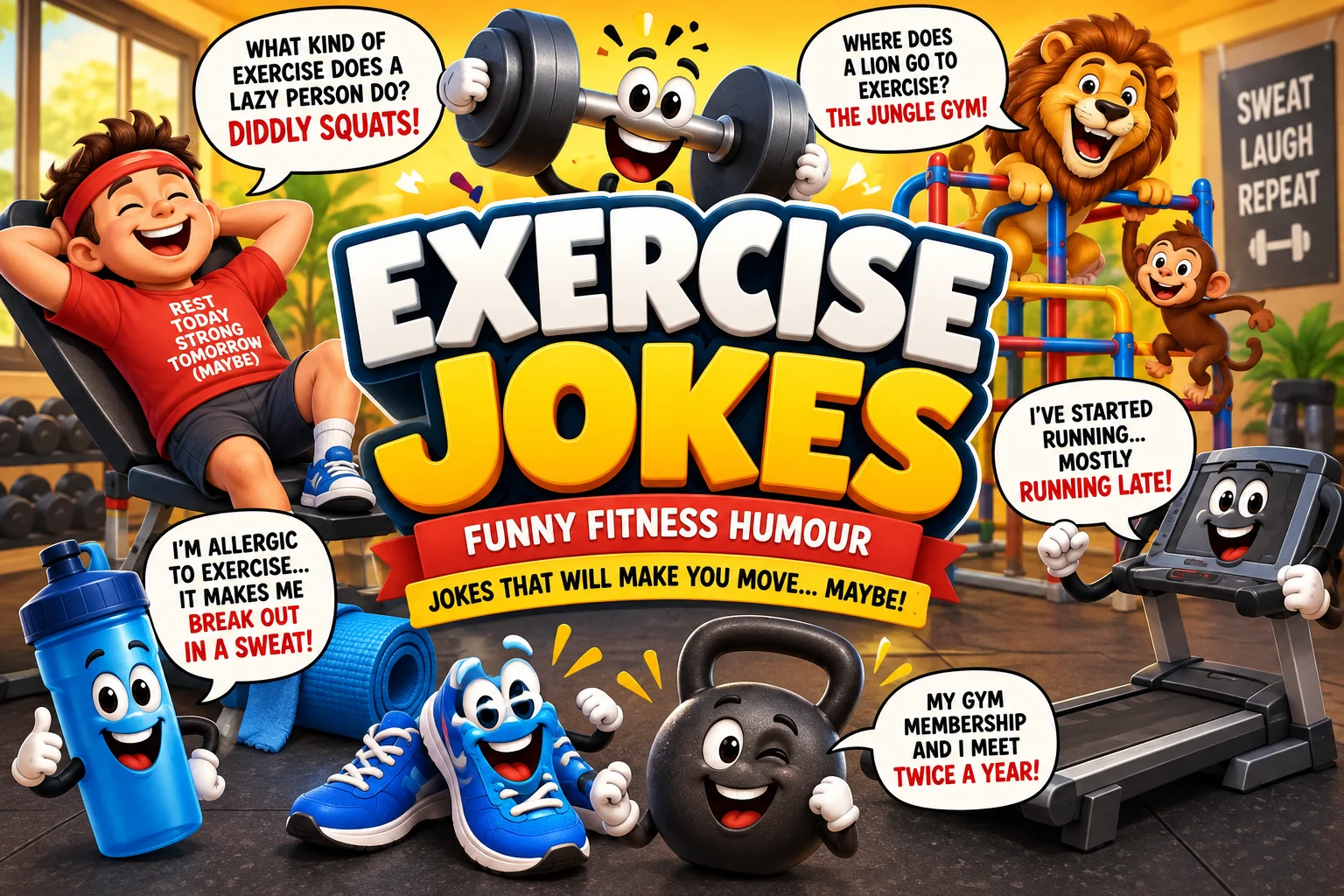
Almost every exercise joke is about the same thing the distance between intending to exercise and actually doing it. That gap is so universal it has a name in behavioural science and a measured size, which means the joke everyone has been telling for decades turns out to be an accurate description of a real phenomenon. This page has the riddles with their answers, the gym jokes worth keeping, and the research that explains why they land so reliably.
Why Exercise Jokes Basically Write Themselves
The comic engine here is not wordplay, it is recognition. Nearly everybody has intended to exercise more and then not done it, which means an exercise joke needs no setup at all. The audience has already lived the premise, usually quite recently.
- The subject is a gap between intention and action
- Almost everyone has personally been on both sides of it
- No setup is required the audience supplies the memory
- The teller is usually the target, which makes it safe
- It works identically across ages, countries and fitness levels
- Selfdeprecation is the default register of the entire category
What the Research Actually Found
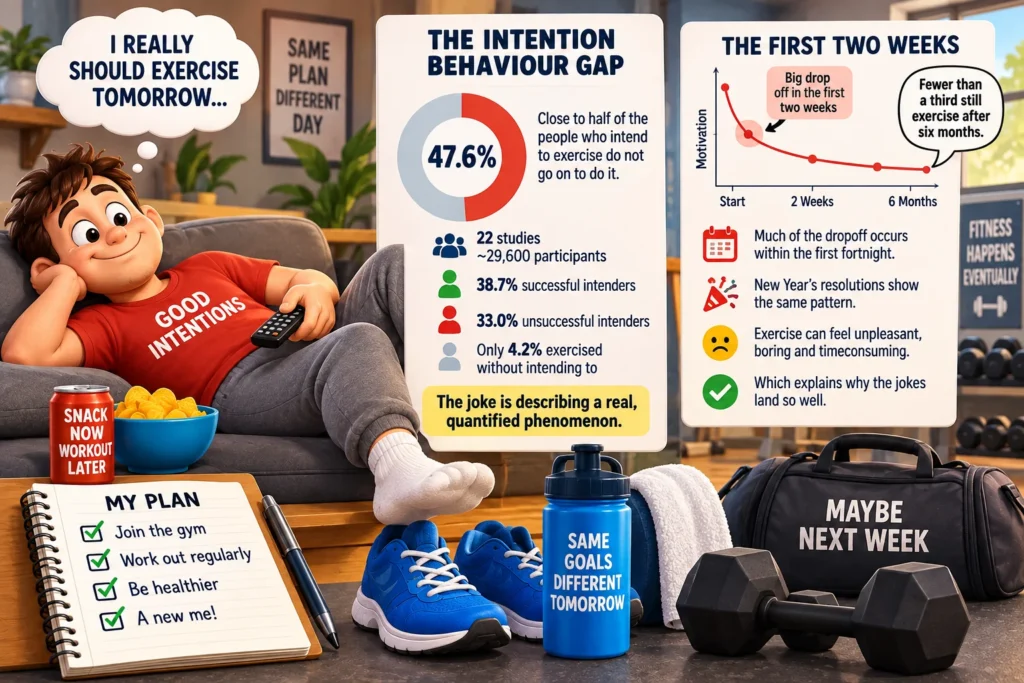
This is the part that makes the joke funnier. Behavioural scientists call it the intention behaviour gap, and a 2023 systematic review and metaanalysis covering 22 studies and nearly 30,000 participants measured the gap for physical activity at 47.6%. In other words, close to half the people who genuinely intend to exercise do not go on to do it.
- The gap for physical activity was measured at 47.6%
- Based on 22 studies and roughly 29,600 participants
- 38.7% were successful intenders; 33.0% were unsuccessful intenders
- Only 4.2% exceeded expectations without intending to
- Intention still matters very few nonintenders exercised at all
- The joke is describing a documented, quantified phenomenon
The First Two Weeks
The exercise psychologist Ryan Rhodes, who directs the Behavioural Medicine Lab at the University of Victoria, has put it more bluntly: fewer than a third of beginners are still following through after six months, and much of the dropoff happens inside the first two weeks. Every January gym joke ever told is describing this exact curve.
- Fewer than a third of beginners persist past six months
- Much of the dropoff occurs within the first fortnight
- New Year’s resolutions are the clearest example of the pattern
- Rhodes notes exercise is genuinely unpleasant, boring and timeconsuming
- Which is a fairly generous explanation for the joke everyone tells
The Exercise Riddles People Search For
These have fixed answers and all of them work with children.
What Kind of Exercise Does a Lazy Person Do?
Diddly squats. It is the best pun in the category, because diddly squat already means nothing at all, and a squat is a real exercise two unrelated meanings meeting perfectly.
- Q What kind of exercise does a lazy person do? A Diddly squats.
Where Does a Lion Go to Exercise?
The jungle gym. The same answer covers the monkey version of the question, which is why both turn up in search constantly.
- Q Where does a lion go to exercise? A The jungle gym.
- Q Where do monkeys get their exercise? A Also the jungle gym.
Where Does a Train Go to Exercise?
The training ground. A single word pun, and one of the few exercise jokes that works better written than spoken.
- Q Where does a train go to exercise? A The training ground.
Are You Allergic to Exercise?
It makes me break out in a sweat. This is the most repeated exercise one liner in English and it works because break out belongs to both allergies and perspiration.
- The line I’m allergic to exercise it makes me break out in a sweat.
- Works as a reply to almost any suggestion of going to the gym
The Exercise I Get at Work Joke
This is a format rather than a single joke, and it is endlessly extendable. You claim to get plenty of exercise, then list activities that are not exercise at all. The best versions build to something slightly too honest.
- I get plenty of exercise jumping to conclusions.
- Running late.
- Pushing my luck.
- Dodging responsibility.
- Stretching the truth.
- Carrying the team.
- Skipping meetings.
- Wrestling with my inbox.
The Potato Sack Progression
A specific search asks about a potato sack exercise joke, and it is a genuine classic of the slowbuild format. The joke presents itself as a beginner’s fitness programme start by holding an empty fivepound potato sack in each hand at arm’s length. Hold for a minute, then rest. After a few weeks, move up to tenpound sacks. Then fiftypound sacks. Once you can hold a hundredpound sack in each arm for a full minute, you begin putting potatoes in the sacks.
- Framed as a serious beginner’s training plan
- Escalates through increasing sack weights
- The punchline is that the sacks have been empty throughout
- Works because the setup mimics genuine fitness advice
- Best told slowly and completely deadpan
- One of the oldest fitness jokes still in wide circulation
Best Gym Jokes
Gymspecific humour is about the culture rather than the exercise the mirrors, the equipment nobody understands, the person on their phone occupying the machine you need.
- The hardest part of going to the gym is the bit where you go to the gym.
- I have a gym membership. We see each other twice a year, like distant relatives.
- Why do gyms have mirrors? So you can watch yourself deciding to leave.
- My gym has a lift to the first floor, and it is always busy.
- I did twenty minutes of cardio today, mostly looking for a parking space.
- Someone has been on that machine for forty minutes and has moved only their thumb.
- Why don’t gym equipment manuals help? Because nobody has ever read one.
- I told my trainer I wanted to work on my core. He said start with showing up.
- The scales at the gym are calibrated for pessimism.
January Gym Jokes
These arrive every year and they land because everyone can see the evidence in front of them.
- The gym in January is a car park with weights in it.
- New members have until roughly the twelfth. After that the place is ours again.
- January is when the treadmills learn what they were built for.
- My resolution was to go three times a week. I have averaged that across the year.
Exercise Dad Jokes
The dad joke version leans on the vocabulary reps, sets, weights, run, lift delivered with complete confidence to someone who is out of breath.
- I used to lift weights, but I couldn’t handle the pressure.
- Why did the bicycle go to the gym? It was two tired to walk there.
- I’ve started running. So far the only thing I’ve run is late.
- I asked the trainer for a workout that fits my schedule. He suggested a shorter schedule.
- Why don’t dumbbells ever complain? They know their weight in the world.
- I bought a treadmill. It’s the most expensive clothes rail I have ever owned.
Exercise Jokes for Kids
Children respond to the animal versions rather than the self deprecating ones, because they have not yet developed the necessary relationship with a gym membership.
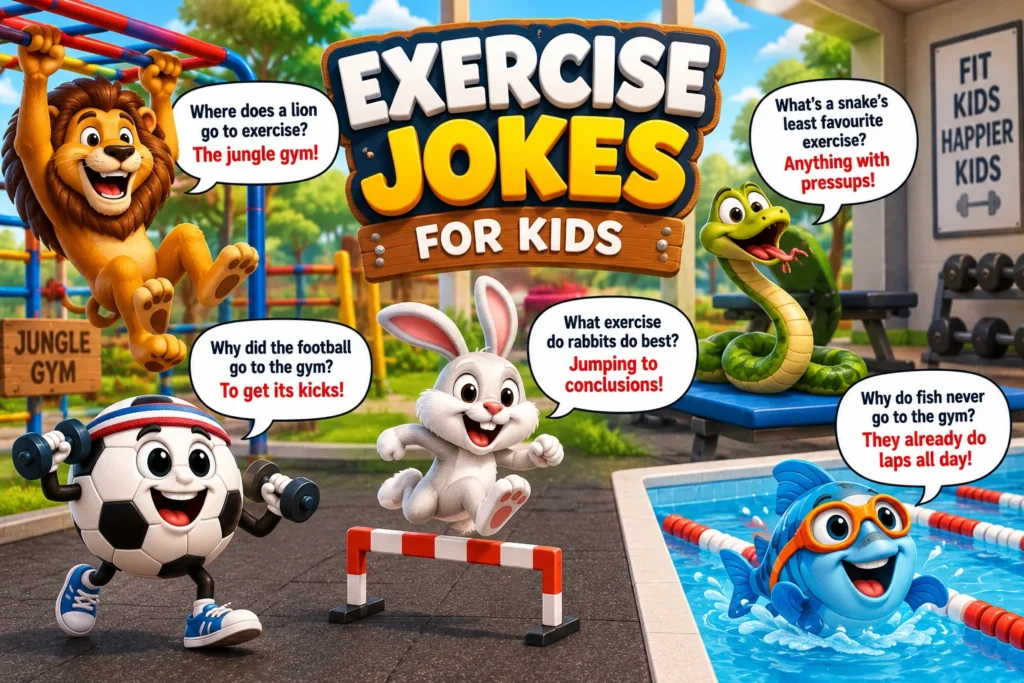
- Where does a lion go to exercise? The jungle gym.
- Why did the football go to the gym? To get its kicks.
- What’s a snake’s least favourite exercise? Anything with pressups.
- Why did the skeleton skip the gym? He had no body to lift with.
- What exercise do rabbits do best? Jumping to conclusions.
- Why do fish never go to the gym? They already do laps all day.
Where Gym Humour Goes Wrong
This is worth saying plainly, because exercise jokes are one of the easiest categories to get wrong. Jokes about your own reluctance to exercise are harmless and universal. Jokes about other people’s bodies are a different thing entirely, and they land badly for good reason. The gym is already an environment many people find intimidating, and a joke at somebody’s expense there does real work in keeping them away.
- Aim at your own reluctance, not at anyone’s body
- Never joke about another person’s size, shape or fitness level
- Avoid jokes about how someone looks while exercising
- Avoid anything implying a correct body or a proper gymgoer
- Beginners are the people most easily discouraged
- If a joke would stop someone coming back, it is not worth the laugh
- Self deprecation is available and works better anyway
Jump into Other Related Article
- Monthly Jokes: A Month Full of Laughs
- Work From Home Jokes | The Classics, the Playset, and What Lands on Video Calls
- Weekly Jokes: A Funny Joke for Every Day of the Week
- Shark Jokes | 60+ Funny Ones for Kids & Adults
Conclusion
Exercise jokes are the rare category where the punchline is a documented statistic. Close to half of the people who intend to exercise do not follow through, most of the dropoff happens in the first fortnight, and every gym joke ever told is a description of that curve. Save three diddly squats for anyone, the jungle gym for a child, and the allergic to exercise line for the next time somebody invites you. And keep the jokes aimed at your own reluctance rather than at anyone else’s body, because the gym is intimidating enough without an audience.
- The intention behaviour gap for exercise is measured at around 47.6%
- Fewer than a third of beginners persist past six months
- Diddly squats is the best pun the category has produced
- Aim at your own reluctance, never at anyone else’s body
What kind of exercise does a lazy person do?
Diddly squats. It is the most searched exercise riddle and works because diddly squat already means nothing while a squat is a genuine exercise.
Where does a lion go to exercise?
The jungle gym. The same answer covers the version of the riddle about monkeys.
Where does a train go to exercise?
The training ground a singleword pun that works better written than spoken.
What is the allergic to exercise joke?
I’m allergic to exercise it makes me break out in a sweat. It works because break out belongs to both allergic reactions and perspiration.
What is the potato sack exercise joke?
A fake beginner’s training plan involving holding empty potato sacks of increasing weight. The punchline is that only once you can manage a hundred pounds in each hand do you start putting potatoes in them.
Why are exercise jokes so relatable?
Because they describe a measured phenomenon. Research puts the intention behaviour gap for physical activity at around 47.6%, meaning close to half of people who intend to exercise do not follow through.
When do most people give up on exercise?
Research from the University of Victoria’s Behavioural Medicine Lab indicates fewer than a third of beginners are still going after six months, with much of the dropoff occurring in the first two weeks.