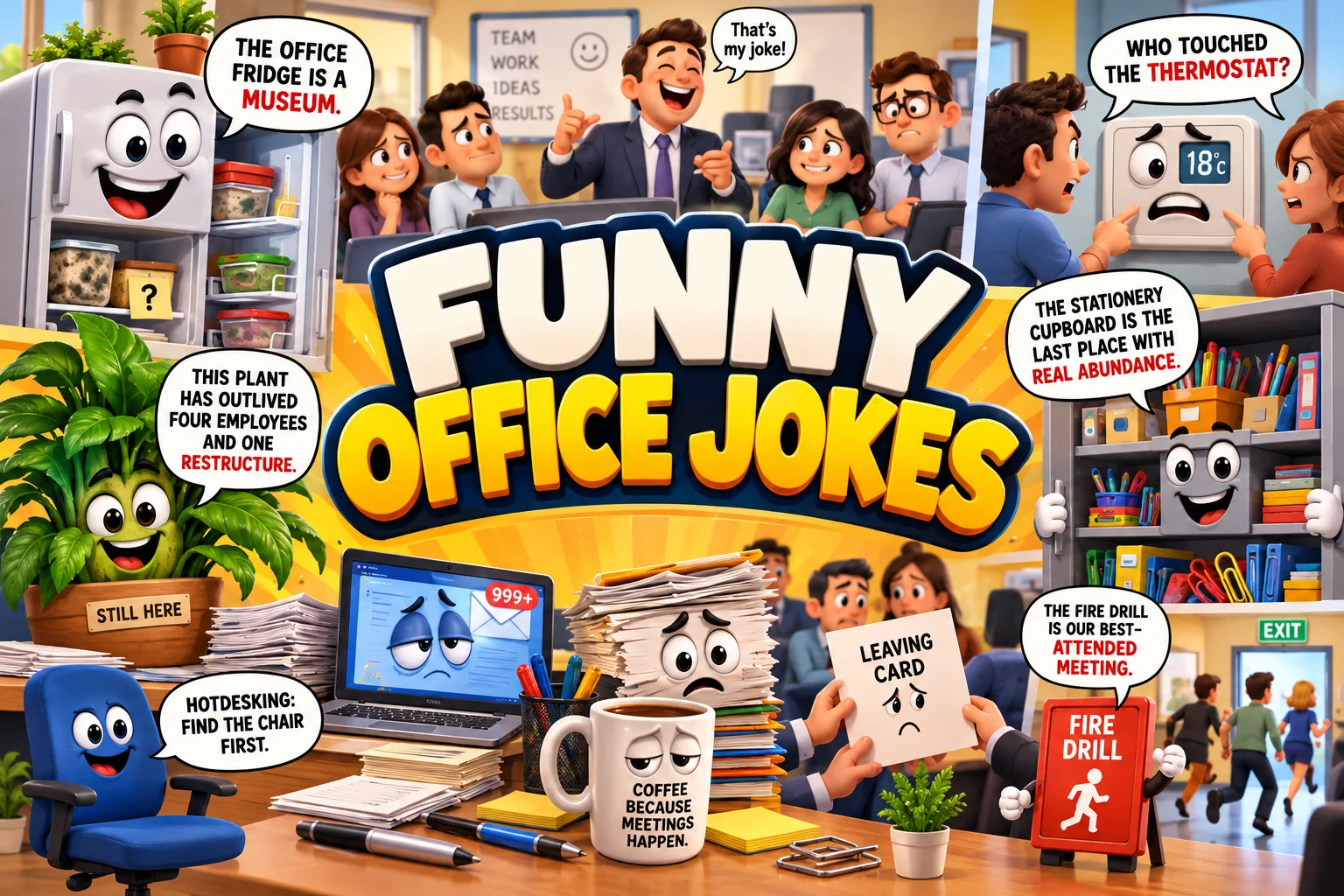
Office jokes have a peculiar problem that no other category has: the audience did not choose to be there, cannot leave, and in many cases reports to the person telling the joke. That last part turns out to matter far more than anyone assumed, and there is now research on it. This page has jokes about the actual office, the fridge, the thermostat, the stationery cupboard plus what happens when the boss is the one being funny, and a short detour into the other two things people mean when they search for an office.
Which Office Did You Mean?
Three completely different places share the word, and all three turn up in these searches. It is worth separating them before anything else, because the humour in each is entirely different.
- The workplace office the largest group, covered below in detail
- The doctor’s office waiting rooms, appointments and medical humour
- The post office queues, parcels and the counter
- The TV series a mockumentary sitcom set in a paper company
- Each has its own comic territory and almost no overlap
- The last one accounts for a surprising share of the searches
Funny Office Jokes About the Actual Office
Most workplace joke lists are about meetings and email. These are about the building the fridge nobody cleans, the thermostat nobody controls, and the plant that has outlived several employees. That shared physical experience is more reliable than anything about processes, because everybody in the building can see it.
- The office fridge is a museum where nothing is labelled and nothing is ever removed.
- The thermostat is the only genuinely contested territory left in modern business.
- Somebody’s lunch has been in there since a previous job title.
- The stationery cupboard is the last place in the building with real abundance.
- The office plant has now outlived four employees and one restructure.
- There is one mug everyone avoids and nobody can remember why.
- The fire drill is the only companywide event with full attendance.
- The sign above the sink has never once worked and never will.
- Hotdesking is paying rent on a chair you have to locate first.
- Nobody in recorded history has willingly signed a leaving card first.
Why These Land Better Than Process Jokes
Jokes about meetings and email require the listener to think about their workload. Jokes about the fridge require them only to look at the fridge. That is a lower cognitive cost and a lower emotional one, which is why the physical office produces the safest workplace humour available.
- The subject is visible to everyone in the room
- Nobody has to think about their own workload to get it
- Nothing about it reflects on anyone’s competence
- The target is a building, which cannot be offended
- It works identically across every industry and company size
- New starters get it on their first day
Why the Boss’s Jokes Are a Special Case
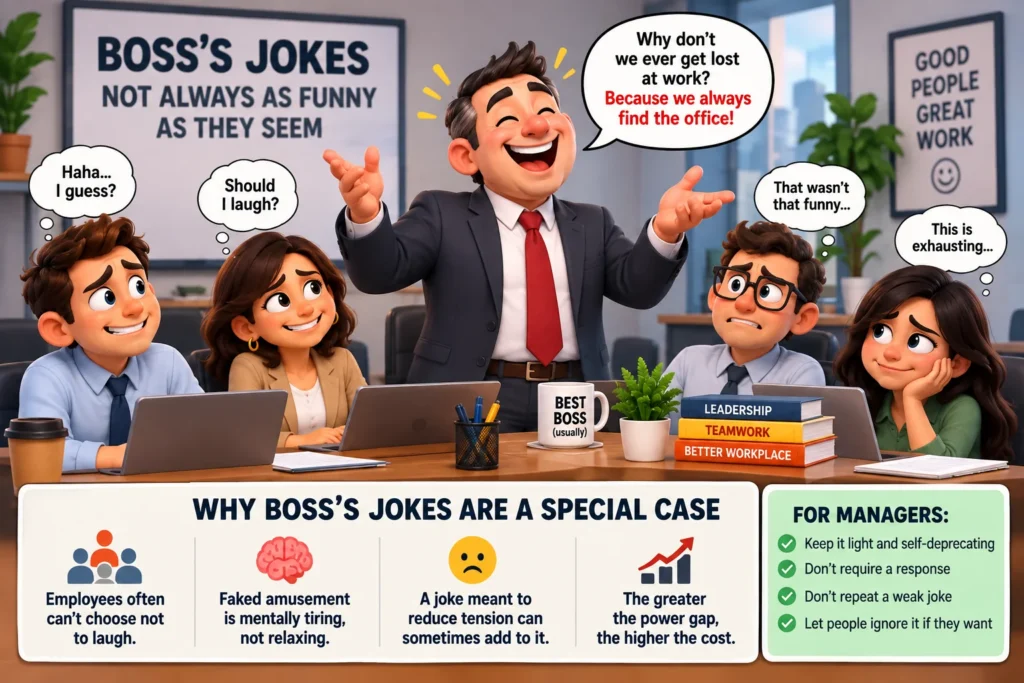
This is the part almost no workplace joke list covers, and it is genuinely useful. Research led by Randall Peterson, Professor of Organisational Behaviour at London Business School, with colleagues at LSE and the University of Pennsylvania, examined whether humour is always a good tool for leaders. The conventional assumption is that a joke from the boss relieves tension and makes work more enjoyable. The study, titled Faking it with the boss’s jokes, found that this is not reliably true.
- Led by Randall Peterson at London Business School
- Conducted with researchers at LSE and the University of Pennsylvania
- Examined whether leaders’ humour always helps
- Departs from the standard view that jokes reduce workplace strain
- Found that laughing at the boss’s jokes can be its own form of labour
- Faked amusement produced exhaustion rather than relief
What That Means If You Manage People
The mechanism is straightforward once stated. When a colleague tells a bad joke, you can simply not laugh. When your manager tells one, not laughing carries a cost, so you perform amusement instead and performing an emotion you do not feel is tiring. The joke you intended as a small kindness has become a small task.
- Employees cannot decline to react to a manager’s joke
- Performed amusement is effortful, not restful
- A joke intended to relieve tension can quietly add to it
- The more one sided the power, the higher the cost
- Self deprecating jokes largely avoid this, since no performance is required
- If you always get a laugh, that is data about power, not comedy
The Practical Rule for Managers
None of this means managers should stop being funny. It means the target matters more for them than for anyone else in the room.
- Aim at yourself, the process or the building never at a person
- Never require a response; let people ignore it if they want
- Do not repeat a joke that got a thin reaction
- Do not comment on who did or did not laugh
- Written jokes in a channel are safer than spoken ones in a room
- Nobody has ever been promoted for laughing, but plenty have felt obliged to
The Office: Why Michael Scott’s Jokes Fail
A significant share of office joke searches are about the television series, and it is worth explaining what the show is actually doing, because it is the clearest illustration of everything above. The programme is a mockumentary filmed as though a documentary crew is present, complete with direct to camera interviews and reaction shots. Its central character is a regional manager whose desperate need to be liked overrides every managerial instinct he has.
- Filmed as a mockumentary with direct to camera interviews
- The reaction shots do most of the comic work
- The manager’s jokes are written to fail, not to land
- His need to be liked overrides his judgement constantly
- The British original featured an equivalent character in the same role
- The genre is usually described as cringe comedy
The Joke Is the Room, Not the Line
Here is the useful part. Michael Scott’s jokes are not funny, and they are not supposed to be. What is funny is the room, the silence, the polite halfsmile, the employee glancing at the camera. The show is a comedy about exactly the dynamic the London Business School research measured, made twenty years before the study.
- The character’s jokes are deliberately weak
- The comedy lives in the staff’s reaction, not the punchline
- The camera glance is the audience’s standing
- It dramatises the cost of having to react to a manager
- Which is precisely what the research later measured
- Nobody in that office is enjoying the joke either
Doctor’s Office Jokes
A separate meaning of office, and a separate comic territory. Waiting rooms are one of the few universally shared experiences left, and the humour is about time rather than about medicine.
- The waiting room is where time goes to have a lie down.
- The doctor will see you now is the most optimistic sentence in medicine.
- The magazines in a waiting room are a form of accidental time travel.
- Nothing cures a symptom faster than confirming the appointment.
- Why are receptionists so powerful? They control the only door that matters.
- The chairs are arranged so that nobody can avoid eye contact with everyone.
Post Office Jokes
The third meaning, and the one with the most reliable comic subject in the world: a queue.
- The post office queue is where you find out who you really are.
- What do you call a letter sent without a stamp? Ambitious.
- Why was the letter so confident? It knew it would arrive eventually.
- The post office is the only shop where the queue moves but you do not.
- Why did the parcel take the scenic route? Because it could.
- What’s the difference between a postbox and a black hole? One returns your calls.
Office Jokes for a Team Chat
Written jokes in a channel are the safest format in any workplace, because nobody has to react in real time and anyone can scroll past. That single property makes them better than spoken jokes for almost every purpose.
- Nobody has to perform a reaction in the moment
- People can ignore it without it being visible
- It works across time zones and remote teams
- Emoji reactions let people respond at zero social cost
- One a day is plenty; three is a personality
- Keep it under two lines so it does not disrupt the channel
Jump into Other Related Article
- Food Jokes: Deliciously Funny Jokes That Will Make You Hungry
- Monthly Jokes: A Month Full of Laughs
- Dinosaur Jokes for Kids | 60+ Funny Ones They’ll Love
- Weekly Jokes: A Funny Joke for Every Day of the Week
- Shark Jokes | 60+ Funny Ones for Kids & Adults
What Not to Joke About in an Office
The list is short and it is the same everywhere, but the reason is worth stating: an office is a place people cannot leave and where the consequences of a bad joke outlast the joke by years.
- Anyone’s performance, competence or workload
- Salaries, promotions or who is on which grade
- Anyone’s appearance, accent, age or background
- Redundancies, restructures or job security, even as a windup
- Anything faking an email from IT, HR or leadership
- Anyone who reports to you the power gap removes their choice
- Anything you would not want quoted back in a meeting
- If a joke needs no offence, it is already finished
Conclusion
The safest funny office joke is about the building rather than the people in it the fridge, the thermostat, the plant that outlived a restructure. That is true for everyone, and it is true twice over for anyone who manages people, because research suggests that laughing at the boss’s jokes is a task rather than a break. Aim at the room, keep it to one a day, and put it in writing where people can scroll past. And if you are searching for office jokes because of the television series, the useful thing to know is that the jokes in it were never meant to be funny the silence afterwards was the joke all along.
- Jokes about the building beat jokes about the work
- Managers’ jokes carry a cost employees cannot decline to pay
- Written jokes in a channel are the safest format available
- The three offices workplace, doctor’s and post share nothing but a word
What’s a good funny office joke?
Aim at the building rather than the work. The office fridge is a museum where nothing is labelled and nothing is ever removed lands in any company because everybody can see the fridge.
Are jokes from the boss a good idea?
With care. Research from London Business School and partner institutions found that employees often fake amusement at a manager’s jokes, and that performing an emotion you do not feel is tiring rather than relieving.
Why do Michael Scott’s jokes never land in The Office?
Because they are written not to. The comedy is in the staff’s reaction, the silence, the polite halfsmile, the glance at the camera rather than in the punchline itself.
What’s the safest way to share an office joke?
In writing, in a team channel. Nobody has to react in the moment, people can scroll past, and emoji reactions let anyone respond at no social cost.
What’s a good doctor’s office joke?
The waiting room is where time goes to have a lie down. Waiting room humour works because it is about time rather than about anybody’s health.
What should I never joke about at work?
Performance, salaries, job security, appearance, and anyone who reports to you. Also avoid anything faking a message from IT, HR or leadership those go wrong every single year.
How many jokes a day is too many?
One. Two is generous, three makes you the person who does bits, and a run of them turns a workplace into an audience that cannot leave.

Pingback: 50 Tooth Jokes | Tooth Fairy, Kids & Dad Jokes