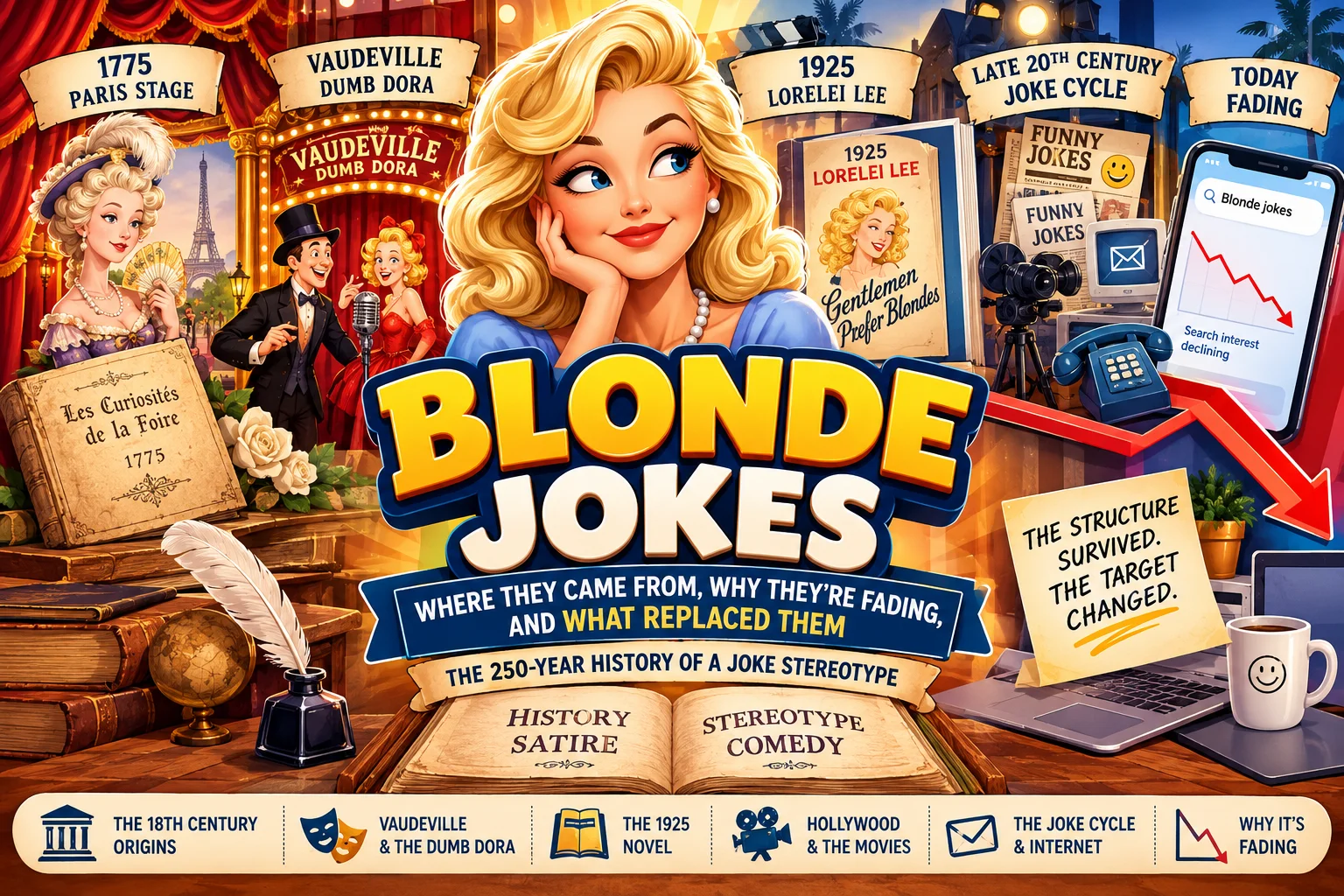
Blonde jokes are one of the few joke genres with a documented, traceable origin you can follow them from an 18th century Paris stage to a 1925 novel to a Marilyn Monroe film and out into every school playground of the late twentieth century. This page traces that history properly, explains what the genre actually does, and looks at why it is measurably declining. What it does not do is list the jokes themselves, and the reason for that is explained below rather than skipped over.
What a Blonde Joke Actually Is
Structurally, a blonde joke is a question and answer or short narrative joke in which the punchline depends on a woman with blonde hair behaving stupidly. The hair colour is doing no comedic work whatsoever it is a label indicating that the character is the one who will be foolish. Swap the label for anything else and the joke structure is identical, which is the clearest evidence of what the genre is: a delivery mechanism for a stereotype, wearing a joke’s shape.
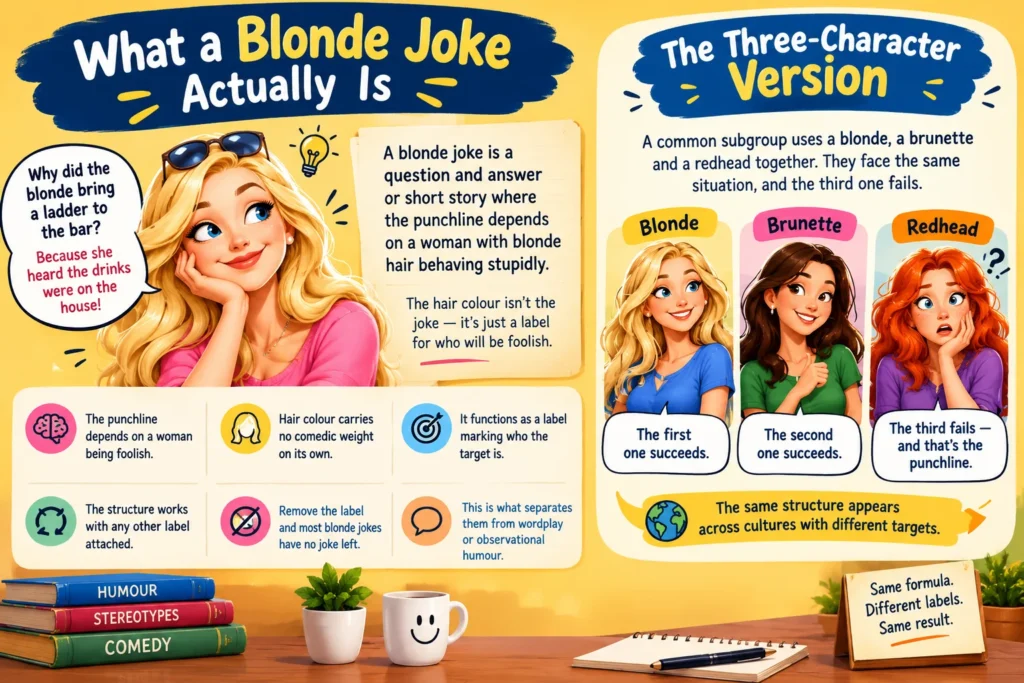
- The punchline depends on a woman being foolish
- Hair colour carries no comedic weight on its own
- It functions as a label marking who the target is
- The structure works identically with any other label attached
- Remove the label and most blonde jokes have no joke left
- This is what separates them from wordplay or observational humour
The ThreeCharacter Version
A large subgroup uses a blonde, a brunette and a redhead together. This is a variant of an old folkjoke structure in which three characters face the same situation and the third fails. The first two exist purely to establish the pattern, and the punchline is always at the same character’s expense.
- Three characters face an identical situation in sequence
- The first two establish the pattern and succeed
- The third fails, and the failure is the punchline
- The same structure appears across cultures with different targets
- It is one of the oldest joke architectures in existence
- The target is interchangeable; the structure is not
The 250YearOld Origin
Historians trace the stereotype to a specific person. CatherineRosalie Duthé was an 18th century French courtesan, a favourite of wealthy and titled men and the subject of numerous paintings. In 1775 she was satirised in a one act play called Les Curiosités de la Foire, which mocked her habit of pausing at length before speaking making her appear both unintelligent and literally dumb, in the older sense of mute. The historian Joanna Pitman, in her book On Blondes, identifies her as the original of the type, and Slate traced the same lineage in its account of the stereotype’s history.
- CatherineRosalie Duthé, an 18th century French courtesan
- Satiriser in the 1775 play Les Curiosités de la Foire
- The mockery focused on her long pauses before speaking
- Dumb originally meant mute, not unintelligent
- Historian Joanna Pitman identifies her as the original
- The stereotype is roughly 250 years old, not a modern invention
Why She Became the Target
Duthé’s position made her an easy one. A courtesan of her era occupied a socially visible but structurally powerless position famous enough to be recognised, exposed enough to be attacked, and without the standing to answer back. That combination is the standard profile of a stereotype’s first victim, and it is worth noting that the genre began by punching downward at a specific woman rather than at an abstract category.
- Visible enough to be recognised across society
- Powerless enough that ridicule carried no consequence
- Her image was widely reproduced, increasing exposure
- Attacks on her carried no social cost to the attacker
- The genre began with a real person, not an abstraction
Vaudeville and the Dumb Dora
The stereotype moved from France into English language performance through a standard vaudeville double act. A man played the straight role while a woman’s peculiar logic defeated every attempt at sensible conversation. The form was known as the dumb Dora act, and its highest expression came from Burns and Allen, where Gracie Allen’s character operated on a completely coherent internal logic that simply did not match anyone else’s.
- A twohander with a straight man and an illogical woman
- Known in the trade as the dumb Dora act
- Burns and Allen elevated the form considerably
- Allen’s character was internally consistent, not merely stupid
- The act established the template that jokes would later compress
- Vaudeville turned a French satire into a repeatable format
1925: The Year It Went Global
The decisive moment is documented precisely. In 1925 the screenwriter Anita Loos began publishing a series of sketches in Harper’s Bazaar written as the diary of a character named Lorelei Lee. The response was extraordinary the magazine’s sales tripled and the collected novel, Gentlemen Prefer Blondes, sold over a hundred thousand copies in its first run and produced a Broadway play the following year.
- Anita Loos began the Lorelei sketches in Harper’s Bazaar in 1925
- The magazine’s sales tripled during the run
- The novel sold over 100,000 copies in its first printing
- A Broadway adaptation followed in 1926
- Two film versions followed, decades apart
- 1925 is when the archetype entered global popular culture
What Loos Actually Wrote
This part is consistently misremembered. Loos wrote Lorelei as satire a parody of a specific real acquaintance and of Jazz Age social climbing. Lorelei is superficial rather than stupid, and she is notably effective at getting what she wants from the men around her. The joke in the original is aimed at the men who fall for her, not at her intelligence. That distinction disappeared entirely as the character was absorbed into popular culture.
- Loos intended satire, not endorsement of a stereotype
- Lorelei is calculating rather than genuinely foolish
- The original target was male gullibility
- She succeeds throughout the book
- The satirical intent was lost in adaptation
- What survived was the surface, not the point
Hollywood Cemented It
The 1930s onward turned an archetype into an industry standard. Jean Harlow’s roles in Platinum Blonde (1931) and Bombshell (1933) established the glamorous, scatterbrained persona on screen. Marilyn Monroe played Lorelei Lee in the 1953 film, opposite Jane Russell as the sensible brunette friend, a pairing that hardwired the blonde versus brunette contrast into popular culture. Alfred Hitchcock, as Refinery29 notes, described blonde characters as virgin snow and cast them deliberately so that audiences would not suspect them.
- Jean Harlow established the screen persona in the early 1930s
- Platinum Blonde (1931) and Bombshell (1933) set the template
- Monroe played Lorelei in the 1953 film adaptation
- Jane Russell’s brunette character created the standard contrast
- Hitchcock cast blondes to manipulate audience assumptions
- A 1960s hair dye campaign asked whether blondes have more fun
The Monroe Irony
Monroe is the face of the stereotype and one of the clearest arguments against it. She read seriously, founded her own production company in an era when almost no actress did, and negotiated her own contracts. The persona she performed was a professional creation, and the fact that it was mistaken for the person is the most efficient demonstration available of how the stereotype works.
- Monroe founded her own production company
- She negotiated her own contracts in a restrictive studio system
- The persona was a performance, not a personality
- Audiences consistently mistook one for the other
- The stereotype survived its own most famous counterexample
The Modern Cycle and Its Decline
Blonde jokes as a mass joke cycle peaked in the late twentieth century, circulating through playgrounds, offices, email forwards and early internet joke sites. That cycle is now clearly fading, and unlike most claims about humour, this one is measurable. Search interest in the genre has been declining steadily for years, and the joke sites still ranking for it are largely archives rather than active publications.
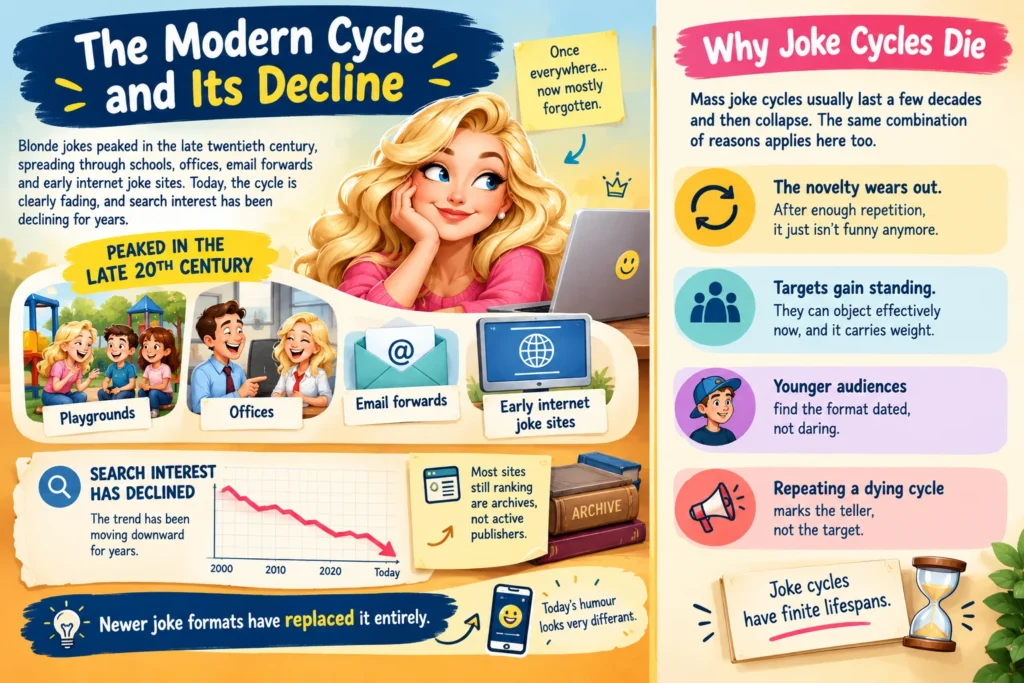
- The genre peaked as a mass cycle in the late twentieth century
- Playgrounds, offices and email forwards carried it
- Search interest has declined consistently since then
- Most sites still ranking are archives, not active publishers
- Newer joke formats have replaced it entirely
- Joke cycles have finite lifespans this one is ending
Why Joke Cycles Die
Mass joke cycles historically last a few decades and then collapse, usually for the same combination of reasons. The novelty wears out, the targets acquire enough social standing to object effectively, and a new generation simply finds the format embarrassing rather than transgressive. Blonde jokes are following the same arc that earlier cycles followed before them.
- Novelty exhausts itself after enough repetition
- Targets gain the standing to object effectively
- Younger audiences read the format as dated, not daring
- Repeating a dying cycle marks the teller, not the target
- The structures survive; the targets get replaced
What the Research Says
Humour aimed at a group is a studied phenomenon rather than a matter of opinion. Research into what psychologists call disparagement humour has examined the specific effect of the joke frame: presenting a prejudiced idea as a joke can make expressing it more socially acceptable, because objecting to a joke looks humourless in a way that objecting to a statement does not. That is the mechanism, and it holds regardless of whether the teller intends any harm.
- Disparagement humour is a recognised research field
- The joke frame makes the underlying idea easier to express
- Objecting to a joke carries a social cost that objecting to a claim does not
- Intent does not change the effect on the listener
- This is why it’s just a joke functions as a defence
- None of this means jokes are dangerous it means the frame does work
Why This Page Doesn’t List Them
Every other page ranking for this term is a list of the jokes. This one is not, and the reason is straightforward rather than moralistic. The genre’s entire mechanism is a group of people being the punchline for something they did not choose and cannot change, and reproducing that at scale is not something worth doing for search traffic. The history is genuinely interesting; the jokes are a two hundred year old insult with a question mark at the end.
- The mechanism requires a group to be the punchline
- The target is an unchosen characteristic
- The jokes add nothing the history does not explain better
- Publishing them at scale serves traffic, not readers
- The structures are worth studying; the targets are not worth repeating
The Structures That Survived Without the Target
The useful part of this history is that the architecture outlived the stereotype. Every joke structure the genre used is still in active service it simply points somewhere else now, usually at the teller.
- Three characters, third one fails now usually the teller fails
- The literal misunderstanding reassigned to a fictional character
- The absurd solution to a simple problem now selfdeprecating
- The overheard exchange now about a shared situation
- The escalating failure the entire shaggy dog tradition
- Selfdirected versions of all five land better with modern audiences
Jump into Other Related Article
- Airplane Dad Jokes | The Classics, Aviation Insider Humour, and the Black Box Question
- Weekly Jokes: A Funny Joke for Every Day of the Week
- Blonde Jokes | Where They Came From, Why They’re Fading, and What Replaced Them
If You’re Writing Comedy Now
The practical version of everything above, for anyone writing jokes rather than researching them.
- Aim at yourself, a situation, or an object never an unchosen trait
- If a joke needs a group label to work, the label is the joke
- Test it: swap the label for something else and see if anything remains
- Self deprecation carries no risk and lands harder
- If a joke needs no offence attached, it is not finished
- Absurdity and wordplay have no target and no expiry date
Conclusion
Blonde jokes have a longer and more specific history than almost any other joke genre from a Paris stage in 1775, through vaudeville, into a 1925 novel written as satire, and out through Hollywood into every playground of the late twentieth century. That history is worth knowing, not least because it shows a satirical creation being flattened into the thing it was satirising. The genre itself is fading, as joke cycles do, and what survives is the architecture rather than the target. That is genuinely good news for anyone writing comedy: the structures were always the interesting part.
- The stereotype dates to a 1775 satire of a real woman
- Anita Loos wrote Lorelei Lee as satire, not endorsement
- Hollywood turned an archetype into an industry standard
- The joke cycle is measurably declining, as cycles do
- The structures outlived the target and work better self directed
Where did blonde jokes come from?
The stereotype traces to CatherineRosalie Duthé, an 18th century French courtesan satirised in the 1775 play Les Curiosités de la Foire for pausing at length before speaking, which made her appear both unintelligent and literally mute.
Who was Lorelei Lee?
The central character of Anita Loos’s 1925 novel Gentlemen Prefer Blondes, later played by Marilyn Monroe in the 1953 film. Loos wrote her as satire of Jazz Age social climbing, aimed at the men who fall for her rather than at her intelligence.
Why is the stereotype associated with Marilyn Monroe?
Because she played Lorelei Lee opposite Jane Russell’s sensible brunette. In reality Monroe founded her own production company and negotiated her own contracts, which makes her the clearest counterexample to the stereotype she came to represent.
Are blonde jokes offensive?
They target an unchosen physical characteristic, which is what defines the category. Research into disparagement humour finds that the joke frame makes the underlying idea easier to express, because objecting to a joke carries a social cost that objecting to a statement does not.
What is the blonde, brunette and redhead joke structure?
An old folkjoke architecture in which three characters face the same situation, the first two establish a pattern, and the third fails. The structure predates the stereotype and appears across many cultures with different targets.
Are blonde jokes still popular?
No. The genre peaked as a mass joke cycle in the late twentieth century and search interest has declined steadily since. Most sites still ranking for the term are archives rather than active publications.