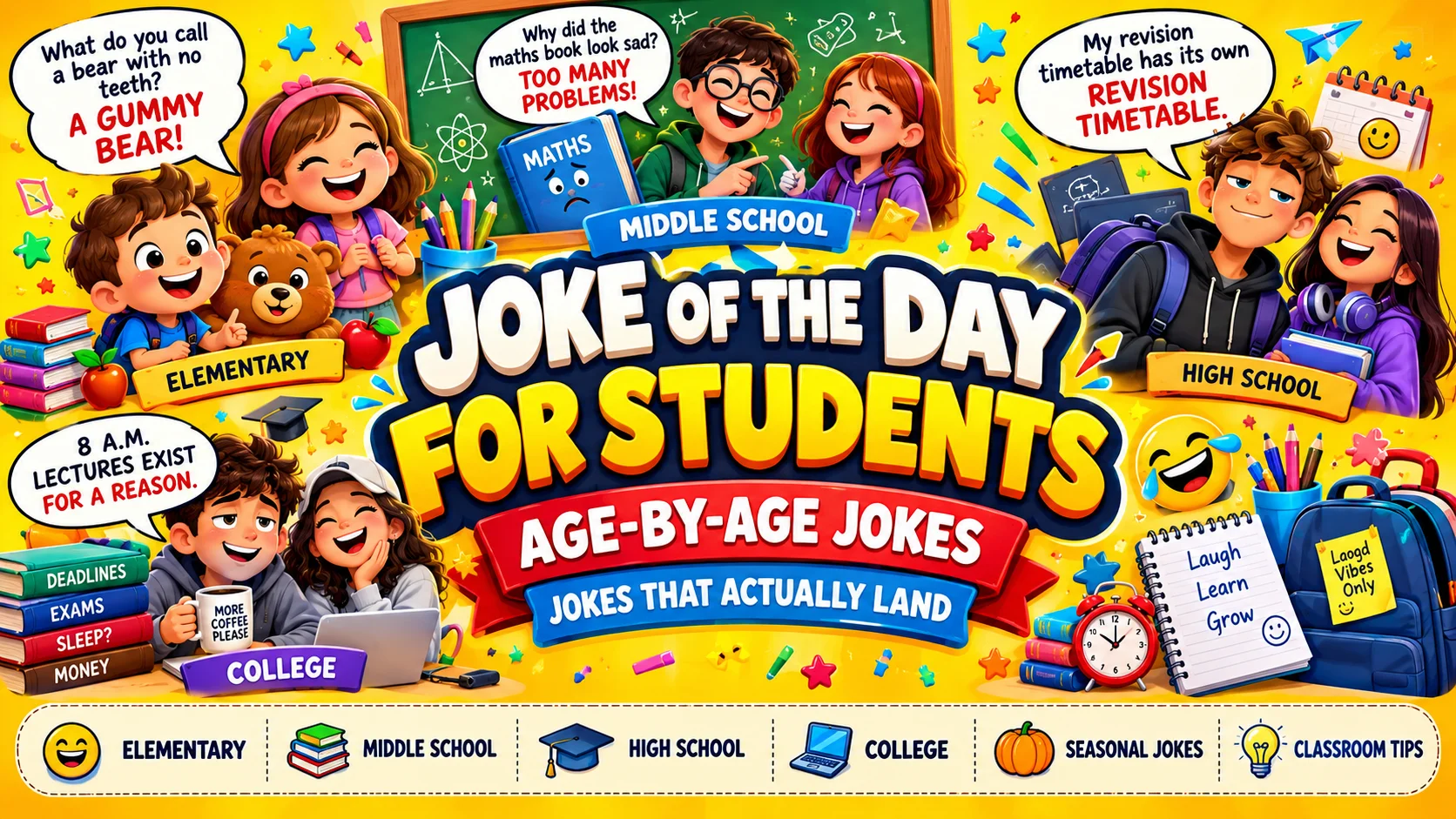
The single biggest mistake with a classroom joke of the day is using the same joke list for every age. A joke that delights a six year old gets a flat stare from a fourteen year old, and a joke that lands with sixthformers goes straight over a Year 2 class. This page sorts them properly by age band, explains why each band needs something different, and covers the part most joke lists skip entirely: how to run the routine so it survives past the second week of term.
Why Age Matters More Than the Joke
Humour develops in stages, and matching the joke to the stage is most of the work. Very young children find sound, repetition and absurdity funny long before they understand that a word can carry two meanings. Somewhere around seven or eight, wordplay clicks and puns suddenly become the funniest thing in the world. By early adolescence, students have heard every pun and start valuing dryness and self awareness instead. By sixteen, the joke that works is usually the one that acknowledges the situation everyone is already in.
- Young children respond to sound, silliness and animals
- Puns start landing properly around ages seven to eight
- Wordplay is the peak format for roughly ages seven to eleven
- Early teens shift toward dry humour and self awareness
- Older teens prefer jokes about the shared situation
- The wrongage joke does not just fail; it loses the room
Joke of the Day for Elementary Students
For the youngest classes, keep it short, keep it silly, and keep an animal in it wherever possible. The punchline should be one or two words so the whole class can repeat it at lunchtime, which is the actual measure of success at this age.
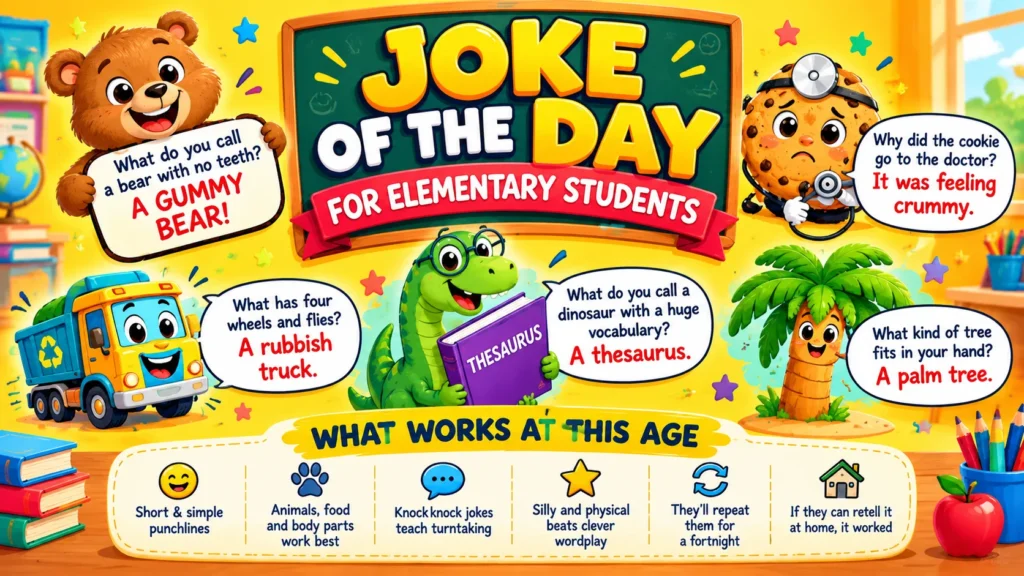
- What do you call a bear with no teeth? A gummy bear.
- Why did the cookie go to the doctor? It was feeling crummy.
- What has four wheels and flies? A rubbish truck.
- What do you call a dinosaur with a huge vocabulary? A thesaurus.
- Why can’t your nose be twelve inches long? Because then it would be a foot.
- What kind of tree fits in your hand? A palm tree.
- What do you call a sleeping bull? A bulldozer.
- Why did the teddy bear say no to pudding? It was already stuffed.
- Knock knock. Who’s there? Lettuce. Lettuce who? Lettuce in, it’s freezing!
- What’s a pirate’s favourite letter? Everyone says R, but his heart belongs to the C.
What Works at This Age
The mechanics are simple and worth knowing, because they let you judge any joke before you use it.
- One or two word punchlines the class can repeat exactly
- Animals, food and body parts reliable every time
- Knockknock jokes, which also teach turntaking
- Physical absurdity beats clever wordplay
- Expect the same joke back at you for a fortnight
- If they can retell it at home, it worked
Joke of the Day for Middle School Students
This is the sweet spot for puns. Students at this age have enough vocabulary to catch a double meaning and have not yet decided that groaning is beneath them. Schoolsubject jokes work particularly well because everyone in the room shares the experience.
- Why did the scarecrow win an award? He was outstanding in his field.
- I’m reading a book about antigravity. It’s impossible to put down.
- Why don’t scientists trust atoms? They make up everything.
- What do you call fake spaghetti? An impasto.
- Why did the maths book look so sad? It had too many problems.
- I only know twentyfive letters of the alphabet. I don’t know y.
- Why did the bicycle fall over? It was two tired.
- What’s the best thing about Switzerland? Hard to say, but the flag is a big plus.
- Why did the student eat his homework? The teacher said it was a piece of cake.
Turning the Joke Into a Lesson
Middle school is where a daily joke stops being a warmup and becomes genuinely useful teaching material, because almost every pun is a vocabulary exercise wearing a disguise.
- Ask which word in the joke has two meanings
- Collect homophones from jokes into a running class list
- Use them for prefix and suffix work impasta, two tired
- Have students write their own using the same structure
- A student who can explain a pun understands the word properly
- Two minutes a day builds a surprising vocabulary bank by June
Joke of the Day for High School Students
By this stage, an obvious pun delivered enthusiastically will get you nothing. What works is dryness, understatement, and jokes about the shared experience of being in school. Delivering it flatly and moving straight on is far more effective than presenting it as a treat.
- I told my teacher I’d work on my punctuality. Starting tomorrow, around 9:15.
- The library has a book on procrastination. I’ll get it next week.
- I have a photographic memory. I just never developed it.
- Parallel lines have so much in common. It’s a shame they’ll never meet.
- I’d tell you a chemistry joke, but I know I wouldn’t get a reaction.
- My revision timetable has its own revision timetable.
- I’m not late. Everyone else is aggressively early.
- Exams test how well you handle exams. That’s the entire skill.
Why Delivery Changes at This Age
Teenagers are unusually sensitive to effort, and a teacher visibly trying to be funny gets a worse reception than one who simply says something dry and carries on. The joke works because it is thrown away, not because it is performed.
- Deliver it flatly and move straight into the lesson
- Never introduce it as today’s joke with enthusiasm
- Self deprecating jokes work better than any other kind
- Never joke about a student, even affectionately
- One groan is a success do not chase a laugh
- If it dies, say nothing and continue
Joke of the Day for College Students
At this level the humour is almost entirely about the shared conditions: deadlines, timetables, money and sleep. Anything that names the situation honestly will land.
- I have an excellent work life balance. Neither is going well.
- The library is the only building where the ground floor is level two.
- Eight a.m. lectures exist purely as a filtering mechanism.
- I’d have graduated on time, but I’m building character.
- My degree is very practical. I can now explain exactly why I have no money.
- I’ve read the reading list. The font was excellent.
Short Jokes for When You Have Ten Seconds
A frequently searched variant asks specifically for short ones, usually because the routine has to fit between register and the actual lesson. These are all under fifteen words.
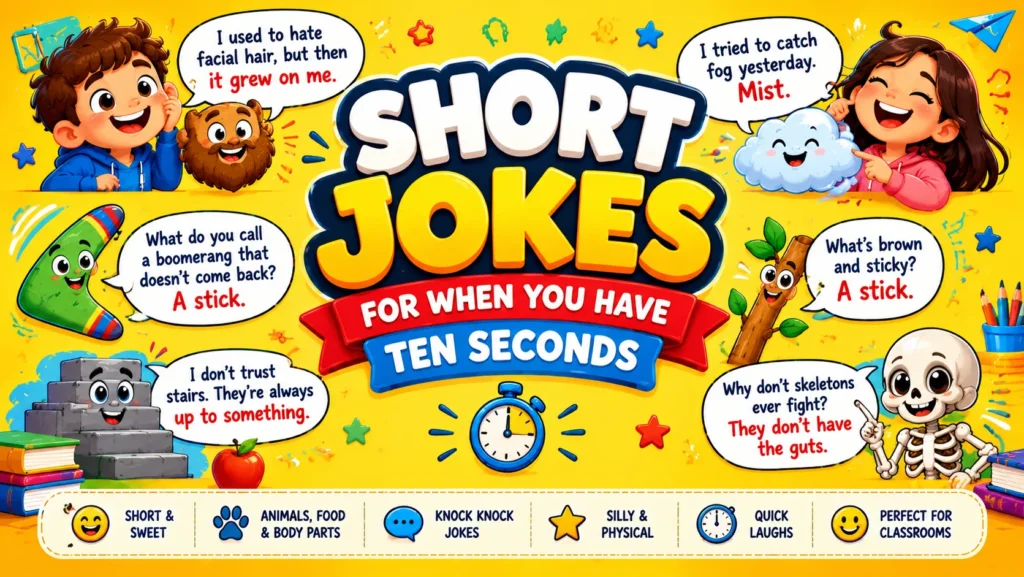
- I used to hate facial hair, but then it grew on me.
- I tried to catch fog yesterday. Mist.
- What do you call a boomerang that doesn’t come back? A stick.
- I don’t trust stairs. They’re always up to something.
- What’s brown and sticky? A stick.
- Why don’t skeletons ever fight? They don’t have the guts.
- I have a joke about time management. I’ll tell you later.
Seasonal Sets
Seasonal jokes get a noticeably better reaction than general ones, because the whole room is already thinking about the same thing. Keep a small set for each point in the year.
Halloween Jokes
- Why don’t skeletons ever fight each other? They don’t have the guts.
- What’s a ghost’s favourite dessert? I scream.
- Why don’t mummies take holidays? They’re afraid to unwind.
- What do you call a skeleton who sleeps all day? Lazy bones.
- Why don’t ghosts like rain on Halloween? It dampens their spirits.
Christmas and EndofTerm Jokes
- What do you call an elf who sings? A wrapper.
- Why was the snowman searching through the carrots? He was picking his nose.
- What’s a Christmas tree’s favourite sweet? Ornaments.
- What do snowmen have for breakfast? Snowflakes.
- Why was the advent calendar exhausted? Its days were numbered.
How to Run a Joke of the Day That Survives the Term
Most classroom joke routines die in the second week, and the reason is always the same: it depended on the teacher remembering and inventing. Build the system properly and it runs itself until July.
- Attach it to a fixed moment registration, or the first two minutes
- Print or save a full half term of jokes in advance
- Never search for one at 8:55 in the morning
- Rotate a different student to read it aloud each day
- Keep a worked well list and reuse winners with next year’s class
- Alternate riddles and puns so the format stays fresh
- Let students submit jokes for approval that is where the ownership comes from
- Two minutes maximum, then straight into the lesson
The StudentSubmission System
The single change that makes this routine last a whole year is handing it over. Students who submit jokes read the board differently, and a submission box turns a teacher led ritual into a class owned one within a fortnight.
- Set up a box or a shared document for submissions
- Approve them yourself before they go on the board
- Credit the student who submitted it
- Reject unsuitable ones quietly and privately, never publicly
- One approved submission changes how a quiet student participates
- Approved jokes become next year’s list at no extra effort
Jump into Other Related Article
- Food Jokes: Deliciously Funny Jokes That Will Make You Hungry
- Monthly Jokes: A Month Full of Laughs
- Dinosaur Jokes for Kids | 60+ Funny Ones They’ll Love
- Weekly Jokes: A Funny Joke for Every Day of the Week
- Funny Jokes That Will Make You Laugh
- Animal Jokes: Funny Animal Jokes That Will Make You Laugh
- Shark Jokes | 60+ Funny Ones for Kids & Adults
What to Avoid in a Classroom
This matters more in a classroom than anywhere else, because students cannot leave and the teacher’s authority makes any joke land harder than intended.
- Never joke about any student’s appearance, ability or family
- Never use a joke that requires a student as the punchline
- Avoid anything relying on cultural knowledge only some students have
- Avoid jokes about weight, food, money or housing
- Avoid anything about accents, names or backgrounds
- Skip anything you would need to explain twice
- If a joke needs no offence attached, do not use it
- A joke that singles out a quiet student is never a kindness
If a Joke Falls Flat
It will happen, and the recovery matters more than the joke did. The one rule is not to fight it.
- Move straight into the lesson without commenting
- Never explain the joke to the class
- Never repeat it louder or ask if they got it
- A brief anyway is a complete recovery
- Never follow a failed joke with a second one
Conclusion
A joke of the day works because it gives a class a shared moment before anything difficult starts, and because two minutes of collective groaning does more for the atmosphere in a room than almost anything else available. Match the joke to the age silly and animalbased for the youngest, puns in the middle years, dry and understated for teenagers and build the routine so it does not depend on you remembering. Then hand the submissions over to the students, and it will run itself until the end of the year.
- Match the joke to the age band, not to your own taste
- Puns peak at roughly ages seven to eleven
- Teenagers want dryness, not enthusiasm
- Print a half term in advance and let students submit their own
What is a good joke of the day for students?
It depends entirely on age. What do you call a bear with no teeth? A gummy bear works for the youngest classes, while older teenagers respond better to dry lines like the library has a book on procrastination. I’ll get it next week.
What jokes work best for elementary students?
Short ones with one or two word punchlines, ideally involving animals or food. Knockknock jokes work especially well because they also teach turntaking.
What jokes work for middle school students?
Puns are at their most effective here. Schoolsubject jokes work particularly well because every student in the room shares the experience.
Why don’t jokes work with high school students?
Usually because they are delivered with too much enthusiasm. Teenagers respond to dry, understated humour thrown away in passing rather than presented as a treat.
How do I run a joke of the day without forgetting?
Attach it to a fixed daily moment, print a full half term in advance, and rotate which student reads it aloud. Never search for one on the morning itself.
Can jokes be used for actual teaching?
Yes. Most puns are vocabulary exercises in disguis ask which word carries two meanings, and collect the homophones into a running class list.
What should I avoid joking about in class?
Anything about a student’s appearance, ability, family, background or circumstances, and anything requiring a student to be the punchline. If a joke needs no offence attached, do not use it.