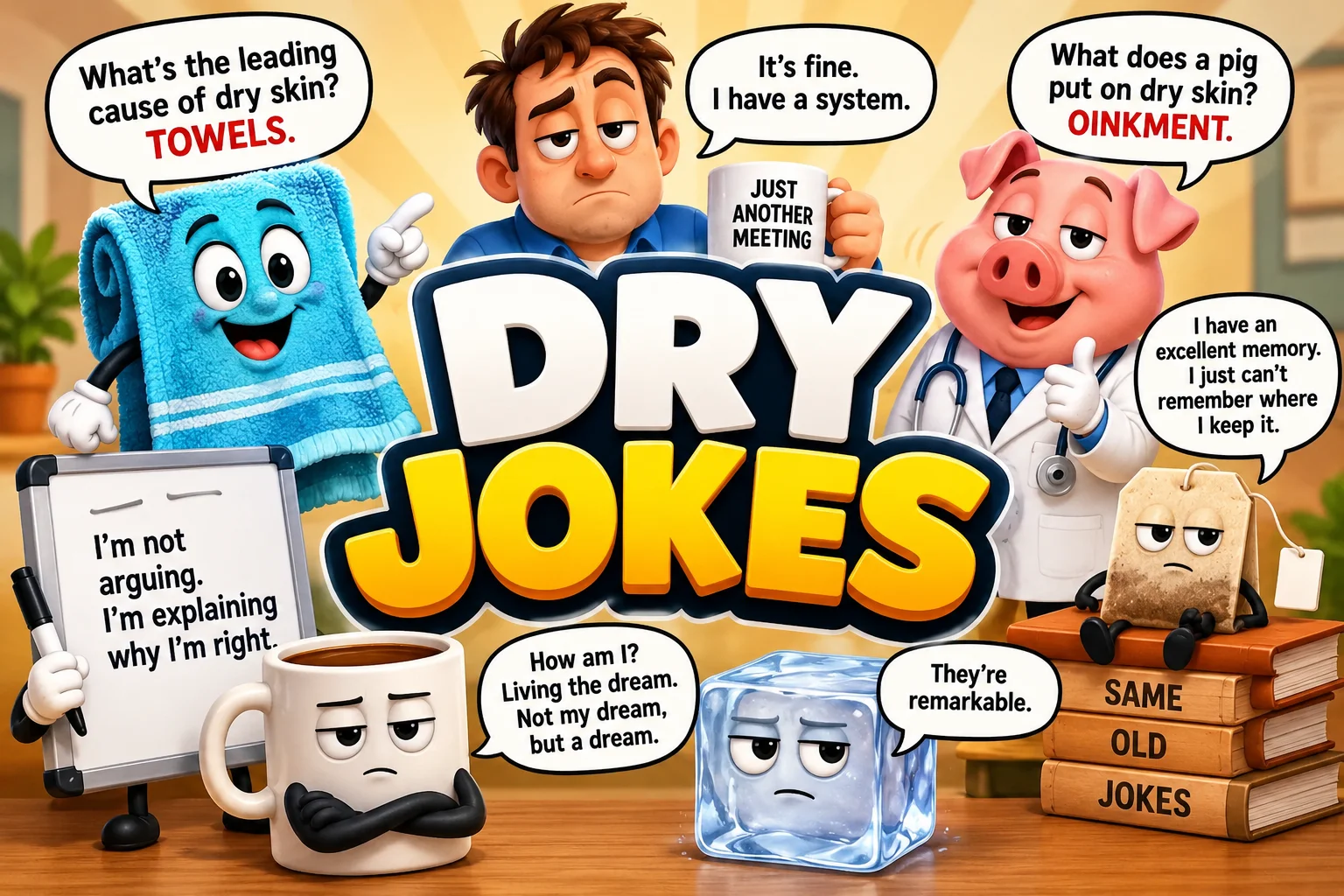
Most people searching for dry jokes want two different things a definition, and some examples. This page has both, starting with what a dry joke actually is because the term gets used interchangeably with sarcasm and deadpan when all three are different. Then come the examples dry oneliners, workplace lines, the dry skin riddles people search for by name, and a practical guide to delivery, which matters more in this style than in any other kind of comedy.
What Is a Dry Joke?
A dry joke is one delivered with no emotional signal at all flat tone, straight face, the same voice you would use to report the weather. The humour lives in the gap between what is being said and how it is being said. That is the entire mechanism a dry joke told with a grin stops being a dry joke and becomes an ordinary one. It is also why dry humour divides people so sharply, since half the room hears a joke and the other half hears a statement.
- Delivered flat, with no smile and no signal
- The gap between content and delivery is the joke
- The speaker acts as though nothing funny has been said
- Works best when nobody warns you it is coming
- Frequently missed entirely, which is part of the appeal
- Grinning while you say it destroys the effect
Dry Humour vs Deadpan vs Sarcasm
These three words get used as synonyms and are not. Deadpan describes the delivery the expressionless face and flat voice. Dry humour describes the overall register, which is understated and unemotional whether or not the face is doing anything. Sarcasm is different again it means saying the opposite of what you mean, usually to mock. A joke can be dry without being sarcastic, and sarcastic without being dry.
- Deadpan the delivery no expression, no vocal signal
- Dry the register understated, matter of fact, unemotional
- Sarcasm the meaning saying the opposite, usually to mock
- Dry humour is often sincere in content and flat in delivery
- Sarcasm delivered flatly is both sarcastic and deadpan
Why Some People Don’t Get It
Dry jokes fail more often than any other kind, and not because the audience is slow. The style deliberately removes every cue that normally tells a listener a joke is happening. Without those cues, someone who does not know your usual manner has no way to tell a joke from a statement, which is why dry humour works far better with people who know you.
- All the usual this is a joke signals are deliberately removed
- Strangers have no baseline to compare your tone against
- It relies on shared context more than any other style
- Missing it is a reasonable response, not a failure of intelligence
Best Dry Humour Jokes and OneLiners
These are the classics of the style short, flat and entirely dependent on how you say them. Read them aloud in the voice you would use to read out a train timetable.
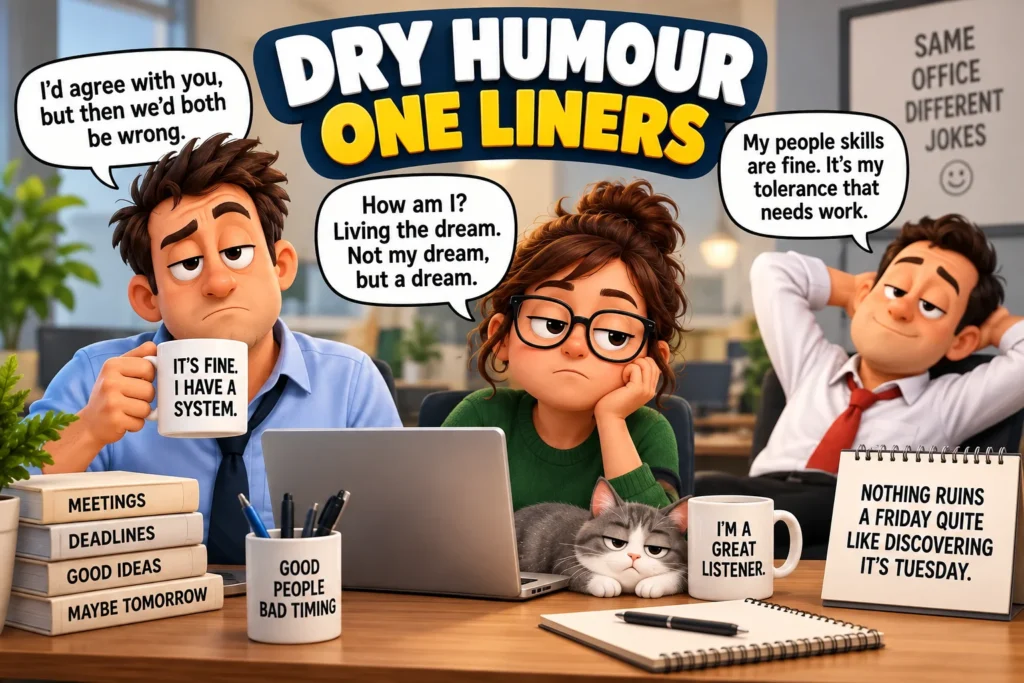
- I’d agree with you, but then we’d both be wrong.
- I’m not arguing. I’m explaining why I’m right.
- How am I? Living the dream. Not my dream, but a dream.
- I have an excellent memory. I just can’t remember where I keep it.
- My people skills are fine. It’s my tolerance that needs work.
- I don’t have a short temper. I have a quick reaction to nonsense.
- Nothing ruins a Friday quite like discovering it’s Tuesday.
- I always give one hundred per cent at work, spread unevenly across the week.
- I’m a great listener. I simply choose not to act on anything I hear.
- The early bird can keep the worm. Worms are horrible.
- It’s fine. I have a system. The system is in panic.
Dry OneLiners for Work
Dry humour is the dominant register in most offices, because it lets you say something honest without anyone having to acknowledge it. These work in meetings, in chat and in the small gap after somebody proposes something unwise.
- I told my boss three companies were after me. The gas, electric and water.
- That’s an interesting idea. Let’s explore it.
- I’ve read the document thoroughly. The font is excellent.
- Happy to help, in the sense that I will be present while you do it.
- We should definitely circle back on that, ideally in a different job.
- Have you tried turning it off and on again? It remains the most effective sentence in English.
The Dry Skin Jokes People Search For
A whole cluster of dry searches are not about humour at all they are about specific pun jokes with the word dry in them. These are the ones people hunt for by name, and every one has a fixed answer.
What Is the Leading Cause of Dry Skin?
Towels. It is the best joke in this cluster, because the setup sounds exactly like a medical question and the answer is completely literal. It works particularly well, said flatly, which makes it a dry joke about dryness.
- Q What’s the leading cause of dry skin? A Towel.
What Does a Pig Put on Dry Skin?
Oinkment. A straightforward pun on ointment, and the one children find funniest of the group.
- Q What does a pig put on dry skin? A Oinkment.
What Goes In Dry and Comes Out Wet?
A tea bag. It is a riddle rather than a pun, and the answer is satisfying because it is completely obvious the moment you hear it.
- Q What goes in dry and comes out wet? A tea bag.
Why Are Dry Erase Boards So Great?
They’re remarkable. Two syllables doing double duty are able to be marked again, and worthy of remark. It is the tidiest pun on this page.
- Q Why are dry erase boards so great? A. They’re remarkable.
Dry January and Dry July Jokes
Alcoholfree months generate their own comedy, most of it about the counting. These work in group chats and on social posts during January and July, when roughly half the people reading will be doing it and the other half will be watching.
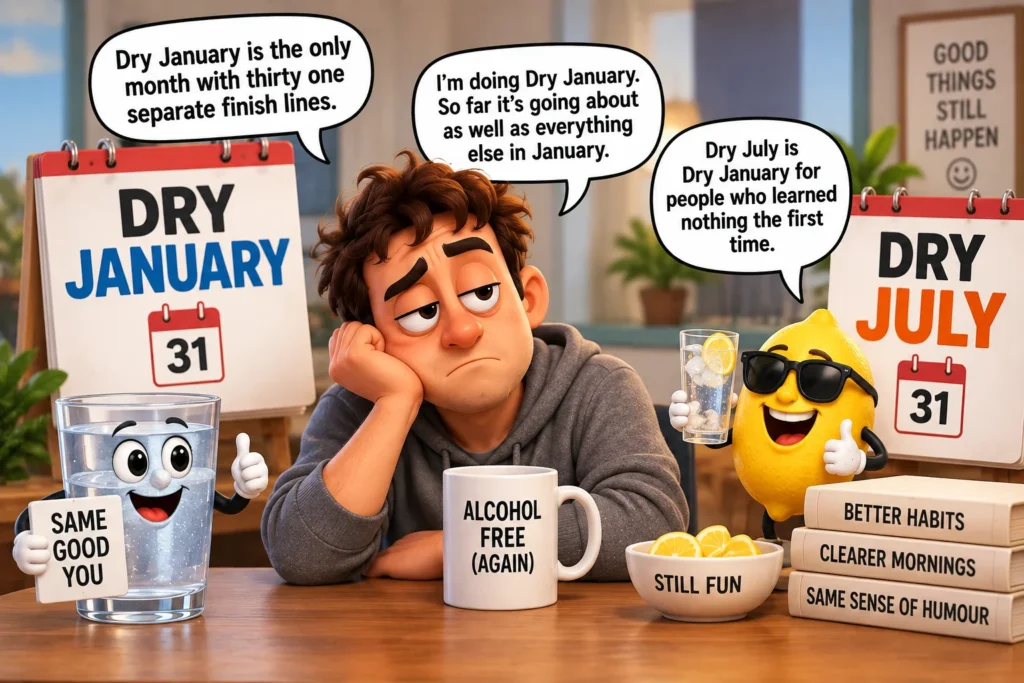
- Dry January is the only month with thirtyone separate finish lines.
- I’m doing Dry January. So far it’s going about as well as everything else in January.
- The hardest part of Dry January is other people’s opinions about Dry January.
- Dry July is Dry January for people who learned nothing the first time.
- I’ve discovered that without a drink, evenings are extremely long.
Other Dry Puns Worth Knowing
A few more dryword jokes turn up in searches regularly, and they are all short enough to keep in reserve.
- I went to Canada last year and drank it dry.
- It’s forty degrees, but it’s a dry heat. So is an oven.
- I made a joke about dry ice. It went straight over their heads without leaving a trace.
- My lips are so dry I’ve started speaking in shorter sentences.
- I told a joke about dry rot. It didn’t get much traction, but it slowly spread.
How to Tell a Dry Joke
Delivery is the whole skill here, and it is almost entirely a matter of removing things rather than adding them. Say the line at the same speed and volume as the rest of the sentence. Do not pause before the funny part, do not look at anyone for a reaction, and above all do not smile. If the room goes quiet, let it stay quiet rescuing a dry joke is what kills it.
- Say it at the same pace and volume as ordinary speech
- No pause before the punchline it is not a punchline
- Do not smile, and do not check for a reaction
- Never signal in advance that a joke is coming
- If nobody laughs, continue as though nothing happened
- Never explain it, and never add I’m joking
- Slightly quieter than the surrounding sentence works better than louder
When Dry Humour Goes Wrong
Dry humour has a higher failure rate than any other style, and the failures are worth knowing about because they are predictable. Text is the biggest problem a message strips out every vocal cue, so a dry line frequently reads as cold or rude to someone who cannot hear your tone. The other reliable failure is using it with people who do not know you, since they have no baseline for what you normally sound like.
- In text, dry humour often reads as coldness or rudeness
- Strangers have no baseline and will take you literally
- Highstakes or formal settings remove the safety margin
- Someone upset or anxious will not hear the joke at all
- Dry humour is more common in some cultures than others
- If you have to say I was joking, the joke has already failed
Jump into Other Related Article
- Funny Jokes That Will Make You Laugh
- Animal Jokes: Funny Animal Jokes That Will Make You Laugh
- Dad Joke of the Day | Today’s Pick + 60 More for Every Day
- Joke of the Day | 50+ Funny Jokes for Every Mood
- Dad Jokes | 60+ Funny, Corny OneLiners (Plus Their Surprising History)
- Deez Nuts Jokes | 50+ Names & Setups (Plus Where It Came From)
- Banana Jokes | 60+ Funny Ones for Kids & Adults
- Shark Jokes | 60+ Funny Ones for Kids & Adults
- Funny Jokes | 60+ Jokes for Kids, Adults & Every Occasion
- Pasta Jokes | 60+ Funny Ones for Kids & Adults
Conclusion
A dry joke is a joke that refuses to admit it is one, which is what makes it satisfying and what makes it risky. Learn the difference between dry, deadpan and sarcastic, keep three oneliners in reserve, and remember that the delivery is the entire technique flat voice, straight face, no followup. Save the towels joke in particular, because a dry joke about dryness is about as neat as this category gets. And if you are typing rather than speaking, consider whether the person on the other end can hear you.
- Dry is the register, deadpan is the delivery, sarcasm is the meaning
- The technique is removing signals, not adding jokes
- Text strips out tone be more careful in writing than in speech
What is a dry joke?
A joke delivered flatly, with no smile, pause or vocal signal, as though the speaker has said something entirely ordinary. The contrast between the content and the deadpan delivery is the humour.
What is the difference between dry humour and sarcasm?
Dry humour describes how something is said understated and unemotional. Sarcasm describes what is meant the opposite of the words used, usually to mock. A joke can be one without being the other.
What is deadpan?
Deadpan is the delivery style itself, an expressionless face and flat voice. Dry humour usually uses deadpan delivery, but the terms describe different things.
What’s the leading cause of dry skin?
Towels. The setup sounds like a medical question and the answer is completely literal, which is what makes it work.
How do you tell a dry joke properly?
Say it at normal speed and volume, do not pause or smile, do not check for a reaction, and never explain it afterwards. The technique is subtraction, not performance.
Why don’t some people get dry jokes?
Because the style deliberately removes every cue that signals a joke. Without those cues, anyone who does not know your usual manner has no way to distinguish the joke from a plain statement