Most joke pages give you a list and assume you already understand it. This one explains every joke, because jokes in English usually depends on one word meaning two things and if you did not grow up with the language, that word is invisible. Below you will find short jokes, question and answer riddles, English teacher gags and jokes about learning the language itself, each with a oneline note on exactly where the humour sits. It is written for learners, teachers and anyone who wants to actually get the joke rather than nod politely.
Why English Is So Good for Jokes
English is unusually well suited to jokes because it has an enormous vocabulary drawn from several different languages, which produces a huge number of words that sound the same but mean different things. Spelling is inconsistent, grammar is full of exceptions, and phrasal verbs like put down or make up carry meanings that have nothing to do with their parts. Every one of those irregularities is a problem for a learner and a gift to a comedian. That is why English humour leans so heavily on puns compared with many other languages.
- A vast vocabulary borrowed from multiple language families
- Large numbers of homophones words that sound identical
- Inconsistent spelling creates constant soundalike pairs
- Phrasal verbs carry meanings unrelated to their parts
- Idioms can be read literally, which is where many jokes live
- The same features that make English hard make it funny
Short Jokes in English, Explained
These are the classics. Each one is followed by a short explanation of the wordplay, so nothing is left to guess. If you are teaching, these work well as a warmup read the joke, ask the class where the double meaning is, then confirm.
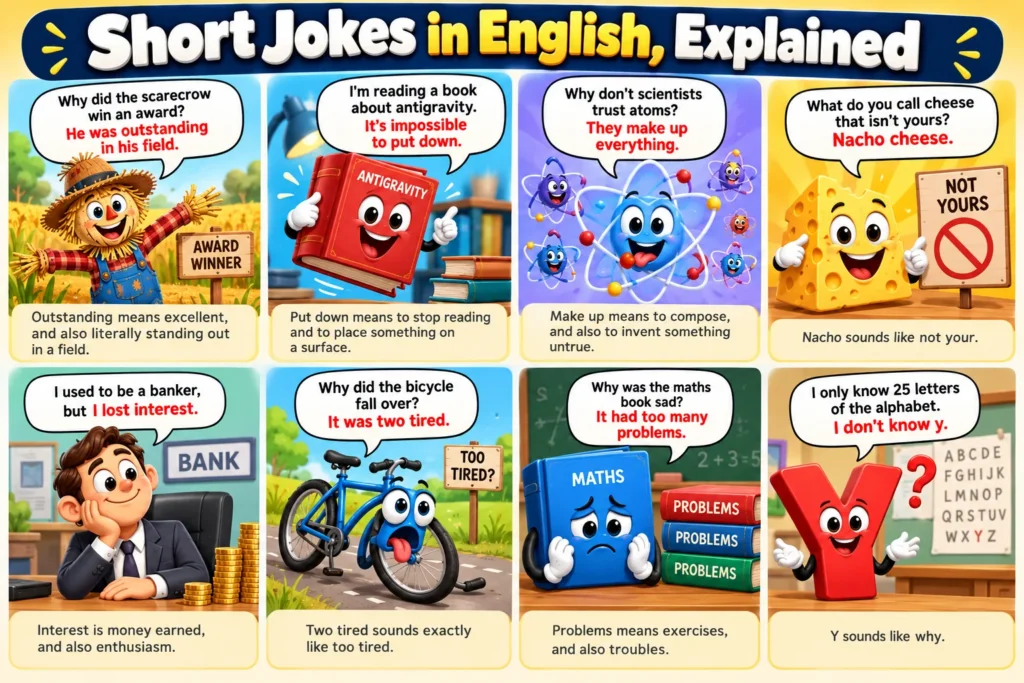
- Why did the scarecrow win an award? He was outstanding in his field. Outstanding means excellent, and also literally standing out in a field.
- I’m reading a book about antigravity. It’s impossible to put down. Put down means to stop reading and to place something on a surface.
- Why don’t scientists trust atoms? They make up everything. Make up means to compose, and also to invent something untrue.
- What do you call cheese that isn’t yours? Nacho cheese. Nacho sounds like not your.
- I used to be a banker, but I lost interest. Interest is money earned, and also enthusiasm.
- Why did the bicycle fall over? It was two tired. Two tired sounds exactly like too tired.
- What’s the difference between a fish and a piano? You can’t tuna fish. Tuna sounds like tune a.
- I told my wife she was drawing her eyebrows too high. She looked surprised. She looked surprised because of the eyebrows, and also because of the comment.
- Why was the maths book sad? It had too many problems. Problems means exercises, and also troubles.
- I only know 25 letters of the alphabet. I don’t know y. Y sounds like why.
English Question and Answer Jokes
Question and answer jokes are the easiest format for learners, because the structure signals exactly when the punchline is coming. These are genuine riddles rather than puns, which means the answer can be worked out from the clue good practice for vocabulary and logic at the same time.
- What has hands but cannot clap? A clock.
- What gets wetter the more it dries? A towel.
- What has a neck but no head? A bottle.
- What has keys but opens no locks? A piano.
- What word becomes shorter when you add two letters? Short.
- What has to be broken before you can use it? An egg.
- What building has the most stories? A library story means floors and also tales.
Jokes About Learning English
English learners have their own comedy, and most of it is about how little sense the language makes. These land well in a classroom because everyone in the room has been personally defeated by at least one of them.
- English is the only language where read and read are spelled the same and sound different, while read and reed sound the same and are spelled differently.
- There is no egg in an eggplant, no ham in a hamburger, and neither apples nor pines in a pineapple.
- I before E, except after C and except in around a hundred other words nobody warned you about.
- A teacher asked a student to use because in a sentence. The student said Because is a conjunction.
- English doesn’t borrow from other languages. It follows them down dark alleys and goes through their pockets.
- We drive on a parkway and park on a driveway, and nobody has ever explained why.
English Teacher and English Class Jokes
English teacher jokes rely on grammar terminology, which makes them the most specific jokes on this page and the most satisfying if you know the rules. They work well on classroom doors, end of term slides and staff room noticeboards.
- How do you comfort an English teacher? You say There, their, they’re. the three homophones learners most often confuse.
- English teachers don’t lose their temper. They lose their common sense.
- How do English teachers get married? Very tensely they can never agree on the future perfect.
- I have a complicated relationship with punctuation.
- My English teacher told me my essay lacked structure. I said I’d get around to it eventually, in no particular order.
- Why did the sentence go to therapy? It had too many issues with its subject.
English Jokes for Kids
A joke in English for children needs short words and an obvious punchline. These are ideal for young learners, primary classrooms and homework rewards, because the vocabulary is simple enough that the pun is the only difficult part.
- What do you call a bear with no teeth? A gummy bear.
- Why did the cookie go to the doctor? It felt crummy.
- What kind of tree fits in your hand? A palm tree.
- Why can’t your nose be 12 inches long? Because then it would be a foot.
- What do you call a sleeping dinosaur? A dinosaur.
- Knock knock. Who’s there? Lettuce. Lettuce who? Lettuce in, it’s cold out here.
Jokes That Work in Two Languages
A common search is for a joke that works in both English and another language, usually Spanish. The honest answer is that almost no pun survives translation, because a pun depends on two meanings sharing one sound, and that coincidence almost never repeats across languages.
Why Most Jokes Don’t Translate
If a joke’s humour comes from a word sounding like another word, translating it destroys the joke completely. Nacho cheese is meaningless in Spanish, and Spanish puns are equally meaningless in English. This is why translated joke books are often disappointing the translator has to choose between the meaning and the joke, and cannot keep both.
- Puns depend on sound coincidences that don’t repeat across languages
- Translating a pun keeps the meaning and loses the humour
- This is the single biggest problem in translating comedy
The Jokes That Do Travel
Jokes built on situations rather than sounds translate perfectly. The classic example is the camping joke where one character deduces something elaborate from the night sky while the other points out that their tent has simply been stolen that works in any language because the humour is in the misplaced reasoning, not in any particular word. If you want a joke that works bilingually, choose a situation joke rather than a pun.
- Situation and logic jokes translate almost perfectly
- Character based jokes usually survive too
- Choose a story, not a pun, when crossing languages
- Absurdist jokes travel better than clever ones
The EuroEnglish Spelling Joke
A satirical text circulates widely proposing that English spelling be simplified in stages replacing awkward letters, removing silent ones, and continuing year by year until the written language looks nothing like it did at the start, and rather more like German. It is a joke about spelling reform, and its real power is that each individual step sounds almost reasonable while the cumulative result is absurd. It is frequently attributed to famous authors, but the authorship is genuinely disputed and most attributions you will see are wrong.
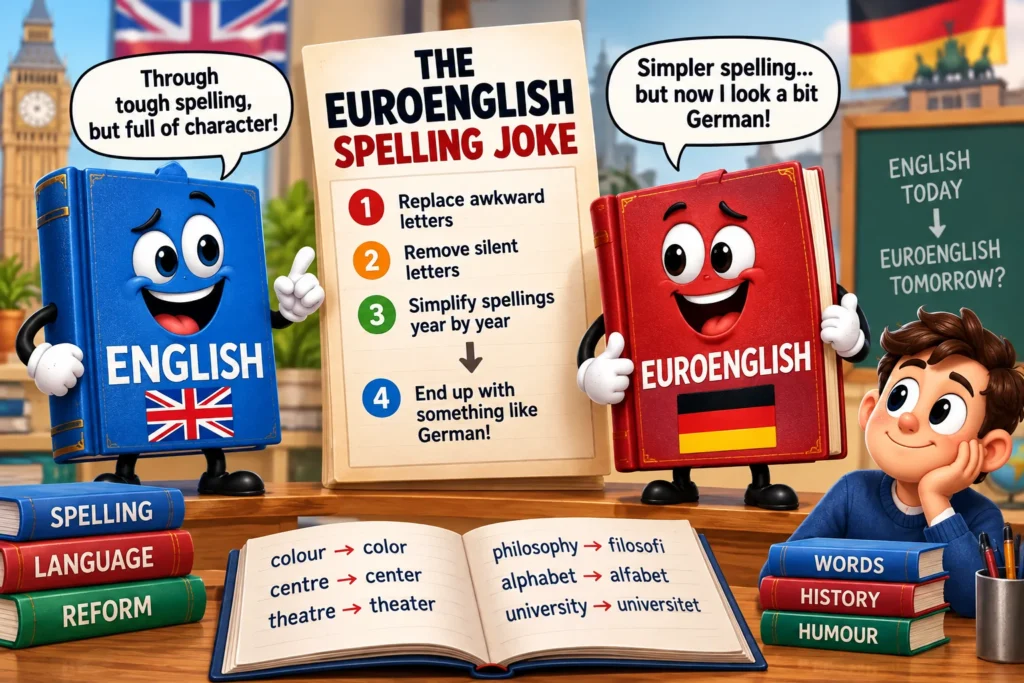
- A satirical proposal to phase in simplified English spelling
- Each step sounds sensible; the cumulative result is nonsense
- The punchline is that the language ends up resembling German
- Widely misattributed the real authorship is disputed
- Often searched as EuroEnglish or the spelling simplification joke
How to Use Jokes to Learn English
Jokes are genuinely useful language learning material, and not just as a break from grammar. A pun forces you to hold two meanings of a word at once, which is exactly the skill that separates intermediate learners from advanced ones. Teachers get the most from them by treating the joke as a puzzle rather than a reward.
- Read the joke, then ask which word has two meanings
- Have learners explain the joke rather than just laugh at it
- Collect homophone pairs from jokes into a vocabulary list
- Use question and answer jokes for listening practice
- One joke per lesson works better than a long list
- Encourage learners to attempt one in English, badly that is the point
Jump into Other Related Article
- Food Jokes: Deliciously Funny Jokes That Will Make You Hungry
- Monthly Jokes: A Month Full of Laughs
- Weekly Jokes: A Funny Joke for Every Day of the Week
- Funny Jokes That Will Make You Laugh
- Funny Jokes and Memes About Friends | 70+ Lines for the Group Chat
- Animal Jokes: Funny Animal Jokes That Will Make You Laugh
Conclusion
A joke in English is usually a small trap built out of one word doing two jobs, which is why explaining them is not spoiling them for a learner, the explanation is the lesson. Save three from this page the scarecrow for a class warmup, the there, their, they’re line for any English teacher, and a situation joke for when you need something that works in two languages. And if English feels unnecessarily difficult, remember that every irregularity frustrating you is also what makes the jokes possible.
- Explaining a joke is the lesson, not the spoiler
- Question and answer jokes are easiest for learners
- Situation jokes, not puns, are the ones that translate
What is a good short joke in English?
Why did the scarecrow win an award? He was outstanding in his field. It works because outstanding means both excellent and literally standing in a field.
Why are English jokes so hard for learners?
Because most rely on a single word having two meanings, or two different words sounding identical. If you know only one meaning, there is no joke which is why explanations matter more in English than in many languages.
What’s a good English teacher joke?
How do you comfort an English teacher? You say there, their, they’re. It uses the three homophones learners confuse most often.
Is there a joke that works in both English and Spanish?
Puns almost never survive translation, but situation jokes do. Any joke where the humour comes from what happens, rather than how a word sounds, will work in both languages.
How can I use jokes to learn English?
Treat each joke as a puzzle find the word with two meanings, explain it in your own words, and add both meanings to a vocabulary list. One joke per lesson beats a long list.
What is the EuroEnglish joke?
A satirical text proposing that English spelling be simplified year by year until the written language becomes unrecognisable. It is widely shared and widely misattributed the authorship is disputed.