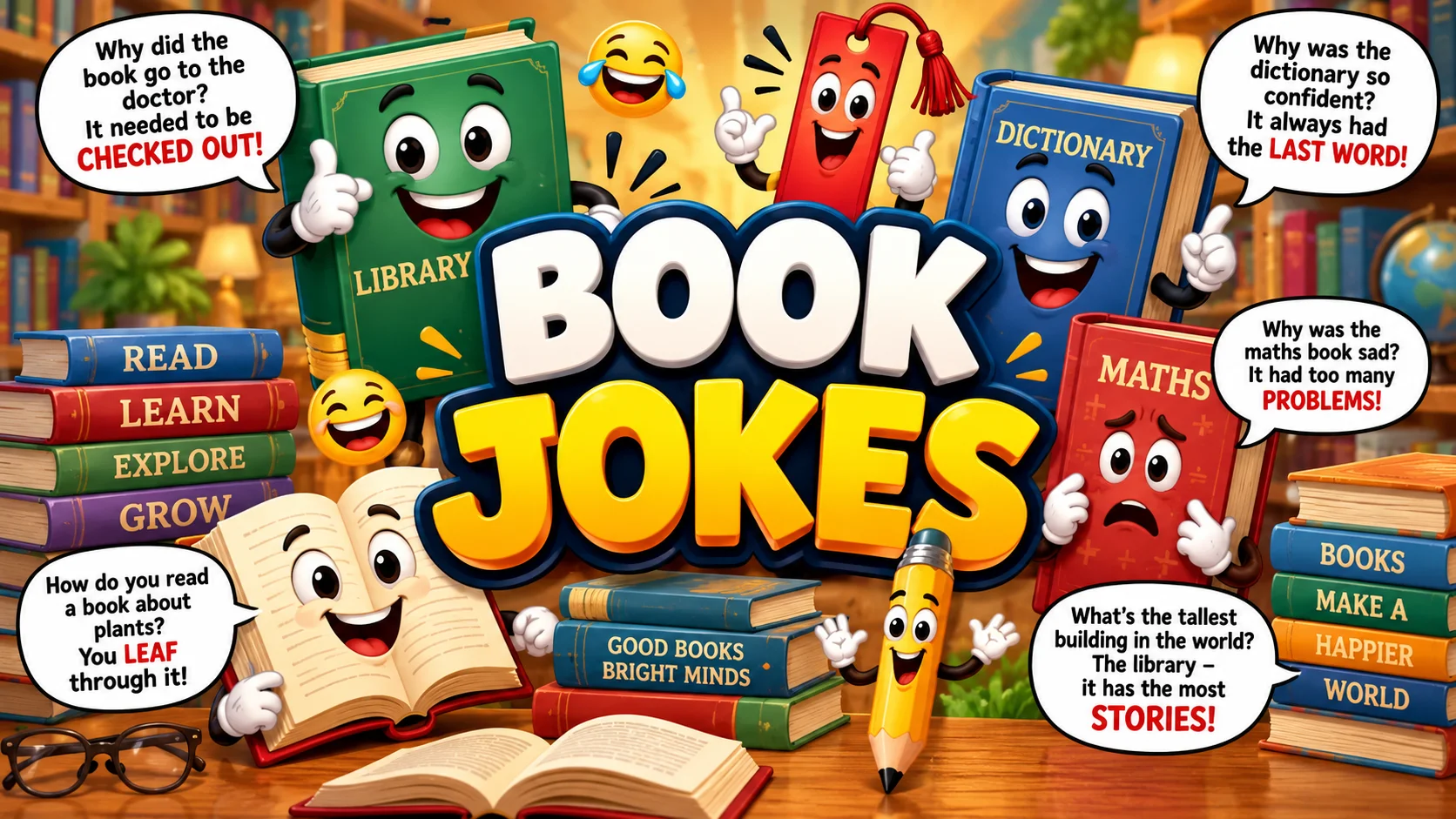
People searching around book jokes want one of two things: jokes about books, or an actual joke book to buy or make. This page has both. First the puns library gags, reading jokes, riddles for children with answers and then a practical guide to choosing a joke book by age, picking titles and cover ideas, and putting one together yourself. It also names the one category of joke book worth steering clear of entirely.
Best Book and Library Jokes
These are the general purpose book jokes: short, clean and usable in a library, a classroom or a group chat. They run on spine, cover, checked out, volume and plot, all of which mean something else in ordinary English. Say one, wait for the groan, and carry on shelving.
- Why did the library book go to the doctor? It needed to be checked out.
- Why was the dictionary so confident? It always had the last word.
- Why did the thesaurus win the argument? It had other words for everything.
- What did the book say to the shelf? You’ve been holding me back.
- Why are books such good listeners? They never once interrupt.
- Why was the bookmark upset? It kept getting left behind.
- Why don’t librarians ever panic? Everything is already in order.
- Why did the novel go to therapy? Unresolved plot issues.
- What’s a book’s favourite weather? Overcast, so nobody goes outside.
- I’d tell you a joke about an unfinished book, but
Book Dad Jokes and Reading Puns
A book dad joke is delivered in a bookshop, slowly, to someone who came in for one specific thing. The formula is the usual one: obvious pun, straight face, no explanation. Reading vocabulary is unusually generous, so they write themselves.
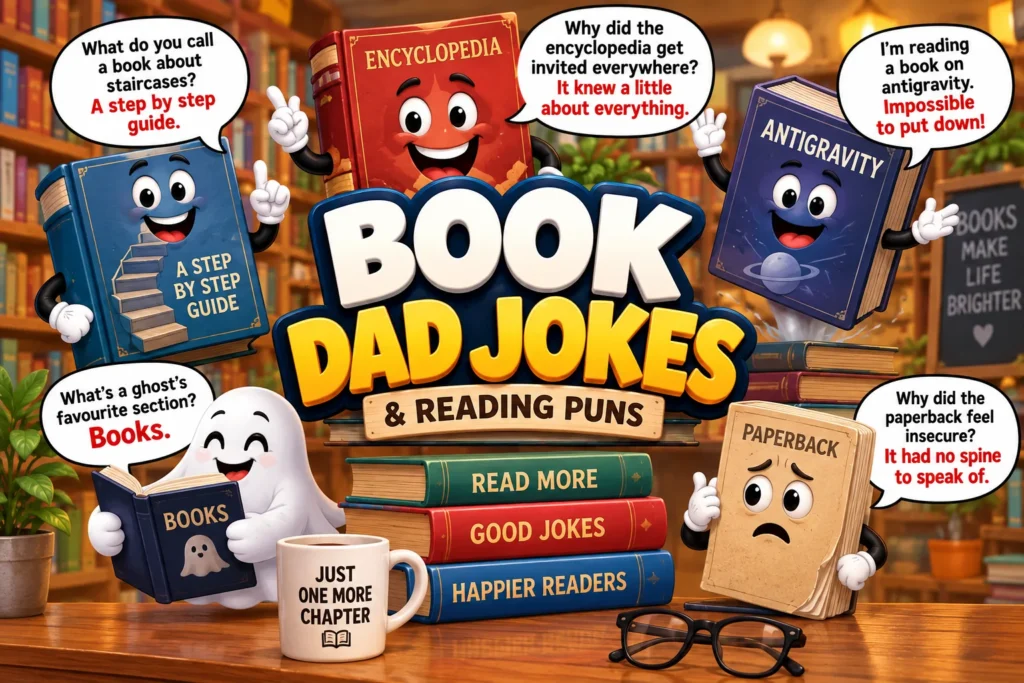
- What do you call a book about staircases? A step by step guide.
- Why did the encyclopedia get invited everywhere? It knew a little about everything.
- I’m reading a book on antigravity. Impossible to put down.
- What’s a ghost’s favourite section? Books.
- Why did the paperback feel insecure? It had no spine to speak of.
- I bought a book about glue. I couldn’t put it down either, but for different reasons.
Book Jokes for Kids
A book joke for kids needs a simple word and an instant punchline. These work in classroom warmups, library visits and reading challenges, and they are the ones children will repeat every single time you open a book together.
- Why did the pencil love the library? It felt inspired.
- Knock knock. Who’s there? Library. Library who? Library quiet, please.
- What kind of book fits in your pocket? A short story.
- Why did the crayon read a book? To get a bit more colourful.
- What’s the tallest building in the world? The library it has the most stories.
- Why don’t books ever get lonely? They’re always in good company.
The Book Riddles People Search For
These are the specific book riddles that turn up in search, usually because someone half remembers one and cannot recall the answer. Both are staples of children’s joke books and have been for decades.
How Do You Read a Book About Plants?
You just leaf through it. It is the most searched book riddle and one of the tidiest puns in the category, because leaf belongs equally to books and to plants.
- Q: How do you read a book about plants? A: You leaf through it.
Why Was the Maths Book Sad?
Because it had too many problems. This one is so widely known that it has become the default example of a groanworthy school joke, which is exactly why it still works.
- Q: Why was the maths book sad? A: It had too many problems.
How to Choose a Joke Book for a Child
This is the practical question behind most joke book searches, and the answer is almost entirely about reading level rather than humour. A joke book that is too advanced gets abandoned in a week; one pitched correctly gets read to destruction. The single best predictor is whether the child can read the punchline unaided, because the joy is in performing it to someone else.
Ages 4 to 6
At this stage the child is performing jokes rather than reading them, so pictures matter more than text. Look for one joke per page, large type, and punchlines of one or two words. Knockknock collections are ideal because the format teaches turntaking.
- One joke per page with a supporting illustration
- Punchlines of one or two words
- Knockknock formats work best at this age
- Expect the same six jokes on rotation for months
Ages 7 to 9
This is the peak joke book age, and almost any format works. Children can now read independently, so riddles, puns and short question and answer jokes all land. Themed books built around something they already love get read far more often than general collections.
- Riddles and question and answer formats work well
- Themed books outperform general ones at this age
- Look for 200 or more jokes so it lasts
- A book pitched here will be memorised entirely
Ages 10 to 12
Older children want wordplay they can appreciate rather than just repeat, and they become sharply aware of jokes being for babies. Look for puns, oneliners and books that acknowledge how bad the jokes are, since self aware humour goes down far better than earnest humour at this age.
- Puns and wordplay over simple riddles
- Self aware these are terrible framing works well
- Avoid anything that looks designed for younger children
- This is the age for building their own joke collection
Themed and Franchise Joke Books
Themed joke books are the biggest category in children’s publishing for a simple reason: a child who loves one thing will read anything attached to it. Video game tie ins, TV franchises and seasonal collections all sell heavily, and quality varies enormously between official releases and unofficial ones. Check who published it before buying, since unofficial tie ins are often padded with recycled material.
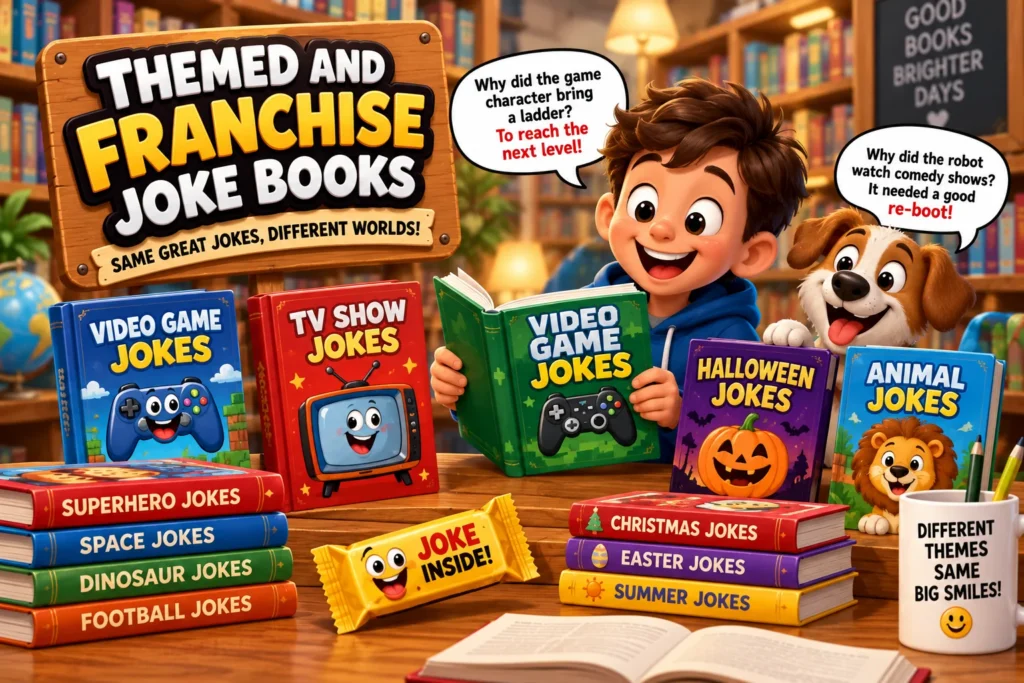
- Video game and TV tie ins dominate the children’s market
- Official releases are generally better edited than unofficial ones
- Seasonal collections make reliable gifts and stocking fillers
- Sweet wrapper jokes are many children’s first joke format
- Regional folk humour collections exist too, usually told within the community they’re about
- Check the publisher before buying an unofficial tie in
How to Make Your Own Joke Book
Making a joke book is one of the best writing activities there is for a child, because it has a real audience and a clear format. Collect thirty to fifty jokes first, then sort them into categories, then lay them out one joke per page with the punchline overleaf so the reader has to turn it. Illustrations are optional but they are usually the part children enjoy most.
- Collect 30 to 50 jokes before starting the layout
- Sort them into categories animals, school, food, knockknocks
- One joke per page, punchline on the following page
- Leave space for a drawing beside each joke
- Number the pages and add a contents list
- Staple or bind it properly it gets read more if it looks like a book
Joke Book Titles and Cover Ideas
The title does a surprising amount of work, especially for a homemade book being given as a gift. Puns work better than descriptions, and the cover should show the format rather than explain it.
- Have You Heard These? for animal jokes
- Totally GroanUp for dad jokes
- Read It and Weep for deliberately terrible ones
- The Big Book of Bad Puns honest and effective
- Covers work best with one large illustration and a huge title
One Category of Joke Book Worth Avoiding
Some historical joke books that turn up in searches are collections of racist material, including minstrel publications. Those are historical artefacts of racism rather than comedy, and they are studied by historians for what they reveal about the period, not read for laughs. They have no place in a joke book recommendation, and nothing on this page draws from them. The same caution applies in the other direction: adult standup tie in books are often marketed alongside children’s joke books online, so check the content before handing one to a child.
- Historical racist joke collections are artefacts, not comedy
- Historians study them; they are not entertainment
- Adult comedy tie ins often sit beside children’s books online
- Always check content before giving a joke book to a child
- Official children’s publishers are the safest bet for gifts
Jump into Other Related Article
- Food Jokes: Deliciously Funny Jokes That Will Make You Hungry
- Monthly Jokes: A Month Full of Laughs
- Weekly Jokes: A Funny Joke for Every Day of the Week
- Funny Jokes That Will Make You Laugh
- Animal Jokes: Funny Animal Jokes That Will Make You Laugh
Conclusion
Book jokes and joke books answer two different needs, and both are worth having. Keep three puns for the library queue the leaf through one, the maths book, and the libraryhasthemoststories line and choose an actual joke book by reading level rather than by theme. If you have a child aged seven to nine, making one together beats buying one, because the jokes get learned properly in the process.
- Match a joke book to reading level, not to a franchise
- Ages seven to nine is the peak joke book age
- Making one is a better activity than buying one
How do you read a book about plants?
You leaf through it. It is the most searched book riddle and works because leaf belongs to both books and plants.
Why was the maths book sad?
Because it had too many problems. It is the best known school joke in circulation.
What is the best joke book for a 7yearold?
Seven is the peak age, so almost any format works look for a collection of at least 200 riddles and question and answer jokes, ideally themed around something the child already loves.
How do I make my own joke book?
Collect thirty to fifty jokes, sort them into categories, and lay them out one joke per page with the punchline overleaf. Add drawings and a contents page, then bind it properly.
What makes a good joke book title?
A pun beats a description. Have You Heard These? or Totally GroanUp tells you the format and the tone in three words.
What’s the tallest building in the world?
The library has the most stories. It is the single most repeated book joke there is.