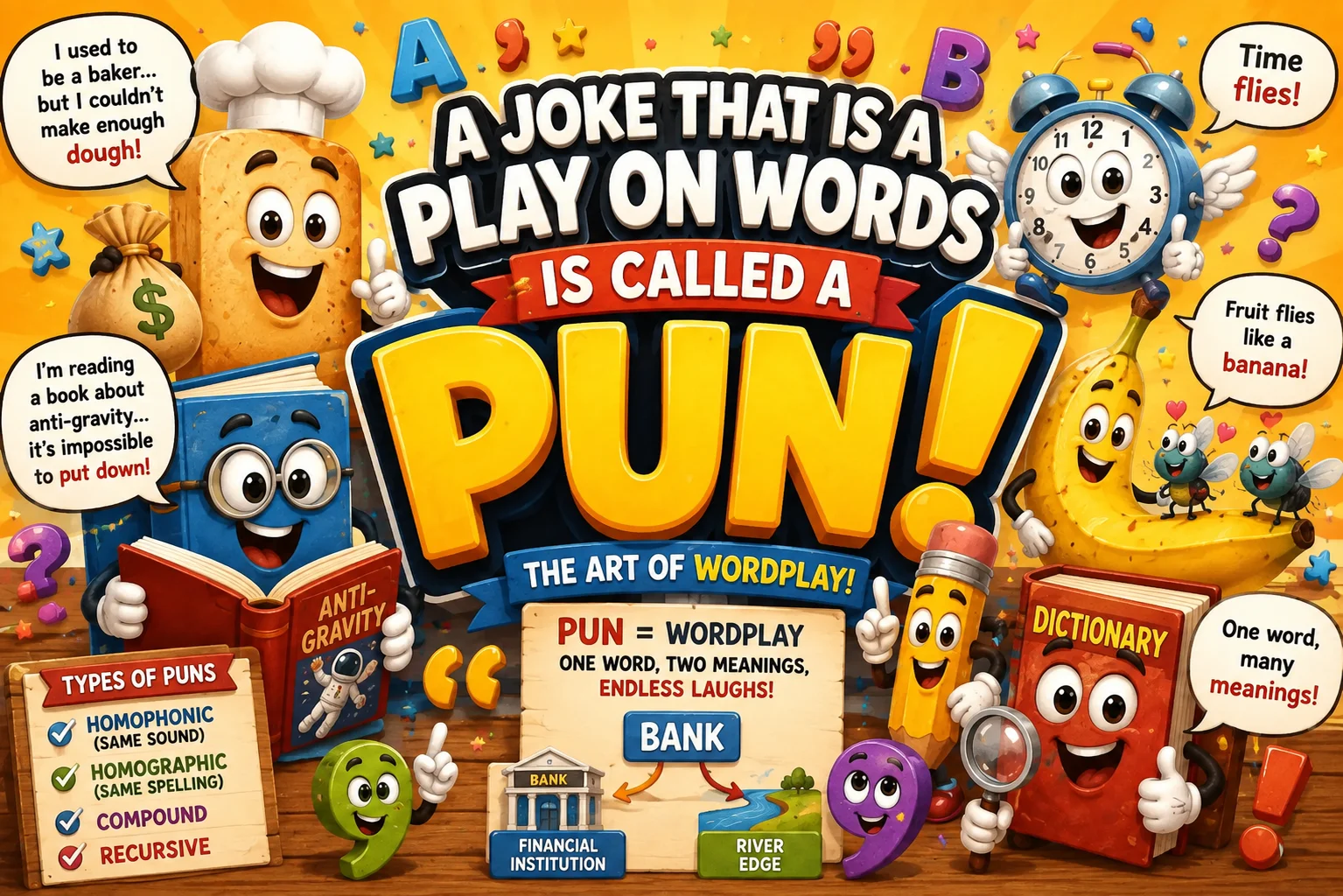
If you’re trying to answer the question, a joke that is a play on words is a , the correct term is a pun. It’s one of the oldest and most widely recognized forms of wordplay in the English language, built on words that sound alike or carry more than one meaning at once. In this guide, we’ll give you the exact definition of a pun, explain where the word itself actually comes from, break down the different recognized types of wordplay jokes, and walk through clear examples of each so the concept fully clicks.
A Joke That Is a Play on Words Is Called a Pun
Before getting into the different types, it helps to nail down the exact, correct definition, since this is the term most commonly tested in vocabulary and grammar exercises.
The Precise Definition
A pun is a form of wordplay that exploits multiple meanings of a term, or the similar sounds of two different words or phrases, specifically for a humorous or rhetorical effect. It differs from a simple mistake or malapropism because a pun always involves an expression with more than one valid, correct interpretation at once.
- The correct answer to a joke that is a play on words is a pun
- Formally exploits either multiple word meanings or similar sounding words
- Created intentionally for humorous or rhetorical effect
- Different from a malapropism, which is simply an incorrect word choice
- A pun requires the wordplay to remain logically valid both ways
- Recognized as one of the most common forms of verbal humor
- The standard, correct term used across dictionaries and vocabulary tests
- Appears frequently in quiz and vocabulary building platforms for this reason
Why Riddle Isn’t the Correct Answer
While some riddles do use puns as their answer, riddle itself is a broader category referring to any puzzling question or statement, whereas pun specifically refers to the wordplay technique itself, making pun the more precise and technically correct answer.
- A riddle is a broader category of puzzling question or statement
- Not every riddle relies specifically on wordplay to work
- A pun is the specific technique, not the broader question format
- Many riddles do use puns as their punchline or answer
- The distinction matters for vocabulary and grammar focused questions
- Pun is the term most educational resources treat as technically correct
- Understanding this distinction helps clarify similar quizstyle questions
- The two terms are related but not interchangeable
The Origin of the Word Pun
Understanding where the word itself comes from adds useful context to why it’s defined the way it is today.
Its Formal Linguistic Name
According to linguistic sources, the formal, technical term for a pun is paronomasia, derived from the Greek para, meaning beside, and on oma, meaning name, essentially describing the act of placing one word or meaning directly alongside another.
- The formal linguistic term for a pun is paronomasia
- Derived from the Greek word para, meaning beside
- Combined with on oma, the Greek word for name
- Literally describes placing one meaning directly beside another
- Pun itself is the shorter, more casual English term used today
- Both terms refer to the exact same underlying concept
- Confirmed through documented etymological and linguistic sources
- Reflects how old and formally studied this type of wordplay actually is
A Long History in Written Language
According to Wikipedia and literary historians, puns have an extensive history in written language, with the ancient Roman playwright Plautus specifically noted for his frequent use of puns and word games in his comedic plays, showing this form of humor predates modern English by well over two thousand years.
- Puns have a documented history stretching back over two thousand years
- Roman playwright Plautus was specifically known for using puns
- Plautus incorporated wordplay throughout his ancient comedic works
- Confirms puns aren’t a modern or recently developed form of humor
- Writers across many centuries and languages have used similar techniques
- Reflects a genuinely longstanding human fascination with double meanings
- Confirmed through Wikipedia’s documented history of the pun as a concept
- Shows how enduring this specific style of wordplay has proven to be
Types of Play on Words Jokes
Puns aren’t all built the same way, linguists generally classify them into a few distinct, recognizable categories.
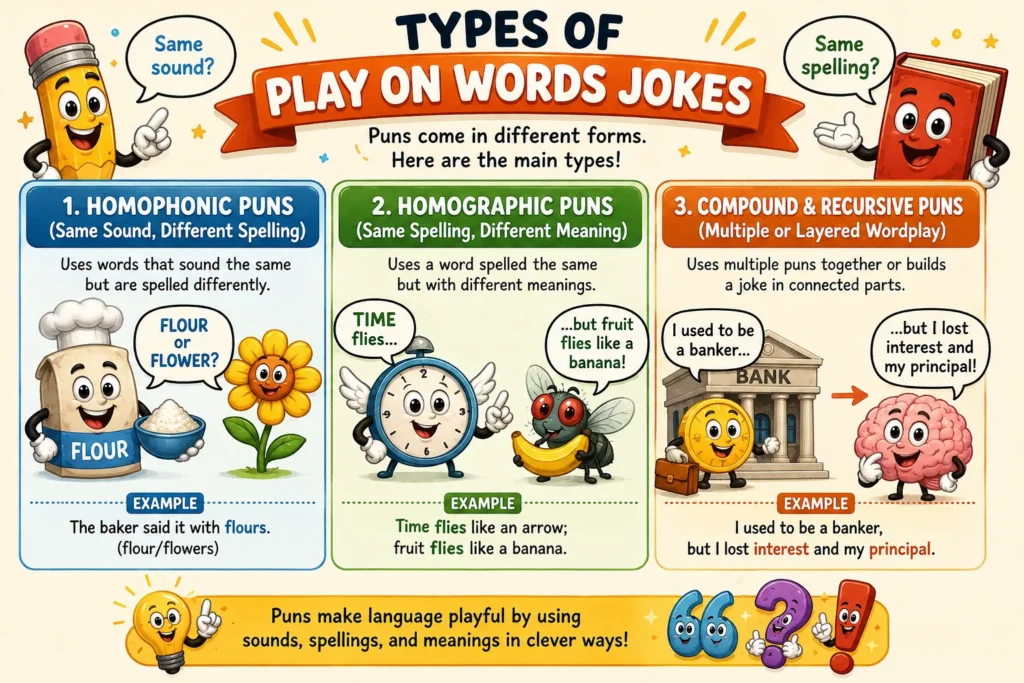
Homophonic Puns (Same Sound, Different Spelling)
These rely on homophones, words that sound identical but are spelled differently and carry different meanings, such as flour and flower.
- Uses word pairs that sound identical but are spelled differently
- The words involved are known as homophones
- Example: The baker said it with flours (flour/flowers)
- Relies entirely on how the words sound when spoken aloud
- One of the most common and widely recognized pun types
- Works especially well in spoken jokes and comedy
- The humor depends on the listener recognizing both meanings
- A staple technique in classic dad jokes and oneliners
Homographic Puns (Same Spelling, Different Meaning)
These use homographs, words spelled exactly the same but carrying entirely different meanings, often pronounced differently depending on which meaning is intended.
- Uses words spelled identically but with different meanings
- The words involved are known as homographs
- Example: Time flies like an arrow; fruit flies like a banana
- Relies on the reader or listener reinterpreting the same word
- Sometimes pronounced differently depending on the intended meaning
- Works especially well in written jokes and headlines
- Requires the audience to hold two meanings in mind at once
- A common technique in more literary or written forms of wordplay
Compound and Recursive Puns
Compound puns stack multiple individual puns together within a single joke, while recursive puns are built in two connected parts, where the second part only makes sense once the first part has already been understood.
- Compound puns combine two or more individual puns at once
- Example: I used to be a banker, but I lost interest and my principal
- Recursive puns require understanding an earlier part to get the next
- Recursive puns often feel like an inside joke building on itself
- Both types are generally considered more advanced wordplay
- Reward careful listening or reading more than simpler pun types
- Popular among people who specifically enjoy pun based humor
- Represent a more layered, deliberate style of constructing a joke
Examples of Play on Words Jokes
To make all of this concrete, here are a few original examples matched to the categories explained above.
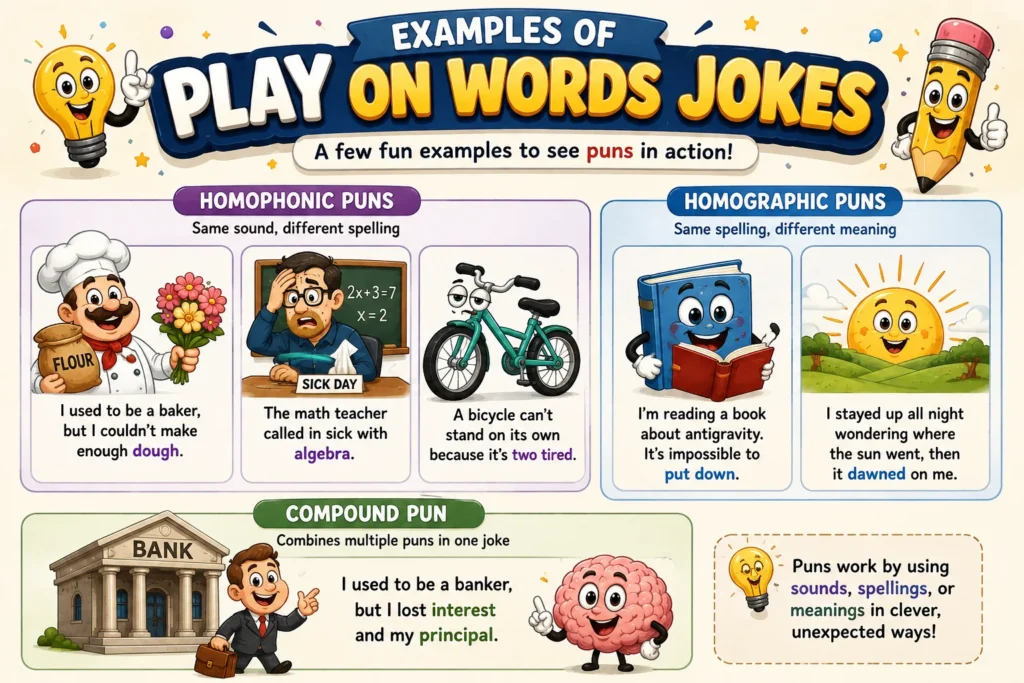
A Few Examples to Try
- I used to be a baker, but I couldn’t make enough dough. (homophonic)
- The math teacher called in sick with algebra. (homophonic)
- A bicycle can’t stand on its own because it’s twotired. (homophonic)
- I’m reading a book about antigravity. It’s impossible to put down. (homographic)
- I stayed up all night wondering where the sun went, then it dawned on me. (homographic)
- The past, present, and future walked into a bar. It was tense. (compound)
Jump into Other Related Article
- Food Jokes: Deliciously Funny Jokes That Will Make You Hungry
- Monthly Jokes: A Month Full of Laughs
- Weekly Jokes: A Funny Joke for Every Day of the Week
- Funny Jokes That Will Make You Laugh
- Animal Jokes: Funny Animal Jokes That Will Make You Laugh
- Dad Joke of the Day | Today’s Pick + 60 More for Every Day
- Joke of the Day | 50+ Funny Jokes for Every Mood
- Dad Jokes | 60+ Funny, Corny OneLiners (Plus Their Surprising History)
- Deez Nuts Jokes | 50+ Names & Setups (Plus Where It Came From)
- Banana Jokes | 60+ Funny Ones for Kids & Adults
- Cop Jokes | 50+ Funny Ones for Every Audience
- Penguin Jokes | 60+ Funny Ones for Kids & Adults
- Dinosaur Jokes for Kids | 60+ Funny Ones They’ll Love
- Cowboy Jokes | 60+ Funny Ones (Plus Dallas Cowboys Jokes)
- Shark Jokes | 60+ Funny Ones for Kids & Adults
- Funny Jokes | 60+ Jokes for Kids, Adults & Every Occasion
- Pasta Jokes | 60+ Funny Ones for Kids & Adults
Conclusion
A joke that is a play on words is called a pun, a term with formal linguistic roots stretching back to the Greek word paronomasia and a documented history in comedy going back over two thousand years to writers like the Roman playwright Plautus. Whether it’s a simple homophonic pun playing on how two words sound, a homographic pun built on a single word’s double meaning, or a more advanced compound or recursive joke, all of these fall under that same single, correct term. Next time you’re asked to define this kind of joke, pun is the precise, technically correct answer.
A joke that is a play on words is what?
A joke that is a play on words is called a pun, a form of wordplay that uses multiple meanings or similar sounding words for humorous effect.
A joke that is a play on words is what?
Its formal linguistic name is paronomasia, derived from the Greek words para (beside) and on oma (name).
Is a pun the same thing as a riddle?
Not exactly. A riddle is a broader category of puzzling question, while a pun specifically refers to the wordplay technique itself, which riddles sometimes use as their answer.
What are the main types of puns?
The main types are homophonic (same sound, different spelling), homographic (same spelling, different meaning), compound, and recursive puns.
What’s an example of a homophonic pun?
I used to be a baker, but I couldn’t make enough dough. It is a classic homophonic pun, playing on dough meaning both bread ingredients and money.
How old is the pun as a form of humor?
Puns have a documented history stretching back over two thousand years, with the ancient Roman playwright Plautus specifically known for using them.

Pingback: Cupcake Jokes | The Frosting Classic + Cupcake vs Muffin Explained