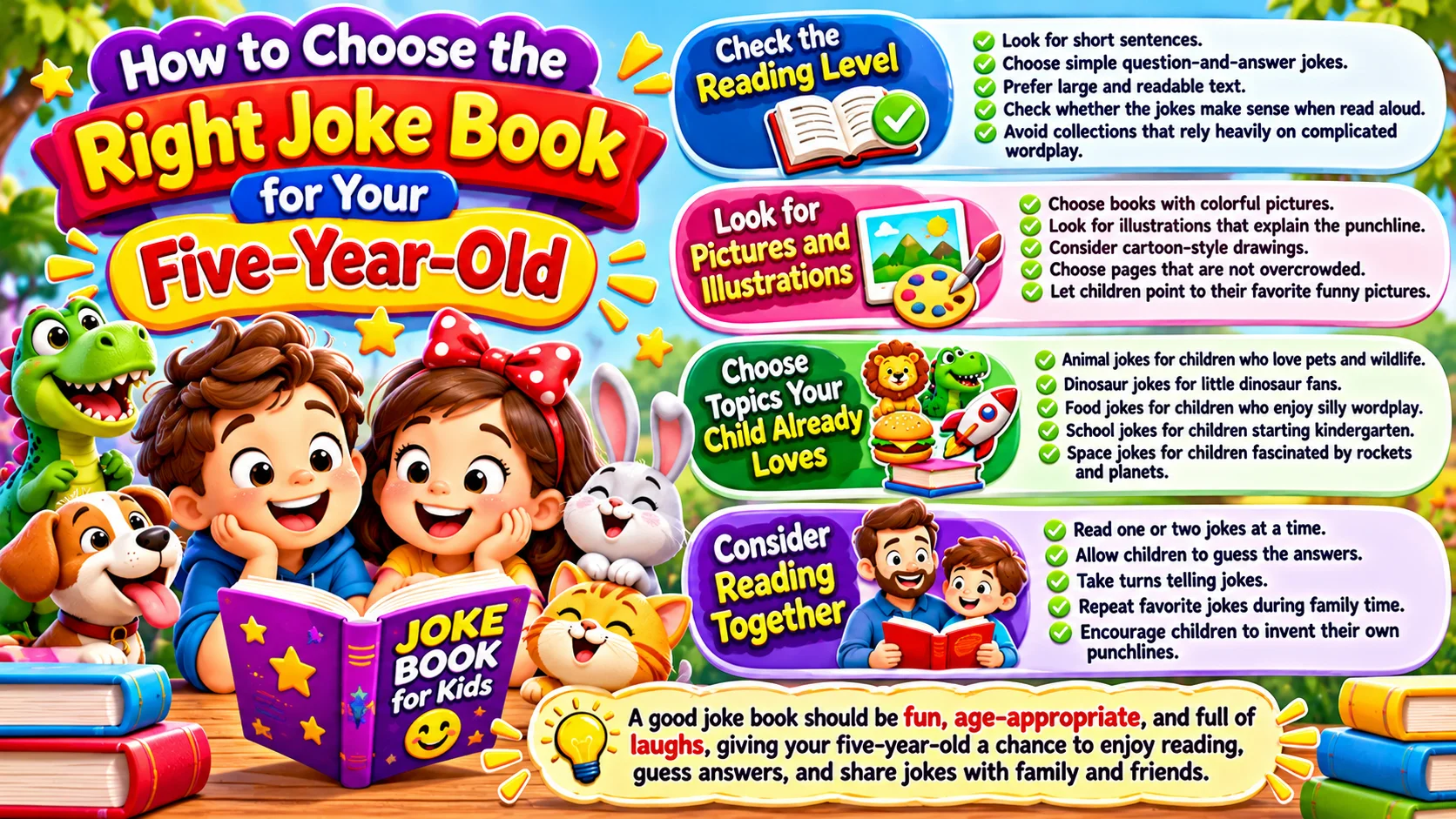
Five-year-olds are at an exciting age when silly words, funny questions, surprising answers, and playful riddles can turn an ordinary moment into a burst of laughter. A good joke book for 5 year olds introduces children to simple humor while giving them opportunities to enjoy stories, remember punchlines, and share jokes with family and friends. Whether a child is just beginning to read independently or enjoys listening to a parent tell funny jokes, the right collection can make reading time more entertaining.
Finding an enjoyable joke book is about more than choosing a book full of punchlines. At this age, children usually benefit from short jokes, familiar subjects, colorful illustrations, simple vocabulary, and answers they can understand. In this guide, you will discover what makes a good joke book for young children, how to choose age-appropriate collections, and plenty of original silly jokes and riddles that five-year-olds can enjoy with their families.
What Makes a Good Joke Book for 5 Year Olds?
A good joke book for five-year-olds combines simple language, familiar situations, and playful surprises. Children at this age are developing their vocabulary and beginning to understand that words can have more than one meaning. Short jokes about animals, food, school, toys, and everyday family experiences can introduce these ideas without making humor difficult to follow.
The best collections also give children a reason to participate. A question-and-answer joke encourages them to guess the punchline, while a riddle gives them a small challenge to solve. Colorful illustrations can help explain unfamiliar situations and keep younger readers interested in turning the pages.
Parents and caregivers should also consider the child’s reading ability. Some five-year-olds can read short sentences independently, while others prefer listening to an adult read aloud. A suitable joke book should make both experiences enjoyable rather than requiring advanced reading skills.
Look for these useful features when choosing a book:
- Short jokes with easy-to-understand punchlines.
- Familiar topics such as animals, food, toys, and school.
- Large, readable text.
- Colorful illustrations that support the jokes.
- Simple riddles with clear answers.
- Clean humor suitable for family reading.
- A mixture of jokes, puns, and guessing games.
- Enough variety to keep children interested.
Best Joke Books for 5 Year Olds to Explore
Choosing a joke book becomes easier when you understand the different collections available. Some books focus on quick one-liners, while others combine riddles, silly questions, funny stories, and illustrated jokes. The right choice depends on whether a child enjoys reading independently, sharing jokes aloud, or listening to an adult.
Below are some established children’s joke-book collections and titles worth exploring. Check the current edition and publisher’s age guidance before purchasing, as formats and recommendations can vary.
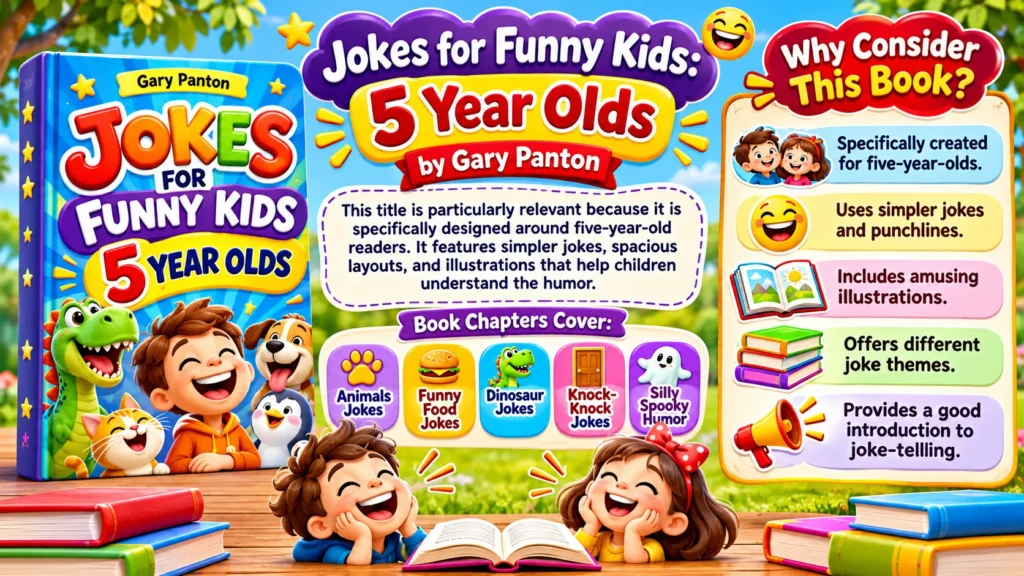
1. Jokes for Funny Kids: 5 Year Olds by Gary Panton
This title is particularly relevant because it is specifically designed around five-year-old readers. It features simpler jokes, spacious layouts, and illustrations that help children understand the humor. Its chapters cover subjects such as animals, funny food, dinosaurs, knock-knock jokes, and silly spooky humor.
Why consider this book?
- Specifically created for five-year-olds.
- Uses simpler jokes and punchlines.
- Includes amusing illustrations.
- Offers different joke themes.
- Provides a good introduction to joke-telling.
2. Funniest Illustrated Jokes for Kids! by Jeremy Nguyen
This book is a useful option for children who enjoy pictures alongside their jokes. Its illustrated format helps young readers understand wordplay, funny situations, and unexpected punchlines. The collection includes knock-knock jokes, silly puns, and clean humor.
Why consider this book?
- Recommended for ages five to seven.
- Includes funny illustrations.
- Features simple and family-friendly humor.
- Introduces different types of jokes.
- Encourages children to experiment with writing and drawing jokes.
3. Knock-Knock Jokes and Silly Stories for Kids
This collection combines traditional knock-knock jokes with silly stories. Its short joke format makes it an interesting choice for children who enjoy repeating punchlines and sharing jokes with family members. The illustrations also help younger readers follow the funny situations.
Why consider this book?
- Suitable for children aged five and older.
- Includes hundreds of jokes and silly stories.
- Offers illustrated content.
- Provides short reading activities.
- Works well for shared reading with parents.
4. Hot Dogs and Dinosnores by Amanda Li
Children who love animals may enjoy this collection of animal-themed jokes. It uses familiar creatures and playful word combinations to create memorable punchlines. The jokes are designed to be easy to read and remember, making the book suitable for beginner readers.
Why consider this book?
- Focuses on funny animal jokes.
- Uses accessible wordplay.
- Suitable for ages five to seven.
- Offers short jokes children can repeat.
- Makes a fun choice for animal-loving kids.
5. Elmo and Ernie’s Joke Book
For younger children who enjoy familiar Sesame Street characters, this is another option to explore. It features simple jokes involving animals, fish, elephants, and knock-knock humor. The familiar characters and visual style make it suitable for reading together with a parent or caregiver.
Why consider this book?
- Designed for very young readers.
- Features familiar Sesame Street characters.
- Includes animal jokes and knock-knock jokes.
- Uses visual humor and playful word combinations.
- Suitable for shared reading.
Note: Some popular joke collections are aimed at ages six to nine rather than five. For example, Highlights’ Best Kids’ Jokes Ever! Volume 1 is officially listed for ages six to nine, so it may be better suited to a slightly older child or a five-year-old enjoying jokes with adult help.
Jump into Other Related Article
- Bull Joke | Funny Bull Jokes, the Young and Old Bull Story, and More
- Bagel Jokes | Funny Bagel Puns, Dad Jokes, and One-Liners
- BBQ Jokes | Funny Barbecue Jokes, Grilling Puns, and Dad Jokes
Funny Joke Categories That Five-Year-Olds Enjoy
Not every child laughs at the same type of humor. Some love animal sounds, others enjoy silly food combinations, and many find simple knock-knock jokes especially entertaining. Offering different joke styles helps children discover what makes them laugh and gives them more opportunities to share jokes with others.
A good collection should include a mixture of short questions, unexpected answers, rhyming words, and familiar situations. Parents can also encourage children to invent their own punchlines instead of simply memorizing jokes. Here are some popular categories worth including in a joke book for young children.
Animal Jokes
Animal jokes are easy to understand because children already recognize many animals and their sounds. These jokes use familiar creatures in silly situations.
- What do you call a sleeping dinosaur? A dino-snore!
- Why did the cow go to school? To improve its moo-sic skills!
- What is a rabbit’s favorite music? Hip-hop!
- Why did the duck bring a pencil? To draw its quack-tions!
- What do you call a bear with no teeth? A gummy bear!
- Why did the frog take a bus? Its car had a frog in the engine!
- What do cats eat for breakfast? Mice Krispies!
- Why did the chicken sit on the clock? It wanted to be on time!
- What is a dog’s favorite subject? Bark-itecture!
- Why did the elephant bring a suitcase? It was going on a trunk trip!
Food Jokes
Food jokes turn everyday meals into funny conversations. Children often enjoy jokes about bananas, pizza, cookies, and vegetables because these subjects are familiar.
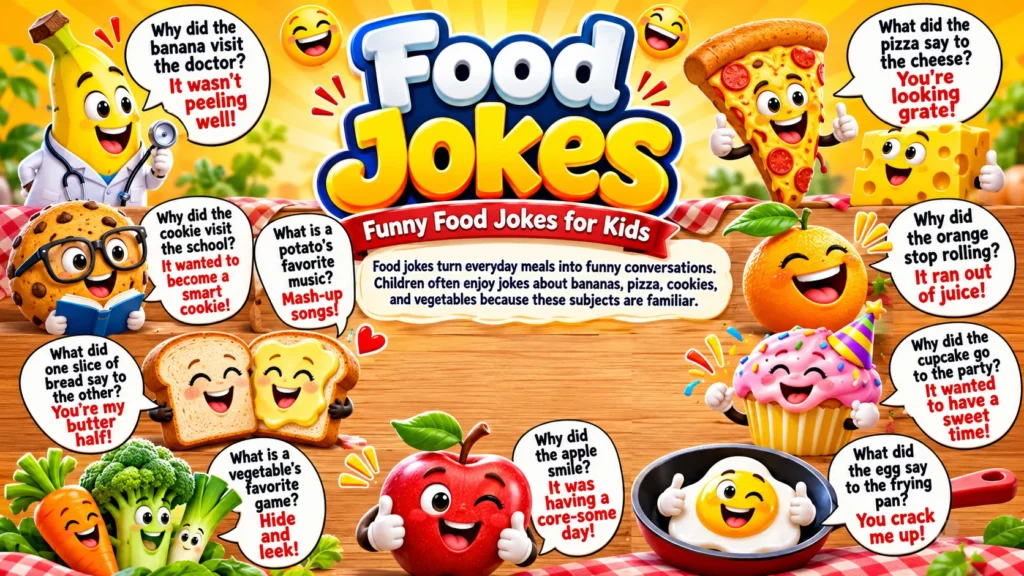
- Why did the banana visit the doctor? It wasn’t peeling well!
- What did the pizza say to the cheese? You’re looking grate!
- Why did the cookie visit the school? It wanted to become a smart cookie!
- What is a potato’s favorite music? Mash-up songs!
- Why did the orange stop rolling? It ran out of juice!
- What did one slice of bread say to the other? You’re my butter half!
- Why did the cupcake go to the party? It wanted to have a sweet time!
- What is a vegetable’s favorite game? Hide and leek!
- Why did the apple smile? It was having a core-some day!
- What did the egg say to the frying pan? You crack me up!
Knock-Knock Jokes
Knock-knock jokes are especially enjoyable because children can participate by repeating the same questions and waiting for the answer. Their predictable structure makes them easy to remember and share. Parents can also pause before the punchline and let children guess what comes next.
- Knock, knock! Who’s there? Boo! Boo who? Don’t cry, it’s only a joke!
- Knock, knock! Who’s there? Lettuce! Lettuce who? Lettuce in, it’s cold outside!
- Knock, knock! Who’s there? Cow says! Cow says who? No, a cow says moo!
- Knock, knock! Who’s there? Tank! Tank who? You’re welcome!
- Knock, knock! Who’s there? Harry! Harry who? Harry up and open the door!
- Knock, knock! Who’s there? Olive! Olive who? Olive you!
- Knock, knock! Who’s there? Donut! Donut who? Donut forget to smile!
- Knock, knock! Who’s there? Annie! Annie who? Annie body home?
- Knock, knock! Who’s there? Bee! Bee who? Bee happy today!
- Knock, knock! Who’s there? Peas! Peas who? Peas open the door!
School Jokes
School jokes are a great choice for children who enjoy talking about teachers, classrooms, crayons, books, and playground activities. These jokes make familiar school experiences feel a little more entertaining. They can also be shared during breaks or with parents after school.
- Why did the pencil go to school? To get a little sharper!
- What is a teacher’s favorite nation? Expla-nation!
- Why did the book look so happy? It had a great story to tell!
- What did the crayon say to the paper? You color my world!
- Why did the student bring a ladder? To reach the high grades!
- What is a classroom’s favorite animal? A school fish!
- Why was the math book sad? It had too many problems!
- What did the eraser say to the pencil? Don’t worry, I can fix your mistakes!
- Why did the ruler become famous? It knew how to measure up!
- What do you call a funny student? A class clown!
Dinosaur Jokes
Dinosaurs are fascinating to many young children, especially those who enjoy learning their names and imagining prehistoric adventures. Dinosaur jokes combine that excitement with silly wordplay. They are also useful for making reading time more interactive because children can act out dinosaur sounds while telling the jokes.
- What do you call a dinosaur that sleeps all day? A dino-snore!
- Why can’t you hear a dinosaur using the bathroom? Because the P is silent!
- What do dinosaurs use to build houses? Dino-saws!
- Why did the T. rex cross the playground? To get to the other slide!
- What is a dinosaur’s favorite snack? Dino-nuggets!
- Why did the dinosaur bring an umbrella? It heard there was a meteor shower!
- What do you call a dinosaur who tells stories? A dino-narrator!
- Why did the dinosaur sit on its homework? It wanted to make an impression!
- What is a dinosaur’s favorite number? Dino-eight!
- Why did the baby dinosaur laugh? Someone told it a roaring joke!
Birthday and Party Jokes
Birthday celebrations give children plenty of reasons to laugh. Jokes about cakes, balloons, presents, and candles are easy to understand and work well during family parties. They can also be written inside birthday cards or used as playful conversation starters.
- Why did the birthday cake visit the doctor? It was feeling crumby!
- What did the balloon say to the birthday boy? Have an uplifting day!
- Why did the candles go to school? They wanted to become brighter!
- What is a birthday cake’s favorite dance? The slice shuffle!
- Why did the present arrive early? It couldn’t contain its excitement!
- What do you give a sleepy birthday cake? A little rest and frosting!
- Why was the birthday party so loud? Everyone was having a ball!
- What did the birthday hat say? I’m on top of the celebration!
- Why did the cupcake get invited? It was sweet company!
- What is the best birthday present for a joke lover? A box full of giggles!
How to Choose the Right Joke Book for Your Five-Year-Old
Choosing a suitable book requires a little more thought than simply picking the one with the most jokes. Children develop reading and language skills at different speeds, so a book that one five-year-old enjoys independently may be easier for another child to enjoy with help. Think about the child’s interests, attention span, and familiarity with simple wordplay before making a purchase.
A good book should feel entertaining rather than like another reading assignment. It should give children opportunities to laugh, guess answers, and tell jokes in their own words. Parents can also look through a few sample pages to see whether the humor is understandable and appropriate.
Consider these factors when comparing different collections:
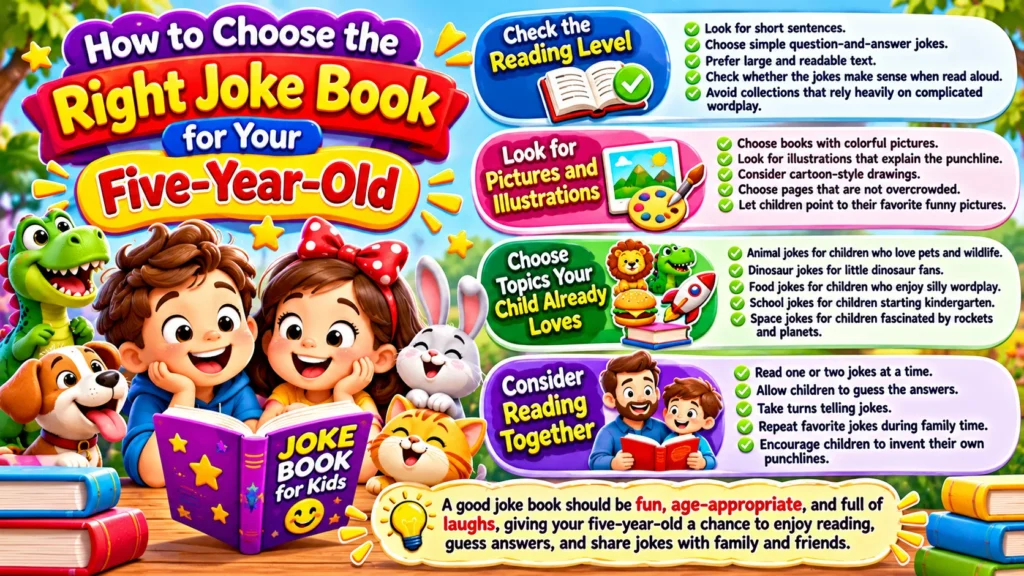
Check the Reading Level
A five-year-old may recognize many words but still need assistance with longer sentences. Choose books with short questions, familiar vocabulary, and clearly presented answers.
- Look for short sentences.
- Choose simple question-and-answer jokes.
- Prefer large and readable text.
- Check whether the jokes make sense when read aloud.
- Avoid collections that rely heavily on complicated wordplay.
Look for Pictures and Illustrations
Pictures can make jokes easier to understand, particularly when the punchline involves an unfamiliar object or situation. They also give children something interesting to look at while listening to an adult read.
- Choose books with colorful pictures.
- Look for illustrations that explain the punchline.
- Consider cartoon-style drawings.
- Choose pages that are not overcrowded.
- Let children point to their favorite funny pictures.
Choose Topics Your Child Already Loves
A child who loves animals may enjoy animal jokes more than jokes about computers or school. Choosing familiar subjects can make punchlines easier to understand and encourage children to tell jokes themselves.
- Animal jokes for children who love pets and wildlife.
- Dinosaur jokes for little dinosaur fans.
- Food jokes for children who enjoy silly wordplay.
- School jokes for children starting kindergarten.
- Space jokes for children fascinated by rockets and planets.
Consider Reading Together
Reading jokes together can turn a simple book into a fun family activity. Adults can demonstrate how to pause before a punchline, use funny voices, and encourage children to guess the answer. This approach is particularly useful when a joke contains a word or phrase that the child has not encountered before.
- Read one or two jokes at a time.
- Allow children to guess the answers.
- Take turns telling jokes.
- Repeat favorite jokes during family time.
- Encourage children to invent their own punchlines.
Fun Ways to Use a Joke Book at Home
A joke book can become more than something children read occasionally. It can be part of a family game, a bedtime activity, a rainy-day entertainment plan, or a fun way to practice speaking confidently. Children often enjoy telling the same joke several times because they like seeing how different people react to the punchline.
You do not need special equipment or a complicated activity to make joke time enjoyable. A few minutes of playful conversation can be enough to encourage children to participate. The following activities offer simple ways to bring humor into everyday family routines.
Start a Daily Joke Challenge
Choose one joke every day and invite your child to share it with someone at home. Keep the activity relaxed so it feels like play rather than homework.
- Pick a new joke after breakfast.
- Let your child choose the funniest joke.
- Take turns reading the punchline.
- Ask everyone to rate the joke with a smile.
- Repeat favorite jokes at the weekend.
Create a Family Joke Contest
A family joke contest gives children a chance to become the entertainer. Each person can share a joke, act out a funny situation, or invent a silly question. The goal should be participation and laughter rather than deciding who is the best comedian.
- Give everyone a turn.
- Allow children to use funny voices.
- Include animal sounds and silly expressions.
- Let parents share their favorite childhood jokes.
- Celebrate creative answers, even when they are unexpected.
Make a Homemade Joke Book
Children can create their own little joke collection using paper, crayons, stickers, and drawings. An adult can write down the jokes while the child contributes pictures or ideas. This activity can help turn a simple interest in humor into a creative project.
- Choose a small notebook.
- Give the joke book a funny title.
- Write down favorite family jokes.
- Draw pictures beside each punchline.
- Add a new joke whenever someone invents one.
Why Joke Books Are Great for Family Reading Time
A joke book can make reading feel like an enjoyable game rather than a task. Children get to hear new words, recognize familiar patterns, and discover how a surprising answer can change the meaning of a question. Sharing jokes also gives parents and children an easy activity they can enjoy together without screens or complicated preparation. Some children may become more confident when they get an opportunity to tell a joke and make someone smile. The most important thing is to keep the experience playful and choose jokes that match the child’s interests and understanding.
Benefits of Sharing Jokes With Young Children
- Vocabulary practice: Children encounter new words and expressions.
- Listening skills: They learn to listen carefully to questions and answers.
- Creative thinking: They explore unexpected meanings and funny situations.
- Speaking confidence: Telling a joke gives children an opportunity to speak in front of others.
- Family interaction: Parents and children enjoy an activity together.
- Reading enjoyment: Funny content can make children more interested in books.
- Memory practice: Repeating favorite jokes helps children remember words and punchlines.
- Imagination: Silly situations encourage children to think creatively.
Funny Books and Silly Poems Beyond Traditional Joke Collections
Sometimes, a five-year-old may enjoy funny poems, silly stories, and interactive picture books just as much as traditional joke collections. These books provide different ways to experience humor through rhyming words, unexpected characters, playful storytelling, and ridiculous situations. Parents looking for additional reading ideas can explore humorous children’s literature alongside dedicated joke books.
For example, a discussion in the UK Parenting community about funny books for a five-year-old included suggestions such as Silly Verse for Kids by Spike Milligan and Ha Ha Bonk by Alan Ahlberg. These are examples of funny reading beyond conventional joke collections.
Other Funny Reading Ideas
- Silly poetry collections.
- Funny animal picture books.
- Interactive books with surprising choices.
- Illustrated joke collections.
- Rhyming stories with humorous endings.
- Short books featuring playful characters.
- Books with knock-knock jokes.
- Funny dinosaur and monster stories.
Conclusion
Finding the right joke book for 5 year olds can turn ordinary reading time into an exciting opportunity for laughter, imagination, and family fun. Books featuring simple punchlines, colorful illustrations, animal jokes, knock-knock questions, and silly stories are excellent starting points for young children. Titles such as Jokes for Funny Kids: 5 Year Olds, Funniest Illustrated Jokes for Kids!, and Knock-Knock Jokes and Silly Stories for Kids offer different approaches to introducing children to humor. The best choice is always one that matches the child’s reading ability, interests, and personality.
Whether your little one enjoys telling dinosaur jokes, solving silly riddles, or making up funny answers, a good joke collection can provide plenty of entertaining moments. Read together, take turns sharing punchlines, and encourage your child to create original jokes along the way. Most importantly, make laughter a natural part of family reading time and let every funny moment become another happy memory.
1. What is the best joke book for a 5-year-old?
Jokes for Funny Kids: 5 Year Olds by Gary Panton is a particularly relevant option because it is specifically created for this age group. Funniest Illustrated Jokes for Kids! by Jeremy Nguyen is another option, recommended for children aged five to seven.
2. Are joke books suitable for kindergarten children?
Yes. Simple joke books can be enjoyable for kindergarten children, especially when they contain familiar words, short sentences, colorful illustrations, and easy punchlines. Reading together with an adult can make more complicated jokes easier to understand.
3. What types of jokes do five-year-olds enjoy?
Many five-year-olds enjoy animal jokes, food jokes, knock-knock jokes, dinosaur jokes, and silly question-and-answer jokes. Familiar subjects and unexpected answers often make these jokes entertaining.
4. Should a five-year-old read joke books independently?
It depends on the child’s reading ability. Some five-year-olds can enjoy simple joke books independently, while others benefit from having a parent read the jokes aloud and explain unfamiliar words.
5. Are illustrated joke books better for young children?
Illustrated joke books can be particularly helpful because pictures provide visual clues and make funny situations easier to understand. However, children who enjoy listening to jokes may also appreciate books with fewer illustrations.
6. How many jokes should a five-year-old read each day?
There is no required number. A few jokes during reading time can be enough to keep the activity enjoyable. Let the child decide whether to continue rather than turning joke reading into a daily requirement.
7. What are good alternatives to traditional joke books?
Funny poetry, silly picture books, humorous stories, and interactive children’s books are good alternatives. They introduce humor through rhymes, characters, surprising situations, and playful language.
8. Can joke books help children enjoy reading?
They can make reading more enjoyable by introducing short, entertaining content. Children may become interested in reading more when they discover books that match their interests and sense of humor.
9. What makes a joke too difficult for a five-year-old?
Jokes involving complicated vocabulary, unfamiliar cultural references, or several layers of wordplay may be difficult for some five-year-olds. Simple setups and clear punchlines are usually easier to understand.
10. What should parents look for when buying a joke book?
Parents should check the recommended age, reading level, illustrations, joke topics, and overall content. Previewing a few pages is a useful way to decide whether the collection matches the child’s interests.