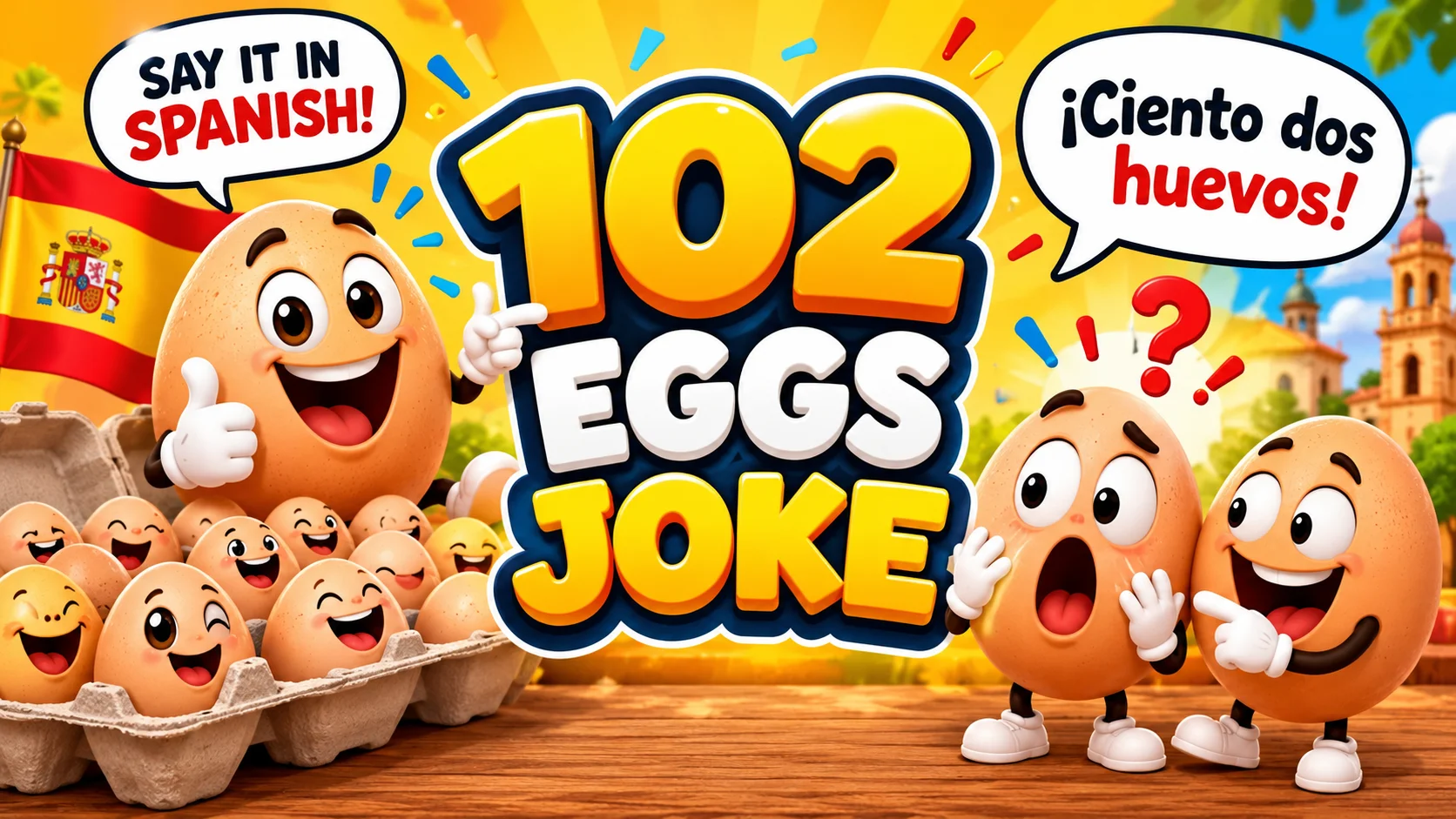
The 102 eggs joke meaning comes from a simple Spanish wordplay that turns an ordinary number into a cheeky joke. If someone asks, How do you say 102 eggs in Spanish?the normal answer is ciento dos huevos.On its own, that simply means one hundred two eggs.The joke appears when the phrase is spoken aloud because ciento doscan sound like siento dos,which means I feel two.SpanishDictionary specifically notes this sound-based joke and gives the slang interpretation of huevos as balls/testicles.
The joke became especially visible online through social-media videos and posts where people were asked to translate 102 eggswithout being told why the number was funny. A 2024 report on the TikTok trend described creators asking people to say the phrase aloud before they realized the alternate meaning. The humor therefore depends on pronunciation, Spanish vocabulary, and slang, rather than on the number 102 having any special meaning by itself.
What Is the 102 Eggs Joke Meaning?
The basic 102 eggs joke is a phonetic joke. In standard Spanish, 102 eggsis ciento dos huevos. The word ciento means one hundred,dos means two,and huevos means eggs.Spanish translation resources give this exact construction for 102 eggs.
When spoken aloud, however, ciento dos huevos can be heard as siento dos huevos. Here, siento comes from the verb sentir and means I feel.Since huevos can also be used as vulgar slang for testicles, the phrase becomes a crude double meaning: roughly, I feel two balls/testicles.
The Joke Broken Down
- 102 = one hundred two.
- Ciento = one hundred.
- Dos = two.
- Huevos = eggs.
- Ciento dos huevos = 102 eggs.
- Siento = I feel.
- Siento dos huevos = I feel two eggs.
- In slang, huevos can refer to testicles.
- That creates the cheeky interpretation I feel two testicles.
- The joke depends on how the words sound when spoken.
- The spelling is different between ciento and siento.
- The pronunciation can make the difference difficult to notice.
- The literal sentence is completely ordinary.
- The alternate sentence is deliberately suggestive.
- That contrast creates the punchline.
102 Eggs in Spanish Joke Meaning
The phrase 102 eggs in Spanish joke meaning is easiest to understand by separating the literal translation from the hidden wordplay. If someone genuinely wanted to order 102 eggs, they could use ciento dos huevos. There is nothing inherently humorous about the literal phrase.
The joke begins because ciento and siento are close enough in pronunciation to create a different interpretation. SpanishDictionary’s usage note directly connects 102 eggswith ciento dos huevos and the similar-sounding siento dos huevos.
Literal vs. Joke Meaning
- English: 102 eggs.
- Spanish: ciento dos huevos.
- Ciento: one hundred.
- Dos: two.
- Huevos: eggs.
- Literal meaning: one hundred two eggs.
- Alternative opening: siento.
- Siento: I feel.
- Dos: two.
- Huevos: eggs or, in vulgar slang, testicles.
- Alternative reading: I feel two eggs.
- Crude reading: I feel two testicles.
- The number itself is not dirty.
- The humor comes from the sound similarity.
- The joke is therefore linguistic rather than mathematical.
Why the Translation Sounds Funny
- Ciento and siento are spelled differently.
- Their sounds can be extremely similar.
- The difference becomes less obvious when spoken quickly.
- The following words remain the same.
- Dos huevos means two eggs.
- Huevos has a vulgar slang meaning in addition to its food meaning.
- The listener initially expects a normal translation.
- The speaker knows there is a second interpretation.
- That creates a surprise.
- The surprise is the main comedic device.
- People unfamiliar with Spanish may miss the joke completely.
- Spanish speakers may recognize the sound-based pun more quickly.
- Accent can affect how obvious the pun sounds.
- Context also influences whether the phrase sounds innocent or suggestive.
- That is why saying the phrase aloud is important to the joke.
Why Is 102 Eggs Funny in Spanish?
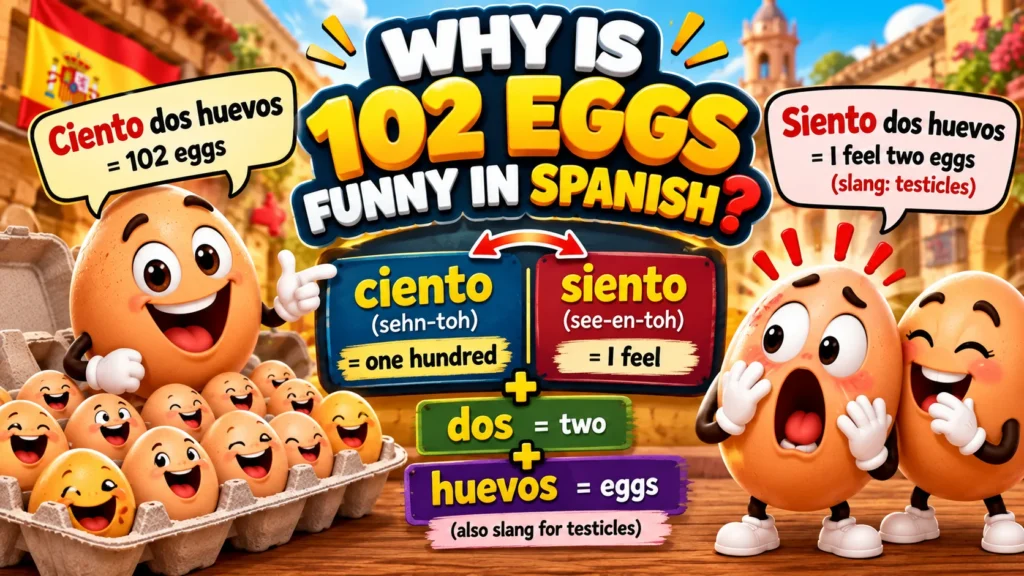
The 102 eggs joke meaning in Spanish depends on a phenomenon called homophony or near-homophony, where differently spelled words or phrases sound the same or very similar. The joke uses ciento and siento.
There is also a pronunciation detail behind the joke. In many Spanish-speaking regions, particularly much of Latin America, the c in ciento before i is pronounced like an s. This pronunciation pattern is commonly associated with seseo, making ciento and siento sound especially close. A discussion of the viral joke also shows Spanish speakers debating how the pronunciation varies between regions, including differences within Spain.
Spanish Words Behind the Punchline
- Ciento means one hundred.
- Siento means I feel.
- Dos means two.
- Huevo means egg.
- Huevos means eggs.
- Huevos can also have a vulgar anatomical meaning.
- Ciento dos is the correct number phrase for 102.
- Siento dos creates the alternate sound.
- The two phrases have different meanings.
- Their similarity exists mainly in speech.
- The joke becomes clearer when said aloud.
- Spelling alone does not reveal the punchline.
- The final word huevos adds the adult humor.
- Without huevos, the joke loses much of its crude twist.
- Without the ciento/siento similarity, the wordplay disappears.
102 Eggs Joke Meaning in Spanish Explained Simply
If you are searching 102 eggs joke meaning in Spanish, the easiest explanation is this:
102 eggs= ciento dos huevos.
When said aloud, that can sound like:
siento dos huevos.
The first phrase means 102 eggs.The second can be understood literally as I feel two eggs,but because huevos is also used as vulgar slang for testicles, the joke is usually interpreted as I feel two balls/testicles.Spanish-language translation resources explicitly document this double meaning.
Quick Explanation of the 102 Eggs Joke
- Someone asks, How do you say 102 eggs in Spanish?
- The expected answer is ciento dos huevos.
- The speaker asks the person to repeat it.
- The phrase is heard aloud.
- Cientosounds like siento.
- Sientomeans I feel.
- Dosmeans two.
- Huevosliterally means eggs.
- Huevoscan also be vulgar slang.
- The listener suddenly hears the hidden sentence.
- The innocent translation becomes a crude joke.
- The number 102 is only useful because of the sound.
- 101 or 103 do not create exactly the same wordplay.
- The joke is therefore pronunciation-based.
- That is the complete trick.
102 Eggs Joke Meaning Urban Dictionary
People also search for 102 eggs joke meaning Urban Dictionary because Urban Dictionary is commonly associated with explanations of slang and internet jokes. However, an exact Urban Dictionary entry for this specific 102 eggs joke was not found in the current search results.
That does not change the basic explanation. The slang element of the joke is supported by Spanish-language translation resources, which identify huevos as a vulgar expression that can refer to testicles. So it is more accurate to describe the joke as a Spanish phonetic pun involving slang rather than claim that a particular Urban Dictionary page is the definitive source.
What the Urban Dictionary Search Usually Points Toward
- The search is generally about slang rather than formal Spanish grammar.
- Huevos is the important slang word.
- Its literal meaning is eggs.
- Its vulgar meaning can refer to testicles.
- The number phrase itself is not slang.
- Ciento dos is an ordinary Spanish number.
- Siento dos creates the alternative interpretation.
- The humor appears when the phrases are spoken.
- The joke is often shared as a prank.
- Beginners in Spanish can be especially easy targets for the setup.
- The speaker may ask someone to translate the phrase.
- The person repeats the phrase without knowing the punchline.
- The other person then points out the sound similarity.
- Online communities often explain the joke using ballsas the English equivalent.
- The exact level of vulgarity depends on audience and context.
Jump into Other Related Article
- Mosquito Joke | Funny Mosquito Jokes, Puns, Dad Jokes & One-Liners
- 6 7 Joke | Meaning, Origin, Classic 6-7 Meme, and South Park Explained
102 Eggs Joke Meaning Spanish: Why Pronunciation Matters
The phrase 102 eggs joke meaning Spanish cannot be fully understood by looking only at the written translation. The joke is designed to be heard. When a person reads ciento dos huevos, the distinction between ciento and siento is visible immediately. When the phrase is spoken, however, the difference can become much less obvious.
This is why many versions of the joke tell the target to say 102 eggs in Spanish out loud. A written answer gives away less of the trick, while speaking creates the phonetic effect.
Pronunciation Features That Make the Joke Work
- The phrase contains three key words: ciento, dos, and huevos.
- Ciento is the correct word for the one hundredpart of 102.
- Siento is a different word with a different meaning.
- The words can sound very similar in many accents.
- The similarity is especially noticeable with seseo pronunciation.
- The difference is easier to see in writing than in speech.
- Saying the phrase quickly can make the pun more effective.
- Saying it slowly can make the spelling difference easier to notice.
- Regional accents can change how obvious the joke sounds.
- Latin American pronunciation often makes the similarity particularly straightforward.
- Some Spanish speakers may not find the pun equally convincing.
- Spanish speakers from different regions can perceive the phrase differently.
- The joke does not depend on everyone pronouncing the words identically.
- It depends on enough listeners recognizing the sound relationship.
- That makes it a good example of language-based humor.
Funny 102 Eggs Joke Variations
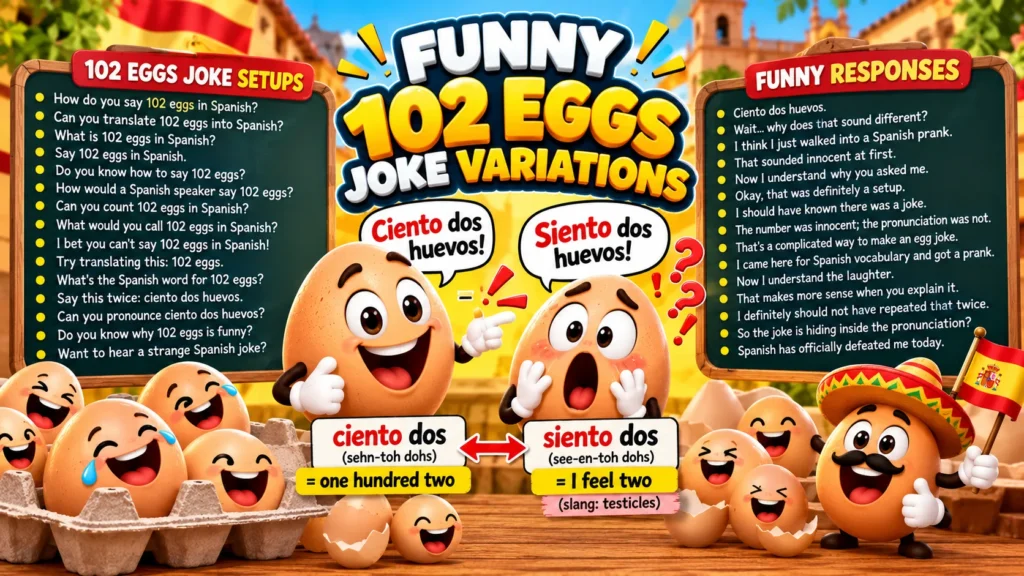
The original joke can be presented in several ways. Some versions ask directly for the translation, while others create a fake language-learning situation. The underlying wordplay remains the same.
102 Eggs Joke Setups
- How do you say 102 eggs in Spanish?
- Can you translate 102 eggs into Spanish?
- What is 102 eggs in Spanish?
- Say 102 eggs in Spanish.
- Do you know how to say 102 eggs in Spanish?
- How would a Spanish speaker say 102 eggs?
- Can you count 102 eggs in Spanish?
- What would you call 102 eggs in Spanish?
- I bet you can’t say 102 eggs in Spanish.
- Try translating this: 102 eggs.
- What’s the Spanish word for 102 eggs?
- Say this Spanish phrase twice: ciento dos huevos.
- Can you pronounce ciento dos huevos?
- Do you know why 102 eggs is funny in Spanish?
- Want to hear a strange Spanish joke involving 102 eggs?
Funny Responses to the 102 Eggs Joke
- Ciento dos huevos.
- Wait… why does that sound different when I say it aloud?
- I think I just walked into a Spanish prank.
- That sounded innocent until you explained it.
- Now I understand why you asked me to repeat it.
- Okay, that was definitely a setup.
- I should have known there was a joke coming.
- The number was innocent; the pronunciation was not.
- That is a surprisingly complicated way to make an egg joke.
- I came here for Spanish vocabulary and got a prank instead.
- Now I understand the laughter.
- That makes much more sense when you explain the Spanish.
- I definitely should not have repeated that twice.
- So the joke is hiding inside the pronunciation?
- Spanish has officially defeated me today.
Is the 102 Eggs Joke Actually Correct Spanish?
Yes, ciento dos huevos is a legitimate way to say 102 eggsin Spanish. The joke does not depend on using incorrect grammar. In Spanish, cien is used for exactly 100, while ciento is used when the number continues beyond 100, such as 102. Translation resources give ciento dos huevos as the standard translation.
The funny part is what the correct phrase happens to resemble when spoken. In other words, the prank works precisely because the person is usually saying the correct Spanish phrase.
Spanish Grammar Behind 102 Eggs
- 100 eggs = cien huevos.
- 101 eggs = ciento un huevos.
- 102 eggs = ciento dos huevos.
- 103 eggs = ciento tres huevos.
- 104 eggs = ciento cuatro huevos.
- 105 eggs = ciento cinco huevos.
- 106 eggs = ciento seis huevos.
- 107 eggs = ciento siete huevos.
- 108 eggs = ciento ocho huevos.
- 109 eggs = ciento nueve huevos.
- 110 eggs = ciento diez huevos.
- 120 eggs = ciento veinte huevos.
- 150 eggs = ciento cincuenta huevos.
- 199 eggs = ciento noventa y nueve huevos.
- 200 eggs = doscientos huevos.
Why the Joke Became an Online Trend
The 102 eggs joke gained renewed attention through short-form social media, where creators could ask someone to translate the phrase on camera and capture their reaction. A February 2024 report described a TikTok video built around exactly this setup, noting millions of views and hundreds of thousands of likes at the time of publication.
Reddit discussions from the same period also show people explaining the joke to users who did not understand why 102 eggswas funny. One discussion specifically breaks down ciento dos huevos and its similarity to siento dos huevos, while commenters also discuss regional pronunciation differences.
Why People Share the Joke
- It is short.
- The setup is easy to remember.
- The listener can participate.
- The punchline depends on pronunciation.
- It works well in videos.
- It creates genuine reactions.
- People unfamiliar with Spanish may not expect the wordplay.
- Spanish learners may recognize the vocabulary.
- The number 102 makes the setup specific.
- The phrase sounds like a normal translation question.
- The joke can be explained quickly afterward.
- It works as a language-learning prank.
- It can be written as a meme.
- It can be used in a short video.
- It encourages people to repeat the phrase aloud.
Conclusion
The 102 eggs joke meaning is ultimately a clever piece of Spanish wordplay rather than a mysterious meaning attached to the number 102. The correct Spanish phrase is ciento dos huevos, meaning 102 eggs.When spoken aloud, however, it can resemble siento dos huevos, creating the humorous alternative I feel two eggs.Since huevos can also be used as vulgar slang for testicles, the innocent translation suddenly becomes a cheeky joke.
The reason this joke works so well online is that the target usually gives the correct answer without realizing the hidden pun. Social-media videos and online discussions have helped spread the format, particularly among people learning or practicing Spanish. If you understand the difference between ciento and siento, the meaning becomes straightforward: one is the number word used in 102, while the other means I feel.The humor comes entirely from the sound similarity and the double meaning of huevos.
1. What is the 102 eggs joke meaning?
The 102 eggs joke meaning comes from the Spanish phrase ciento dos huevos, meaning 102 eggs.When spoken, it can sound like siento dos huevos, which means I feel two eggs.Because huevos can also be vulgar slang for testicles, the phrase gets a cheeky second meaning.
2. What is 102 eggs in Spanish?
102 eggsin Spanish is ciento dos huevos. Ciento means one hundred, dos means two, and huevos means eggs. The phrase is grammatically ordinary; the joke comes from how it sounds when spoken.
3. Why is 102 eggs funny in Spanish?
It is funny because ciento dos huevos can sound like siento dos huevos. The first phrase means 102 eggs,while the second can be understood as I feel two eggs.Because huevos has a vulgar slang meaning, the joke takes on an adult interpretation.
4. Does ciento dos huevosreally mean I feel two balls?
Literally, ciento dos huevos means 102 eggs,not I feel two balls.The second meaning comes from the similar-sounding phrase siento dos huevos, where siento means I feeland huevos can be slang for testicles. It is therefore a phonetic joke, not the literal translation.
5. Is the 102 eggs joke appropriate for everyone?
The literal Spanish phrase is completely ordinary, but the joke’s hidden interpretation is vulgar or suggestive. It is therefore better treated as adult or mature humor when the slang meaning is intended. A clean explanation can simply discuss the pronunciation and the literal meanings without using the crude interpretation.