The Boston Tea Party joke is a type of history-based humor that turns the famous 1773 protest into playful jokes about tea, taxes, ships, Boston Harbor, rebellion, and the phrase spill the tea. The historical event happened on December 16, 1773, when colonists boarded East India Company ships and dumped 342 chests of tea into Boston Harbor. The protest was connected to resistance against British taxation and the East India Company’s special position in the tea trade.
Because the event combines an ordinary drink with a dramatic political protest, it naturally creates opportunities for wordplay. Modern jokes often focus on the contrast between a peaceful cup of tea and the very unpeaceful decision to throw hundreds of tea chests into a harbor. Other versions use puns involving steep, brew, spill the tea, harbor, party, and revolution.
The keyword Boston Tea Party joke can therefore refer to several kinds of humor, including short one-liners, classroom jokes, historical puns, social-media captions, dad jokes, and jokes explaining why the event was called a party despite not being an ordinary party. Online joke collections currently feature multiple versions built around these themes.
The Classic Boston Tea Party Joke
A simple Boston Tea Party joke usually takes one recognizable historical fact and gives it an unexpected punchline. The strongest versions do not require a detailed history lesson because the audience already understands that the party involved throwing tea into the harbor.
Here is an original, family-friendly version:
Why was the Boston Tea Party such a terrible tea party?
Because nobody remembered to serve the tea they just served it to the harbor.
Another version:
The colonists invited everyone to a tea party.
The British expected tea cups.
The colonists brought ships, crates, and a very different definition of steeping.
The humor works because the phrase tea party normally suggests cups, snacks, conversation, and polite behavior. The historical event reverses that expectation completely. Instead of drinking tea, protesters destroyed the tea cargo as an act of resistance.
Modern joke collections use similar contrasts. JokoJokes, for example, lists jokes involving the price is too steep, classroom tea jokes, and playful comparisons involving the Boston Tea Party.
Boston Tea Party Joke Meaning and Wordplay
The meaning behind most Boston Tea Party jokes comes from combining historical facts with ordinary tea vocabulary. The joke does not usually depend on a complicated punchline. Instead, it makes a familiar historical event sound like an everyday tea-related situation.

The word party is especially useful because it normally suggests celebration. In this historical context, however, the word refers to a famous protest rather than a casual social gathering. That difference gives comedians an immediate setup.
Tea vocabulary also provides several easy wordplay opportunities. Words such as steep, brew, spill, cup, tea time, and harbor can be connected to the historical event without changing the basic facts.
Another popular expression is spill the tea, which has a modern meaning related to revealing gossip or information. The Boston Tea Party involved literally putting tea into the harbor, making the phrase especially convenient for modern jokes.
15 Boston Tea Party Wordplay Ideas
Here are original joke-friendly wordplay concepts based on the topic:
- Steep protest the colonists had a very steep disagreement.
- Spill the tea Boston took the expression remarkably literally.
- Tea time in Boston, tea time became history time.
- Harbor brew the harbor received the largest unwanted tea delivery.
- Brewed rebellion the revolution was brewing before the tea was.
- Tea trouble one shipment created much bigger problems than expected.
- Cup of resistance the colonists preferred resistance to refreshments.
- Tea overboard the shortest description of the punchline.
- Party crashers the colonists crashed the tea shipment rather than the party.
- Steeping tension political tension had been building for years.
- Tea cargo the punchline can focus on the huge shipment rather than cups.
- Harbor hospitality Boston gave the tea an unusual place to stay.
- Revolutionary refreshments tea became part of a revolutionary story.
- Brewed-up trouble a playful way to describe the growing conflict.
- Not your usual tea party the simplest contrast between the phrase and the event.
These concepts can be used for jokes, captions, classroom activities, history presentations, or social-media posts.
Boston Tea Party History Behind the Joke
Understanding the history makes the humor easier to appreciate. The Boston Tea Party took place on December 16, 1773, after months of disagreement over tea, taxation, trade, and colonial political authority. The Tea Act of 1773 gave the East India Company an important advantage in selling tea in the American colonies, while the tea still carried a tax that many colonists opposed.
The crisis became particularly intense when East India Company tea ships arrived in Boston. Bostonians held large meetings to debate what should happen to the tea. The National Park Service records that thousands gathered at the Old South Meeting House on December 16 before the confrontation reached its decisive point.
That evening, disguised men went to the ships at Griffin’s Wharf and destroyed the tea cargo. The National Park Service records the destruction of 342 chests of tea.
The British government responded with punitive measures that included closing Boston Harbor. Those consequences helped intensify tensions between Britain and the colonies and contributed to the chain of events leading toward the American Revolutionary War.
This historical background creates the basic contrast behind the modern joke: a drink associated with calm conversation became the centerpiece of a major act of political protest.
Boston Tea Party Jokes for Kids and Classrooms
The Boston Tea Party is particularly suitable for clean educational humor because children can understand the basic story while learning vocabulary and historical context. A joke can make the lesson memorable without turning the event into a complicated political argument.
For classroom use, the best jokes are short, simple, and based on recognizable facts. Teachers can use tea puns as warm-up activities before discussing the Tea Act, colonial protests, Boston Harbor, or the events of December 1773.
A classroom joke should also make clear that the historical party was not a normal celebration. The event involved destruction of tea as an act of protest, so humor should not replace the historical explanation.
Here are several original classroom-friendly examples:
- Why did the tea avoid Boston Harbor? Because it heard the harbor had a serious dumping problem.
- What was the colonists’ favorite tea recipe? One part tea and one very large harbor.
- Why did the tea fail its swimming lesson? It never made it back out of the harbor.
- What did the tea say before leaving the ship? This is going to be a steep situation.
- Why was the British tea shipment nervous? It heard Boston had strong opinions about beverages.
- What was the most dramatic tea break in history? The Boston Tea Party.
- Why did the tea bring a life jacket? It had heard rumors about Boston Harbor.
- What did the harbor order at tea time? Everything.
- Why did the tea never get served in a cup? It had already been invited somewhere else.
- What made the Boston Tea Party unusual? The refreshments never reached the table.
- Why did the tea get a history-book career? It made a very memorable splash.
- What kind of tea makes history? Boston tea.
- Why did the tea shipment need directions? Its final destination was unexpectedly wet.
- Why was the tea party unforgettable? Nobody actually drank the tea.
- Why did the harbor become famous? It received a very large tea delivery.
These jokes can work as quick classroom openers while still leaving room for the actual history lesson.
Funny Boston Tea Party Puns
Boston Tea Party puns usually work best when they combine a historical reference with familiar tea language. This makes them easy to understand even for people who are not history experts.
The phrase too steep is particularly useful because steep relates directly to preparing tea while also describing something expensive or excessive. The idea of spilling the tea works because the modern expression already has a second meaning connected with gossip.
The word brew can also be connected to the idea that political tension was developing before the actual protest. A joke can therefore describe the political situation as something brewing.
Here are more original Boston Tea Party puns:
- The colonists had a steep disagreement.
- Boston really knew how to spill the tea.
- That protest was definitely brewing for a while.
- The harbor became the unexpected tea table.
- The tea party had a very wet ending.
- The colonists wanted liberty and got everyone steeped in history.
- Nobody could accuse Boston of keeping the tea under wraps.
- The tea shipment had a rough brew.
- Boston turned tea time into revolution time.
- The tea was definitely overboard with its historical importance.
- The harbor got more tea than the teapot could ever handle.
- That was one steep price for political disagreement.
- The tea did not make it to the cup, but it made it into history.
- Boston’s tea service was definitely outside the box—or the cup.
- The whole event was a brew-tiful disaster for the tea.
Boston Tea Party Joke Variations for Social Media
Social-media versions are usually shorter than traditional jokes. They often use a single historical reference, a modern expression, or an emoji-friendly punchline.
The modern phrase spill the tea is especially useful for captions because many audiences already recognize it. A Boston Tea Party caption can turn that expression into a historical pun without requiring a long setup.
Recent public examples show that Boston Tea Party references continue to appear in modern humor. In 2026, a State Dinner joke made a direct reference to the Boston Tea Party by comparing the dinner favorably with the historical event. The remark was reported as a humorous reference to the 1773 protest.
15 Original Social-Media Boston Tea Party Captions
- Spilling the tea since 1773.
- Tea time took a revolutionary turn.
- Boston understood spill the tea literally.
- Steeped in history, one tea chest at a time.
- The original tea-related plot twist.
- When tea becomes a historical event.
- Boston: serving history, not refreshments.
- A tea party nobody forgot.
- The harbor had one unforgettable delivery.
- Too much tea, too little patience.
- Brewed for rebellion.
- Tea, ships, harbor, history.
- When the tea refuses to stay in the cup.
- History was definitely steeping.
- The original drop the tea moment.
Boston Tea Party Dad Jokes
Dad jokes depend on simple wordplay, predictable setups, and intentionally obvious punchlines. The Boston Tea Party is perfect for this style because the topic already contains words such as party, tea, steep, brew, and spill.
A good dad joke does not need a complicated historical explanation. The audience only needs to recognize the event and understand the wordplay. That makes these jokes suitable for family conversations, history classrooms, trivia nights, and casual social posts.
Here are original examples:
Why did the Boston Tea Party have no refreshments?
Because the refreshments were the protest.
Why was the tea so popular in history class?
Because it really knew how to make a splash.
Why did the tea go to Boston Harbor?
It wanted to become a part of history.
Why was the tea argument so intense?
Things had been steeping for a long time.
Why did Boston become famous for tea?
Because it took tea time to another level.
What did the tea say about the harbor?
I think I’m in deep water.
Why did the tea never reach the teapot?
It had an unexpected change of destination.
Boston Tea Party Joke for History Students
Students can use Boston Tea Party jokes as memorable introductions to presentations, essays, posters, or classroom activities. The joke should support the historical subject instead of replacing the facts.

A strong student presentation can begin with a short pun and then immediately explain what actually happened. This approach makes the opening entertaining while maintaining historical accuracy.
For example:
The Boston Tea Party was the one party where the refreshments never made it to the table.
The presenter can then explain that the event took place on December 16, 1773, and involved the destruction of 342 chests of East India Company tea in Boston Harbor. The National Park Service also notes that thousands of people had gathered at the Old South Meeting House before the action took place.
Students can then connect the joke to the broader historical context. The Tea Act, colonial resistance, taxation disputes, and British responses all provide useful background. The U.S. Department of State’s historical overview describes the tea protest as part of the growing resistance to British parliamentary policies.
This makes the joke more than entertainment: it becomes a memory device for understanding why the event is historically significant.
Boston Tea Party Party Wordplay
The word party creates one of the easiest joke structures around the topic. In everyday English, a party usually involves people gathering for entertainment, food, drinks, music, or celebration.
The Boston Tea Party was fundamentally different. Although people gathered together, the famous event was an organized act of protest involving the destruction of tea cargo. The National Park Service describes the December 16 gathering as a major political confrontation that culminated in the destruction of the tea.
That contrast allows jokes to treat the event like a badly organized social gathering. The punchline can imagine missing cups, absent refreshments, unusual party invitations, or a harbor replacing the dining table.
Original examples include:
- Party invitation: Bring your own cup. Actually, never mind.
- Party menu: Tea, rebellion, and absolutely no refreshments.
- Party location: Boston Harbor, because the kitchen was apparently unavailable.
- Party activity: Throwing the refreshments away.
- Party rule: No tea stays on the ship.
- Party favor: A history lesson.
- Party problem: The tea disappeared before anyone could drink it.
- Party theme: Revolutionary.
- Party dress code: Colonial protester.
- Party cleanup: Ask the harbor.
The humor is strongest when the joke clearly separates the modern meaning of party from the historical meaning of the event.
Boston Tea Party Joke and Spill the Tea Humor
The expression spill the tea has become a major source of modern wordplay. In contemporary informal English, it can mean sharing gossip or revealing interesting information.
The Boston Tea Party provides a literal historical image of tea being spilled or dumped into water. That makes the event particularly compatible with modern tea-related expressions.
A joke can therefore create a two-layer punchline: first the audience recognizes the modern phrase, then they realize the historical reference. The result is a simple bridge between modern internet language and eighteenth-century history.
Examples include:
- Boston did not just spill the tea—it made history with it.
- If Boston had a group chat in 1773, someone definitely spilled the tea.
- The original tea spill was surprisingly revolutionary.
- Boston took spill the tea very seriously.
- Some people gossip; Boston dumped the evidence into a harbor.
- Tea was spilled, but the gossip was political.
- Boston had the hottest tea and the coldest harbor.
- The tea was steeped in controversy before it ever reached the water.
These jokes are particularly effective for social captions because the phrase is already familiar to many modern audiences.
Boston Tea Party Joke History and Online Humor
The Boston Tea Party has been used in humorous contexts for generations, but the modern internet has made the wordplay much easier to share. Joke websites now collect short versions involving tea prices, classroom situations, spill the tea, and comparisons with popular culture.
JokoJokes currently lists several Boston Tea Party jokes, including a classroom joke, a price is too steep pun, and a pop-culture comparison.
Worst Jokes Ever also has a Boston Tea Party category containing user-submitted jokes based on tea, British-American history, and historical references.
The humor has also appeared outside dedicated joke websites. A 2024 U.S. State Department briefing included a Boston Tea Party joke during a discussion involving tea and U.S.-UK relations. In April 2026, a dinner speech by King Charles III included another Boston Tea Party reference, demonstrating that the historical event remains a recognizable source of light humor in contemporary public culture.
This continued use shows why the subject remains searchable: the historical reference is instantly recognizable, while the vocabulary of tea provides an unusually large number of easy puns.
Jump into Other Related Article
- Why Did the Chicken Cross the Road? The Origin, the Meaning and the Game
- Shark Jokes | 60+ Funny Ones for Kids & Adults
- Potato Jokes | 90+ Puns, Riddles and Dad Jokes with Answers
Boston Tea Party Joke Ideas for Memes
Memes usually need very little setup. A historical image combined with a short caption can create the entire joke.
For a Boston Tea Party meme, useful themes include:
- A teacup labeled before 1773.
- A harbor labeled after tea time.
- A colonial character saying This tea is going somewhere.
- A modern coffee drinker asking why nobody simply ordered coffee.
- A teacher saying Today we are learning about the original tea spill.
- A teapot looking horrified at Boston Harbor.
- A ship carrying a warning sign reading Fragile: historical significance.
- A tea bag saying I should have stayed home.
- A history book captioned The tea that made headlines.
- A classroom poster saying Tea + taxes + protest = history.
These concepts can be adapted for Instagram captions, TikTok text overlays, Pinterest graphics, classroom slides, or humorous history posts.
Boston Tea Party Joke Versus Historical Fact
Keeping the joke separate from the history is important because some online versions exaggerate or simplify the event.
| Joke Element | Historical Context |
| Tea was thrown into the harbor | 342 chests of tea were destroyed |
| It happened in Boston | The event occurred at Boston Harbor |
| It was called a party | The name refers to the historical protest, not an ordinary celebration |
| Colonists protested British policies | Resistance involved taxation, trade, representation, and political authority |
| Ships were involved | East India Company tea ships were at the center of the crisis |
| The event happened in 1773 | The destruction took place on December 16, 1773 |
| People gathered beforehand | Thousands gathered at the Old South Meeting House |
| The event had major consequences | Britain responded with punitive measures including closing Boston Harbor |
The National Park Service records that approximately 5,000 people gathered at the Old South Meeting House on December 16, while disguised men later destroyed 342 chests of tea at Griffin’s Wharf.
The U.S. Department of State similarly describes the protest as part of broader colonial resistance to British parliamentary policies and notes the subsequent closure of Boston Harbor.
These facts give joke writers plenty of material without needing to invent historical details.
Short Boston Tea Party One-Liners
Short jokes are useful when the audience wants something quick for a caption, classroom slide, text message, or social-media post.
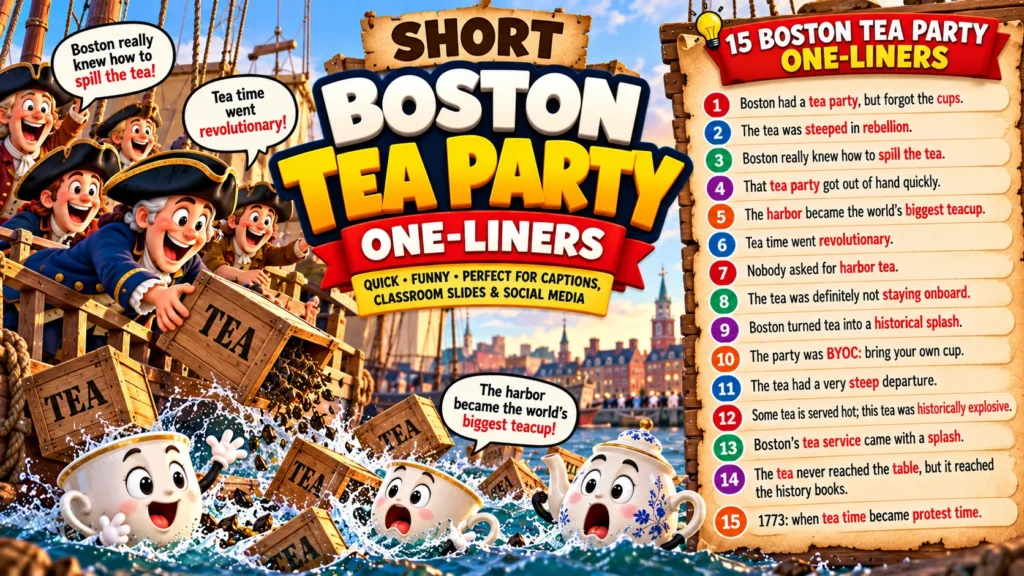
- Boston had a tea party, but forgot the cups.
- The tea was steeped in rebellion.
- Boston really knew how to spill the tea.
- That tea party got out of hand quickly.
- The harbor became the world’s biggest teacup.
- Tea time went revolutionary.
- Nobody asked for harbor tea.
- The tea was definitely not staying onboard.
- Boston turned tea into a historical splash.
- The party was BYOC: bring your own cup.
- The tea had a very steep departure.
- Some tea is served hot; this tea was historically explosive.
- Boston’s tea service came with a splash.
- The tea never reached the table, but it reached the history books.
- 1773: when tea time became protest time.
Conclusion
The Boston Tea Party joke works because the historical event contains several naturally funny contrasts. A tea party normally sounds peaceful and social, yet the famous Boston event involved protest, ships, political conflict, and the destruction of 342 chests of tea.
Tea vocabulary makes the subject even more flexible. Words such as steep, brew, spill, cup, tea time, harbor, and party can all become parts of original jokes and puns.
For children and classrooms, simple jokes can make the historical event easier to remember. For adults and social media, wordplay around spill the tea provides an obvious modern connection. Dad jokes can focus on the party that never actually served refreshments, while history-themed jokes can use the Tea Act, Boston Harbor, and colonial protest as their setup.
The most effective approach is to keep the humor original while maintaining the underlying historical facts. That allows the Boston Tea Party joke to be funny without confusing the real events that inspired it.
What is the Boston Tea Party joke?
The Boston Tea Party joke is humor based on the 1773 Boston Tea Party, especially the contrast between a normal tea party and the historical protest in which tea was dumped into Boston Harbor. Common versions use puns about tea, steeping, spilling, parties, and the harbor.
Why is the Boston Tea Party called a party?
The historical name refers to the famous protest rather than a conventional social celebration. The word party creates a natural source of humor because modern readers normally associate a party with food, drinks, and entertainment.
What happened during the Boston Tea Party?
On December 16, 1773, protesters boarded East India Company ships in Boston Harbor and destroyed 342 chests of tea. The action followed a period of colonial resistance involving tea taxation, trade, and British parliamentary authority.
What makes a Boston Tea Party joke funny?
Most versions depend on expectation reversal. The audience hears tea party and expects cups and refreshments, but the historical reference produces an image of tea being thrown into a harbor instead.
What is a good Boston Tea Party joke for kids?
A simple example is: Why did the tea never reach the teacup? Because it had already been invited to Boston Harbor. It uses the historical event without relying on offensive or complicated humor.
What does spill the tea have to do with the Boston Tea Party?
Spill the tea is a modern expression associated with sharing gossip, while the Boston Tea Party provides a literal historical image of tea being dumped into water. That double meaning makes the phrase useful for modern Boston Tea Party puns.
What is the main historical fact behind the jokes?
The central fact is that protesters destroyed 342 chests of tea in Boston Harbor on December 16, 1773. The National Park Service documents the event and its surrounding meetings and political tensions.
Can Boston Tea Party jokes be used in school?
Yes. Short, factual puns can work as classroom introductions or memory aids, particularly when the joke is followed by an accurate explanation of the Tea Act, colonial resistance, and the events of December 1773.
What is the best style for a Boston Tea Party meme?
Short historical wordplay usually works well. Phrases involving spill the tea, steep, brew, tea time, and harbor can create recognizable captions without requiring a long explanation.
Is the Boston Tea Party joke based on a real historical event?
Yes. The humor is based on the real Boston Tea Party of 1773. The jokes themselves are modern humorous interpretations, while the underlying protest and destruction of tea are documented historical events.