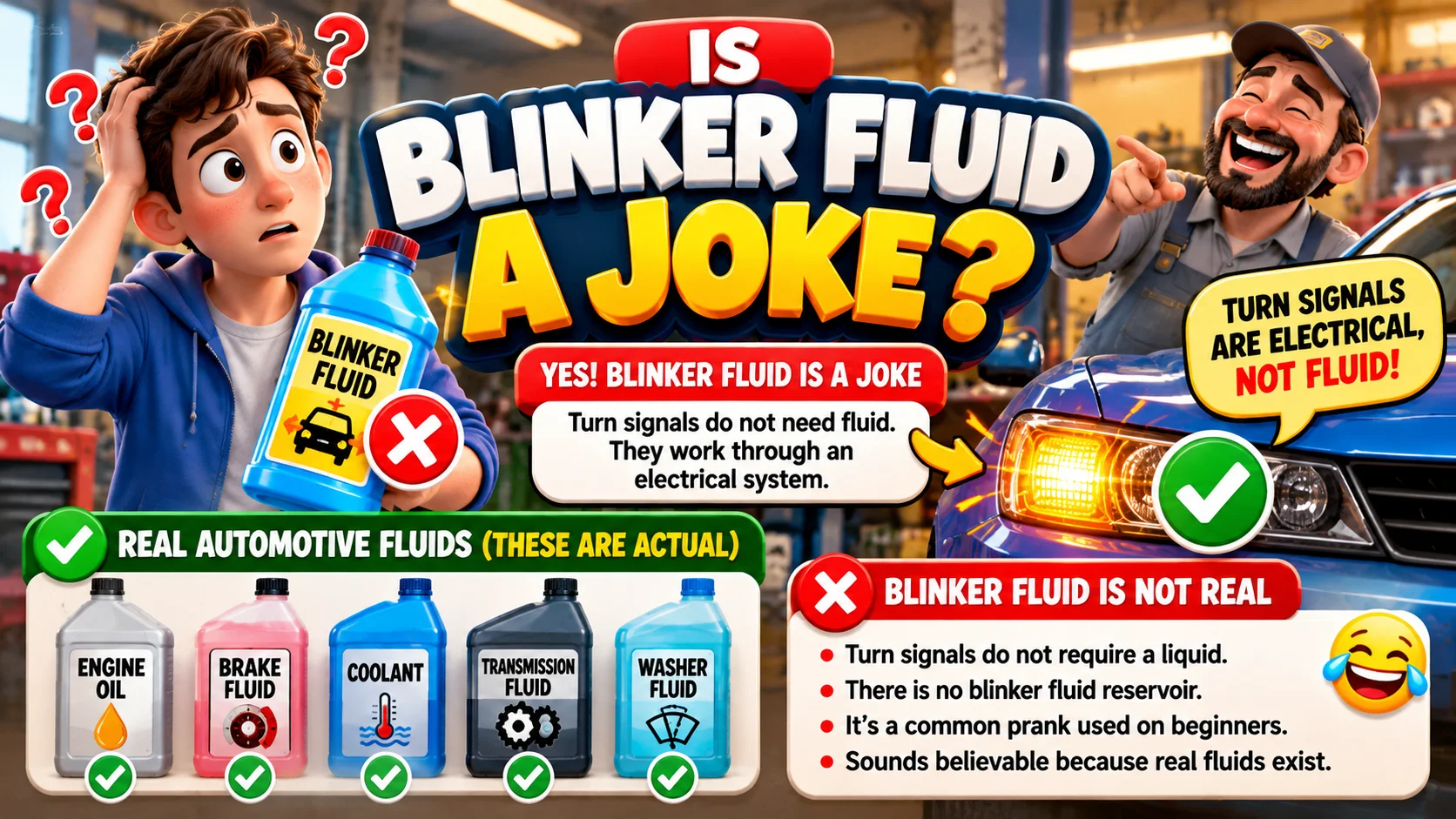
The blinker fluid joke is one of the best-known automotive pranks used on people who are new to cars, driving, or mechanical work. Someone may casually say that a vehicle is running low on blinker fluid and needs a refill, or they may send a beginner to an auto-parts store to buy a bottle. The trick sounds believable because vehicles really do use several different fluids, including engine oil, coolant, brake fluid, and washer fluid. The important difference is that turn signals do not use fluid at all. They operate through an electrical system involving switches, wiring, lamps or LEDs, and a flasher or electronic control system.
The blinker fluid joke meaning is therefore straightforward: it is a fictional maintenance product used as a prank. The joke works because the name combines two things that sound perfectly compatible blinker, a common name for a turn signal, and fluid, something that many genuine vehicle systems require.
The exact blinker fluid joke origin is harder to establish. Available sources describe it as an old automotive fool’s errand prank, and documented online references go back at least to the early 2000s. Engineer Fix reports online mentions dating to around 2004, while SlashGear notes a 2006 Urban Dictionary entry and Google-search activity beginning in 2007. Neither establishes a definitive first inventor.
That uncertainty is worth preserving rather than inventing a specific origin story. What is clear is that the prank became part of automotive culture and later spread through forums, social media, videos, novelty products, and mechanic communities.
What the Blinker Fluid Joke Actually Means
The blinker fluid joke pretends that a vehicle’s turn signals require a special liquid. The prankster may tell someone that their car needs its blinker fluid topped off, changed, flushed, or replaced. A more elaborate version can involve specifying an imaginary quantity, grade, brand, or service interval.
None of that is genuine automotive maintenance.
Turn signals are part of a vehicle’s lighting and electrical systems. NHTSA materials describe turn-signal lamps as being wired to flash, while vehicle manufacturers use electrical switches, wiring, flashers, and control modules to manage the signaling function. Toyota, for example, describes its turn-signal flasher assemblies as components that regulate the flashing cycle through the vehicle’s electrical system.
This makes the joke especially effective for beginners. A person who knows that cars have multiple fluids may reasonably assume that another component has its own specialized fluid.
The prankster is exploiting that assumption.
15 Core Facts Behind the Blinker Fluid Joke
- Blinker fluid is fictional.
- Turn signals do not require a liquid reservoir.
- Blinker is a common informal name for a turn signal.
- Turn signals are electrical components.
- The lights or LEDs flash through electrical control.
- Vehicles contain many genuine fluids.
- That makes the fake fluid sound plausible to beginners.
- Mechanics and experienced drivers use the phrase as a prank.
- The prank is often described as a fool’s errand.
- A novice may be sent to an auto-parts store to ask for it.
- The prank can be presented as a routine maintenance task.
- Turn signal oil is another possible fictional variation.
- Headlight fluid belongs to the same family of jokes.
- Novelty bottles can be sold even though the actual product is fictional.
- A genuine turn-signal problem needs electrical or lighting diagnosis, not fluid replacement.
These points explain both the mechanics and the humor behind the expression.
Is Blinker Fluid a Joke?
Yes. Blinker fluid is a joke and not a real automotive maintenance fluid. Capital One’s automotive guidance explicitly describes references to blinker fluid as jokes and states that turn signals do not need to be topped up. Chase similarly describes blinker fluid as a made-up term and confirms that turn signals do not need fluid to operate.
The prank works because the name sounds technical without being complicated. Someone does not need to know much about automotive engineering to understand the basic idea of fluid being added to something that operates on a vehicle.
There are genuine automotive fluids that sound similarly specialized. Brake fluid, transmission fluid, coolant, engine oil, and windshield-washer fluid all have legitimate purposes. A person who has never worked on a vehicle may therefore have no immediate reason to question another unfamiliar fluid name.
That knowledge gap creates the opportunity for the joke.
The phrase can be funny even when the target knows about cars because the prank has become a recognizable piece of automotive folklore.
Why the Blinker Fluid Joke Sounds Believable
The effectiveness of the joke comes from plausibility rather than technical accuracy. The word fluid appears in many legitimate automotive maintenance terms, so adding it to another vehicle component does not initially sound impossible.
Consider the difference between saying banana lubricant and blinker fluid. The first phrase immediately sounds absurd because there is no obvious automotive system called a banana. Blinker fluid, however, combines a familiar vehicle function with a familiar maintenance category.
A beginner may know that a car has:
- Engine oil
- Brake fluid
- Coolant
- Transmission fluid
- Windshield washer fluid
They may not yet know which systems are hydraulic, mechanical, electrical, or electronic.
That distinction is exactly what the prank exploits.
Engineer Fix describes the joke as a fool’s errand, in which a knowledgeable person sends someone with less experience looking for something that does not exist.
Jump into Other Related Article
- 50+ Fat Animal Jokes | Chonky Cats, Round Dogs & Fluffy Puns
- 50 Tooth Jokes to Make You Grin | Tooth Fairy, Kids & Dad Jokes
- Blowing Bubbles Joke | Meaning, Dirty Joke, Kid Version, Duck Joke, and Clown Variations
How Turn Signals Actually Work
Understanding the real system makes the blinker fluid joke explained much easier.
When a driver activates the turn-signal control, the vehicle’s electrical system sends a signal through the appropriate circuitry. Depending on the vehicle, the flashing function can be controlled by a traditional flasher unit, an electronic flasher, or a body/control module. The electrical system then controls the lamps or LEDs that communicate the driver’s intended direction.
Toyota’s parts documentation describes turn-signal flasher assemblies as components that regulate the timed flashing of turn signals and hazard lights. NHTSA documentation likewise describes turn-signal lamps as electrical lighting components that are wired to flash.
There is therefore no need for a liquid to move through the turn signal.
Older vehicles may use different electrical designs from newer vehicles, but the basic principle remains: the turn signal is an electrical signaling system, not a fluid-based system.
That is why there is no blinker-fluid reservoir, dipstick, refill cap, or manufacturer maintenance interval for genuine blinker fluid.
The Real Components Behind a Turn Signal
- Turn-signal lever or switch gives the driver control over the signal.
- Electrical wiring carries the electrical signal.
- Fuse or circuit protection protects the relevant electrical circuit.
- Flasher or electronic controller controls the blinking cycle on systems that use a separate unit.
- Turn-signal lamps produce the visible signal.
- LED assemblies used instead of conventional bulbs on many vehicles.
- Body control module may manage signaling on modern vehicles.
- Hazard switch activates the warning-light function.
- Ground connections complete electrical circuits.
- Instrument-panel indicators show the driver that the signal is operating.
- Connectors join wiring and components.
- Lamp housings protect lighting components.
- Steering-column controls commonly contain the turn-signal input.
- Vehicle battery/electrical supply provides electrical power.
- Vehicle-specific control logic determines how the system flashes and cancels.
The exact arrangement varies by vehicle, but none of these components requires a substance called blinker fluid.
Blinker Fluid Joke Origin and History
The exact blinker fluid joke origin is not firmly established. This is one of the areas where online articles sometimes make stronger claims than the available evidence supports.
Engineer Fix reports online references dating to approximately 2004, while SlashGear notes a 2006 Urban Dictionary entry and Google-search activity appearing in 2007. These records demonstrate that the phrase was already circulating online by the mid-2000s, but they do not prove that the prank was invented during that period.
That distinction matters because automotive fool’s-errand pranks can easily exist in spoken form for years before somebody writes them down online.
The broader prank tradition is much older. Mechanics, technicians, tradespeople, and experienced workers have long used fictional parts or impossible tasks to test newcomers. Blinker fluid fits naturally into this family.
A 2018 WordReference discussion illustrates that cultural familiarity: a user asked why telling a child to obtain blinker fluid was supposed to be funny, and respondents described it as an old prank played on young or inexperienced drivers.
Therefore, the most defensible origin statement is that the exact creator and first use are unknown, while documented internet evidence shows the phrase was established by the 2000s and likely reflects an older practical-joke tradition.
How the Blinker Fluid Joke Became a Mechanic Classic
The prank became particularly effective in garages because mechanics regularly work with real fluids and replacement parts.
A newcomer might genuinely be asked to find:
- Engine oil
- Brake fluid
- Coolant
- Power-steering fluid on applicable vehicles
- Transmission fluid
- Washer fluid
- Grease
- Gear oil
Adding blinker fluid to that list does not immediately sound ridiculous to someone who is unfamiliar with automotive systems.
This is why the joke can function as a kind of informal initiation prank. A new apprentice may be told to retrieve the imaginary product, while experienced workers wait for the moment when the person discovers that it does not exist.
The joke has also appeared in automotive forums for many years. A 2009 LS1 discussion, for example, mentions floor mat alignment alongside other fictional automotive items, demonstrating that these jokes were already circulating among car enthusiasts long before many recent social-media videos.
A 2004 Honda-Tech forum discussion also includes blinker fluid among humorous references to nonexistent automotive items.
Blinker Fluid and Floor Mat Alignment Joke
The blinker fluid and floor mat alignment joke belongs to the same family of fake automotive services.
Floor mat alignment sounds almost legitimate because vehicle floor mats really can be installed incorrectly, move around, or interfere with pedals in certain circumstances. But presenting alignment as a special routine fluid-like maintenance service turns an ordinary object into a fake technical procedure.
Automotive forums have paired these concepts with other imaginary items such as muffler bearings, piston return springs, and fictional valves. A Physics Forums compilation from 2003–2004-era discussions lists both blinker fluid and floor mat alignment among examples of fake car parts and services.
The humor comes from the same mechanism:
real-sounding terminology + nonexistent service = prank.
The important caveat is that floor mats themselves are not purely a joke topic. Proper installation and secure placement can matter for driver safety. So the humorous phrase should not be confused with legitimate advice about checking whether a mat is correctly positioned.
The Floor Mat Alignment and Blinker Fluid Joke Family
The combination of blinker fluid and floor mat alignment illustrates how automotive communities build entire collections of fictional maintenance tasks.
A prankster might jokingly suggest that a new worker needs to locate:
- Blinker fluid
- Muffler bearings
- Piston return springs
- Left-handed tools
- Floor mat alignment
- Seasonal tire air
- Exhaust belts
- Headlight fluid
- Battery filters
- Catalytic-converter fluid
- Turbo brake fluid
- Window-return springs
- Tire gaskets
- Canooder valves
- Flux capacitors
Many of these phrases are intentionally constructed to sound like legitimate components.
The more technical the wording sounds, the better the prank can work on someone who is unfamiliar with the field.
However, not every item in online joke lists is equally fictional. Some terms can resemble real components or maintenance procedures, so readers should not assume that every unfamiliar automotive term is a prank.
Blinker Fluid Joke Meaning in Simple Language
For readers searching blinker fluid joke meaning, the simplest explanation is:

Someone is pretending that a car’s turn signals need a special liquid, even though turn signals operate through an electrical system.
The joke is funny because a beginner may believe the statement.
The prankster may say:
- Your blinker fluid is low.
- You need to refill your blinker fluid.
- Your blinkers are flashing slowly because the fluid is old.
- Get a bottle of blinker fluid from the parts store.
- Ask for synthetic blinker fluid.
- Make sure you get the correct viscosity.
The more confidently the fake information is delivered, the more believable the prank can sound.
The final line or reveal usually comes when the target realizes that there is no such automotive fluid.
Why Is Blinker Fluid a Joke?
The why is blinker fluid a joke question has a simple answer: because turn signals do not use fluid, but the phrase sounds like a legitimate maintenance term.
The joke is based on a knowledge gap.
An experienced mechanic knows that the turn signal system is electrical. A novice may know only that the vehicle has several fluids and that blinkers are an important part of the car.
The prank connects those two facts incorrectly.
The result is a fictional product that sounds plausible until the listener understands how the system actually works.
That makes it a classic knowledge-gap prank rather than a technical misunderstanding.
How Did the Blinker Fluid Joke Start?
The exact answer to how did the blinker fluid joke start remains uncertain.
There is no reliable source identifying one person as the inventor or one precise date as the beginning of the joke. Sources that discuss its history generally describe it as a long-running automotive prank whose precise origin is unclear. SlashGear specifically notes that the starting point is uncertain and that the prank may predate the internet.
One theory mentioned in modern discussions is that the joke may have been helped by older lighting assemblies in which moisture could sometimes appear inside a lamp housing. That theory is interesting, but it should be treated as a possibility rather than a proven origin story.
The stronger historical evidence concerns its documented existence, not its invention.
Online records place the phrase in automotive discussions by the early-to-mid 2000s.
That gives us a reasonable timeline without pretending to know something that cannot currently be proven.
Blinker Fluid Joke on Reddit and Automotive Forums
Reddit and automotive forums have played an important role in keeping the joke alive.
In mechanic communities, the prank often appears as a story about sending a new employee or inexperienced worker to retrieve blinker fluid. One Reddit post from r/Justrolledintotheshop describes a parts-related prank involving someone being sent to find blinker fluid, while the comments add another classic fake item: the ID-10-T gag.
The r/Machinists discussion shown among the competitive results similarly treats blinker fluid as part of a broader workplace-prank tradition involving fictional tools or materials.
This demonstrates why the joke continues to circulate even among experienced workers. The target changes from one generation of apprentices to another.
It is essentially a reusable template.
A mechanic can create a new version simply by changing the supposed reason the vehicle needs the fluid.
Blinker Fluid Joke as a Fool’s Errand
The technical term fool’s errand is useful for understanding the prank.
A fool’s errand sends someone somewhere to obtain an item that does not exist or cannot reasonably be obtained. The classic goal is to make the inexperienced person spend time searching before realizing what happened.
Blinker fluid fits perfectly.
The prankster might say:
We’re almost finished. We just need some blinker fluid.
The target may ask where it is located.
The prankster might respond:
Try the auto-parts store.
The target then goes searching.
At the store, the employee may recognize the prank immediately.
This is why the joke can produce a stronger reaction in person than in a written article. The humor comes partly from the real-time discovery.
Blinker Fluid Joke and Other Fake Car Products
Blinker fluid is not the only fictional automotive product used in jokes. Automotive communities have developed many similar expressions.
15 Common Fake Automotive Prank Items
- Blinker fluid supposedly keeps turn signals working.
- Headlight fluid imaginary fluid for vehicle lights.
- Muffler bearings fake bearings supposedly used inside exhaust components.
- Piston return springs fictional springs for pistons.
- Floor mat alignment fake precision service for floor mats.
- Left-handed screwdriver a classic impossible-tool prank.
- Seasonal tire air fictional summer or winter air.
- Battery filter nonexistent filter for electrical power.
- Exhaust belt fictional belt for the exhaust.
- Windshield wiper governor imaginary speed-control component.
- Canooder valve fictional technical-sounding valve.
- Turbo brake imaginary braking device for a turbocharger.
- Tire gaskets fake sealing components.
- Muffler fluid another invented liquid.
- Flux capacitor service a fictional reference popularized by Back to the Future.
A historical forum compilation includes many examples from automotive prank culture, including blinker fluid, floor mat alignment, muffler bearings, and other invented parts.
Is Blinker Fluid Real or a Joke?
Blinker fluid is a joke, not a real automotive fluid.
There is no standard automotive product that a vehicle owner should purchase and pour into the turn-signal system. Capital One explicitly describes it as a joke, and Chase likewise states that turn signals do not require fluid.
If someone tells you that your vehicle needs blinker fluid, the safest interpretation is that they are joking.
If your turn signals actually stop working, however, the problem is real.
Possible causes can include:
- Burned-out bulbs
- Failed LEDs or lamp assemblies
- Blown fuses
- Wiring problems
- Faulty switches
- Failed flasher components
- Control-module issues
- Connector problems
- Grounding problems
The exact diagnosis depends on the vehicle.
Toyota documentation, for example, notes that abnormal turn-signal flashing can indicate a lighting fault such as a burned-out bulb on applicable vehicles.
So the joke is fictional, but turn-signal maintenance is absolutely real.
What to Do When Your Blinkers Stop Working
The fact that blinker fluid is fictional should not make someone dismiss an actual turn-signal problem.
Turn signals are safety equipment, and NHTSA regulations specifically address turn-signal lamps and their flashing function under Federal Motor Vehicle Safety Standard No. 108.
If a turn signal stops working, a driver should use the vehicle owner’s manual or seek appropriate automotive assistance rather than looking for a nonexistent fluid.
Common checks may include:
- Check whether one or both signals are affected.
- Check whether the dashboard indicator behaves normally.
- Inspect the relevant bulbs if the vehicle uses replaceable bulbs.
- Check the fuse using the vehicle’s manual.
- Look for visible wiring or connector damage.
- Check whether the hazard lights work.
- Notice whether the signal flashes unusually fast.
- Check the lamp housing for damage or moisture.
- Consult the vehicle’s diagnostic information if equipped.
- Seek professional diagnosis when the cause is unclear.
These are genuine troubleshooting considerations, unlike refilling blinker fluid.
Blinker Fluid Joke in Social Media Culture
Social media has transformed the blinker-fluid prank from a garage joke into a reusable meme.
Videos can show a person being sent into an auto-parts store to request the nonexistent product. The audience gets to watch the employee recognize the prank while the target remains convinced that the request is legitimate.
A widely reported 2017 prank involved a father sending his daughters into an AutoZone to ask for fake automotive items including blinker fluid and a bucket of steam. CBS Detroit reported on the resulting viral video and the daughter’s reaction after discovering the prank.
That type of video works especially well because the audience knows the truth before the target does.
The same knowledge gap that powers the traditional joke becomes the entertainment mechanism for short-form video.
Blinker Fluid Joke as a Workplace Prank
In a workplace, the joke is often presented as an initiation ritual for a new worker or apprentice.
A senior worker may tell the newcomer:
We need another bottle of blinker fluid.
The newcomer may search the shelves.
Someone may then add another imaginary item.
The prank can escalate into an entire list of fictional products.
This is a classic structure for trades and technical workplaces because newcomers are expected to learn a large vocabulary quickly.
However, there is an important distinction between good-natured teasing and humiliating someone. A harmless joke should end once the person realizes what happened, rather than being used to embarrass or endanger them.
The best version of the prank creates a laugh without wasting significant work time or interfering with safety.
Blinker Fluid Joke Не понимаю: A Simple Explanation
For people searching blinker fluid joke не понимаю or simply I don’t understand the blinker fluid joke, the explanation is very simple.
Blinker = turn signal.
Fluid = liquid.
The joke pretends that the turn signal needs a liquid to operate.
It does not.
Turn signals are electrical.
Therefore:
Blinker fluid = imaginary car fluid used as a prank.
The reason it can be confusing is that the phrase sounds like legitimate automotive terminology. If someone has never worked on a car, there is nothing about the words themselves that immediately proves they are fake.
Once you know how turn signals work, the joke becomes obvious.
Why the Joke Keeps Surviving
The blinker fluid joke has survived for several reasons.
First, every generation produces new drivers and automotive beginners.
Second, cars contain enough genuine fluids and technical components to keep the phrase believable.
Third, the joke requires almost no setup.
Fourth, it can be delivered verbally, in writing, as a meme, or as a video.
Fifth, it can be modified endlessly.
A person can joke about synthetic blinker fluid, winter blinker fluid, premium blinker fluid, or an imaginary service interval without changing the central idea.
The joke therefore has a built-in ability to reproduce itself.
Blinker Fluid Joke vs Real Automotive Fluids
| Product or System | Real or Fictional | Purpose |
| Engine oil | Real | Lubricates and protects engine components |
| Brake fluid | Real | Transfers hydraulic pressure in applicable brake systems |
| Coolant | Real | Helps manage engine temperature |
| Transmission fluid | Real | Lubricates and supports transmission operation |
| Windshield washer fluid | Real | Cleans windshield glass |
| Power-steering fluid | Real on applicable systems | Supports hydraulic power steering |
| Blinker fluid | Fictional | No actual automotive function |
| Headlight fluid | Fictional | No actual automotive function |
| Muffler bearings | Fictional joke item | No ordinary automotive function |
| Floor mat alignment service | Joke/prank phrase | Not a standard fluid-style maintenance item |
| Seasonal tire air | Fictional joke | Tires do not require summer/winter air changes |
| Battery filter | Fictional joke item | Not a standard automotive maintenance component |
This distinction is important because an unfamiliar term is not automatically fake. When in doubt, check the vehicle owner’s manual or a reliable manufacturer source.
How to Use the Blinker Fluid Joke Without Confusing Someone About Safety
The prank is generally harmless when it is clearly revealed as a joke. It becomes less appropriate when someone uses it to interfere with genuine vehicle maintenance.

For example, nobody should tell a driver that a serious turn-signal failure can be fixed by adding imaginary fluid.
A safer version is to use the joke as a quick piece of automotive humor and then explain the truth.
A simple approach is:
- Make the joke.
- Let the person react.
- Reveal that blinker fluid is fictional.
- Explain that turn signals use electricity.
- If their signal really is malfunctioning, help them identify the legitimate issue.
- Do not pour unknown substances into a vehicle’s lighting system.
- Use the owner’s manual for actual maintenance requirements.
That keeps the joke funny without turning misinformation into vehicle advice.
Conclusion
The blinker fluid joke is a classic automotive prank based on a fictional product that sounds surprisingly believable. The joke tells an inexperienced driver or mechanic that a vehicle’s turn signals need a special fluid, often encouraging the person to search for a bottle at an auto-parts store.
The reality is simple: there is no blinker fluid. Turn signals are electrical systems, using switches, wiring, lamps or LEDs, and flasher or control components rather than a liquid. NHTSA documentation describes turn-signal lamps as electrical lighting equipment that is wired to flash, while Toyota’s parts documentation describes turn-signal flashers as electrical components controlling the blinking cycle.
The blinker fluid joke origin is less certain. No reliable source establishes one inventor or exact starting date. Modern sources identify online references dating to the early 2000s, while the prank itself appears to belong to a much older tradition of fool’s errands in which newcomers are sent to find nonexistent tools, parts, or supplies.
The related floor mat alignment and blinker fluid joke belongs to the same automotive-prank family. Forums have long paired blinker fluid with fictional items such as muffler bearings, piston return springs, and floor-mat alignment.
The joke continues to work because it exploits a very simple idea: cars have many real fluids, so an inexperienced person may reasonably assume that another vehicle component has one too.
Once the real electrical operation of turn signals is understood, the mystery disappears—and the blinker fluid joke becomes exactly what it was intended to be: a classic piece of automotive humor.
Is blinker fluid a real thing?
No. Blinker fluid is a fictional product used as an automotive joke or prank. Turn signals do not require fluid to operate.
What is the blinker fluid joke?
The blinker fluid joke involves pretending that a vehicle’s turn signals require a special liquid. It is commonly used to tease inexperienced drivers, mechanics, or automotive beginners.
What does blinker fluid mean?
Blinker fluid is a humorous term for an imaginary automotive fluid. It is another name for the classic prank of sending someone to find a nonexistent product.
Why is blinker fluid a joke?
It is a joke because turn signals operate through an electrical system rather than through a fluid. The phrase sounds believable because cars really do use several different fluids.
Where did the blinker fluid joke come from?
Its exact origin is unknown. Modern sources document the term online by the early 2000s, while the prank appears to belong to the older tradition of fool’s errands.
How did the blinker fluid joke start?
There is no confirmed single inventor or starting date. It likely developed as part of automotive practical-joke culture and later became widespread through internet forums and social media.
Is blinker fluid real or a joke?
It is a joke. There is no normal vehicle maintenance procedure involving the purchase or replacement of blinker fluid.
How do turn signals actually work?
Turn signals work through electrical controls, wiring, lamps or LEDs, and a flasher or electronic control system. Toyota and NHTSA documentation both describe electrical components and flashing circuits rather than any fluid-based system.
What is the floor mat alignment and blinker fluid joke?
They are related automotive prank terms. Blinker fluid is a nonexistent fluid, while floor mat alignment is used as a similarly technical-sounding joke about a fake service. Automotive forums have listed both among fictional car-related items.
What other fake automotive products are used in jokes?
Common examples include headlight fluid, muffler bearings, piston return springs, left-handed screwdrivers, seasonal tire air, battery filters, and fictional exhaust or suspension components.
Can I buy blinker fluid?
You may find novelty bottles or gag products labeled blinker fluid, but these are joke products rather than genuine automotive fluids. They should not be treated as vehicle maintenance products.
What should I do if my blinkers stop working?
Check the vehicle’s manual and have the actual electrical or lighting system diagnosed. Possible causes include bulbs, LEDs, fuses, wiring, switches, connectors, flashers, or control modules. The appropriate cause depends on the vehicle.
Why do mechanics use the blinker fluid prank?
The prank takes advantage of the knowledge gap between experienced mechanics and newcomers. It is a classic fool’s errand because the target may be sent searching for something that does not exist.
Is the blinker fluid prank old?
Yes. Although its exact origin is unknown, references to the term appear online by the early 2000s, and descriptions of it as an older prank appear in automotive and language discussions.
Why does the blinker fluid joke sound believable?
The phrase combines a familiar vehicle function with a familiar automotive maintenance category. Because cars use many legitimate fluids, an inexperienced person may initially assume that blinker fluid is another one.
Is turn signal oil also a joke?
Yes. Turn signal oil or similar expressions are variations of the same fictional-product prank. The basic idea remains that someone pretends the electrical turn-signal system needs a liquid.

Pingback: 150+ DJ Jokes | Funny DJ Puns, Dad Jokes & One Liners
Pingback: 150+ Mailman Jokes| Funny Postman Jokes and Puns