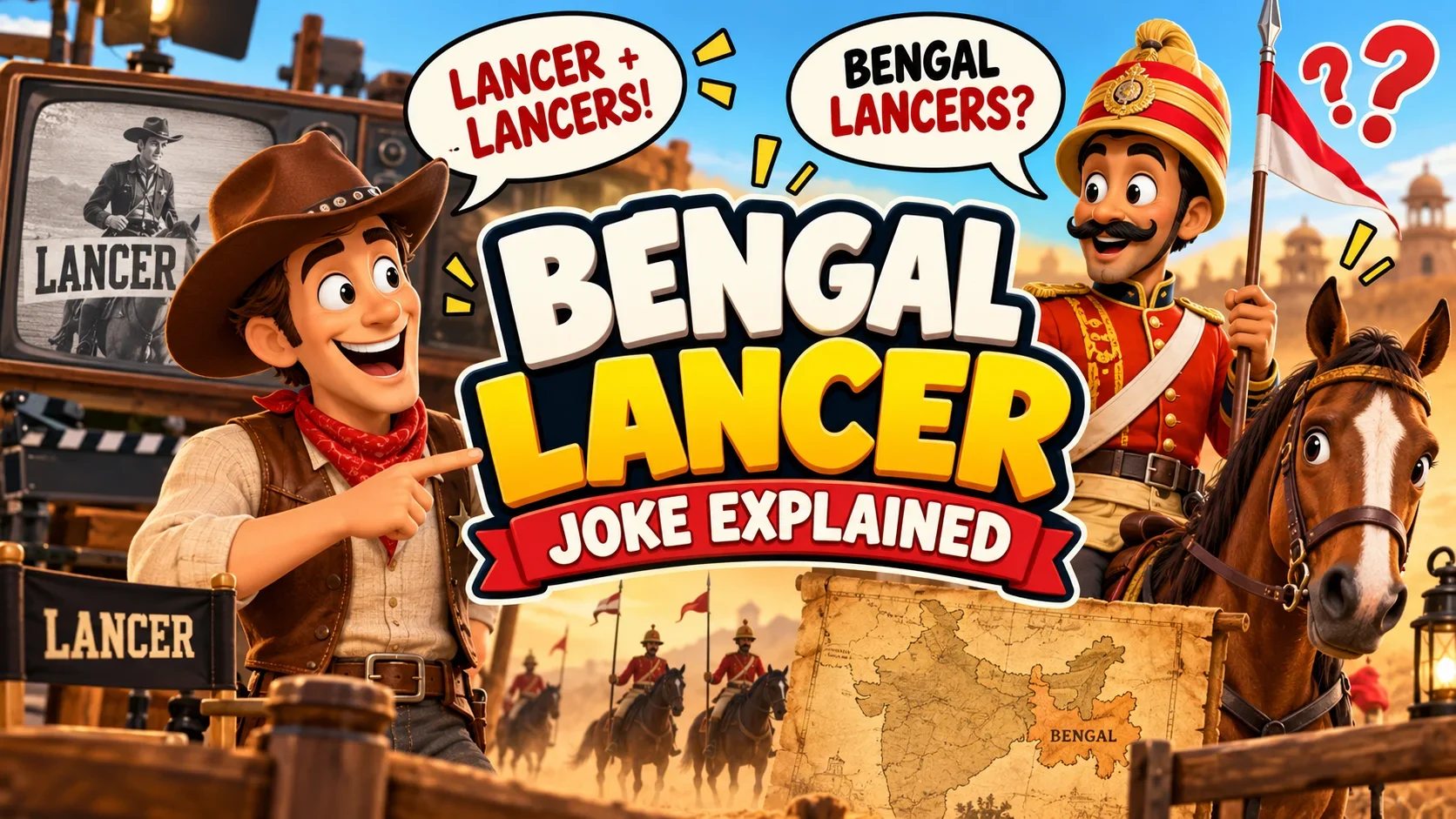
The Bengal Lancer joke became a popular search topic because of Quentin Tarantino’s 2019 film Once Upon a Time in Hollywood. The joke appears during a scene from the fictional Western television series Lancer, where the characters discuss a man who served with the British cavalry in India. When the military unit is identified as the Bengal Lancers, the character suddenly treats the name as funny. The moment can be confusing because the humor is deliberately understated and depends on knowing what Lancer refers to in the film. The phrase also has a genuine historical connection because Bengal Lancers were cavalry units associated with the British Indian Army.
The scene has generated many explanations online, including theories about pronunciation, wordplay, and the relationship between the name Lancer and the historical military unit. Reddit discussions show that viewers have interpreted the joke in several different ways, with some seeing it as a deliberately weak pun and others looking for an additional hidden meaning.
The simplest explanation is also the most useful one: a character named Lancer has a story about serving in a military group called the Bengal Lancers, and the coincidence of Lancer appearing as both his surname and the military designation is treated as amusing. The scene then makes the audience watch the joke being explained, which is part of the humor itself.
The Bengal Lancer Joke Explained in Simple Terms
The joke takes place inside the fictional Western show Lancer that is being filmed within Once Upon a Time in Hollywood. The television series Lancer was actually a real CBS Western that ran from 1968 to 1970, starring Wayne Maunder as Scott Lancer, among others.
In Tarantino’s film, Luke Perry portrays Wayne Maunder playing Scott Lancer, while Leonardo DiCaprio’s character Rick Dalton performs the role of Caleb DeCoteau within the fictional production. The scene concerns a military veteran who says he rode with the British cavalry in India. When asked what the outfit was called, the answer is Bengal Lancers.
The humor comes from the fact that the character being discussed is a Lancer, and he served in the Bengal Lancers. In other words, his name and the military organization happen to share the word Lancer. That creates a deliberately simple verbal coincidence.
The scene then draws attention to the phrase rather than letting the joke pass naturally. One character laughs immediately, another character says that it is not particularly funny, and the joke is then explained. This awkward explanation is important because the scene is not necessarily presenting a sophisticated word puzzle.
That is why many viewers initially miss the point. The joke is less about a hidden historical secret and more about a character finding a corny coincidence amusing.
The Actual Scene in Once Upon a Time in Hollywood
The scene is part of the film’s recreation of the television Western Lancer. The film uses the fictional production to connect its 1969 Hollywood setting with an actual television program from the period. The real Lancer aired on CBS from September 1968 through 1970 and centered on the Lancer ranch family.
Wayne Maunder originally played Scott Lancer in the television series. IMDb specifically notes the connection between Maunder’s Scott Lancer and Luke Perry’s portrayal of the character in Once Upon a Time in Hollywood.
During the film-within-the-film scene, the dialogue establishes that a character received his limp during the war. He explains that he fought with the British cavalry in India. The discussion then identifies the unit as the Bengal Lancers. At that point, the response is laughter because the speaker sees the coincidence between Lancer and Bengal Lancers as funny.
The little girl in the scene does not immediately understand why the phrase should be funny. After the joke is explained, she gives it a reluctant acknowledgment. This creates a second layer of comedy because the audience is effectively put into the same position as the child.
Instead of simply telling a joke and receiving a laugh, the movie shows how a bad or overly obvious joke can become funny because someone insists that it is funny. That is one reason the scene has continued to generate discussion.
The Real Meaning of Bengal Lancers
The phrase Bengal Lancers was not invented for Tarantino’s movie. It refers to cavalry units associated with the British Indian Army. Several regiments historically carried Bengal Lancer names, including units such as the 1st, 2nd, 10th, 11th, 13th, 14th, 17th, and 19th Bengal Lancers.

The word lancer historically relates to a cavalry soldier armed with a lance. The term therefore has a genuine military meaning rather than being merely a surname or fictional invention. The Bengal designation connects these units to the Bengal region within the historical structure of British India.
The phrase also had a strong presence in popular culture. The 1935 film The Lives of a Bengal Lancer, starring Gary Cooper, helped make the expression recognizable to generations of movie audiences. Contemporary writing about that film frequently used the Bengal Lancer image as part of the adventure-film tradition surrounding British imperial stories.
This historical background matters because the movie’s audience is expected to recognize that Bengal Lancers sound like a real old-fashioned cavalry formation. The phrase fits naturally into a Western-style television drama while also sounding unusual enough to become the setup for a joke.
The historical meaning therefore provides the foundation, while the fictional character’s surname provides the wordplay.
The Lancer Television Connection
Understanding the original Lancer television series makes the joke considerably easier to follow. The CBS series was an American Western that ran for two seasons and 51 episodes. Its story focused on rancher Murdoch Lancer and his two sons, Scott and Johnny. Wayne Maunder played Scott Lancer, while James Stacy played Johnny Madrid Lancer.
The name Lancer was therefore already a character surname before Tarantino incorporated the program into his movie. The historical term lancer and the fictional Lancer family name coexist within the scene.
That creates the central coincidence: a person named Lancer is described as having served with the Bengal Lancers. For someone who enjoys word associations, the repetition of the word can sound amusingly neat.
The joke becomes even more recognizable to viewers who know that Lancer was a genuine television program from the era. Tarantino’s movie does not invent the show’s title simply to create this joke; it uses an existing piece of 1960s television history as part of its fictional Hollywood world.
This historical layering is one reason the scene can feel confusing if someone has never heard of the original television series.
Key Details Behind the Bengal Lancer Joke
Here are the most important facts that explain the reference:
- Lancer was a real television series, not a title invented exclusively for Tarantino’s film.
- The original series aired on CBS between 1968 and 1970.
- Wayne Maunder played Scott Lancer in the original series.
- Luke Perry portrays the character connected to Scott Lancer in Tarantino’s recreation.
- Lancer is a surname in the Western story.
- A character in the scene describes serving in the British cavalry.
- The cavalry service is said to have occurred in India.
- The military formation is identified as the Bengal Lancers.
- Bengal Lancers were associated with the British Indian Army.
- The word Lancer therefore appears in both the character’s name and the military unit.
- The repeated word creates the basic verbal coincidence.
- The joke is intentionally presented as a somewhat corny observation.
- The little girl’s reaction makes the awkwardness part of the comedy.
- Online viewers have proposed additional interpretations, but these are not equally established.
- The safest explanation is the direct Lancer-name/Bengal-Lancers coincidence shown by the scene itself.
The Bengal Lancer Joke Meaning and Wordplay
The Bengal Lancer joke meaning becomes clearer when the wording is separated into its two components. Bengal identifies the historical geographic association, while Lancer describes the cavalryman or appears as the family surname in the fictional Western. Put together, Bengal Lancer sounds like a formal military designation but also happens to contain the exact family name that is already important to the scene.
That repetition is the joke’s main mechanism. It is similar to making fun of someone named Hunter who turns out to have worked as a hunter, except the historical title makes the coincidence sound more elaborate.
Some viewers have proposed that the pronunciation of Bengal contributes additional wordplay. Online discussions have included interpretations involving bang, Bangel, or other phonetic possibilities. However, these interpretations are largely viewer theories rather than something that should be presented as a confirmed explanation.
The movie itself gives the audience enough information to understand the basic joke without requiring those theories. The character explicitly reacts to Bengal Lancer, and the next exchange explains that the phrase itself is what he finds funny.
So, for an SEO-friendly Bengal Lancer joke explained answer, the most accurate approach is to distinguish the confirmed scene mechanics from fan interpretations.
Why the Joke Feels So Confusing
The confusion surrounding the Bengal Lancer joke is understandable because the scene does not deliver a traditional setup-and-punchline structure. Instead, the movie presents a phrase that one character immediately considers funny, while another character does not understand the reaction.
This means the audience is deliberately placed in the position of asking what they are supposed to find funny. The scene then makes that confusion part of its comedic rhythm.
Another difficulty comes from the fact that modern viewers may not know the original Lancer television show. Without knowing that Lancer is the surname of a major character in the fictional Western, the repetition seems less meaningful.
The historical phrase Bengal Lancers can also sound unfamiliar. Someone who has never encountered the British Indian Army or historical cavalry terminology may assume that Bengal Lancer is simply a made-up phrase from the movie.
Finally, online discussions have produced many competing explanations. Reddit threads show people proposing everything from simple surname coincidence to more complicated phonetic interpretations. Because those comments are user theories, they should not be treated as definitive evidence about Tarantino’s intention.
Bengal Lancer Joke Origin and Historical Background
The Bengal Lancer joke origin should be separated into two different histories: the historical term Bengal Lancers and the modern movie joke.
The historical expression predates the movie by many decades. Bengal Lancers were cavalry regiments connected with the British Indian Army, and the name has appeared in military history, literature, and film.
The expression also became part of Hollywood’s older adventure tradition. The Lives of a Bengal Lancer, released in 1935, is one of the best-known cinematic references to the term. Historical discussions of the film place it within the larger cycle of British imperial adventure stories set in or around India.
The modern joke, however, belongs to Once Upon a Time in Hollywood. The film places the phrase inside a recreation of the 1960s television Western Lancer, creating a connection between real television history, real military terminology, and fictional dialogue.
There is no need to claim that the movie created the phrase or that Tarantino invented the historical association. The comedy depends on taking an existing phrase and noticing its accidental relationship to the fictional character’s name.
Bengal Lancer Joke Reddit Discussions and Popular Interpretations
The Bengal Lancer joke Reddit discussions are useful for understanding why so many viewers searched for an explanation. A 2019 Reddit thread specifically asked what the joke meant, and the replies included several competing interpretations. Some users focused on the fact that the television show is called Lancer and that the character is a Lancer, while others searched for a deeper pun.
Later discussions continued to revisit the scene. Some commenters suggested that Bengal Lancer could be heard as a phrase involving bang, while others rejected that interpretation and returned to the simpler surname coincidence.
This disagreement is important because it demonstrates that not every internet explanation has the same evidentiary status. A Reddit comment can document how viewers interpreted a joke, but it does not automatically establish what the screenwriter intended.
The film’s own dialogue provides stronger evidence than speculative comments. The scene explicitly draws attention to the phrase Bengal Lancer, and the characters react to the coincidence involving Lancer.
Therefore, when explaining the joke, it is better to say that additional wordplay has been suggested by viewers, rather than claiming that every proposed interpretation is definitely part of the original joke.
The Humor Behind the Awkward Delivery
The comedy also comes from delivery, not just vocabulary. A joke can become funnier when someone takes a weak pun extremely seriously and then insists that everyone else should appreciate it.
That is essentially what happens in the scene. The phrase is introduced naturally through the fictional Western’s dialogue, but the reaction suddenly shifts toward comedy.
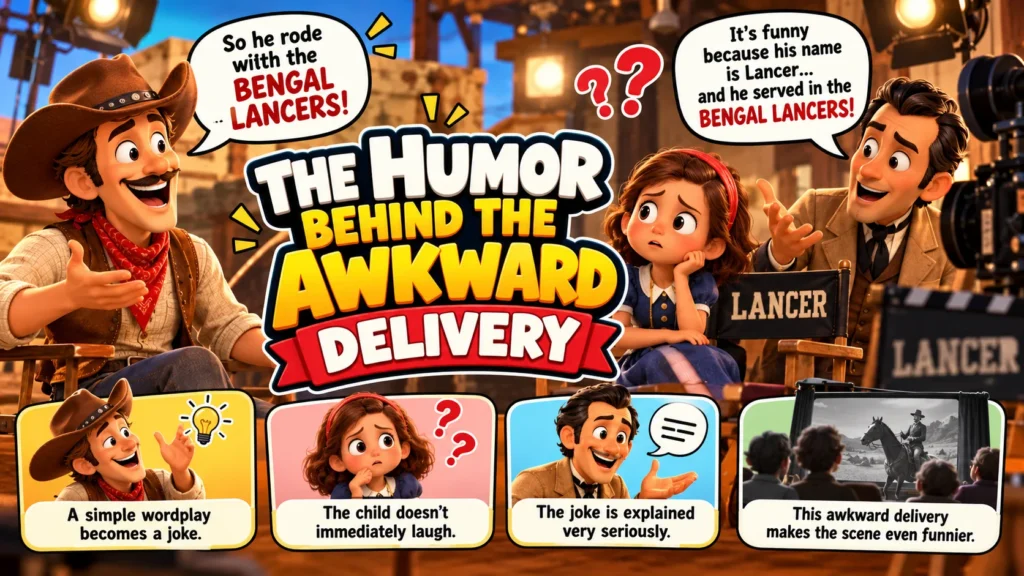
The child character’s initial lack of enthusiasm gives the audience a mirror for their own confusion. She does not immediately laugh, which makes the adult character’s explanation even more awkward.
Once the explanation is given, the audience can appreciate the scene as a piece of character comedy rather than merely evaluating whether the pun itself is clever.
This is particularly consistent with the movie’s broader interest in old Hollywood, television acting, rehearsals, genre conventions, and the strange ways performers interact with dialogue. The scene is therefore doing more than delivering a standalone joke.
Bengal Lancer Joke Variations and Related Wordplay
The phrase has inspired numerous online reinterpretations because Lancer works well as a word for historical, Western, military, and horse-related humor. Many internet jokes take the original structure and replace the military unit, character name, or setting.
The most useful variations retain the basic idea without copying the movie’s dialogue. They can also help explain the underlying mechanism to readers who are unfamiliar with the reference.
Jump into Other Related Article
- 50 Horse Jokes for Kids | Clean, Short and Stable Approved
- You’re So Skinny Jokes | Why They Hurt and How to Respond
- Weekly Jokes | A Fresh Joke for Every Day of the Week
15 Original Bengal Lancer-Style Joke Ideas
- A man named Archer joined an archery club and immediately became the club’s easiest introduction.
- A cowboy named Rider got hired at a ranch because his résumé already had the perfect job title.
- A soldier named Hunter was asked what he hunted, and he simply pointed to his surname.
- A man named Walker joined a hiking group and everyone assumed he had professional experience.
- A farmer named Cooper opened a barrel shop and suddenly his surname made perfect sense.
- A sailor named Captain became everyone’s favorite person to introduce at sea.
- A man named Fletcher started making arrows and finally gave his family name some practical use.
- A rancher named Colt became tired of explaining that his name came before his horse.
- A drummer named Beat joined a band and said his résumé was practically written already.
- A baker named Cook entered a cooking contest and called the competition unfair.
- A hunter named Chase became a detective and joked that his career had finally caught up with his surname.
- A man named Porter started working at a railway station and stopped correcting people about his job.
- A cowboy named Marshal became a town marshal and said the paperwork had saved him an introduction.
- A rider named Lance joined a cavalry history club and immediately became the group’s favorite pun.
- A character named Lancer served with a unit called the Bengal Lancers and discovered that his name had accidentally written half the joke for him.
These examples illustrate the same basic mechanism: a person’s name overlaps with a profession, organization, title, or historical phrase.
Bengal Lancer Joke and the Role of Lancer in the Movie
The original Lancer television series is especially important because it gives the phrase a fictional identity before the joke appears. The series centered on the Lancer family and included Scott Lancer, played by Wayne Maunder.
Tarantino’s film uses this existing Western as a fictional production being made in 1969. This allows the movie to blend real television history with invented events involving Rick Dalton and other characters.
The Bengal Lancer reference consequently works on multiple levels. It sounds like a historical military phrase, it contains the surname Lancer, and it appears during a performance of a television show actually called Lancer.
That combination is why the scene can seem more complicated than it really is. A viewer who recognizes only one of those layers may miss the connection.
Once all three are visible, the joke becomes much easier to understand.
A Clear Comparison of the Main Bengal Lancer References
| Reference | Meaning | Connection to the Joke |
| Bengal | Historical geographic designation | Connects the phrase to India and British Indian military history |
| Lancer | Cavalry soldier associated with a lance | Historical military term |
| Bengal Lancers | Historical cavalry designation | The phrase spoken in the film |
| Lancer family | Fictional Western family | Gives Lancer a character-name meaning |
| Lancer | Real 1968–1970 CBS Western | Provides the television context |
| Scott Lancer | Character in the original series | Central connection to the film’s recreation |
| Luke Perry’s role | Film recreation of the television character | Connects the old series to Tarantino’s movie |
| Once Upon a Time in Hollywood | 2019 Tarantino film | Modern source of the joke’s popularity |
| Reddit explanations | Viewer interpretations | Shows why the joke has generated debate |
| Phonetic theories | Fan-created interpretations | Possible but not established as definitive |
The important distinction is that the historical Bengal Lancers are real, while the comedic situation surrounding the phrase belongs to the fictional world of the movie.
The Simplest Final Explanation of the Joke
If the entire Bengal Lancer joke explained topic needs to be reduced to one paragraph, the explanation is straightforward. The movie’s fictional Western is called Lancer, and its important character belongs to the Lancer family. During a scene, another character says that he served with the British cavalry in India and identifies his unit as the Bengal Lancers. The word Lancer therefore appears both as the character’s surname and as part of the historical military unit’s name. That coincidence is treated as a deliberately corny joke, and the awkward need to explain why it is funny becomes part of the scene’s humor.
Some viewers have proposed extra phonetic jokes, including interpretations based on how Bengal Lancer sounds when pronounced differently. Those ideas appear in online discussions, but they should be treated as fan interpretations rather than established facts.
The historical part is much less ambiguous: Bengal Lancers were genuine cavalry units associated with the British Indian Army, and the term existed long before the 2019 movie.
The television connection is also documented: Lancer was a real CBS Western from 1968–1970, with Wayne Maunder playing Scott Lancer, and the film deliberately recreates that television world.
So the joke is best understood as a deliberately simple name coincidence wrapped inside a fictional recreation of a real 1960s Western.
Conclusion
The Bengal Lancer joke in Once Upon a Time in Hollywood is easier to understand once its historical and television references are separated. Bengal Lancers were real cavalry units associated with the British Indian Army, while Lancer was a genuine CBS Western that aired from 1968 to 1970. Wayne Maunder played Scott Lancer in the original series, and Tarantino’s film recreated that television world as part of its 1969 Hollywood setting.
The actual joke centers on the repeated word Lancer. A character named Lancer is connected with the Bengal Lancers, creating a coincidence that another character finds amusing. The scene then intentionally makes the audience sit through the explanation, which adds an extra layer of awkward comedy.
Online discussions have produced alternative interpretations, particularly around pronunciation and possible phonetic wordplay. Those theories are interesting, but they should remain clearly labeled as interpretations rather than confirmed facts.
Ultimately, the Bengal Lancer joke meaning does not require an elaborate hidden code. Knowing the real Bengal Lancers, the original Lancer television series, and the Lancer family name makes the scene much easier to follow.
What is the Bengal Lancer joke?
The joke comes from the coincidence between the name Lancer and the historical military designation Bengal Lancers. In the film’s fictional Lancer scene, that repeated word is treated as a funny coincidence.
Is the Bengal Lancer joke from Once Upon a Time in Hollywood?
Yes. The joke appears during the movie’s recreation of the television Western Lancer. The scene became especially discussed online because many viewers initially did not understand why the phrase was supposed to be funny.
Were the Bengal Lancers real?
Yes. Bengal Lancers refers to several historical cavalry units associated with the British Indian Army. The expression therefore has a genuine historical background.
Was Lancer a real television show?
Yes. Lancer was a CBS Western that aired from 1968 to 1970 and ran for two seasons. Wayne Maunder played Scott Lancer in the original series.
Who played Scott Lancer in the original series?
Wayne Maunder played Scott Lancer in the original Lancer television series. IMDb also documents the connection between Maunder’s character and Luke Perry’s portrayal in Once Upon a Time in Hollywood.
Does the joke mean bang all lancers?
Some online commenters have proposed phonetic interpretations involving bang, but those are fan theories rather than an established explanation. The scene itself supports the simpler connection between the Lancer name and Bengal Lancers.
Why does the girl laugh after the joke is explained?
Her reaction helps establish the scene’s awkward humor. She initially does not find the phrase funny, but after the explanation she acknowledges the wordplay, allowing the scene to move forward.
Why do people search for the Bengal Lancer joke meaning?
The phrase sounds obscure to modern viewers, and the movie does not spend much time explaining its historical background. Without knowing about Bengal Lancers or the original Lancer series, the joke can appear almost random.
Is the Bengal Lancer joke a historical joke?
The historical phrase is real, but the comedic exchange is part of the fictional movie scene. The movie combines a genuine historical military term with the name of a fictional television character.