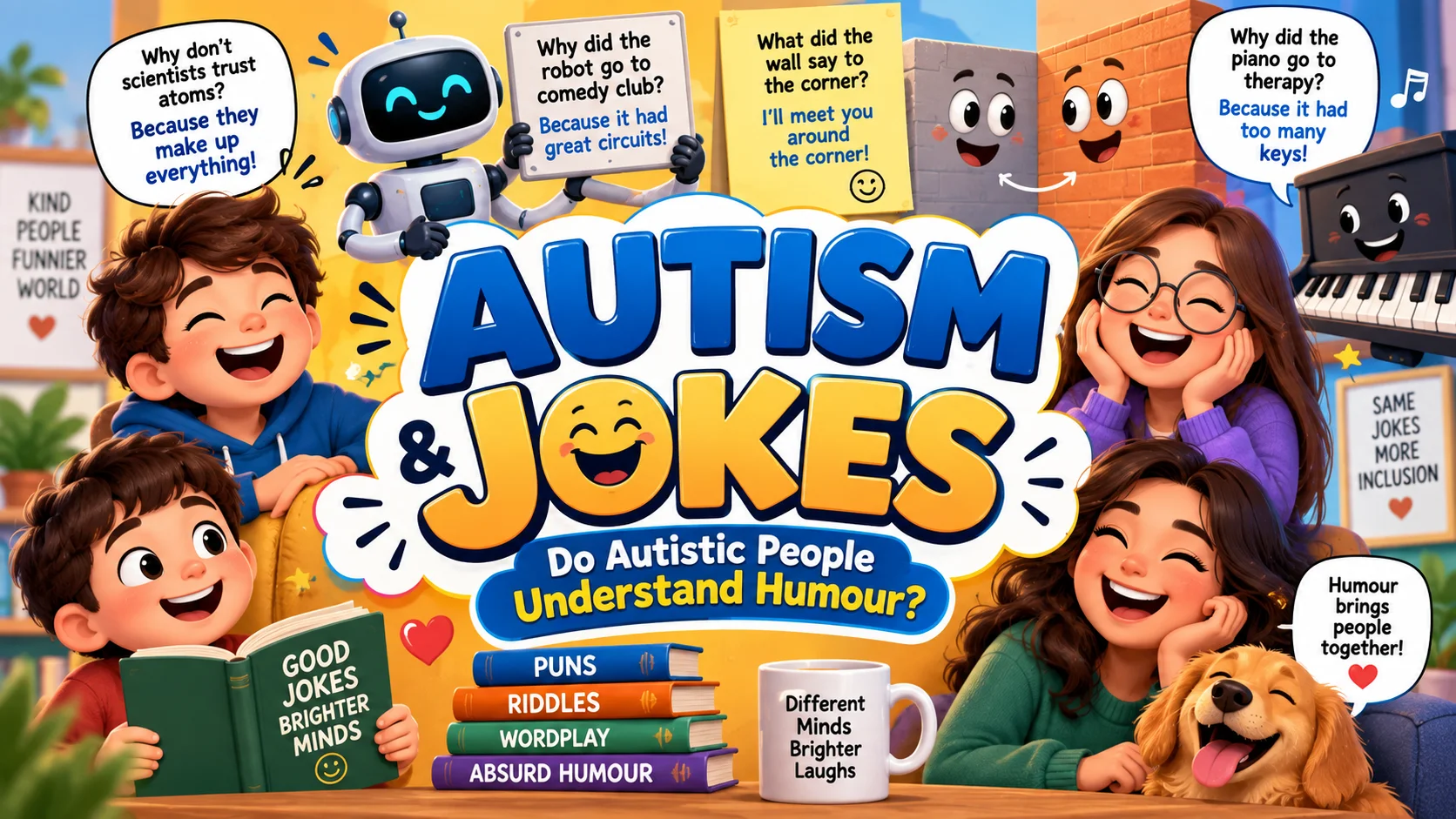
Search autism and jokes and you’ll find two very different things: people looking for cruel gags at autistic people’s expense, and a much larger group asking real questions. Does my child take everything literally? Is not getting a joke a sign of autism? Why do people make jokes about autism at all, and what do you say when they do? This article answers those questions using published research rather than stereotypes. It also covers the kinds of jokes that tend to land well with autistic children, and the persistent myth that autistic people don’t have a sense of humour.
Do Autistic People Understand Jokes?
Yes, though the picture is more nuanced than either stereotype suggests. The old clinical assumption was that autistic people simply couldn’t do humour, and researchers have spent two decades dismantling that. A widely cited review by Lyons and colleagues in the Journal of Autism and Developmental Disorders examined the existing literature and concluded that the old idea was wrong: many autistic people understand and create humour, and the skill is patchy rather than absent. Some jokes land differently, but they land.
What the Early Research Got Wrong
Early work, going back to Asperger’s own writing, suggested autistic individuals had difficulty detecting and understanding humour. Later research complicated this considerably. Ricks and Wing found comparatively better engagement with slapstick and with the simpler language of straightforward jokes, which points to a difference in which humour works rather than a blanket inability.
Where the Difficulty Actually Sits
The sticking point is usually not the joke itself but the layers around it: tone of voice, facial expression, and working out what the speaker intended. A pun sitting plainly in the words is much easier to catch than a comment whose meaning depends entirely on a raised eyebrow.
Why Sarcasm Is Harder Than Other Humour
Sarcasm is the category that causes the most trouble, and there’s a clear reason why. It requires you to register that someone means the opposite of what they said, which means reading tone, context and intent all at once. Research indicates there’s no consistent speech pattern that reliably signals sarcasm, so it can’t simply be memorised as a rule. That leaves autistic listeners doing significant real-time processing with few dependable cues.
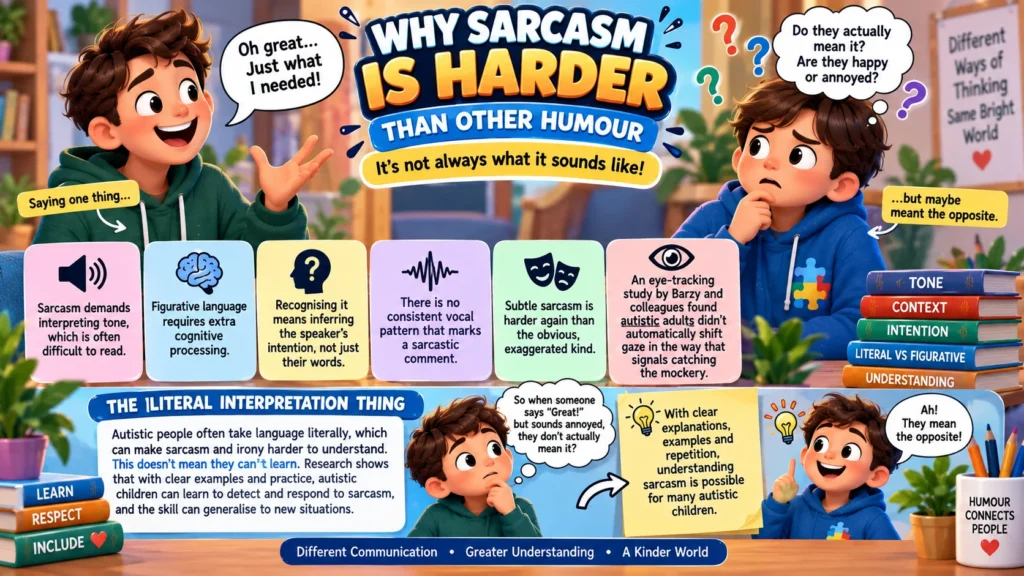
- Sarcasm demands interpreting tone, which is often difficult to read.
- Figurative language requires extra cognitive processing.
- Recognising it means inferring the speaker’s intention, not just their words.
- There is no consistent vocal pattern that marks a sarcastic comment.
- Subtle sarcasm is harder again than the obvious, exaggerated kind.
- An eye-tracking study by Barzy and colleagues found autistic adults didn’t automatically shift gaze in the way that signals catching the mockery.
The Literal Interpretation Thing
The stereotype of taking everything literally has a basis, but it gets flattened in popular culture. Literal interpretation of irony and sarcasm is one documented reason jokes can misfire, alongside difficulty resolving incongruity. It doesn’t mean an autistic person can’t learn. One study by Persicke and colleagues taught three autistic children to detect and respond appropriately to sarcasm using rules and repeated examples, and the skill generalised to new situations and people.
Is Not Understanding Jokes a Sign of Autism?
On its own, no. Plenty of people miss jokes for reasons that have nothing to do with autism: unfamiliar cultural references, a second language, tiredness, hearing difficulties, or simply not finding the joke funny. Humour comprehension also develops through childhood in everyone, with the trickier forms arriving last. Autism is diagnosed on a broad pattern across social communication and behaviour, assessed by a qualified professional, not on any single trait.
- Missing jokes is common and has many ordinary explanations.
- Humour comprehension develops gradually in all children.
- Autism assessment looks at a broad pattern, never one behaviour.
- Laughing at your own jokes is a universal human habit, not a diagnostic marker.
- Many autistic people are highly skilled at wordplay and wit.
- Only a qualified clinician can assess for autism.
If any of this sounds familiar for you or your child, the useful next step is a conversation with a GP or paediatrician rather than an internet checklist.
What Autistic Humour Often Looks Like
This is the part that gets missed entirely by lists of autism jokes. Autistic humour exists, it’s plentiful, and it often has a recognisable flavour: literal, absurd, very dry, precise, and delighted by the mechanics of language. Wordplay lands especially well because the joke is contained in the words rather than in a tone of voice you have to decode.
- Puns and wordplay, where the humour sits plainly in the language.
- Absurdist humour that follows a rule to its ridiculous conclusion.
- Very dry, deadpan delivery.
- Jokes built on precision, including correcting an imprecise statement.
- Slapstick and physical comedy, which need no social decoding.
- Repetition and running jokes that build over time.
- Humour about special interests, delivered with real expertise.
Jokes That Work Well for Autistic Kids
Parents often search for jokes for kids with autism, usually wanting material their child will actually enjoy rather than feel confused by. The research points in a useful direction: the clearer the joke sits in the words, the better it tends to work.
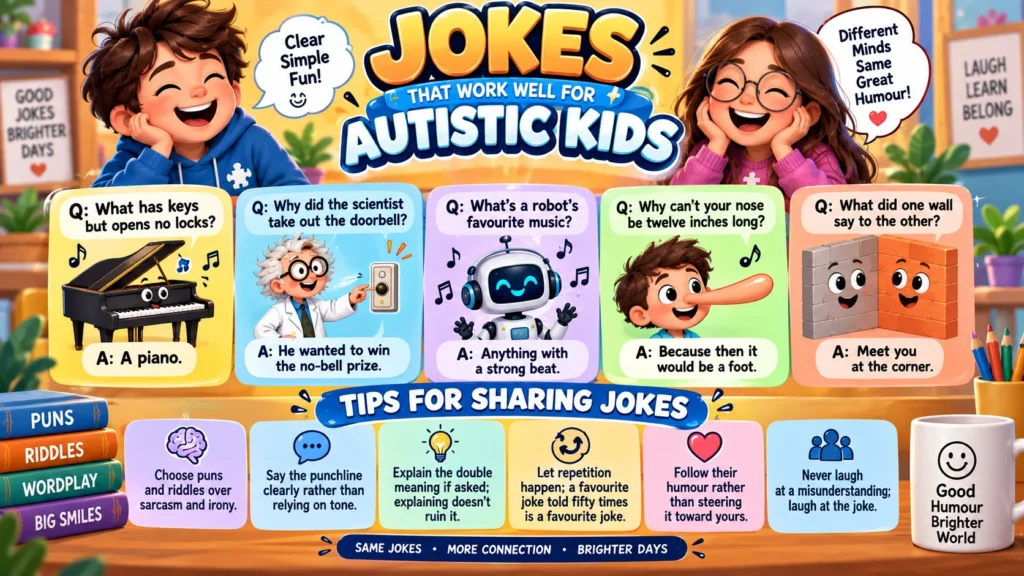
- Q: What has keys but opens no locks? A: A piano.
- Q: Why did the scientist take out the doorbell? A: He wanted to win the no-bell prize.
- Q: What’s a robot’s favourite music? A: Anything with a strong beat.
- Q: Why can’t your nose be twelve inches long? A: Because then it would be a foot.
- Q: What did one wall say to the other? A: Meet you at the corner.
Tips for Sharing Jokes
- Choose puns and riddles over sarcasm and irony.
- Say the punchline clearly rather than relying on tone.
- Explain the double meaning if asked; explaining doesn’t ruin it.
- Let repetition happen; a favourite joke told fifty times is a favourite joke.
- Follow their humour rather than steering it toward yours.
- Never laugh at a misunderstanding; laugh at the joke.
Why People Make Jokes About Autism
There isn’t one answer, but the common ones are worth naming. Some jokes come from ignorance, repeating a stereotype the person never examined. Some use autistic as a lazy insult meaning socially awkward, which is closer to a slur than a joke. Some are made by autistic people about their own experience, which is a completely different thing. And some come from parents and family members in the specific, exhausted register that anyone caring for anyone recognises. Intent doesn’t decide the impact, but it does change the right response.
Jump into Other Related Article
- Cupcake Jokes | The Frosting Classic, the Muffin Question, and What Actually Makes a Cupcake
- Shark Jokes | 60+ Funny Ones for Kids & Adults
- Potato Jokes | 90+ Puns, Riddles and Dad Jokes with Answers
How to Respond to Autism Jokes
If someone makes one at your expense, or about your child, a calm reply usually works better than an argument. The aim is to end it rather than win it, and most people making these jokes haven’t thought about them at all.
- That one doesn’t really land with me ends it without escalation.
- My son’s autistic, so that’s a bit close to home often stops it immediately.
- Asking what did you mean by that? makes the speaker explain themselves.
- With repeat offenders, be direct: I’ve asked you not to make those jokes.
- At work or school, document repeated incidents rather than relying on comebacks.
- If your child heard it, talk to them afterwards about it being the other person’s failure, not theirs.
- You’re allowed to simply not laugh. Silence is a complete response.
The Difference Between Laughing With and Laughing At
This is the whole distinction, and it’s not a subtle one. Autistic comedians, writers and creators make plenty of sharp, funny work about autistic experience, and neurodivergent meme communities are full of humour by and for autistic people. That’s laughing with. A joke whose entire structure is autistic people are stupid is laughing at, and it isn’t rescued by calling it dark humour or edgy. If you’re unsure which side of the line something sits on, the test is simple: would you tell it to an autistic person’s face, expecting them to laugh?
CONCLUSION
Autistic people understand and make jokes; the research has said so for twenty years. What differs is which humour lands, with sarcasm and irony genuinely harder because they depend on cues that are difficult to read in real time. Missing a joke isn’t a diagnosis. And the best thing anyone can do with an autistic child’s humour is follow it rather than correct it. If you came here looking for jokes to mock autistic people, that’s the one thing this page won’t give you.
Do people with autism understand jokes?
Yes. A review in the Journal of Autism and Developmental Disorders found many autistic people understand and create humour, and that the old assumption they couldn’t was wrong.
Why do autistic people take jokes literally?
Literal interpretation of irony and sarcasm is documented as a reason jokes misfire, partly because sarcasm depends on tone and intent rather than on the words themselves.
Is not getting jokes a sign of autism?
Not by itself. Many ordinary things cause someone to miss a joke, and autism is assessed on a broad pattern of traits by a qualified professional.
Is laughing at your own jokes a sign of autism?
No. Laughing at your own jokes is a common human habit and isn’t a diagnostic indicator of anything.
Can autistic children learn to understand sarcasm?
Research by Persicke and colleagues taught three autistic children to detect and respond to sarcasm using explicit rules and repeated examples, with the skill generalising to new people and settings.
What jokes are best for autistic kids?
Puns and riddles usually work best, because the joke sits in the words rather than depending on tone of voice or facial expression.