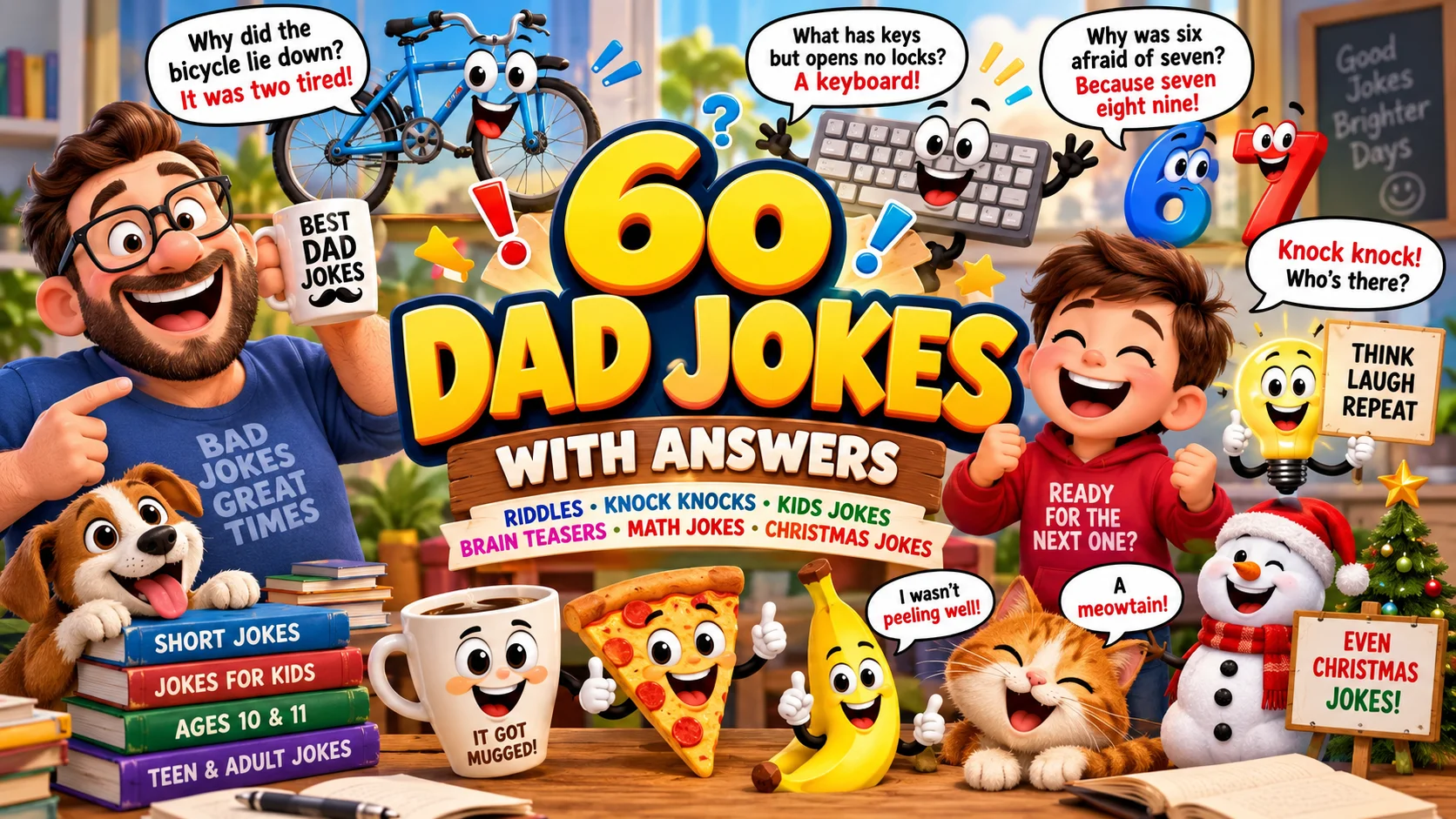
There’s a reason people search for dad jokes with answers rather than just dad jokes. Half the fun is asking the question, watching someone think, and then delivering the payoff. This page gives you 60 original jokes with answers, organised by what you actually need: quick oneliners, riddles for kids, knock knocks, guess what gags, and brain teasers for older children and adults. Every answer is right there, so nobody’s left hanging. There’s also a section on which age can handle which type, because that turns out to matter more than most joke lists admit.
Why the Question and Answer Format Works Best
A joke with a builtin answer is really a tiny game. The setup asks something, the listener guesses, and the reveal either confirms or surprises them. That pause between question and answer is what makes these stick in a child’s memory far better than a straight oneliner. It also makes them ideal for car journeys, classrooms, and dinner tables, where everyone can take a turn guessing. And when the answer lands, the person who told it gets the credit, which is exactly why kids love repeating them.
What Makes an Answer Satisfying
The best answers hinge on a word with two meanings, so the listener feels slightly tricked rather than confused. If the answer needs explaining, the joke has failed. Test it by saying it out loud: if the room takes longer than a second to react, pick a different one.
Riddles Versus Jokes
A riddle asks you to work something out; a joke asks you to be surprised. Both use the same question and answer shape, which is why they end up on the same lists. Riddles reward thinking, so they suit a slower setting like a long drive.
Short Dad Jokes With Answers
These are the quick ones, built for the two seconds between someone sitting down and someone regretting it. Short dad jokes with answers work anywhere: a text message, a lunchbox note, or the start of a meeting. Say the question, hold for exactly one beat, then deliver. The groan is the point, and if nobody groans, the joke didn’t work.
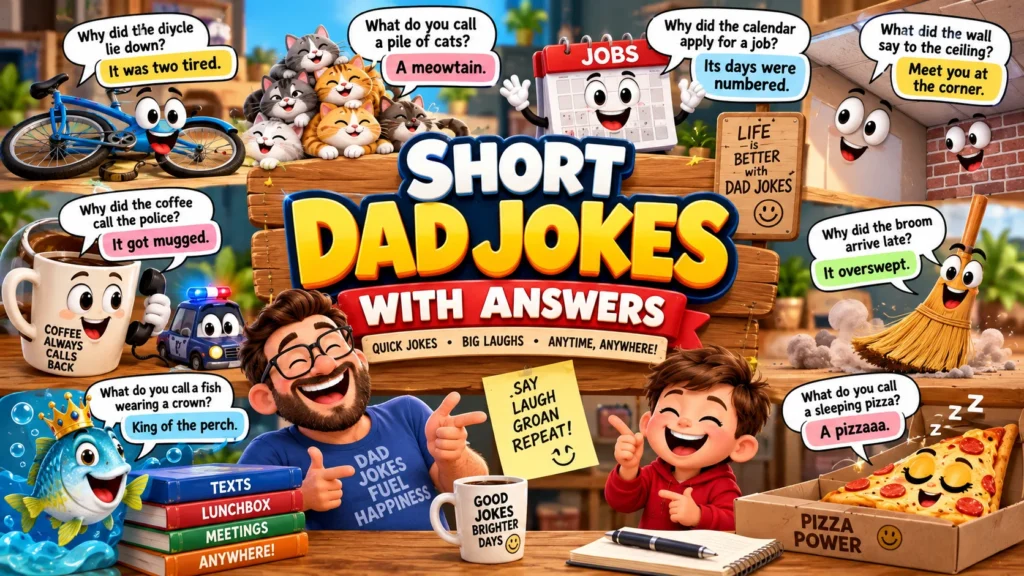
- Q: Why did the bicycle lie down? A: It was two tired.
- Q: What do you call a pile of cats? A: A meowtain.
- Q: Why did the calendar apply for a job? A: Its days were numbered.
- Q: What did the wall say to the ceiling? A: Meet you at the corner.
- Q: Why did the coffee call the police? A: It got mugged.
- Q: What do you call a fish wearing a crown? A: King of the perch.
- Q: Why did the broom arrive late? A: It overswept.
- Q: What do you call a sleeping pizza? A: A pizzaaa.
Funny Jokes for Kids With Answers
These are written for children who have just worked out how punchlines function, roughly ages six to nine. They use familiar words and one simple twist, which is what makes them easy to memorise and retell. Read the question aloud, give everyone a moment to guess, then reveal the answer with a grin. If your child invents a different answer, that’s a win too, since making up jokes is how the skill develops.
- Q: What does a cloud wear under its raincoat? A: Thunderwear.
- Q: Why did the crayon sit down? A: It was worn out from colouring.
- Q: What’s a shoe’s favourite food? A: Sole food.
- Q: Why did the banana go to hospital? A: It wasn’t peeling well.
- Q: What do you call a dog that can do magic? A: A labra cadabrador.
- Q: Why did the pencil get a prize? A: It was sharp all year.
- Q: What has a neck but no head? A: A bottle.
- Q: Why do bees hum? A: They forgot the words.
Jump into Other Related Article
- Basketball Jokes | Kids’ Classics, Dad Jokes, and Why the Inventor Had a Losing Record
- Shark Jokes | 60+ Funny Ones for Kids & Adults
- Cat Joke Memes | The Formats, the Real Origins, and How to Make Your Own
Jokes and Riddles With Answers for Ages 10 and 11
Older children want something they have to actually solve, which changes what works. Research backs this up: a Cardiff University study of sixty British schoolchildren found that the ability to unpick different types of wordplay in riddles develops in stages between ages six and eleven, with the trickiest forms landing last. So the jokes below use layered wordplay rather than simple puns, which is what makes them a proper challenge for a ten or eleven year old.
| Riddle | Answer |
| I get wetter the more I dry. What am I? | A towel |
| I have keys but open no locks, and space but no room. What am I? | A keyboard |
| The more you take, the more you leave behind. What are they? | Footsteps |
| I’m tall when I’m young and short when I’m old. What am I? | A candle |
| What can travel around the world while staying in one corner? | A stamp |
| What has many teeth but never bites? | A comb |
| What gets broken without being held? | A promise |
Knock Knock Jokes With Answers
Knock knock jokes come with the answer built into the structure, which is why they’re the easiest format for young children. Everyone gets a speaking part, so they work at sleepovers, in classrooms, and on long journeys. Kids can invent new ones by picking any word that sounds like the start of a sentence. Here are five that land reliably.
- Knock knock. Who’s there? Lettuce. Lettuce who? Lettuce in, it’s freezing out here!
- Knock knock. Who’s there? Harry. Harry who? Harry up, the film’s starting!
- Knock knock. Who’s there? Doughnut. Doughnut who? Doughnut ask, it’s a long story.
- Knock knock. Who’s there? Olive. Olive who? Olive next door, remember me?
- Knock knock. Who’s there? Cash. Cash who? No thanks, I’d rather have peanuts.
Guess What Jokes With Answers
The guesswhat format is its own little genre, where the setup deliberately sounds like a real question before turning silly. Guess what jokes with answers are perfect for younger children because the answer is always absurd rather than clever, so nobody feels caught out. They also build anticipation, which is half the comedy.
- Guess what? Chicken butt. (The original, and still the one every playground knows.)
- Guess what’s invisible and smells like carrots? A rabbit’s burp.
- Guess what’s brown and sticky? A stick.
- Guess why the tomato turned red? It saw the salad dressing.
- Guess what has four wheels and flies? A rubbish truck.
Math Jokes With Answers
Numbers make surprisingly good punchlines, which is why math jokes with answers are a staple in classrooms. They give a teacher a way to open a lesson without it feeling like a lesson. These work for upper primary and above, since they need a bit of arithmetic knowledge to land.
- Q: Why was six afraid of seven? A: Because seven eight nine.
- Q: Why did the equals sign stay humble? A: It knew it wasn’t greater or less than anyone.
- Q: What’s a maths teacher’s favourite dessert? A: Pi.
- Q: Why did the student wear glasses in maths class? A: To improve division.
- Q: What do you call a number that can’t sit still? A: A roamin’ numeral.
Christmas Jokes With Answers
Seasonal jokes get pulled out once a year and somehow still work, mostly because everyone’s in a good mood. Christmas jokes with answers slot neatly into crackers, advent calendars, and cards. They’re also handy at a family dinner when conversation stalls.
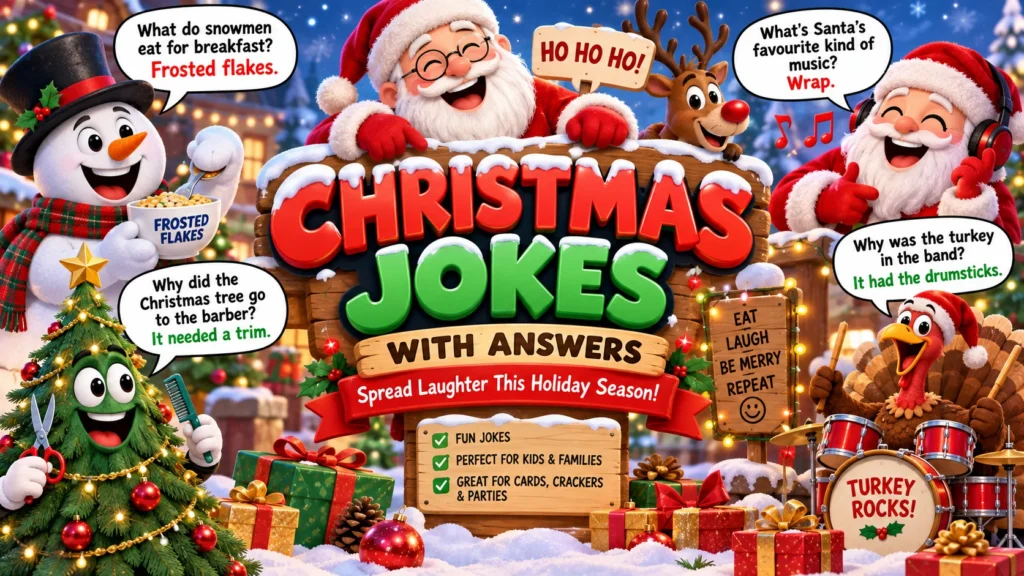
- Q: What do snowmen eat for breakfast? A: Frosted flakes.
- Q: Why did the Christmas tree go to the barber? A: It needed a trim.
- Q: What’s Santa’s favourite kind of music? A: Wrap.
- Q: Why was the turkey in the band? A: It had the drumsticks.
Which Jokes Work at Which Age
This is where most joke lists fall down, because a riddle that delights an eleven year old baffles a five year old, and vice versa. Research from Nottingham Trent University found that only children above the age of eight showed a reliable link between actually understanding a riddle and laughing at it, meaning younger children often laugh without getting the joke at all. That’s worth knowing before you judge whether a joke landed.
- Ages 4 to 5: expect imitation rather than understanding; laughter isn’t proof they got it.
- Ages 6 to 7: simple soundalike puns start to click.
- Ages 8 to 9: children can explain why a joke is funny, not just laugh at it.
- Ages 10 to 11: layered wordplay and logic riddles become genuinely satisfying.
- Teens and adults: prefer setups that subvert an expectation rather than a pure pun.
- At any age, a bigger vocabulary correlates with better joke comprehension.
How to Use These at Home and in Class
A list only helps if it becomes a habit, and the habit is what builds a child’s confidence in front of a group. Small routines work better than a single long session. Rotate between formats so nothing gets stale, and let children take the role of the one asking rather than always answering.
- Start a car journey with one riddle per person.
- Put a joke of the day on the classroom board with the answer hidden underneath.
- Slip a short joke into a lunchbox note.
- Run a Friday round where students bring their own.
- Use a riddle as a settling activity after break.
- Let kids write new answers to old setups.
- Keep a family notebook of the ones that actually worked.
CONCLUSION
Jokes with answers are the most useful kind to have on hand, because they turn a moment of silence into a small game anyone can play. The 60 above cover short gags, kids’ puns, proper riddles, knock knocks, guesswhat jokes, maths and Christmas, all with the answers ready so nobody’s left guessing for long. Match the type to the age, share them out loud rather than reading them silently, and let the groans do the rest.
What is the best dad joke with an answer?
Why did the bicycle lie down? It was two tired. It’s short, the answer hinges on one word, and it works on any audience.
What jokes with answers work for 10 and 11 year olds?
Riddles with layered wordplay, like I have keys but open no locks. What am I? A keyboard. Research shows this age can handle the trickier forms of ambiguity.
At what age do children really understand riddles?
Understanding builds in stages from about six to eleven. One study found only children over eight reliably laughed because they understood, rather than just copying the reaction.
What’s the difference between a joke and a riddle?
A riddle asks you to solve something; a joke asks you to be surprised. Both share the same question and answer shape.
Are guess what jokes suitable for young children?
Yes. The answers are deliberately absurd rather than clever, so younger children can enjoy them without needing to decode wordplay.